ChatGPT
 Gemini
 Claude
 Perplexity
 DeepSeek
 Grok
Grok
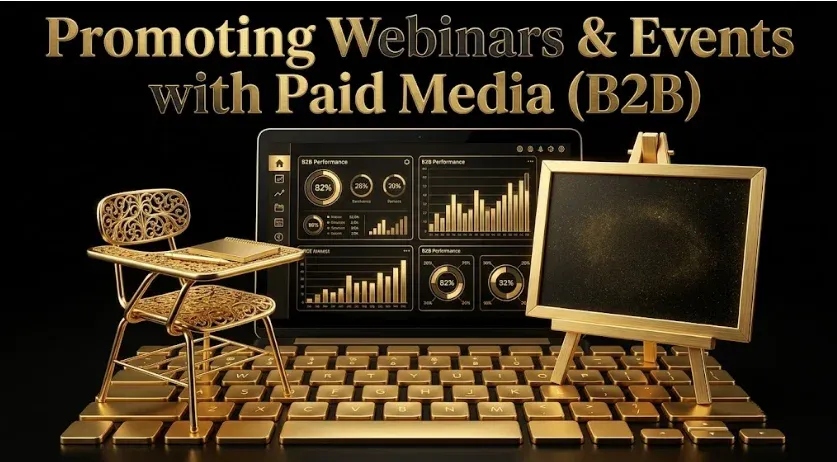
Promoting Webinars & Events with Paid Media: A B2B Guide
Quick answer: Promoting B2B webinars and events with paid media means driving registrations through the right channels — LinkedIn is strongest for B2B events, supported by retargeting and search — then converting registrants to attendees to pipeline. The critical thing most teams miss is that registration isn’t the goal: a big registration number means nothing if attendees don’t show or don’t convert, so measure to attendance and pipeline, not sign-ups. Target your ICP and warm audiences, make the value/topic/speaker/date crystal clear, and build the follow-up and retargeting that turns an event into pipeline rather than a vanity metric.
Key takeaways
- Drive registrations, then attendance, then pipeline — registration alone is a vanity metric.
- LinkedIn is strongest for B2B events, with retargeting and search support.
- The attendance gap is real — many registrants never show; plan for it.
- Make value, topic, speaker, and date crystal clear in the creative.
- Measure to pipeline from attendees, not registration counts.
Webinars and events are a staple of B2B marketing, and paid media is how you fill them — but “we got 500 registrations” is not success if none become pipeline. This guide covers the event funnel, the best channels, the registration-vs-attendance gap, follow-up, and how to measure events honestly.
Why promote events with paid media?
Because a great webinar or event nobody attends is wasted, and paid media is the most reliable way to fill it with the right people. Organic promotion (email, social) reaches your existing audience; paid extends reach to new ICP-fit prospects and lets you precisely target who you want in the room. Events are also excellent demand-creation vehicles — they build awareness, demonstrate expertise, and warm prospects through genuine value — so paid promotion of them does double duty: filling the event and creating demand. The catch is measuring it right, since events influence pipeline in ways that resist clean attribution.
What is the event funnel?
Promoting an event is a multi-stage funnel, and each stage loses people:
- Awareness — people see your event promotion.
- Registration — some register (a form; effectively gated content).
- Attendance — some registrants actually show up (many don’t).
- Engagement — attendees engage with the content.
- Follow-up / pipeline — engaged attendees become pipeline through follow-up.
The mistake is optimizing for stage 2 (registration) when the value is in stages 3–5. A campaign that maximizes cheap registrations but fills the room with no-shows and non-buyers has optimized the wrong stage.
What channels work best for event promotion?
- LinkedIn — the strongest paid channel for B2B events, because you can target the exact ICP and roles you want in the room, and its formats suit event promotion. Usually the primary channel.
- Retargeting — re-engage site visitors and prior engagers, who are warmer and more likely to attend; often the most efficient event traffic.
- Search — capture people searching for your topic or event, and defend your branded event terms.
- Email + paid together — paid extends reach beyond your list while email works your existing audience; the two compound.
For most B2B events, LinkedIn plus retargeting is the core, with search as support.
Who should you target?
- Your ICP — the specific roles and companies you want in the room, not just anyone who’ll register.
- Warm audiences — retargeting site visitors and engagers, who attend at higher rates.
- Past attendees — people who attended prior events are strong prospects for the next.
- Target accounts — for ABM, events are excellent air cover; promote to your target-account list.
Targeting quality matters more than registration volume — a smaller room of ICP-fit attendees beats a large room of irrelevant ones.
What creative works for event promotion?
Event creative must answer the attendee’s implicit questions fast:
- Crystal-clear value. What will they learn or gain? Lead with the benefit, not the logistics.
- Compelling topic. A specific, relevant topic that matters to your ICP.
- Speaker credibility. Who’s presenting and why they’re worth listening to.
- Clear date/time and format. The practical details, unmissable.
- Strong, specific CTA. “Register” with a clear sense of the value behind it.
The creative principles that govern all B2B ads apply — lead with the attendee’s interest, be specific — with the added job of conveying topic, speaker, and timing clearly.
The registration vs. attendance gap
This is the reality every event marketer must plan for: a significant share of registrants never attend. Registration is easy (a quick form); actually showing up on a specific date is harder. So a big registration number systematically overstates your real reach, and optimizing purely for cheap registrations makes the gap worse (low-commitment registrants are the least likely to attend). To close the gap:
- Target for intent, not just registration — warmer, more ICP-fit audiences attend at higher rates.
- Run reminder sequences (email, retargeting) between registration and the event.
- Retarget registrants to reinforce attendance.
- Measure attendance rate, not just registrations, and judge campaigns on attendees.
How do you follow up and retarget?
The event isn’t the end — it’s the middle. The pipeline comes from follow-up:
- Follow up with attendees promptly while the content is fresh, via fast handoff to sales for high-fit accounts.
- Retarget attendees with next-step offers (demo, deeper content), since they’re now warm.
- Retarget no-shows with the recording — they registered, so they’re interested; recover them.
- Score and route attendees by fit and engagement via lead scoring.
How do you measure event promotion?
On attendance and pipeline, not registrations. Track registration cost, but judge success on cost per attendee, attendee quality (ICP fit), and — the real metric — pipeline influenced by the event. Because events influence pipeline through multiple touches and often without a clean last click, this is a multi-touch/influence measurement problem: use self-reported attribution and downstream pipeline, connecting event and CRM data via the complete MCP stack. A campaign optimized to cheap registrations will look great and mean little; one measured to attendee pipeline tells the truth.
Field note: “We got 500 registrations!” is the most misleading sentence in event marketing. Registration is a vanity metric dressed up as a result — it’s cheap to generate, systematically overstated by no-shows, and disconnected from whether anyone valuable actually showed up or bought anything. The campaigns that optimize hardest for registration volume tend to produce the emptiest rooms, because they attract low-commitment sign-ups who never attend. The metric that matters runs three stages later: pipeline from attendees. Optimize the promotion for ICP-fit attendance and build the follow-up that converts attendees, and a “smaller” event with 150 registrations and a full, relevant room will crush a “bigger” one with 500 registrations and forty no-show-heavy attendees. Count attendees and pipeline, not sign-ups.
Honest limitations
- Registration overstates reach. No-shows mean registration numbers systematically overstate real attendance; always look past them.
- Events are influence-heavy. Their pipeline impact is often assisted and multi-touch, so clean last-click attribution undercounts them.
- Attendance depends on more than paid. Topic, timing, reminders, and format drive attendance as much as promotion — paid fills the room but can’t make a weak event good.
- Costs compound. Event promotion plus production plus follow-up is a real investment; judge it on pipeline, not registration cost alone.
- Timing is fixed. Unlike evergreen content, an event has a date, so promotion has a hard deadline and a short window.
Frequently Asked Questions
Q1. How do you promote a B2B webinar with paid media?
Drive registrations through the right channels — LinkedIn is strongest for B2B, supported by retargeting and search — targeting your ICP and warm audiences with creative that makes the value, topic, speaker, and date clear. Then convert registrants to attendees with reminders, and attendees to pipeline with follow-up. Measure to attendance and pipeline, not registrations.
Q2. What’s the best channel for promoting B2B events?
LinkedIn is usually the strongest paid channel for B2B events because you can target the exact roles and companies you want in the room, supported by retargeting (warm audiences attend at higher rates) and search (capturing topic and branded event searches). LinkedIn plus retargeting is the typical core.
Q3. Why is registration a bad metric for events?
Because registration is easy and cheap to generate but systematically overstated by no-shows, and disconnected from whether valuable people attended or converted. Optimizing for cheap registrations attracts low-commitment sign-ups who don’t show, producing empty rooms. Measure attendance and pipeline, which are three stages further down the funnel.
Q4. How do you reduce webinar no-shows?
Target warmer, more ICP-fit audiences (who attend at higher rates), run reminder sequences via email and retargeting between registration and the event, and retarget registrants to reinforce attendance. Optimizing for intent rather than cheap registration volume also raises the share of registrants who actually show up.
Q5. Who should you target when promoting B2B events?
Your ICP (the specific roles and companies you want in the room), warm audiences via retargeting, past attendees, and target accounts for ABM air cover. Targeting quality matters more than registration volume — a smaller room of relevant attendees beats a large room of irrelevant ones.
Q6. How do you turn event attendees into pipeline?
Follow up promptly while the content is fresh (fast handoff to sales for high-fit accounts), retarget attendees with next-step offers like demos, retarget no-shows with the recording to recover them, and score and route attendees by fit and engagement. The event is the middle of the funnel; follow-up is where pipeline is made.
Q7. How do you measure event promotion?
On cost per attendee, attendee quality (ICP fit), and — the real metric — pipeline influenced by the event, not registration counts. Because events influence pipeline through multiple touches without a clean last click, use self-reported attribution and downstream pipeline, connecting event and CRM data.
Sources & further reading
- Measure event promotion on cost per attendee and pipeline influenced, using self-reported attribution and your own CRM data.
- Plan for the registration-to-attendance gap with reminders and retargeting; judge campaigns on attendees, not sign-ups.
This guide is educational; event performance depends on topic, timing, and follow-up as much as promotion, so validate against your own attendance and pipeline data.
Related guides: LinkedIn Ads for ABM · Retargeting for B2B SaaS · Gated vs. Ungated Content for B2B Paid Media · Lead Gen vs. Demand Gen for B2B · Multi-Touch Attribution for B2B SaaS.