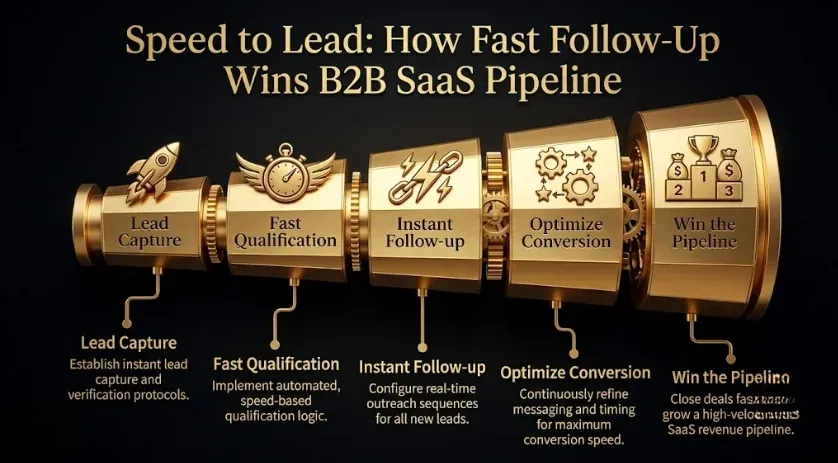
Speed to Lead: How Fast Follow-Up Wins B2B SaaS Pipeline
Quick answer: Speed to lead (or lead response time) is how long it takes for a rep to make first contact after a lead converts. It matters because buying intent decays fast: the same lead contacted within minutes is far more likely to connect and qualify than one contacted the next day. Fixing it is usually operational, not motivational — instant routing, a written first-touch SLA, alerting when the SLA breaches, and measuring median time-to-first-touch as a core metric.
Key takeaways
- What it is: the elapsed time between lead conversion and first sales contact.
- Why it matters: intent decays quickly; late contact competes against a prospect who has moved on.
- Root causes are operational: unassigned leads, manual routing, no SLA, no alerting.
- The fix: auto-assign on conversion, set a written SLA, alert on breach, measure the median.
- Measure the median, not the average. A few instant responses hide a long tail of neglect.
Most B2B SaaS teams spend heavily to generate a demo request, then let it sit in a queue. Speed to lead is the least glamorous, highest-leverage fix in the funnel: it costs nothing to improve, and it protects the leads you already paid for. This guide covers what it is, why slow follow-up loses deals, and exactly how to instrument it.
What is speed to lead?
Speed to lead — also called lead response time — is the elapsed time between a lead converting (submitting a form, requesting a demo, hitting a scoring threshold) and a salesperson’s first genuine contact attempt. It’s measured per lead and reported as a median, since averages are skewed by a handful of instant responses masking leads that waited days.
Why does speed to lead matter so much?
Because intent is perishable. When a prospect fills out a demo form, they are — briefly — actively evaluating. Within hours they’re back in meetings; within a day they may have filled out your competitor’s form too. Fast contact catches them while the problem is top of mind, before the evaluation broadens. Slow contact means you’re re-selling from a cold start against a prospect who has already moved on, sometimes to a vendor that answered first.
There’s a second, less obvious cost: your paid acquisition spend is what generated that lead. Slow follow-up quietly raises your effective cost per opportunity without changing a single bid.
Why is your speed to lead slow?
The causes are almost always process, not effort:
- No auto-assignment. Leads land in a pool and wait for someone to claim them.
- Manual routing rules. A human decides who gets what, and they’re in a meeting.
- No written SLA. Nobody agreed what “fast” means, so nothing is late.
- No alerting. SLA breaches are invisible until a monthly report surfaces them.
- Bad handoff data. The rep opens the record, can’t tell why the lead is qualified, and deprioritizes it.
- Off-hours and weekend gaps. Leads that arrive Friday evening go stale by Monday.
How do you improve speed to lead?
- Auto-assign on conversion. Route instantly by territory, segment, or round-robin — no human step between conversion and ownership.
- Write a first-touch SLA. Define the target (e.g., first contact attempt within X minutes during business hours), get sales and marketing to sign off, and document it.
- Alert on breach. Push a notification when a lead approaches the SLA limit. Visibility drives compliance far better than a monthly scolding.
- Give the rep context at handoff. Include why the lead qualified, the ICP-fit signals, and recent activity so the first touch is relevant, not generic.
- Cover the gaps. Decide deliberately how off-hours and weekend leads are handled — even if the answer is an automated acknowledgment plus first-thing-Monday contact.
- Report the median weekly. What gets measured in public gets fixed.
What should you measure?
| Metric | Why it matters |
|---|---|
| Median time-to-first-touch | The honest headline number (averages lie) |
| % of leads contacted within SLA | Compliance, not just speed |
| Time-to-first-touch by source | Reveals routing gaps by channel |
| Connect rate by response time | Proves the decay curve on your own data |
| MQL-to-SQL rate by response time | Ties speed directly to qualification |
Field note: Report the median, never the average. A team that answers five leads in 90 seconds and lets fifteen sit for two days will show a flattering average and a damning median. The median is where the neglected leads live — and it’s the number that moves when you fix routing.
How do you instrument it in your CRM?
Speed to lead lives or dies in the CRM. Build the auto-assignment rules and SLA timers in HubSpot or Salesforce, then make the reporting effortless. Connecting the CRM to an AI assistant turns the weekly check into a single question: “What was our median time-to-first-touch by lead source last week, and which leads breached SLA?” Because slow follow-up is one of the main reasons qualified leads never convert, this work pairs directly with improving your MQL-to-SQL conversion rate. And since the leads in question were bought with ad spend, the payoff shows up in the acquisition metrics you track through the complete MCP stack.
Does faster always mean better?
No — fast and relevant beats fast and generic. A rep who calls in three minutes with no idea why the lead converted wastes the advantage. Speed buys you attention; the context in the handoff is what converts it. Prioritize both: instant routing plus a handoff record that tells the rep exactly what the prospect did and why they qualified.
Frequently Asked Questions
Q1. What is speed to lead?
Speed to lead, or lead response time, is the elapsed time between a lead converting and a salesperson’s first contact attempt. It’s best reported as a median, since averages hide leads that waited days.
Q2. Why does speed to lead matter in B2B SaaS?
Buying intent decays quickly. A prospect who just requested a demo is actively evaluating; hours later they’ve moved on or contacted a competitor. Fast contact catches live intent and protects the ad spend that generated the lead.
Q3. What is a good speed-to-lead target?
Set an SLA that your team can consistently meet during business hours and measure compliance against it, rather than adopting an external number. What matters is that the target is written, agreed by sales and marketing, alerted on, and tracked as a median.
Q4. How do you improve lead response time?
Auto-assign leads on conversion, write and sign off a first-touch SLA, alert reps before the SLA breaches, include qualification context in the handoff, plan for off-hours coverage, and report the median weekly.
Q5. Should I measure average or median lead response time?
Median. A handful of instant responses will pull the average down and mask a long tail of leads that sat for days. The median reflects the typical lead’s experience.
Sources & further reading
- HubSpot and Salesforce documentation — lead assignment, routing rules, and SLA fields.
- Analyze your own CRM cohort data to establish the response-time decay curve for your funnel.
Related guides: How to Improve MQL-to-SQL Conversion Rate · HubSpot CRM MCP · Salesforce MCP · The Complete MCP Stack for B2B SaaS Marketing Teams.