How GrowthSpree Helped PriceLabs Grow Google Ads ROAS from 0.7 to 2.5
A loss-making $90K/month Google Ads account became a profitable $180K/month account in nine months. Then AI Max and value-based bidding took PriceLabs into five new language markets, and Google published the results.
.webp)
AI-powered dynamic pricing and revenue management for vacation rentals and hotels
PriceLabs case study in one sentence
GrowthSpree, a B2B SaaS paid acquisition agency, took PriceLabs’ Google Ads account from a loss-making 0.7 ROAS to 2.5 ROAS in nine months while doubling spend to $180K a month, then used AI Max for Search and value-based bidding to grow high-quality user volumes 2.8x, in results Google published as an official case study.
- PriceLabs’ Google Ads ROAS rose from 0.7 to 2.5 in nine months with GrowthSpree, about 3.6 times the starting level.
- Monthly Google Ads spend doubled from $90,000 to $180,000 while ROAS kept rising.
- Cost per signup fell 45%, from about $100 to $55, after bidding moved to CRM-verified conversion values.
- Conversion data had been inflated about 5x; rebuilding tracking cut that variance from about 500% to about 20%.
- With AI Max for Search, Google reports PriceLabs grew high-quality user volumes 2.8x quarter over quarter and scaled into new regions 4x faster.
- Google published the results as an official Google Ads case study that names GrowthSpree as PriceLabs’ agency.
Where they started
$90K a month on Google Ads at 0.7 ROAS, with conversions inflated about 5x and 90+ campaigns competing with each other.
What we changed
Consolidated the account, sent CRM outcomes back to Google as valued conversions, moved to value-based bidding, then added AI Max by market.
Where they are now
2.5 ROAS on $180K a month, 45% lower cost per signup, and growth in five non-English markets documented by Google.
What does Google’s case study say about PriceLabs and GrowthSpree?
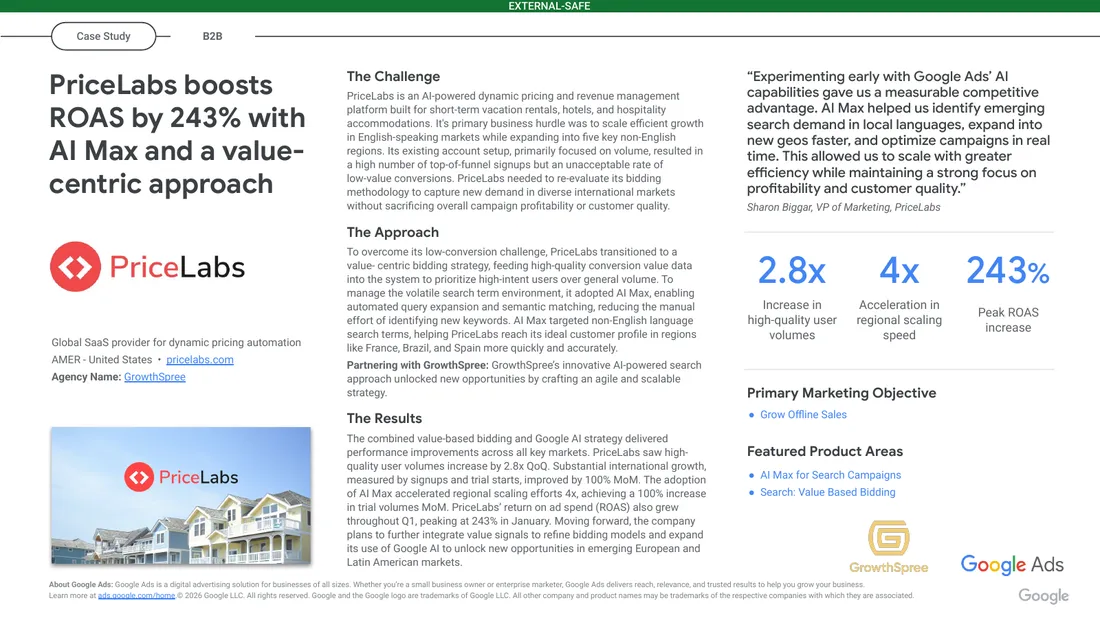
Google Ads published an official case study, “PriceLabs boosts ROAS by 243% with AI Max and a value-centric approach.” It names GrowthSpree as PriceLabs’ agency and says GrowthSpree’s AI-powered search approach built an agile, scalable strategy that opened new opportunities. The featured products are AI Max for Search campaigns and value-based bidding.
“Experimenting early with Google Ads’ AI capabilities gave us a measurable competitive advantage. AI Max helped us identify emerging search demand in local languages, expand into new geos faster, and optimize campaigns in real time. This allowed us to scale with greater efficiency while maintaining a strong focus on profitability and customer quality.”
Why was PriceLabs losing money on Google Ads?
PriceLabs was spending about $90,000 a month on Google Ads and getting back about $0.70 per dollar. Conversion data was inflated about five times, so Smart Bidding was learning from false signals, and 90+ campaigns with 600+ bid strategies left too little data in any one place for the algorithm to learn.
- 90+ campaignsRunning at once with no deliberate budget allocation
- 600+ bid strategiesCompeting against each other inside one account
- 5x inflated conversionsEvery signal Google optimized on was wrong
- Quality Score of 5Pushing CPCs up and ad positions down
- 700+ ad groupsToo thin for machine learning to find patterns
- 0.7 ROASLosing 30 cents on every dollar spent
| Monthly ad spend | About $90,000 on Google Ads |
|---|---|
| Cost per signup | About $100, with no reliable value attribution |
| ROAS | 0.7, so $1 of spend returned about $0.70 in revenue |
| Tracking | Conversions inflated about 5x (roughly 500% variance). No offline conversion import from the CRM and no GCLID-level attribution. |
How did GrowthSpree fix PriceLabs’ Google Ads account?
GrowthSpree fixed the account in three phases over nine months: consolidate the structure, rebuild conversion tracking around CRM-verified values, then scale spend with value-based bidding. ROAS stayed near 0.7 for the first two months, reached 1.3 by month 6 and 2.5 by month 9, while monthly spend doubled.
View the numbers behind this chart
| Month | ROAS | Monthly spend | Phase |
|---|---|---|---|
| Month 0 | 0.7 | $90K | Baseline |
| Month 1 | 0.7 | $100K | Stabilize |
| Month 2 | 0.75 | $120K | Stabilize |
| Month 3 | 0.8 | $130K | Fix data |
| Month 4 | 0.9 | $140K | Fix data |
| Month 5 | 1.1 | $150K | Fix data |
| Month 6 | 1.3 | $160K | Fix data |
| Month 7 | 1.8 | $165K | Scale |
| Month 8 | 2.2 | $175K | Scale |
| Month 9 | 2.5 | $180K | Scale |
The four levers we pulled
Campaign structure
Consolidated 90+ campaigns to 40, retired single-keyword ad groups, and built themed groups with enough data for Smart Bidding to learn.
Conversion tracking
Imported CRM outcomes as offline conversions with GCLID-level attribution, cutting conversion-data variance from about 500% to about 20%.
Bidding
Replaced 600+ competing strategies with value-based bidding weighted by customer lifetime value, so budget went to buyers likely to pay.
Landing pages
Reworked 25+ landing pages for message match, lifting landing-page conversion rate about 30% and supporting a higher Quality Score.
- 1Months 1 to 2
Stabilize the structure
The problem: with 90+ campaigns and 600+ bid strategies, the account was too fragmented for any algorithm to learn from, so growth had to wait until the structure held.
What we did: cut campaigns from 90+ to 60, removed wasteful SKAG structures, improved ad relevance to lift Quality Score, and built themed ad groups with enough signal density for machine learning.
Quality Score 5 to 8Spend $120K/month - 2Months 3 to 6
Fix the data, then bid on value
The finding: conversion data was inflated by over 500%, which meant every past optimization had been made on false signals.
What we did: set up offline conversion tracking from the CRM, GCLID-level attribution and conversion values based on customer LTV, moved the account to value-based bidding, and optimized 25+ landing pages.
Data variance 500% to ~20%ROAS 1.3Landing page CVR +30% - 3Months 7 to 9
Scale profitably
The test: could the account hold efficiency while spend doubled? ROAS kept improving as budget grew, which only happens when bidding learns from accurate values.
What we did: finished consolidating to 40 campaigns, introduced AI Max for incremental query discovery, and held efficiency through 2 to 3x CPC increases while scaling to twice the original budget.
ROAS 2.5Spend $180K/monthCost per signup -45%
How did AI Max help PriceLabs expand into new markets?
With a profitable English-market account in place, PriceLabs expanded into five non-English regions, including France, Brazil and Spain. Value-based bidding kept Google focused on high-intent users, and AI Max for Search found local-language queries through automated query expansion and semantic matching. Google reports 2.8x more high-quality users and 4x faster regional scaling.
The challenge
A volume-first setup in new markets would bring plenty of top-of-funnel signups but too many low-value conversions. PriceLabs needed new demand across very different languages without giving up profitability or customer quality.
What we did
- Value-centric bidding. Fed high-quality conversion values into Google so bids favored high-intent users over raw volume.
- AI Max for Search. Query expansion and semantic matching found local-language searches no keyword list would have caught, with far less manual research.
- ICP targeting by region. Pointed AI Max at non-English search terms that reached PriceLabs’ ideal customer profile faster and more accurately.
Results in this section are as reported in Google’s PriceLabs case study. ROAS grew throughout Q1 and peaked in January. PriceLabs plans to add more value signals and expand into emerging European and Latin American markets.
How do PriceLabs’ results compare with typical AI Max results?
Google reports that advertisers adopting AI Max for Search see about 27% more conversions at a similar CPA or ROAS than campaigns built mostly on exact and phrase match (Think with Google). An independent review of 250+ campaigns by ALM Corp found a median revenue lift of 13%, a median CPA increase of 16%, and ROAS changes ranging from -35% to +42% (ALM Corp). PriceLabs’ 2.8x growth in high-quality users sits well above those ranges. In GrowthSpree’s view, the difference is the CRM-verified conversion values built during the rebuild, because AI Max expands toward whatever the account tells it is valuable.
PriceLabs’ conversions were inflated 5x before anyone noticed. Are yours?
Check my conversion dataWhat didn’t work, and what we did about it
The turnaround was slower and bumpier than the final numbers suggest. Structural fixes alone did not move ROAS, past optimizations turned out to rest on bad data, and CPCs rose sharply as spend scaled.
Two months of cleanup barely moved ROAS
Consolidating campaigns and lifting Quality Score from 5 to 8 left ROAS at 0.7 to 0.75. What we did: kept going to the data layer, where the real problem was. ROAS only started climbing once CRM values replaced inflated conversions.
Earlier optimization rested on false signals
With conversions inflated about 5x, earlier bid and budget decisions had rewarded the wrong traffic. What we did: rebuilt tracking from scratch with offline conversion import and GCLID-level attribution before trusting any automated bidding.
CPCs rose 2 to 3x during scaling
Pushing spend toward $180K a month made clicks much more expensive. What we did: let value-based bidding pay more only for high-LTV buyers, which kept ROAS rising while CPCs went up.
Volume bidding attracted low-value signups
A volume-first setup brought in many top-of-funnel signups that rarely became valuable customers, a risk Google also flagged for new markets. What we did: switched to value-based bidding before adding AI Max, so expansion chased quality users.
Why it worked
AI Max and value-based bidding are only as good as the conversion values they receive. Had PriceLabs switched on AI Max with the old 5x-inflated tracking, Google would have expanded into new languages chasing the wrong users. The CRM-verified values from the rebuild are what let Google’s AI scale PriceLabs into new markets profitably.
What results did PriceLabs get?
PriceLabs’ Google Ads ROAS rose from 0.7 to 2.5 while spend doubled to $180K a month, and cost per signup fell 45%. In the AI Max expansion, Google reports high-quality users up 2.8x quarter over quarter, international signups and trials up 100% month over month, and a peak ROAS increase of 243% in January.
| Metric | Before | After | Change | Source |
|---|---|---|---|---|
| ROAS | 0.7 | 2.5 | 3.6x | GrowthSpree, month 0 to 9 |
| Monthly ad spend | $90K | $180K | 2x, profitably | GrowthSpree, month 0 to 9 |
| Cost per signup | ~$100 | ~$55 | -45% | GrowthSpree, month 0 to 9 |
| Click-through rate | 4% | 7%+ | +75% | GrowthSpree, month 0 to 9 |
| Quality Score | 5 | 8 | +60% | GrowthSpree, month 0 to 9 |
| Active campaigns | 90 | 40 | -56% | GrowthSpree, month 0 to 9 |
| High-quality user volume | Quarter over quarter | 2.8x | Google case study | |
| International signups and trials | Month over month | +100% | Google case study | |
| Regional scaling speed | With AI Max | 4x | Google case study | |
| Peak ROAS increase | January, Q1 | 243% | Google case study | |
What does PriceLabs’ VP of Marketing say about GrowthSpree?
Sharon Biggar, VP of Marketing at PriceLabs, says GrowthSpree takes ownership and is super proactive, and recommends it to any B2B or SaaS company that wants a marketing partner that feels like its own team and delivers outcomes.
“I love working with GrowthSpree because A. They take ownership and B. they are super proactive. Big shoutout to my ACC manager, Pratik. He is insanely responsive and fast with solutions. If you are a B2B or SaaS looking for a marketing partner that feels like your team, takes ownership, and delivers outcomes, GrowthSpree is it.”
Transcript of the video testimonial.
If you want a partner that drives outcomes, thinks ahead, and takes ownership, GrowthSpree it is!Watch more client video reviews
How can a B2B SaaS company apply this to its Google Ads account?
Fix what Google learns from before asking it to spend more. Audit conversions against the CRM, import qualified outcomes with values, consolidate campaigns, move to value-based bidding, and only then let AI Max expand into new queries and markets.
Audit what Google is learning from
Compare Google Ads conversions with real signups and deals in your CRM, or run the free Google Ads Health Analyzer. If they disagree by more than 20%, fix tracking before touching bids.
Send CRM outcomes back to Google
Capture the GCLID on every lead and import qualified leads, trials and closed-won deals as offline conversions.
Give each conversion a value
Weight values by the revenue or LTV each stage tends to produce, so Smart Bidding can tell a strong signup from a weak one.
Consolidate so the algorithm has data
Fewer themed campaigns with enough conversions each beat hundreds of thin ad groups. PriceLabs went from 90+ campaigns to 40.
Move to value-based bidding
Shift to maximize conversion value or target ROAS once value data is reliable.
Then let AI Max expand, market by market
With trustworthy values in place, AI Max for Search can find local-language and long-tail demand you would never have added as keywords.
Services behind this result
Related Google Ads case studies
Frequently asked questions about the PriceLabs case study
In nine months GrowthSpree took PriceLabs’ Google Ads ROAS from 0.7 to 2.5, about 3.6 times the starting level, while monthly spend doubled from $90K to $180K. Cost per signup fell 45% (about $100 to $55), click-through rate rose from 4% to 7%+, and Quality Score went from 5 to 8. In the international expansion that followed, Google reports 2.8x more high-quality users quarter over quarter and 4x faster regional scaling.
Yes. Google Ads published an official B2B customer case study titled “PriceLabs boosts ROAS by 243% with AI Max and a value-centric approach.” It names GrowthSpree as PriceLabs’ agency and credits GrowthSpree’s AI-powered search approach with building an agile, scalable strategy. The featured products are AI Max for Search campaigns and value-based bidding.
AI Max for Search is a set of Google Ads features that adds automated query expansion and semantic matching to Search campaigns, so ads can reach relevant searches that are missing from a keyword list. PriceLabs used it to find emerging local-language demand and reach its ideal customers in non-English markets such as France, Brazil and Spain, with much less manual keyword research.
Value-based bidding tells Google how much each conversion is worth, so Smart Bidding prioritizes valuable customers over raw conversion counts. PriceLabs’ earlier setup chased volume and produced many low-value signups. GrowthSpree imported CRM outcomes as offline conversions, weighted them by customer lifetime value and moved bidding to value, which let AI Max expand into new markets without hurting profitability.
The account had 90+ campaigns, 700+ ad groups and 600+ competing bid strategies, a Quality Score of 5, and conversion data inflated about 5 times. Smart Bidding was learning from false signals, so ROAS sat at 0.7, meaning every $1 of spend returned about $0.70 in revenue.
Nine months. ROAS held near 0.7 during stabilization (months 1 to 2), climbed to about 1.3 once tracking and value-based bidding were in place (months 3 to 6), and reached 2.5 during profitable scaling (months 7 to 9).
By fixing conversion tracking, importing offline conversions from the CRM with GCLID-level attribution, weighting conversion values by customer lifetime value, and consolidating campaigns so Smart Bidding had enough signal. Budget moved away from inflated or low-quality conversions toward customers likely to pay.
Google’s case study says PriceLabs set out to keep growing efficiently in English-speaking markets while expanding into five key non-English regions, naming France, Brazil and Spain. Its next step is to use Google AI in emerging European and Latin American markets.
It is the peak ROAS increase Google reports for PriceLabs’ international AI Max and value-based bidding program. ROAS grew throughout Q1 and peaked at a 243% increase in January. It is a separate measurement from the 0.7 to 2.5 ROAS turnaround GrowthSpree delivered during the earlier nine-month rebuild.
PriceLabs is an AI-powered dynamic pricing and revenue management platform for short-term vacation rentals, hotels and other hospitality accommodations. It was founded in 2014, is headquartered in Chicago, Illinois, and has customers in more than 150 countries.
Sharon Biggar, VP of Marketing at PriceLabs, says GrowthSpree takes ownership and is super proactive, singling out account manager Pratik as insanely responsive, and says that for a B2B or SaaS company looking for a partner that feels like its own team and delivers outcomes, “GrowthSpree is it.”
GrowthSpree is a Google Partner (since 2020) and HubSpot Solutions Partner that runs Google Ads, LinkedIn Ads and ABM for B2B SaaS and B2B tech companies, with $60M+ in managed ad spend across 300+ companies. Results depend on tracking quality, market and budget, so the first step is a call with co-founder Ishan Manchanda to review your account. Pricing starts at $3,000 per month, month to month.
Sources
- Google Ads, “PriceLabs boosts ROAS by 243% with AI Max and a value-centric approach”, customer case study, 2026
- Think with Google, “How brands use AI Max for Search campaigns”, 2026
- ALM Corp, “Google AI Max for Search: what data from 250+ real campaigns reveals”, 2026
- GrowthSpree Wall of Fame, client testimonials
- GrowthSpree reviews on G2
Want PriceLabs-level ROAS from your Google Ads?
Book a call with Ishan Manchanda, GrowthSpree’s co-founder. Bring your numbers and he will walk you through how the PriceLabs approach (CRM-verified values, value-based bidding, then AI Max) would apply to your account.
