Pipeline,
not promises.
Senior operators audit your funnel in 48 hours. Ship 3 specific moves in 30 days.
- Full-funnel audit · 4 velocity levers
- 3 wins to ship in 30 days
- $3K flat · month-to-month
30-min call · No commitment
- Full-funnel audit · 4 velocity levers
- 3 wins to ship in 30 days
- $3K flat · month-to-month
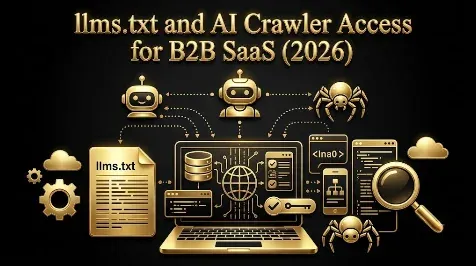
llms.txt and AI Crawler Access for B2B SaaS (2026): What Actually Moves AI Citations, and What Just Feels Productive
Quick answer: llms.txt is a plain-text Markdown file you place at yoursite.com/llms.txt that points AI crawlers to your most important pages, proposed in late 2024 as a kind of inverted robots.txt that says what matters rather than what to avoid. It is worth being clear-eyed about it: as of late 2026 it is a community proposal, not a standard, and no major answer engine has publicly confirmed it uses llms.txt to choose citations. Perplexity is the one engine practitioners most often report reading it, the evidence there is small and confounded, and Google has stated plainly that AI Overviews and AI Mode need no special machine-readable files. So llms.txt is cheap and low-risk to add, it genuinely helps a narrower set of tools (developer assistants like Cursor and some retrieval pipelines read it), but it is not the lever that gets a B2B SaaS cited in AI answers, and treating it as one is where teams waste effort. The lever that actually matters is AI crawler access in your robots.txt: the answer and retrieval bots that fetch pages in real time to build cited answers, OAI-SearchBot and ChatGPT-User for ChatGPT, PerplexityBot and Perplexity-User for Perplexity, Claude’s user-triggered fetcher, and the regular Googlebot that powers AI Overviews, must not be blocked, because a page a citation crawler cannot fetch cannot be cited. The useful distinction is between training crawlers (GPTBot, ClaudeBot, CCBot, Bytespider, and the Google-Extended and Applebot-Extended control tokens), which collect data for model training and which you can allow or block on your own terms, and answer/retrieval crawlers, which generate live citations and which you should let in. One important and widely misunderstood point: blocking Google-Extended does not remove you from Google AI Overviews, because AI Overviews draw on the normal Google index through Googlebot, not Google-Extended. The honest 2026 playbook for a B2B SaaS is therefore to audit robots.txt so no citation crawler is accidentally blocked, decide deliberately about training crawlers, add an llms.txt because the downside is near zero, and then put real effort into the things that do move citations: extractable on-page content, entity and schema signals, and snippet-friendly answers.
Key takeaways
- llms.txt is cheap but unproven: it is a community proposal, not a standard, and no major answer engine has publicly confirmed using it to pick citations, so treat it as low-cost housekeeping, not a growth lever.
- The real lever is crawler access: the answer and retrieval bots (OAI-SearchBot, ChatGPT-User, PerplexityBot, Claude’s fetcher, and Googlebot for AI Overviews) must be able to fetch your pages, or you cannot be cited.
- Know the two crawler types: training crawlers collect data for model training and are your choice to allow or block; answer/retrieval crawlers build live cited answers and should be let in.
- Google-Extended is not AI Overviews: blocking Google-Extended only opts you out of Gemini and Vertex training, it does not remove you from AI Overviews, which use the normal Google index.
- Spend effort where it pays: after fixing crawler access and adding llms.txt, the citations come from extractable content, entity and schema signals, and snippet-friendly answers, not from the file itself.
There is a lot of confident advice in 2026 telling B2B SaaS teams that an llms.txt file is how you get cited by ChatGPT, and most of it overstates a small, unconfirmed effect while ignoring the thing that actually controls whether an AI engine can quote you at all. This guide separates the two. It explains what llms.txt is, looks honestly at whether it moves citations, then covers the crawler-access decisions in robots.txt that genuinely decide your AI visibility, and closes with where to spend effort instead. It is part of our SEO and AEO series and pairs with the answer engine optimization, schema markup, and technical SEO guides.
What llms.txt actually is
llms.txt is a plain-text file written in Markdown that you serve at the root of your domain, at yoursite.com/llms.txt, and its job is to give AI systems a curated map of your most important content. It was proposed in late 2024 by Jeremy Howard of fast.ai, and the idea is often described as robots.txt inverted: where robots.txt tells crawlers what not to access, llms.txt tells them what matters most and where to find it. A typical file has an H1 with your company name, a one-sentence description in a blockquote, and then topic sections that list absolute URLs with a short note on each. There is also an optional larger variant, llms-full.txt, which concatenates the full text of a handful of key pages into one document so a tool can read your core content in a single fetch rather than following many links. The important framing for a B2B SaaS is that llms.txt is a community proposal, not a W3C or IETF standard and not something any search engine requires, so whether it does anything depends entirely on which systems choose to read it.
Does llms.txt actually move AI citations?
This is where honesty matters, because the gap between the marketing claim and the evidence is wide. No major answer engine has publicly confirmed that it uses llms.txt to decide which sources to cite. Here is the state of support as of late 2026, described plainly:
| Engine | Uses llms.txt for citations? | What is actually known |
|---|---|---|
| Perplexity | Unconfirmed, most reported | Practitioners most often report PerplexityBot reading it; no official confirmation, and the citation evidence is small |
| OpenAI / ChatGPT | No confirmation | OpenAI’s crawler documentation does not mention llms.txt |
| Google / Gemini | Explicitly not needed | Google says AI Overviews and AI Mode need no special machine-readable files |
| Anthropic / Claude | No public documentation | Some report better Claude citations, but that is correlation, not a confirmed mechanism |
| Developer tools / MCP | Yes, genuinely | Tools like Cursor and Continue, and some retrieval pipelines, do read llms.txt |
The largest piece of evidence available points the same way. In November 2025, SE Ranking analyzed roughly 300,000 domains (it found an llms.txt file on about 10.13% of them) and tested whether having one related to how often a domain was cited by major LLMs. Simple statistical tests found no significant correlation between llms.txt and citation frequency, and the firm’s conclusion was blunt: llms.txt “doesn’t seem to directly impact AI citation frequency, at least not yet.” Tellingly, its own server logs showed GPTBot only occasionally fetching llms.txt files, infrequently and with no link to citation outcomes. The smaller field data agrees. One widely shared practitioner test across four sites over four months found on average about 2.3 times more Perplexity citations after adding llms.txt, but the author was careful to say the sample is too small to be statistically significant, that every site made other GEO changes at the same time so the effect cannot be attributed to llms.txt alone, and that there was no measurable ChatGPT citation difference. That is the most favorable evidence, and set against a 300,000-domain analysis showing no clear effect, it still does not support the claim that llms.txt gets you cited. The fair conclusion is that llms.txt is cheap and low-risk to add, it has a confirmed read path with developer tools and a plausible one with Perplexity, and it is not a reliable lever for AI citations, so it should not crowd out higher-return work. Some practitioners now compare it to the meta keywords tag of the early web: widely adopted, intuitively appealing, and ultimately not a ranking input.
The real lever: AI crawler access in robots.txt
If llms.txt is the thing that gets talked about, crawler access is the thing that actually decides whether an AI engine can cite you, and it lives in your robots.txt. The logic is simple: an answer engine that fetches a page in real time to build a cited answer cannot cite a page it is blocked from fetching. So the first and most important audit is to confirm that your robots.txt is not quietly blocking the crawlers that generate citations. These are the user-agents that matter for a B2B SaaS in 2026:
| Crawler (user-agent) | Operator | Role |
|---|---|---|
| OAI-SearchBot | OpenAI | Retrieval for ChatGPT search results and citations |
| ChatGPT-User | OpenAI | Real-time fetch when a user’s ChatGPT prompt browses |
| GPTBot | OpenAI | Training data collection (also tied to browsing) |
| PerplexityBot | Perplexity | Indexing for Perplexity answers and citations |
| Perplexity-User | Perplexity | Real-time fetch for a user’s Perplexity query |
| ClaudeBot | Anthropic | Training data collection |
| Claude-User | Anthropic | Real-time fetch when Claude retrieves a page for a user |
| Googlebot | Powers normal search and AI Overviews / AI Mode | |
| Google-Extended | Control token for Gemini and Vertex AI training (not AI Overviews) | |
| Applebot-Extended | Apple | Control token for Apple Intelligence training (Applebot is the separate index crawler) |
| Bytespider | ByteDance | Training data collection, often high-frequency |
| CCBot | Common Crawl | Open dataset used to train many models |
| Meta-ExternalAgent | Meta | Training (Meta-ExternalFetcher is the user-triggered variant) |
| Amazonbot | Amazon | Used by Alexa and Amazon AI services |
The practical rule is to allow the answer and retrieval crawlers (OAI-SearchBot, ChatGPT-User, PerplexityBot, Perplexity-User, Claude-User) and Googlebot without restriction on your public content, give each AI crawler its own user-agent block rather than relying on a wildcard (AI crawlers do not always honor a wildcard rule), and reserve Disallow rules for genuinely private paths like /account/, /admin/, /api/, and /internal/. Review the file every quarter, because new crawlers appear often and a blanket block written a year ago may now be shutting out a citation engine.
robots.txt is a request, not a wall
It is worth being honest that robots.txt is a voluntary protocol, not an enforcement mechanism, so a Disallow rule is a request that a well-behaved crawler chooses to honor, not a lock that stops a determined one. Most of the major operators do respect it, but the ecosystem has already shown the limits: a 2025 Cloudflare report alleged that Perplexity continued fetching content from sites that had blocked it by switching to an undeclared user-agent, which is the kind of behavior robots.txt cannot prevent on its own. For a B2B SaaS this matters in two directions. If your only goal is citation visibility, robots.txt is enough, because the citation crawlers you want are the ones that honor it, so correct Allow rules do the job. But if you genuinely need to stop a crawler, whether for bandwidth, cost, or a real content-protection reason, robots.txt alone is not reliable, and you should back it with server-side controls: confirm a crawler’s identity with reverse DNS and forward confirmation or against the operator’s published IP ranges, and use a web application firewall, a bot-management layer such as Cloudflare’s AI crawler controls, or rate limiting to actually enforce the decision. And in every case, read your server access logs, because they are the ground truth of which crawlers are really visiting and how often, and they will tell you more than any blog post about what is happening on your own site.
Training crawlers versus answer crawlers, and the blocking trade-off
The decision that confuses most teams is whether to block the training crawlers, and it helps to separate the two jobs these bots do. Answer and retrieval crawlers fetch your page at the moment an AI is building an answer, and they are the ones that produce a citation, so blocking them directly costs you AI visibility. Training crawlers (GPTBot, ClaudeBot, CCBot, Bytespider, and the control tokens Google-Extended and Applebot-Extended) collect data to train future models, and blocking them is a legitimate choice about whether your content is used for training, with no clear, proven effect on whether you get cited today. The nuance is that some bots wear both hats: GPTBot, for example, is a training crawler that is also involved in ChatGPT browsing, so blocking it is not purely a training decision. The genuinely important and most misunderstood point is Google-Extended: it is only a control token for whether Google uses your content to train Gemini and Vertex AI models, and blocking it does not remove you from Google AI Overviews, because AI Overviews are built from the normal Google index through Googlebot. So a team that blocks Google-Extended to “opt out of Google AI” and thinks it has protected itself has usually changed nothing about its AI Overviews exposure. Decide on training crawlers deliberately based on your view of training use, and never let a training-crawler block accidentally take a citation crawler with it.
How to write an llms.txt if you choose to
Because the downside is near zero, adding an llms.txt is reasonable housekeeping even though it is unproven. Keep it simple and accurate. Start with an H1 of your company name and a one-sentence blockquote summary of what you do, then add topic sections that list your genuinely important pages as absolute URLs, each with a short description: your core product and pricing pages, your best guides and documentation, and your comparison and use-case pages. Keep it to roughly 20 to 30 of your most valuable URLs rather than your whole sitemap, make sure each URL matches that page’s canonical tag, and update it monthly or whenever your key pages change. If you want to add llms-full.txt, concatenate the full text of five to ten of your most important pages, but keep the file size sane, because a file that balloons to hundreds of kilobytes is less likely to be read in full. Treat the whole exercise as a 20-minute task, not a project, and do not let it stand in for the work that actually earns citations.
Where llms.txt genuinely helps today
It is fair to the file to name where it does real work, because “unproven for citations” is not the same as “useless.” Developer-facing tools read llms.txt now: coding assistants such as Cursor and Continue, and some Model Context Protocol pipelines, use it to find and load a product’s key documentation, which matters a great deal if your B2B SaaS has an API or a developer audience, because it shapes how accurately those tools describe and use your product. Perplexity is the answer engine most often reported to read it, so if Perplexity is a meaningful channel for your category, the small effort is easy to justify on that basis alone. And an llms.txt is a forcing function: writing one makes you decide which 25 pages actually represent your product, which is a useful clarifying exercise regardless of who reads the file. None of this makes llms.txt a citation lever, but it does make it a sensible, low-cost addition for a product with a technical audience.
What to do instead, or first, for AI citations
If the goal is to be cited in AI answers, the effort that pays is the same work that answer engines reward, and it is mostly on-page. Confirm crawler access first, as above, because nothing else matters if the citation bots cannot fetch you. Then rewrite your key pages so the first sentence under each heading directly answers the question a buyer would ask, in the 40-to-60-word form that feeds snippets and AI answers, as the featured snippets guide covers. Strengthen your entity and structured-data signals so engines understand what your product is and how it relates to your category, as the schema markup guide covers, remembering that schema supports understanding rather than guaranteeing a citation. Make your pricing and comparison facts readable and extractable rather than hidden, so budget and comparison answers can quote you. And test directly: ask ChatGPT, Perplexity, and Google AI Overviews the questions your buyers ask, see how you are described, log where the answer is wrong or absent, and fix the page that caused it. That loop, not a text file at your domain root, is what moves AI citations for a B2B SaaS.
Field note: The llms.txt conversation is a useful case study in how AEO advice goes wrong, because it follows a pattern worth recognizing. A plausible, easy-to-implement idea appears, a few early adopters report encouraging results, the results get repeated without their caveats, and within months “add an llms.txt” is being sold as the way to get cited by ChatGPT, even though no one selling it can point to an engine that confirms using it for citations. The tell is always the same: the tactic is concrete and quick, which makes it feel productive, while the thing that actually works is diffuse and slow, which makes it easy to avoid. A team can add an llms.txt in an afternoon and feel like it has done AI optimization, and it has done something real but minor, while the pages that would actually get cited still bury their prices in tooltips, answer questions three paragraphs in, and carry no entity signals. The honest version of the advice is not “don’t add llms.txt”, because it is cheap and it helps developer tools and possibly Perplexity. The honest version is “add it in twenty minutes, then spend the rest of the week on the boring work”, which means checking that no citation crawler is blocked, rewriting the opening sentence of every key page to answer the question directly, and making your commercial facts extractable. The uncomfortable truth of AEO in 2026 is that the shortcuts are mostly small and the real levers are mostly old-fashioned, and the teams that get cited are the ones that resist the temptation to mistake the quick, satisfying task for the one that works.
Honest limitations
- The ecosystem is moving. Crawler names, behaviors, and engine policies change often, so verify the current user-agents and any engine’s stance before relying on this, and review robots.txt quarterly.
- llms.txt support is unconfirmed. No major answer engine has publicly confirmed using it for citations, and the favorable field data is small and confounded, so treat any citation gain as unproven.
- Blocking choices have real trade-offs. Blocking training crawlers is a legitimate stance, but some bots serve both training and browsing, so a block can have effects beyond training.
- Google-Extended is narrow. It controls Gemini and Vertex training only; do not treat it as an AI Overviews control.
- No file guarantees a citation. Answer engines select sources on signals no provider fully publishes, so neither llms.txt nor robots.txt settings can guarantee you are cited.
- This is educational, not legal or financial advice; verify current crawler policies and validate against your own server logs and testing.
Frequently Asked Questions
Q1. What is llms.txt and do I need one for my B2B SaaS?
llms.txt is a plain-text Markdown file you serve at the root of your domain, at yoursite.com/llms.txt, that gives AI systems a curated list of your most important pages, with your company name as an H1, a one-sentence description, and topic sections of absolute URLs. It was proposed in late 2024 and is often described as robots.txt inverted, because it points to what matters rather than what to avoid. Whether you “need” one depends on your honest goal. If the goal is to be cited in AI answers, llms.txt is not a requirement and not a proven lever, because no major answer engine has publicly confirmed using it to choose citations, so you should not expect ChatGPT or Google AI Overviews to cite you more because of it. If your product has an API or a developer audience, there is a stronger case, because developer tools such as Cursor and Continue and some retrieval pipelines genuinely read llms.txt to find your documentation, which affects how accurately they describe and use your product. The sensible position for most B2B SaaS companies is that llms.txt is cheap, low-risk housekeeping worth about twenty minutes, especially if Perplexity or developer tools matter to you, but it is not where your AI-visibility effort should go. The work that actually earns citations is making sure the answer crawlers can fetch your pages, writing extractable answers, and building entity and schema signals, so add the file if you like but do not treat it as the strategy.
Q2. Does llms.txt actually get me cited by ChatGPT or Google?
On the current evidence, no, not in any reliable way. OpenAI’s crawler documentation does not mention llms.txt, and Google has stated that AI Overviews and AI Mode do not require any special machine-readable files, which is close to an explicit statement that llms.txt is not part of how Google builds AI answers. The largest analysis available backs this up: in November 2025 SE Ranking looked at about 300,000 domains, found llms.txt on roughly 10% of them, and reported no significant correlation between having the file and how often a domain was cited by major LLMs, concluding it “doesn’t seem to directly impact AI citation frequency, at least not yet”, with its own logs showing GPTBot fetching llms.txt only occasionally and with no tie to citations. The engine most often reported to read llms.txt is Perplexity, but even there the support is unconfirmed by the company and the field evidence is weak: the most-shared practitioner test, across four sites over four months, found on average about 2.3 times more Perplexity citations after adding llms.txt, but the author stressed that the sample was too small to be statistically significant, that every site made other GEO changes at the same time so the gain cannot be attributed to llms.txt, and that there was no measurable ChatGPT difference. Set against the 300,000-domain result, that most favorable data still does not demonstrate a citation effect. The reason the myth persists is that llms.txt is quick and concrete, so adding it feels like doing AI optimization, while the things that actually move citations are slower and less satisfying. So the accurate answer is that llms.txt will not get you cited by ChatGPT or Google on its own, it has a narrow real use with developer tools and possibly Perplexity, and the effort to get cited belongs in crawler access, extractable content, and entity signals instead.
Q3. Which AI crawlers should I allow, and which can I block?
Allow every answer and retrieval crawler on your public content, because those are the bots that fetch a page in real time to build a cited answer, and blocking them directly removes you from AI citations. The ones to allow are OAI-SearchBot and ChatGPT-User for ChatGPT, PerplexityBot and Perplexity-User for Perplexity, Anthropic’s user-triggered fetcher for Claude, and the normal Googlebot, which powers Google AI Overviews and AI Mode as well as regular search. The crawlers you can choose to block are the training-only ones: GPTBot (OpenAI’s training crawler, though it is also tied to browsing, so blocking it is not purely a training choice), ClaudeBot (Anthropic training), CCBot (Common Crawl, which feeds many training datasets), and Bytespider (ByteDance training), plus the control tokens Google-Extended and Applebot-Extended, which govern whether Google and Apple use your content to train their models. Blocking these is a legitimate decision about training use, and there is no clear evidence it changes whether you get cited today. Two practical rules matter. Give each AI crawler its own user-agent block in robots.txt rather than relying on a wildcard, because AI crawlers do not always honor wildcard rules, and reserve your Disallow rules for genuinely private paths like /account/, /admin/, /api/, and /internal/. And review the file quarterly, because new crawlers appear frequently and an old blanket block can quietly shut out an engine that now sends citations.
Q4. If I block Google-Extended, do I disappear from Google AI Overviews?
No, and this is one of the most common and costly misunderstandings in AI SEO. Google-Extended is only a control token that governs whether Google may use your content to train its Gemini models and Vertex AI products. It is not the crawler behind Google AI Overviews. AI Overviews and AI Mode are built from Google’s normal search index, which is gathered by the regular Googlebot, so your presence in AI Overviews depends on normal Googlebot access and normal ranking, not on Google-Extended. This means a team that adds “Disallow: /” for Google-Extended believing it has opted out of “Google AI” has usually changed nothing about its AI Overviews exposure; it has only declined to let Google train models on its content. If you actually want to influence AI Overviews, the levers are the ordinary ones: let Googlebot crawl your pages, rank well for the query, and write content that answers the question directly in an extractable way. Conversely, if your concern is training use and you block Google-Extended for that reason, understand that you are making a training decision, not an AI Overviews decision, and that you remain fully eligible to appear in AI Overviews. Keeping these two straight prevents both mistakes: accidentally thinking you are hidden from AI Overviews when you are not, and accidentally blocking Googlebot (which would genuinely remove you) when you only meant to block training.
Q5. What is the difference between training crawlers and answer crawlers?
The difference is when the crawler fetches your page and what it does with it, and it is the single most useful distinction for AI crawler decisions. A training crawler collects content to be used in training future AI models; it visits your site in advance, and the content may influence what a model “knows” in general, but the visit is not tied to any specific user question and does not itself produce a citation. GPTBot, ClaudeBot, CCBot, and Bytespider are training crawlers, and Google-Extended and Applebot-Extended are control tokens for training use. An answer or retrieval crawler fetches your page at the moment an AI is assembling an answer for a user, reads it, and can cite it directly in that answer; OAI-SearchBot and ChatGPT-User, PerplexityBot and Perplexity-User, and Anthropic’s user-triggered fetcher are in this group, and Googlebot plays this role for AI Overviews. The practical consequence is that answer crawlers directly determine your AI citation visibility, so you should let them in, while training crawlers are a matter of policy preference with no proven citation impact, so you can allow or block them on your own terms. The one complication is that a few bots do both jobs, GPTBot being the clearest example, so blocking it has browsing-related effects beyond training. Keeping the two categories distinct lets you make a clean decision: always admit the answer crawlers, and decide about the training crawlers separately based on how you feel about your content being used to train models.
Q6. Should I create llms-full.txt as well, and how big should it be?
llms-full.txt is an optional companion to llms.txt that concatenates the full text of a handful of your most important pages into a single document, so a tool can read your core content in one fetch instead of following many links, which is particularly useful for real-time retrieval and for developer tools loading your documentation. Whether it is worth creating follows the same honest logic as llms.txt: it is cheap and low-risk, it has a real use for developer-facing and retrieval tools, and it is unproven as a citation lever for the major answer engines, so create it if you have an API or developer audience or if Perplexity matters to you, and skip it if neither applies. Size is the main thing to get right, because the value of a single-fetch file disappears if the file is too large to be read in full. Concatenate only five to ten of your genuinely most important pages rather than your whole site, and keep the total to a sane size; a file that grows to several hundred kilobytes is both less likely to be fully read and more of a maintenance burden. Keep each included page’s text matching the live canonical page so you are not serving a stale version, and refresh it when those key pages change. Treat llms-full.txt, like llms.txt, as low-effort housekeeping for a technical audience, not as the work that earns you AI citations, which remains extractable on-page content, entity and schema signals, and clean crawler access.
Q7. What should a B2B SaaS actually prioritize to get cited in AI answers?
Prioritize the things answer engines demonstrably reward, in roughly this order. First, fix crawler access: audit robots.txt and confirm that no answer or retrieval crawler (OAI-SearchBot, ChatGPT-User, PerplexityBot, Perplexity-User, Anthropic’s fetcher) or Googlebot is blocked, because a page a citation crawler cannot fetch cannot be cited, and this is the one issue that can silently zero out all your other effort. Second, make your content extractable: rewrite the opening sentence under each heading to answer the buyer’s question directly in about 40 to 60 words, keep your pricing and comparison facts in readable text rather than images or tooltips, and use real HTML tables for comparisons, so engines can lift and quote you. Third, strengthen entity and structured-data signals so engines understand what your product is and how it fits your category, remembering that schema supports understanding rather than guaranteeing a citation. Fourth, build the bottom-of-funnel and comparison content that buyers and engines consult for decision-stage answers, and cross-link it so authority flows to those pages. Fifth, add llms.txt and, if relevant, llms-full.txt, because they are cheap and help developer tools and possibly Perplexity, but do this last and treat it as housekeeping. Sixth, run a recurring test loop: ask ChatGPT, Perplexity, and Google AI Overviews your buyers’ questions, log where you are wrong or absent, and fix the page that caused it. That sequence puts your effort where the evidence is, rather than on the tactic that merely feels productive.
If you want an AI-visibility setup that puts effort where it actually moves citations, book a demo with Growthspree.
Sources & further reading
- SE Ranking’s November 2025 analysis of roughly 300,000 domains (reported by Search Engine Journal) finding no significant correlation between llms.txt and AI citation frequency, with llms.txt present on about 10% of domains and GPTBot only occasionally fetching it. This is the largest evidence point and the basis for the “cheap but unproven” conclusion.
- 2026 practitioner analyses on llms.txt and whether it moves AI citations (Alejandro Rioja’s multi-site test and honest caveats; Web60 on the ChatGPT citation myth and Google’s “no special machine-readable files” position; Deepak Gupta’s GEO writing, including the meta-keywords comparison and the AI crawler user-agent and robots.txt guidance) covering the file format and llms-full.txt, engine-by-engine support status, the training-versus-answer-crawler distinction, and the recommendation to prioritize crawler access and extractable content. Field figures (for example the 2.3x Perplexity-citation test) are small, uncontrolled, and confounded; treat them as directional only.
- Tenten (2026 AI crawler user-agent reference) for the current crawler list and roles, and a 2025 Cloudflare report on undeclared-user-agent crawling, on why robots.txt is a voluntary request that may need server-side enforcement (reverse DNS, IP ranges, WAF or bot management). Verify user-agents against each operator’s own documentation and your server logs.
- Google Search Central (guidance that AI Overviews and AI Mode require no special machine-readable files; crawling and indexing; Googlebot and AI features).
- OpenAI, Anthropic, and Perplexity public crawler documentation (user-agent names and stated crawler purposes), verified against your own server logs.
- GrowthSpree (B2B SaaS practice: audit robots.txt so no citation crawler is blocked, decide training-crawler policy deliberately, add llms.txt as low-cost housekeeping, and put real effort into extractable content, entity and schema signals, and a recurring AI-answer test loop).
- Companion: Answer Engine Optimization for B2B SaaS; Schema Markup for B2B SaaS; Technical SEO for B2B SaaS; Featured Snippets and SERP Features for B2B SaaS.
This guide is educational, not legal or financial advice; the AI crawler ecosystem changes quickly, so verify current crawler policies and validate against your own server logs and testing.
Related guides: Answer Engine Optimization for B2B SaaS · Schema Markup for B2B SaaS · Technical SEO for B2B SaaS · Featured Snippets and SERP Features for B2B SaaS.