Pipeline,
not promises.
Senior operators audit your funnel in 48 hours. Ship 3 specific moves in 30 days.
- Full-funnel audit · 4 velocity levers
- 3 wins to ship in 30 days
- $3K flat · month-to-month
30-min call · No commitment
- Full-funnel audit · 4 velocity levers
- 3 wins to ship in 30 days
- $3K flat · month-to-month
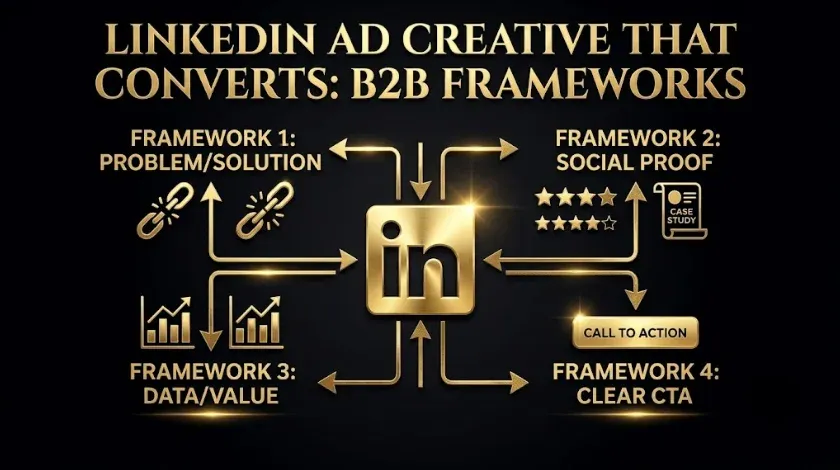
LinkedIn Ad Creative That Converts: B2B Frameworks
Quick answer: Strong B2B LinkedIn ad creative leads with the buyer’s problem, is specific, feels native to the feed, and makes one clear point — not a polished product brochure. Because targeting and bidding are increasingly automated, creative is now the main lever you control, and it’s where most B2B ads fail: they open with the company, list features, and read like ads. The frameworks that work all share a shape: hook the right person fast, name a specific problem or insight, offer one relevant next step, and back it with proof. Match the creative to the funnel stage, and test one variable at a time.
Key takeaways
- Creative is the main lever now that targeting and bidding are automated.
- Lead with the problem, not your product — the buyer cares about their pain first.
- Specificity converts. “Cut onboarding from 6 weeks to 5 days” beats “improve efficiency.”
- Native beats glossy. Feed-native, human creative outperforms corporate polish.
- One ad, one message, matched to the funnel stage — and test one variable at a time.
On LinkedIn, you can no longer out-target or out-bid your way to results — automation has flattened those advantages, leaving creative as the differentiator. Yet most B2B creative is generic and product-centric. This guide covers the anatomy of a converting B2B ad, the frameworks that work, format-specific creative, and how to test creative so you actually learn.
Why does creative matter more now?
Because the other levers have been automated away. As bidding and, increasingly, targeting move to algorithms, the input you most control is what the ad actually says and shows. Two advertisers with similar audiences and budgets now diverge mainly on creative quality — which means creative is where B2B campaigns are won or lost. This is also why the Linkedin Thought Leader Ads B2B 2026 win: they’re formats that let better creative breathe. The uncomfortable implication is that “LinkedIn is too expensive” is often really “our creative isn’t good enough to justify the cost.”
What’s the anatomy of a converting B2B ad?
Strong B2B ads share a structure, whatever the format:
- A hook that stops the right person. The first line (or first second of video) must earn attention — a sharp problem, a surprising stat, a contrarian claim. Feed attention is won or lost immediately.
- A specific problem or insight. Name a real, specific pain your buyer recognizes — the more specific, the more it signals “this is for me.”
- A single, clear point. One idea per ad. Cramming multiple messages dilutes all of them.
- Proof. A concrete result, a named customer, or a specific number that makes the claim credible — see case studies and social proof.
- One relevant CTA, matched to the funnel stage — ungated value up top, a demo only when the audience is warm.
Miss the hook and nothing else matters; miss the specificity and it reads as generic; miss the single point and it reads as noise.
What creative frameworks work for B2B?
A few reliable structures, adapted for B2B:
| Framework | Shape | Best for |
|---|---|---|
| Hook → Value → CTA | Grab attention, deliver one useful idea, invite a next step | Most Sponsored Content |
| Problem → Agitate → Solve | Name the pain, show its cost, present the path | Problem-aware audiences |
| Insight → Implication | Share a specific insight, then what it means for the buyer | Thought leadership / TOFU |
| Before → After | Contrast the status quo with the solved state | Proof-led / MOFU |
| Objection → Answer | Surface a real hesitation and resolve it | BOFU / consideration |
These aren’t formulas to apply mechanically; they’re shapes that keep creative buyer-focused instead of product-focused. The common thread is that every one starts with the buyer’s world, not yours.
What copy principles convert in B2B?
- Write like a human, not a brand. Conversational, direct, specific — the tone of founder-led content, not a press release.
- Be concrete. Numbers, names, and specifics beat adjectives every time.
- Lead with “you,” not “we.” The buyer’s problem, not your company’s greatness.
- Cut the jargon. “Synergistic best-in-class platform” says nothing; plain language says more.
- Earn the CTA. Deliver value before asking; a pitch in line one gets scrolled past.
The positioning and messaging that underpins good copy matters here — if you can’t say who it’s for and why in a line, the ad can’t either.
How does creative change by format?
Match creative to the format’s strengths:
- B2B Manufacturing Marketing Playbook Google Ads Linkedin ABM 2026: a genuine personal POV — the creative is the person’s authentic take.
- Document Ads: a strong first page as the hook, skimmable value, one idea per page.
- Single-image: the hardest format — the image and first line must do all the work, so make both specific and native.
- Video: hook in the first 1–2 seconds, captions on (most watch muted), one message.
- Carousel: one point per card, building to a single CTA.
How do you test creative?
Test one variable at a time so you learn what actually moved the result:
- Start with the hook — usually the highest-leverage variable.
- Then the angle/framework — problem-led vs. insight-led vs. proof-led.
- Then the format — the same message as video vs. document vs. image.
- Then the CTA and offer.
- Give each test enough volume to reach a real read, and rotate before fatigue — small B2B audiences tire of creative fast, inflating costs.
Judge tests on downstream quality, not just CTR — a hook that lifts clicks but attracts the wrong people isn’t a win. Feed results through lead scoring and measure to pipeline.
Field note: The most common B2B creative mistake is making the company the hero. Ad after ad opens with “At [Company], we…” and lists features — and scrolls right past the buyer, who is scanning for something about their problem, not your product. Flip the first line to the buyer’s pain or a specific insight and the same offer, audience, and budget perform noticeably better, because the ad finally answers the only question a feed-scroller is asking: “is this about me?” The product is never the hero of a converting B2B ad; the buyer’s problem is.
Honest limitations
- Creative can’t fix a weak offer or wrong audience. Great creative for the wrong people, or a bad offer, still fails — creative amplifies fit, it doesn’t create it.
- “Best practices” are starting points. What converts is audience-specific; test rather than trusting frameworks blindly.
- Fatigue is relentless on LinkedIn. Even great creative decays fast in small B2B pools; you need a pipeline of creative, not one winner.
- CTR isn’t the goal. A high-CTR ad that attracts poor-fit clicks wastes premium budget; judge on qualified pipeline.
- Proof requires substance. “Specific results” only work if they’re real; invented numbers erode trust and violate platform rules.
Frequently Asked Questions
Q1. What makes LinkedIn ad creative convert?
Creative that leads with the buyer’s problem, is specific, feels native to the feed, and makes one clear point — backed by proof and a single relevant CTA. Product-centric, feature-listing, glossy-corporate creative fails because it answers the company’s agenda, not the buyer’s question of “is this about me?”
Q2. Why does ad creative matter more on LinkedIn now?
Because targeting and bidding are increasingly automated, so creative is the main lever advertisers still control. Two campaigns with similar audiences and budgets now diverge mainly on creative quality, which means creative is where B2B LinkedIn campaigns are won or lost.
Q3. What are good B2B ad creative frameworks?
Reliable shapes include Hook → Value → CTA, Problem → Agitate → Solve, Insight → Implication, Before → After, and Objection → Answer. They all keep the creative buyer-focused by starting with the buyer’s world rather than your product.
Q4. How should LinkedIn ad copy be written?
Write like a human, not a brand: conversational and specific, leading with “you” and the buyer’s problem, using concrete numbers and names, cutting jargon, and earning the CTA by delivering value first. Plain, specific language outperforms corporate polish.
Q5. How does creative differ by LinkedIn ad format?
Thought Leader Ads need a genuine personal POV; Document Ads need a strong first page and skimmable value; single-image ads must do everything with the image and first line; video needs a 1–2 second hook and captions; carousels need one point per card building to one CTA.
Q6. How do you test LinkedIn ad creative?
Test one variable at a time — start with the hook, then the angle/framework, then the format, then the CTA — giving each enough volume for a real read and rotating before fatigue. Judge tests on downstream lead quality and pipeline, not just CTR.
Q7. Why do product-focused B2B ads fail?
Because feed-scrollers are scanning for something relevant to their own problem, and an ad that opens with the company and lists features gives them no reason to stop. Leading with the buyer’s pain or a specific insight answers “is this about me?” and converts the same offer far better.
Sources & further reading
- LinkedIn Campaign Manager documentation — ad formats, specifications, and creative best practices.
- Test creative with properly powered experiments and judge on downstream lead quality, not CTR alone.
This guide is educational; what converts is audience-specific, so treat frameworks as starting points and validate with your own tests and pipeline data.
Related guides: B2B SaaS Ad Testing Framework Google Ads Linkedin Ads 2026 · LinkedIn Document Ads · LinkedIn Ads Funnel Structure · Positioning and Messaging for B2B SaaS · Case Studies & Social Proof.