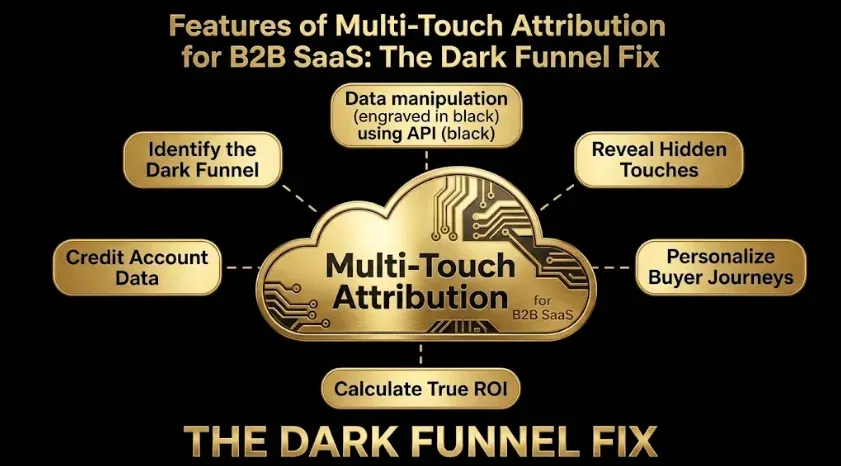
Multi-Touch Attribution for B2B SaaS: Fixing the Dark Funnel Blind Spot
Quick answer: Multi-touch attribution (MTA) distributes credit for a closed deal across every recorded touchpoint, rather than giving it all to the last click. For B2B SaaS it matters because buying committees are large and cycles are long, so a single click never explains a deal. But MTA has a structural blind spot: the dark funnel — podcasts, communities, peer conversations, and AI-assistant research that leave no trackable touch. The practical answer is to pair attribution data with self-reported attribution, and optimize on directional truth rather than false precision.
Key takeaways
- Last-click misleads B2B. It over-credits the final capture channel and starves demand creation.
- MTA spreads credit across touchpoints, but only across touches it can see.
- The dark funnel is real. Peer research, communities, and AI assistants leave no tracked click.
- Pair models with self-reported attribution (“how did you hear about us?”) on the form.
- Optimize directionally. Perfect attribution doesn’t exist; a defensible blended view does.
Attribution is where B2B SaaS marketing arguments go to die. Paid says the ads drove it; content says the blog did; sales says the founder’s LinkedIn post did. They’re often all partly right, and the tracking data can’t settle it. This guide explains what multi-touch attribution actually does, where it breaks in B2B, and how to build a measurement approach you can defend in a board meeting.
What is multi-touch attribution?
Multi-touch attribution is a measurement method that assigns fractional credit for a conversion to each recorded touchpoint in the buyer’s journey — an ad click, a webinar, an email, a demo request — rather than crediting a single interaction. It contrasts with single-touch models (first-click or last-click), which award 100% of the credit to one interaction. The goal is to reflect that B2B purchases are cumulative: nobody buys a $50K platform because of one banner ad.
Why does last-click attribution mislead B2B SaaS?
Because in a long, committee-driven cycle, the last click is usually just the capture moment — someone searching your brand name to find the demo form. Crediting that click credits the channel that harvested demand, not the one that created it. The predictable outcome: brand search and retargeting look spectacular, top-of-funnel content and social look worthless, budget shifts toward capture, and pipeline shrinks a quarter or two later because nothing is creating demand anymore. This is the single most common attribution-driven mistake in B2B SaaS.
Attribution models compared
| Model | How credit is assigned | Best for | Weakness |
|---|---|---|---|
| First-touch | 100% to the first interaction | Understanding demand creation | Ignores everything after |
| Last-touch | 100% to the final interaction | Simple, close to revenue | Over-credits capture channels |
| Linear | Split evenly across touches | Fair-ish default | Treats trivial touches as equal |
| Time-decay | More credit to recent touches | Long cycles | Still favors capture |
| U-shaped / W-shaped | Weights first, lead, and opportunity | B2B committee journeys | Complex, still misses untracked touches |
No model is “correct.” Each answers a different question, and every one of them is blind to touches that were never recorded.
What is the dark funnel, and why does it break attribution?
The dark funnel is all the buying research that happens where you can’t track it: private Slack and community discussions, podcasts, peer recommendations, review-site browsing, LinkedIn scrolling without clicking, and — increasingly — questions asked to AI assistants that return an answer without a click. None of it appears in your attribution model, yet much of it is what actually moved the buyer. This is why a deal can show a single last-click touch on brand search after six months of invisible influence.
Field note: The tell that your model is dark-funnel blind: a large share of pipeline attributed to “direct” or “brand search.” Those aren’t channels — they’re the shadow of demand created somewhere you didn’t measure. Treat a rising direct/brand share as evidence your demand creation is working, not as proof that brand search deserves the budget.
How do you fix the blind spot?
You can’t eliminate it, but you can triangulate:
- Add self-reported attribution. A single required field on the demo form — “How did you hear about us?” — captures what tracking cannot. It’s imperfect and it’s the highest-signal data most B2B teams aren’t collecting.
- Run a multi-touch model as a directional input, not a verdict. Use it to see patterns across channels, not to award budget to the decimal point.
- Watch leading indicators of demand creation. Branded search volume, direct traffic, and community mentions rise when demand creation works — before pipeline does.
- Instrument the CRM as the source of truth. Every model is only as good as the underlying account and opportunity data.
- Test with holdouts. Pausing a channel in a region for a period tells you more about incrementality than any model will.
How do you actually run this analysis?
The practical bottleneck is that the data lives in five places: ad platforms, analytics, Search Console, and the CRM. Connecting them to one AI assistant makes cross-channel attribution questions answerable directly — “which campaigns touched the accounts that became closed-won, and what did we spend on them?” See the complete MCP stack for B2B SaaS marketing teams for how the pieces connect, plus the GA4 MCP server for behavior data and the HubSpot CRM MCP or Salesforce MCP for revenue outcomes. Attribution quality also depends on lead-quality definitions, which is why it’s tied to improving your MQL-to-SQL conversion rate.
What should you actually optimize on?
Blended, directional truth. Rather than trusting any single model, look at: blended CAC by channel over time, self-reported attribution trends, pipeline created (not leads), and whether accounts touched by a channel close at better rates. If a channel’s removal would hurt — test it — it’s working, whatever the model says.
Frequently Asked Questions
Q1. What is multi-touch attribution in B2B SaaS?
It’s a measurement method that assigns fractional credit for a closed deal across every recorded touchpoint — ads, content, email, events — rather than crediting a single first or last interaction. It suits B2B because committee-driven purchases involve many touches over long cycles.
Q2. Why is last-click attribution bad for B2B SaaS?
Because the last click is usually the capture moment (often a brand search), not the interaction that created demand. Optimizing on it shifts budget toward harvesting channels and starves demand creation, which shrinks pipeline a quarter or two later.
Q3. What is the dark funnel?
The dark funnel is buying research that happens where you can’t track it — communities, podcasts, peer recommendations, review sites, unclicked social, and AI-assistant answers. It influences deals but never appears in attribution data.
Q4. How do you measure the dark funnel?
You can’t track it directly. Triangulate instead: add self-reported attribution (“how did you hear about us?”) to forms, watch branded search and direct traffic as leading indicators, and run holdout tests to measure a channel’s incrementality.
Q5. Which attribution model is best for B2B SaaS?
None is definitively best. W-shaped or time-decay models fit long committee journeys better than last-click, but every model is blind to untracked touches. Use a model directionally and pair it with self-reported attribution and holdout tests.
Sources & further reading
- Google — attribution models documentation, Google Ads and Analytics Help.
- Consult your own CRM cohort and holdout-test data before trusting any external model.
- Model Context Protocol — official specification, modelcontextprotocol.io.
Related guides: The Complete MCP Stack for B2B SaaS Marketing Teams · How to Improve MQL-to-SQL Conversion Rate · GA4 MCP Server · HubSpot CRM MCP.