Pipeline,
not promises.
Senior operators audit your funnel in 48 hours. Ship 3 specific moves in 30 days.
- Full-funnel audit · 4 velocity levers
- 3 wins to ship in 30 days
- $3K flat · month-to-month
30-min call · No commitment
- Full-funnel audit · 4 velocity levers
- 3 wins to ship in 30 days
- $3K flat · month-to-month
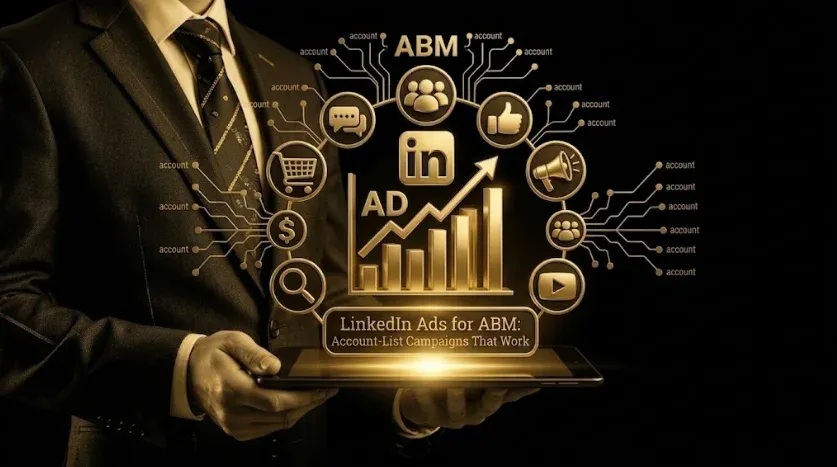
LinkedIn Ads for ABM: Running Account-List Campaigns That Work
Quick answer: LinkedIn is the strongest paid channel for account-based marketing because it lets you target specific companies and the exact people inside them. To run ABM on LinkedIn: build a tight target-account list from your ICP, tier it (1:1, 1:few, 1:many), sequence ad formats across the funnel (Thought Leader Ads to create awareness, Document Ads and retargeting to engage, Lead Gen Forms to capture), coordinate tightly with sales, and measure account engagement and pipeline — not lead volume. The whole point of ABM is depth on the right accounts, so lead-count metrics actively mislead.
Key takeaways
- LinkedIn suits ABM — it targets named accounts and specific roles better than any paid channel.
- Tier your accounts (1:1, 1:few, 1:many) and match effort to tier.
- Sequence formats across the funnel — awareness, engagement, then capture.
- Coordinate with sales. ABM is a marketing-and-sales motion, not a campaign.
- Measure accounts, not leads — engagement and pipeline from target accounts.
Account-based marketing flips the funnel: instead of casting wide and filtering, you pick the accounts worth winning and concentrate on them. LinkedIn is the natural paid channel for that motion. This guide covers how to build and tier the account list, sequence the formats, align with sales, and measure ABM the way it should be measured.
Why is LinkedIn the best paid channel for ABM?
Because ABM requires reaching specific companies and specific roles within them, and LinkedIn is built for exactly that. You can upload a list of target accounts as a Matched Audience and layer role and seniority filters to reach the buying committee — the CFO, the VP of Marketing, the head of RevOps — at each of those accounts. No other paid channel offers that precision at the person level. That makes LinkedIn the demand-generation engine most ABM programs run on, complementing the AI-and-data side of account-based marketing.
How do you build the target-account list?
The list is the foundation; a weak list makes precise targeting worthless. Build it from evidence:
- Start from your ICP. The accounts that match your best-customer profile.
- Layer in intent data. Prioritize accounts showing research activity or trigger events.
- Incorporate sales input. The accounts sales most wants to win, and the ones already in play.
- Keep it current. Add accounts showing new intent; remove closed, churned, and dead ones.
The output is a living list of the specific companies worth concentrated effort — not a broad firmographic approximation.
How do you tier the account list?
Not every target account deserves equal effort. Tier the list and match investment to potential:
| Tier | Approach | Effort per account | Best for |
|---|---|---|---|
| 1:1 | Fully personalized | Highest | A handful of strategic, high-value accounts |
| 1:few | Personalized by segment/cluster | Medium | Groups of similar accounts (industry, use case) |
| 1:many | Programmatic, ICP-wide | Lowest | The broad target-account list |
Tiering keeps ABM economically sane: you reserve bespoke creative and hands-on coordination for the accounts that justify it, and run efficient programmatic campaigns across the rest. A common mistake is trying to run every account at 1:1 effort — it doesn’t scale and burns the budget on accounts that didn’t warrant it.
How do you sequence ad formats across the funnel?
ABM on LinkedIn works as a sequence, not a single campaign. Each stage uses the format best suited to its job:
- Awareness / demand creation: Thought Leader Ads put a credible executive POV in front of the target accounts, warming them before any ask.
- Engagement / education: Document Ads and Sponsored Content let accounts sample real value and identify who’s interested.
- Consideration / retargeting: Linkedin Ads ABM Retargeting Companies Viewed Ads Didnt Convert engaged accounts and site visitors with proof and deeper offers.
- Capture: Lead Gen Forms or demo offers convert the warmed, engaged accounts.
The sequence mirrors the demand creation → capture logic: create awareness and trust first, capture the accounts that respond. Firing a Lead Gen Form at a cold target account skips the work that makes it convert.
How do you coordinate with sales?
ABM is a marketing-and-sales motion, and the ads are only half of it. Coordination that matters:
- Shared account list. Marketing and sales agree on the target accounts and tiers.
- Signal handoff. When an account engages ads or hits an intent threshold, sales knows — fast; see speed to lead.
- Air cover. Ads warm the accounts sales is actively working, so outreach lands on familiar ground.
- Feedback loop. Sales tells marketing which accounts are real, refining the list and targeting.
Without this, LinkedIn ABM becomes expensive brand advertising to a list; with it, the ads and the sales motion compound.
Field note: The measurement mistake that quietly kills ABM programs is judging them on lead volume. ABM deliberately targets a small, high-value set of accounts, so it will always produce fewer leads than a broad campaign — that’s the design, not a failure. If you benchmark an ABM campaign against a demand-gen campaign on lead count, ABM looks terrible and gets cut, right before it would have produced a few large deals. Measure account engagement and pipeline from target accounts, not leads, or you’ll cancel the program for succeeding at exactly what it was built to do.
How do you measure LinkedIn ABM?
At the account level, not the lead level. The metrics that matter:
- Account engagement — how many target accounts are engaging, and how deeply (multiple people, repeated interaction)?
- Account penetration — are you reaching multiple members of the buying committee?
- Pipeline from target accounts — did target accounts enter or advance opportunities?
- Influenced pipeline and deal size — ABM’s payoff is fewer, larger deals, so measure deal value, not lead count.
- Sales acceptance from target accounts — quality, via lead scoring.
Connecting LinkedIn and CRM data makes “which target accounts engaged our ads and entered pipeline?” a direct question via the LinkedIn Ads MCP and the complete MCP stack — the account-level view ABM requires.
Honest limitations
- Minimum audience sizes constrain tight ABM. A 1:1 list of a few accounts may be too small to run as its own LinkedIn campaign; you may need to cluster accounts or broaden — see Matched Audiences.
- It’s expensive per account. LinkedIn’s premium plus concentrated effort means ABM only pays off on high-ACV accounts; low-value accounts don’t justify it.
- It’s slow. ABM warms accounts over months; judged on a short window or on leads, it will disappoint.
- It needs sales alignment to work. Without coordination, it’s just costly advertising to a list.
- The list is everything. A poorly chosen account list executes flawlessly against the wrong companies.
Frequently Asked Questions
Q1. Why is LinkedIn good for account-based marketing?
Because ABM requires reaching specific companies and specific roles inside them, and LinkedIn is uniquely built for that — you can target a list of named accounts and layer title and seniority filters to reach the exact buying committee members. No other paid channel offers that person-level precision at scale.
Q2. How do you run ABM on LinkedIn?
Build a tight target-account list from your ICP and intent data, tier it (1:1, 1:few, 1:many), upload it as a Matched Audience, sequence ad formats across the funnel (Thought Leader Ads for awareness, Document Ads and retargeting for engagement, Lead Gen Forms for capture), coordinate with sales, and measure account engagement and pipeline.
Q3. How should you tier ABM accounts?
Into 1:1 (fully personalized, for a handful of strategic accounts), 1:few (personalized by segment or cluster), and 1:many (programmatic across the broad ICP list). Tiering matches effort to account value so you reserve bespoke work for accounts that justify it.
Q4. How do you measure LinkedIn ABM?
At the account level — account engagement, buying-committee penetration, pipeline and deal size from target accounts, and sales acceptance — not lead volume. ABM deliberately targets few high-value accounts, so lead-count metrics mislead and can get a successful program cancelled.
Q5. Why shouldn’t you measure ABM on lead volume?
Because ABM targets a small, high-value set of accounts by design, so it will always produce fewer leads than a broad campaign. Judging it on lead count makes it look like a failure when it’s working exactly as intended — pursuing fewer, larger deals.
Q6. Can small companies run ABM on LinkedIn?
Yes, but mind the minimum audience sizes — a very small account list may not be large enough to run on its own and may need clustering or broadening. ABM also only pays off on high-ACV accounts, so it suits companies whose deal sizes justify concentrated, premium-cost effort.
Q7. How do ads and sales work together in LinkedIn ABM?
They share the target-account list, hand off engagement and intent signals quickly, and coordinate so ads provide air cover for the accounts sales is actively working. Ads warm the accounts; sales closes them; and sales feedback refines the list — the two compound rather than run in parallel.
Sources & further reading
- LinkedIn Campaign Manager documentation — Matched Audiences, account lists, and campaign objectives (confirm current minimums and specifics).
- Measure ABM at the account level (engagement and pipeline from target accounts) using your own CRM data, not lead volume.
This guide is educational; targeting minimums and platform features change, and ABM economics depend on your ACV, so validate specifics and unit economics against your own account.
Related guides: LinkedIn Matched Audiences · AI Agents for ABM · AI Buying-Committee Mapping · Intent Data for B2B SaaS · B2B SaaS Ad Testing Framework Google Ads Linkedin Ads 2026.