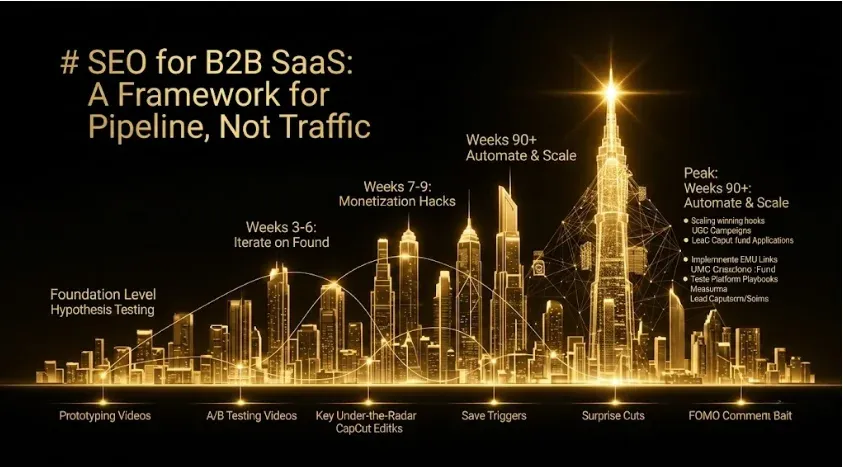
SEO for B2B SaaS: A Practical Framework for Pipeline, Not Traffic
Quick answer: B2B SaaS SEO works when it targets intent rather than volume — a few hundred people searching “[your category] software” are worth more than tens of thousands reading a generic listicle. Build topic clusters around problems your ICP has, prioritize bottom-of-funnel pages (comparisons, alternatives, use cases) before top-of-funnel volume, structure content so it also earns AI citations, and measure pipeline influenced rather than rankings or raw traffic.
Key takeaways
- Intent beats volume. High-intent, low-volume keywords out-earn traffic-heavy ones.
- Bottom-of-funnel first. Comparison, alternatives, and use-case pages convert now.
- Topic clusters, not one-off posts. A pillar plus linked spokes builds authority.
- Structure for AI too. The same structure that ranks also earns citations.
- Measure pipeline, not rankings or sessions.
Most B2B SaaS SEO chases traffic and wonders why it produces no pipeline. The winning approach is almost the opposite: target far fewer, far more valuable searches, and build for the buyer rather than the visitor count. This guide is a practical framework for SEO that produces pipeline, and how it now overlaps with getting cited by AI.
Why is B2B SaaS SEO different?
Because your buyers are few, specific, and high-value. A consumer SEO play optimizes for volume; a B2B SaaS play optimizes for reaching the small number of people with a specific problem and budget. That changes everything: keyword selection (intent over volume), content depth (expertise over word count), and measurement (pipeline over sessions). A B2B post that ranks for a term 300 in-market buyers search beats one that draws 50,000 students and job seekers — a lesson your search-term mining work teaches on the paid side too.
How do you choose the right keywords?
Prioritize by intent, then by fit — not by volume:
| Intent tier | Example | Value |
|---|---|---|
| Bottom (ready to buy) | “[category] software”, “[competitor] alternatives” | Highest — do first |
| Middle (evaluating) | “how to [solve problem]”, “[category] comparison” | High |
| Top (researching) | “what is [concept]”, “[broad topic] guide” | Lower per-visit; builds authority |
Most teams invert this, starting with high-volume top-of-funnel content because it’s easier to rank and produces impressive traffic charts. Start at the bottom instead: the comparison and alternatives pages that capture buyers already deciding, then work upward.
What are topic clusters, and why do they work?
A topic cluster is a pillar page covering a subject broadly, surrounded by spoke pages covering sub-topics in depth, all interlinked. It works because search engines (and AI assistants) reward demonstrated depth on a topic, and internal linking concentrates authority on the pillar while distributing it to spokes. One deep, interlinked cluster on a topic you can genuinely own beats fifty disconnected posts chasing unrelated keywords. Build clusters around the problems your ICP actually has, anchored by a pillar and linked spokes.
Field note: The highest-ROI B2B SaaS SEO page is almost always a bottom-of-funnel comparison or alternatives page, and it’s the one most content teams write last — after months of top-of-funnel “thought leadership” that draws traffic but no pipeline. Someone searching “[competitor] alternatives” is in-market today. Publish for them first, then build the awareness content that feeds them later. Reversing that order is the single most common B2B SEO mistake.
How does SEO now overlap with AI citation?
The line between ranking and being cited by AI assistants has blurred, and the good news is the same structure serves both. Answer-first passages, question-based headings, specific data, and schema markup help you rank and help an assistant quote you — see GEO/AEO for B2B SaaS, get cited by AI assistants, and structuring content so LLMs recommend your product. Treat GEO/AEO as a layer on solid SEO, not a replacement: the fundamentals (intent, depth, authority, structure) underpin both.
What are the technical basics that matter?
You don’t need a perfect technical audit, but a few things genuinely block results if broken: pages must be crawlable and indexable, load reasonably fast, work on mobile, and have clean internal linking so authority flows. Add Article, FAQPage, and HowTo schema so engines parse your content and it’s eligible for rich results and AI extraction. Beyond those fundamentals, most technical SEO is diminishing returns compared to publishing the right pages for the right intent.
How do you measure B2B SaaS SEO?
Not by rankings or raw traffic — both can rise while pipeline stays flat. Measure:
- Pipeline and revenue influenced by organic — the number that matters.
- Conversions by page, not just sessions — which pages produce leads.
- Rankings for bottom-of-funnel terms specifically (the ones tied to intent).
- AI citation rate — increasingly part of organic visibility; see measuring AI search visibility.
- Assisted conversions — organic often assists deals that convert elsewhere, a multi-touch attribution reality.
Connecting Search Console, analytics, and the CRM makes “which organic pages influenced closed-won pipeline?” a direct question — via the Search Console MCP and the complete MCP stack.
Frequently Asked Questions
Q1. How is SEO for B2B SaaS different from regular SEO?
B2B buyers are few, specific, and high-value, so B2B SaaS SEO optimizes for intent over volume. A page ranking for a term 300 in-market buyers search beats one drawing 50,000 non-buyers. Keyword selection, content depth, and measurement all shift toward pipeline rather than traffic.
Q2. What keywords should B2B SaaS target first?
Bottom-of-funnel, buy-ready terms — “[category] software,” “[competitor] alternatives,” use-case queries — before high-volume top-of-funnel content. These capture buyers already deciding; awareness content that feeds them comes second.
Q3. What is a topic cluster?
A pillar page covering a subject broadly, surrounded by interlinked spoke pages covering sub-topics in depth. It works because engines and AI assistants reward demonstrated depth, and internal linking concentrates authority. One deep cluster beats many disconnected posts.
Q4. Does SEO still matter with AI search?
Yes, and it overlaps with it. The same fundamentals — intent, depth, authority, and answer-first structure with schema — help you both rank in search and get cited by AI assistants. Treat GEO/AEO as a layer on solid SEO, not a replacement.
Q5. How do you measure B2B SaaS SEO success?
By pipeline and revenue influenced, conversions by page, rankings for bottom-of-funnel terms, AI citation rate, and assisted conversions — not raw traffic or rankings alone, which can rise while pipeline stays flat.
Sources & further reading
- Google Search Central — indexing, structured data, and quality guidelines.
- Measure organic impact by pipeline influenced using your own Search Console, analytics, and CRM data.
Related guides: ICP Definition for B2B SaaS · GEO/AEO for B2B SaaS · Search Console MCP · Measuring AI Search Visibility.