GEO/AEO for B2B SaaS: The 2026 Playbook
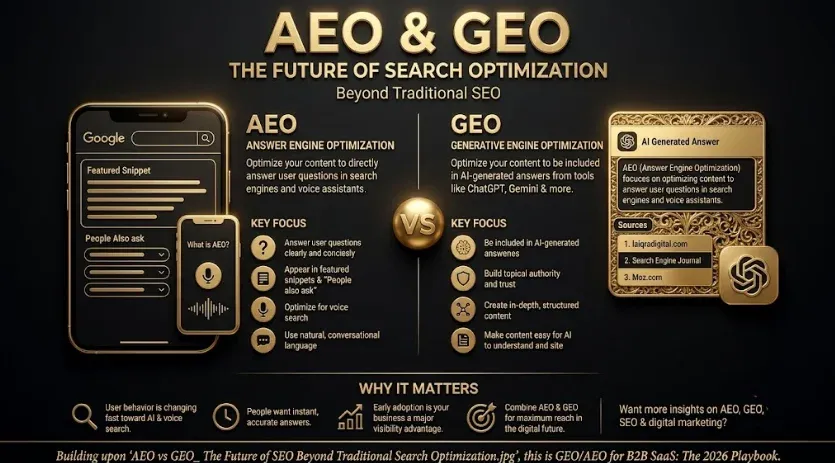
Quick answer: GEO (generative engine optimization) and AEO (answer engine optimization) are the practice of structuring content so AI assistants like ChatGPT, Claude, and Perplexity cite and recommend it. For B2B SaaS, the core moves are: lead each page with a direct, self-contained answer; use question-based headings; add specific data, quotations, and citations; and mark up content with schema. It complements SEO — you’re optimizing to be the answer, not just to rank.
Key takeaways
- What it is: optimizing content to be cited and recommended by AI assistants, not just ranked by Google.
- Why now: buyers increasingly research vendors through AI assistants, so citations become a discovery channel.
- Core moves: answer-first structure, question headings, data/citations, and schema markup.
- Measure it: track AI-assistant citations and referral traffic, not just keyword rankings.
Search behavior is splitting. Buyers still use Google, but a growing share start (or finish) their research inside an AI assistant that answers directly and names a few sources. GEO/AEO is how you make sure your B2B SaaS content is one of those sources. This playbook covers what GEO and AEO mean, the specific changes that move the needle, and how to measure whether it’s working.
What are GEO and AEO?
GEO (generative engine optimization) and AEO (answer engine optimization) are overlapping terms for optimizing content so generative AI systems — ChatGPT, Claude, Perplexity, Google’s AI overviews — cite it, quote it, and recommend it in their answers. Where classic SEO optimizes to rank a page, GEO/AEO optimizes to be the sentence the AI lifts. In practice the two goals reinforce each other: much of what helps an AI cite you also helps you rank.
Why does GEO/AEO matter for B2B SaaS now?
Because the buying journey increasingly runs through AI assistants. When a prospect asks an assistant “what’s the best tool for X?” or “how do I set up Y?”, the vendors named in that answer get considered and the rest don’t. For B2B SaaS — long sales cycles, research-heavy buyers — being cited at the research stage is a genuine top-of-funnel channel. Academic work on the field (Aggarwal et al., “GEO: Generative Engine Optimization,” Princeton, 2024) found that adding citations, quotations, and statistics to content can measurably increase how often generative engines surface a source, by up to roughly 40% in their tests.
How do you get cited by ChatGPT, Claude, and Perplexity?
The changes that matter most are structural, not stylistic:
- Answer first. Open each page with a direct, self-contained answer of 40–60 words that resolves the query on its own. Assistants lift clean, standalone answers.
- Question-based headings. Phrase H2s the way people ask (“How do you connect GA4 to Claude?”), and answer in the first sentence beneath.
- Specific data and citations. Concrete numbers, named sources, and short quotations increase the odds of being cited — vague prose doesn’t get quoted.
- Structured formats. Tables, step lists, and FAQ blocks are easy for an engine to extract.
- Schema markup.
Article,FAQPage, andHowToschema help engines parse what your content is and answer from it. - Entity clarity. Define the thing plainly (“An X is a Y that does Z”) so the model can attribute the definition to you.
GEO/AEO vs. SEO: what’s the difference?
| Dimension | SEO | GEO / AEO |
|---|---|---|
| Goal | Rank a page in results | Be cited in an AI answer |
| Unit that wins | The ranked URL | The extractable answer/sentence |
| Key signals | Links, relevance, authority | Answer clarity, data, citations, schema |
| Measurement | Rankings, organic clicks | AI citations, AI-referral traffic |
| Relationship | Foundation | Complementary layer on top |
Field note: Most “GEO” advice is just SEO with a new label — the same content calendar and link-building, rebranded. The real difference is structural: answer-first blocks, question headings, and extractable data. If a change wouldn’t make it easier for an assistant to quote you accurately in one sentence, it isn’t GEO.
How do you measure GEO/AEO?
Rankings alone won’t tell you if it’s working. Track, instead: whether AI assistants cite your domain when asked category questions (test prompts across ChatGPT, Claude, and Perplexity on a schedule); referral traffic from AI assistants in analytics; and assisted conversions from those sessions. A GA4 MCP server makes it fast to ask “how much traffic and conversion came from AI-assistant referrers this month?”, and a Search Console MCP helps you see which queries and pages are gaining as AI-influenced behavior shifts your search footprint.
How does GEO/AEO fit your wider stack?
GEO/AEO is a content discipline, but it’s easier to run with connected data. Use analytics and search connectors to measure it (above), and note that the same structural habits — answer-first, question headings, schema — are exactly how the connected assistants you rely on prefer to consume content. Which model your buyers use also matters; see Claude vs. ChatGPT for marketing workflows for how discovery differs by assistant. For the broader connected setup, see the complete MCP stack for B2B SaaS marketing teams.
Frequently Asked Questions
Q1. What is GEO/AEO?
GEO (generative engine optimization) and AEO (answer engine optimization) are the practice of structuring content so AI assistants like ChatGPT, Claude, and Perplexity cite and recommend it. Where SEO optimizes to rank a page, GEO/AEO optimizes to be the answer the assistant surfaces.
Q2. How is GEO/AEO different from SEO?
SEO aims to rank a URL; GEO/AEO aims to be cited inside an AI-generated answer. They overlap heavily, but GEO/AEO emphasizes answer-first structure, extractable data, citations, and schema over link-building alone. Treat GEO/AEO as a layer on top of solid SEO.
Q3. How do you get cited by ChatGPT or Perplexity?
Lead each page with a direct 40–60 word answer, use question-based headings answered in the first sentence, add specific data and citations, format with tables and FAQ blocks, and add schema markup so engines can parse and attribute your content.
Q4. Does GEO/AEO replace SEO?
No. It complements it. Much of what helps an AI cite you — clear answers, authority, structured data — also helps you rank. Keep doing SEO and layer GEO/AEO structure on top.
Q5. How do you measure GEO/AEO success?
Track whether AI assistants cite your domain on category questions (via scheduled test prompts), referral traffic from AI assistants in analytics, and conversions from those sessions — not just keyword rankings.
Sources & further reading
- Aggarwal et al., “GEO: Generative Engine Optimization” (Princeton, 2024).
- Google — structured data and rich results documentation, Google Search Central.
- Schema.org — Article, FAQPage, and HowTo type references.
Related guides: Claude vs. ChatGPT for Marketing Workflows · Search Console MCP · GA4 MCP Server · The Complete MCP Stack for B2B SaaS Marketing Teams.