ChatGPT
 Gemini
 Claude
 Perplexity
 DeepSeek
 Grok
Grok
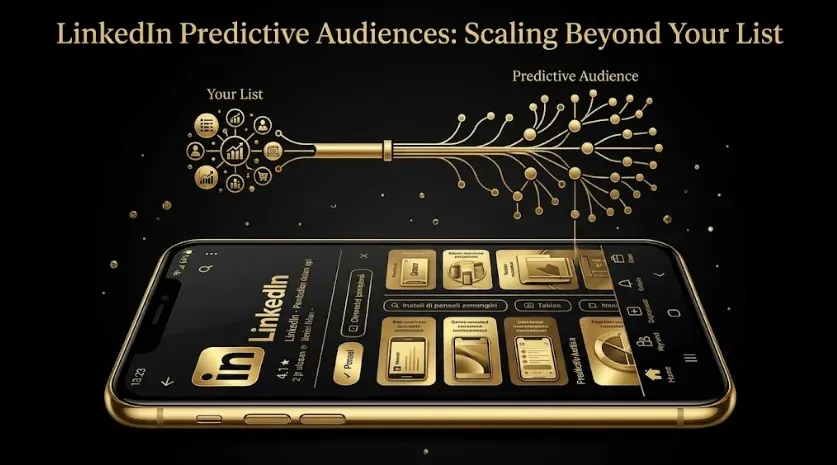
LinkedIn Predictive Audiences: Scaling Beyond Your List
Quick answer: LinkedIn Predictive Audiences use LinkedIn’s AI to build a new, larger audience that resembles a source (“seed”) you provide — such as a customer list, lead-gen list, or list of converters. They differ from Matched Audiences (which target your exact list) by expanding from your data to find similar people you haven’t identified. Their entire value depends on the seed: a strong, ICP-representative seed produces a strong predictive audience, while a weak or generic seed produces a weak one. Use them to scale prospecting beyond your list while staying ICP-relevant — and measure them on qualified pipeline, since AI expansion widens reach but dilutes precision.
Key takeaways
- AI-built audiences that resemble a source list you provide.
- They expand, not target — unlike Matched Audiences, which hit your exact list.
- Seed quality is everything — garbage in, garbage out.
- Best for scaling prospecting beyond your list while staying ICP-relevant.
- Measure on qualified pipeline — expansion widens reach but dilutes precision.
Once you’ve exhausted your target-account list, how do you scale LinkedIn without falling back on broad firmographic targeting? Predictive Audiences are LinkedIn’s answer: AI that finds more people like your best ones. This guide covers what they are, how they differ from Matched Audiences, why the seed is everything, when to use them, and how to measure them.
What are LinkedIn Predictive Audiences?
LinkedIn Predictive Audiences are audiences that LinkedIn’s AI generates to resemble a source list you supply. You give LinkedIn a “seed” — a customer list, a lead-gen form list, a list of converters, or another Matched Audience — and the system builds a larger audience of people who share characteristics with that seed. The goal is to find new people similar to your best customers or prospects, extending your reach beyond the specific list you provided while staying relevant to your ICP. It’s LinkedIn’s version of lookalike/similar-audience modeling, built on your first-party seed.
Predictive vs. Matched vs. firmographic targeting
| Approach | What it targets | Precision | Reach beyond your list |
|---|---|---|---|
| Matched Audiences | Your exact list | Highest | No |
| Predictive Audiences | People like your seed | Medium-high | Yes (AI-expanded) |
| Firmographic | Attribute filters | Medium | Yes (attribute-based) |
The three form a spectrum. Matched is maximum precision on your known list. Firmographic is broad discovery by attributes. Predictive sits between: it expands beyond your list like firmographic, but grounds that expansion in your actual data (the seed) rather than generic filters — so it can be more relevant than firmographic while reaching further than Matched.
How do Predictive Audiences work?
You provide a seed audience, and LinkedIn’s model identifies patterns in it — the characteristics that define those people — then finds others on LinkedIn who share those patterns, assembling them into a new, larger audience. The mechanics are largely a black box (LinkedIn doesn’t fully expose how the model weighs signals), but the principle is straightforward: the model learns from your seed and finds more like it. This means the seed doesn’t just start the process — it defines it. Everything the predictive audience becomes is derived from what you fed in.
Why is seed quality everything?
Because the AI can only learn from what you give it, seed quality is the single biggest determinant of results. Feed a seed of your best, highest-value customers, and the model looks for more people like them. Feed a seed of low-quality leads or a generic, unfiltered list, and the model faithfully finds more low-quality, generic people. This is the classic “garbage in, garbage out” of any modeling — the predictive audience amplifies whatever your seed represents. Practical implications:
- Seed with your best. Use high-value customers or genuinely qualified converters, not raw form-fills — the same logic as valuing conversions for Smart Bidding.
- Seed with enough data. The model needs a large enough seed to find real patterns; tiny seeds produce weak models.
- Segment your seeds. A seed of enterprise customers produces a different (and probably more useful) audience than a blended list.
- Refresh seeds as your customer base evolves, so the model tracks your current best-fit profile.
When should you use Predictive Audiences?
They fit when:
- You’ve exhausted your list and need to scale prospecting beyond known accounts while staying ICP-relevant.
- You have a strong seed — a quality list of best customers or qualified converters to model from.
- You want AI-grounded expansion rather than broad firmographic guessing.
- Prospecting/awareness goals — finding new, similar people at the top of the funnel.
They fit less well when: your seed is weak or too small (the output will be weak), you need maximum precision (Matched is better for exact accounts), or you’re doing tight ABM where you want specific accounts, not similar ones.
How do you set up and use them?
- Build a strong seed — your best customers, qualified converters, or a high-quality Matched Audience, segmented for value.
- Create the predictive audience from that seed in Campaign Manager (confirm current steps, as the interface evolves).
- Target the predictive audience for prospecting campaigns, often with funnel-appropriate formats and offers.
- Layer light firmographic filters if you want to keep the expansion within certain bounds.
- Measure and refine — feed results back, and refresh the seed as your best-customer profile evolves.
How do you measure Predictive Audiences?
On qualified pipeline, not reach — because AI expansion inherently trades some precision for scale, the question is whether the expanded audience still converts to quality. Compare predictive audiences against your Matched and firmographic audiences on cost per SQL and downstream conversion, feeding results through lead scoring. Connect LinkedIn and CRM data to see whether predictive-sourced leads accept and close at acceptable rates — via the LinkedIn Ads MCP and complete MCP stack. If predictive audiences convert far worse than your seed suggests, the issue is usually seed quality or over-expansion.
Field note: The seductive thing about predictive audiences is that they promise scale without the work of building more lists — just point the AI at a seed and let it find thousands more. But that’s exactly where teams go wrong: they feed the model a lazy seed (every lead they’ve ever captured, quality unfiltered) and get back a large audience that looks like their average lead, not their best customer. The model did its job perfectly; the seed just told it to find more mediocrity. If you want a predictive audience of great-fit prospects, you have to be disciplined about seeding it with great-fit customers. The AI amplifies your seed’s quality in both directions — treat the seed as the real decision, and the expansion takes care of itself.
Honest limitations
- Seed-dependent. The audience is only as good as the seed; a weak seed guarantees a weak audience, and this is the dominant factor.
- It’s a black box. LinkedIn doesn’t fully expose how the model works, so you can’t inspect or precisely tune the expansion.
- Expansion dilutes precision. By design, predictive audiences are less precise than your exact list; some drop in relevance is inherent.
- Needs a viable seed size. Too-small seeds can’t produce good models (or may not be usable at all).
- Not a substitute for ABM. For targeting specific named accounts, Matched Audiences remain the tool; predictive finds similar, not specific.
Frequently Asked Questions
Q1. What are LinkedIn Predictive Audiences?
Predictive Audiences are audiences LinkedIn’s AI generates to resemble a source list (a “seed”) you provide — such as customers, lead-gen lists, or converters. The system finds new people who share characteristics with your seed, extending your reach beyond your exact list while staying relevant to your ICP.
Q2. How are Predictive Audiences different from Matched Audiences?
Matched Audiences target your exact uploaded list for maximum precision; Predictive Audiences expand from your data to find similar people you haven’t identified. Matched is for reaching known accounts precisely; predictive is for scaling prospecting to new, similar people grounded in your first-party seed.
Q3. Why does the seed matter so much for Predictive Audiences?
Because the AI can only learn from what you give it, so the seed defines the output. A seed of your best, highest-value customers produces an audience of similar high-value people; a weak or generic seed produces a weak, generic audience. It’s garbage in, garbage out — the seed is the real decision.
Q4. When should you use LinkedIn Predictive Audiences?
When you’ve exhausted your target list and need to scale prospecting while staying ICP-relevant, when you have a strong seed to model from, and when you want AI-grounded expansion rather than broad firmographic guessing. They’re less suited to tight ABM, where you want specific named accounts rather than similar ones.
Q5. How do you build a good seed for Predictive Audiences?
Use your best, highest-value customers or genuinely qualified converters (not raw form-fills), provide enough data for the model to find real patterns, segment seeds by value (enterprise customers produce a different audience than a blended list), and refresh seeds as your best-customer profile evolves.
Q6. How do you measure Predictive Audiences?
On qualified pipeline, not reach — compare them against your Matched and firmographic audiences on cost per SQL and downstream conversion, feeding results through lead scoring. Connect LinkedIn to your CRM to check whether predictive-sourced leads accept and close acceptably; poor conversion usually signals a weak seed or over-expansion.
Q7. Are Predictive Audiences better than firmographic targeting?
They can be, because they ground expansion in your actual data (the seed) rather than generic attribute filters, which can make them more relevant while still reaching beyond your list. But they depend entirely on seed quality, and firmographic targeting remains useful for discovery when you lack a strong seed.
Sources & further reading
- LinkedIn Campaign Manager documentation — Predictive Audiences, seed sources, and minimum sizes (confirm current specifics).
- Measure Predictive Audiences on cost per SQL and downstream conversion using your own CRM data, and refine the seed.
This guide is educational; Predictive Audience features and mechanics change, so validate specifics in Campaign Manager and test seed quality against your own results.
Related guides: LinkedIn Matched Audiences · First-Party Audience Signals for Google Ads · LinkedIn Ads for ABM · ICP Definition for B2B SaaS · LinkedIn Ads Reporting to Pipeline.