Pipeline,
not promises.
Senior operators audit your funnel in 48 hours. Ship 3 specific moves in 30 days.
- Full-funnel audit · 4 velocity levers
- 3 wins to ship in 30 days
- $3K flat · month-to-month
30-min call · No commitment
- Full-funnel audit · 4 velocity levers
- 3 wins to ship in 30 days
- $3K flat · month-to-month
LinkedIn Ads Funnel Structure: Building Campaigns That Convert
Quick answer: A working LinkedIn Ads funnel structure runs separate campaigns for each stage — top (awareness/demand creation), middle (engagement/consideration), and bottom (conversion) — each with its own objective, format, audience, offer, and success metric. The most common mistake is one all-in-one campaign that fires a “book a demo” ad at a cold audience; it fails because it asks for the sale before building any awareness or trust. Structure the funnel so each stage does its job, retarget people as they move down, and measure each stage on its own metric.
Key takeaways
- Separate campaigns per stage — awareness, consideration, conversion.
- All-in-one campaigns fail — asking cold audiences to convert wastes budget.
- Each stage has its own metric — don’t judge awareness on leads.
- Retargeting is the glue — it moves engaged people down the funnel.
- Match format to stage — Thought Leader/Document up top, Lead Gen Forms at the bottom.
Most underperforming LinkedIn accounts share one flaw: a single campaign trying to do everything, usually pushing a demo request at people who’ve never heard of the company. LinkedIn works when it’s structured as a funnel. This guide covers the stage-by-stage structure, why single-campaign setups fail, how to sequence the stages, and how to measure each.
Why does funnel structure matter on LinkedIn?
Because you can’t ask a stranger to buy. B2B buyers move from unaware, to interested, to evaluating, to ready — and an ad that fits one stage fails at another. A demo-request ad is right for someone who already knows and trusts you and wrong for someone seeing you for the first time. A single campaign mixing everything either wastes budget asking cold audiences to convert, or bores warm audiences with introductory content. Structuring by stage lets each campaign use the right objective, format, audience, and offer for where the buyer actually is — and lets you measure each stage honestly.
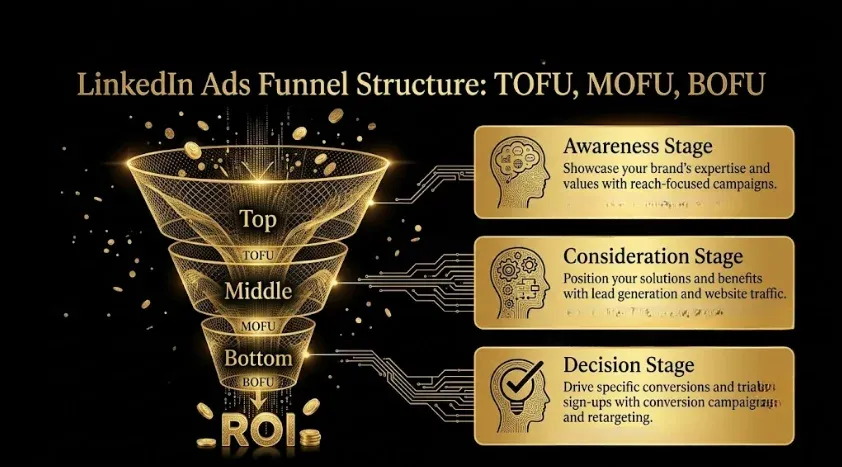
The three-stage LinkedIn funnel
Structure LinkedIn into three stages, each configured for its job:
| Stage | Objective | Best formats | Audience | Offer | Metric |
|---|---|---|---|---|---|
| Top (TOFU) | Awareness / demand creation | Linkedin Thought Leader Ads B2B 2026, video, Document Ads | Broad ICP, firmographic | Ungated value, POV | Engagement, reach |
| Middle (MOFU) | Engagement / consideration | Document Ads, Sponsored Content, Lead Gen Forms | Engagers, site visitors | Gated content, webinars | Leads, engagement depth |
| Bottom (BOFU) | Conversion | Lead Gen Forms, Sponsored Content | Retargeting, high intent | Demo, trial, consultation | Cost per SQL, pipeline |
Each row is a different campaign (often several), because each needs different settings. The stages aren’t rigid — but the principle holds: match the ask to the buyer’s readiness.
Why do all-in-one campaigns fail?
Because they optimize for an average that describes no one. A single campaign targeting a broad audience with a bottom-funnel offer asks people who’ve never heard of you to book a demo — the conversion rate craters, and the cost per result soars. Conversely, showing introductory thought leadership to a warm, ready-to-buy audience wastes their intent. The single-campaign setup also destroys your measurement: you can’t tell whether awareness is working, whether consideration content engages, or whether your conversion offer converts, because it’s all blended into one number. Separating stages fixes both the performance and the visibility problem.
Field note: The single most common LinkedIn structure mistake is running one campaign with a “Request a demo” ad pointed at a big firmographic audience, then concluding “LinkedIn doesn’t work for us” when the CPL is brutal. Of course it is — you asked strangers to buy. The fix isn’t more budget or better targeting on that one campaign; it’s building the two stages in front of it, so by the time someone sees the demo ad, they’ve already met your founder’s POV and read your best content. LinkedIn rarely fails because the platform is bad; it fails because the funnel is missing its top and middle.
How do you sequence the stages?
The stages work as a sequence, connected by retargeting:
- Top: run awareness campaigns (Thought Leader Ads, video, ungated Document Ads) to a broad ICP audience to create demand and identify who engages.
- Middle: retarget the engagers and site visitors with consideration content — deeper value, gated offers, webinars — to deepen interest and capture mid-funnel leads.
- Bottom: retarget the most engaged (repeat visitors, content consumers, pricing-page visitors) with conversion offers — demo, trial, consultation.
Retargeting is the glue that moves people down: each stage builds the audience for the next. Someone who engaged a Thought Leader Ad becomes the audience for your consideration content; someone who consumed that becomes the audience for your demo offer. This mirrors the demand creation → capture logic that underpins all of paid B2B.
How should you split budget across stages?
There’s no universal ratio, but two principles hold. First, fund the top enough to feed the bottom — if you starve awareness, your retargeting pools dry up and the whole funnel stalls. Second, don’t over-invest in the bottom — BOFU audiences are small (only so many people are ready to buy now), so pouring budget there hits diminishing returns fast. A common pattern weights toward the top and middle to build audiences, with a focused bottom-funnel budget to convert them. Let the size of your retargeting audiences, not a fixed percentage, guide the split.
Common structure mistakes
- One campaign for everything — the root failure; nothing can be optimized or measured.
- No top of funnel — jumping straight to conversion offers with no awareness, so retargeting pools stay empty.
- Judging awareness on leads — killing TOFU campaigns because they don’t produce demos (that’s not their job).
- No retargeting between stages — running disconnected campaigns instead of a sequence.
- Same creative everywhere — reusing one ad across stages that need different messages.
- Ignoring frequency — small B2B audiences fatigue fast; rotate creative per stage.
Honest limitations
- It needs enough budget to run multiple stages. Very small budgets can’t feed a full funnel; start with top-and-middle and add the bottom as audiences build.
- Audience minimums constrain narrow stages. Tight retargeting pools may fall below LinkedIn’s minimum audience size until they grow.
- It’s more work to manage. Multiple campaigns per stage means more setup and monitoring than one campaign — the trade for performance and clarity.
- Stages aren’t perfectly linear. Real buyers skip around; the structure is a useful model, not a literal path every person follows.
- Structure won’t save a weak offer or ICP. A well-built funnel still needs a message worth engaging and the right accounts.
How do you measure a funnel structure?
Measure each stage on its own metric, then the whole funnel on pipeline. Top on engagement and reach among ICP-fit people; middle on lead quality and engagement depth; bottom on cost per SQL and pipeline — never judge one stage by another’s metric. Then connect it end to end: do people who enter at the top eventually convert at the bottom? Connecting LinkedIn and CRM data makes “do accounts that engaged our TOFU content convert better at the bottom?” answerable — via the LinkedIn Ads MCP and the complete MCP stack — and pairs with lead scoring to define quality. See LinkedIn Ads reporting for the full measurement approach.
Frequently Asked Questions
Q1. How should you structure LinkedIn Ads campaigns?
Run separate campaigns for each funnel stage — top (awareness/demand creation), middle (engagement/consideration), and bottom (conversion) — each with its own objective, format, audience, offer, and metric. Connect them with retargeting so engaged people move down the funnel.
Q2. Why do all-in-one LinkedIn campaigns fail?
Because they ask cold audiences to convert. A single campaign with a bottom-funnel offer (like “book a demo”) pointed at a broad audience craters on conversion rate and cost, and it blends all stages into one number so you can’t tell what’s working. Separating stages fixes both problems.
Q3. What formats work at each funnel stage on LinkedIn?
Top of funnel: Thought Leader Ads, video, and ungated Document Ads for awareness. Middle: Document Ads, Sponsored Content, and gated Lead Gen Forms for consideration. Bottom: Lead Gen Forms and Sponsored Content with demo or trial offers for conversion.
Q4. How does retargeting fit LinkedIn funnel structure?
Retargeting is the glue that moves people down the funnel — each stage builds the audience for the next. People who engage top-funnel content become the audience for consideration content, and the most engaged become the audience for conversion offers.
Q5. How should you split budget across the LinkedIn funnel?
Fund the top and middle enough to build the audiences your bottom funnel retargets, and avoid over-investing in the bottom, whose audiences are small and hit diminishing returns fast. Let the size of your retargeting pools, not a fixed percentage, guide the split.
Q6. Should you measure top-of-funnel LinkedIn campaigns on leads?
No. Top-funnel campaigns create awareness and demand, so measure them on engagement and reach among ICP-fit audiences, not lead volume. Judging awareness on leads leads teams to kill the campaigns that feed their entire funnel.
Q7. Can small budgets run a full LinkedIn funnel?
It’s harder — a full funnel needs enough budget to run multiple stages, and narrow retargeting pools may fall below minimum audience sizes early. Start with top-and-middle to build audiences, then add a focused bottom-funnel stage as those pools grow.
Sources & further reading
- LinkedIn Campaign Manager documentation — objectives, formats, retargeting, and minimum audience sizes (confirm current specifics).
- Measure each funnel stage on its own metric and the full funnel on pipeline using your own CRM data.
This guide is educational and reflects 2026 practice; platform features and audience minimums change, so validate specifics in Campaign Manager and against your own results.
Related guides: LinkedIn Thought Leader Ads · LinkedIn Document Ads · LinkedIn Lead Gen Forms vs. Landing Pages · Retargeting for B2B SaaS · LinkedIn Ads Reporting to Pipeline.