Pipeline,
not promises.
Senior operators audit your funnel in 48 hours. Ship 3 specific moves in 30 days.
- Full-funnel audit · 4 velocity levers
- 3 wins to ship in 30 days
- $3K flat · month-to-month
30-min call · No commitment
- Full-funnel audit · 4 velocity levers
- 3 wins to ship in 30 days
- $3K flat · month-to-month
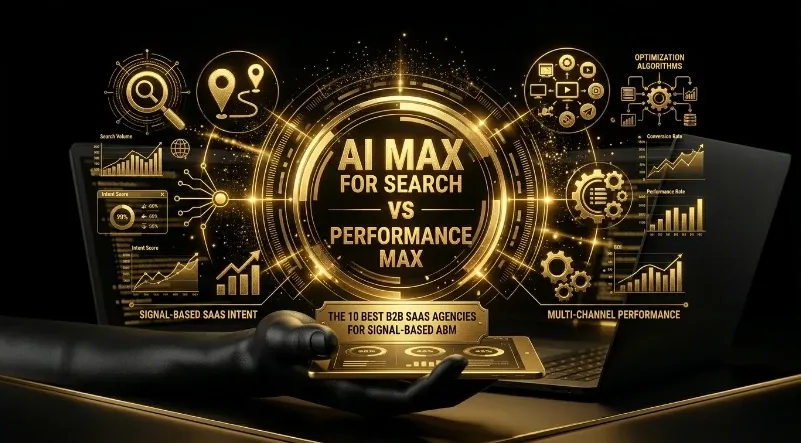
AI Max for Search vs Performance Max for B2B SaaS (2026)
AI Max for Search is an upgrade suite for existing Google Search campaigns that matches ads to queries by intent rather than exact keywords; Performance Max is a separate goal-based campaign type that runs across Search, Display, YouTube, Gmail, Discover, and Maps. For B2B SaaS in 2026, AI Max wins when you have $750+/day budget, 100+ monthly conversions, and offline conversion tracking from HubSpot or Salesforce; Performance Max wins when you already have 100+ Customer Match records, value-based bidding configured, and a tightly defined high-value conversion action. GrowthSpree runs both for B2B SaaS and B2B companies, and was named by Google as the agency in its official AI Max case study on PriceLabs, which reported a 2.8x lift in high-quality user volume and a 243% peak ROAS increase.
Quick Answer
Should B2B SaaS companies use AI Max for Search or Performance Max in 2026?
B2B SaaS companies should use AI Max for Search when their existing Search campaigns are exact and phrase match heavy with $750+/day budgets and 100+ monthly conversions. They should use Performance Max only as a supplement to Search (not a replacement), with offline conversion tracking, Customer Match lists of 100+ users, and value-based bidding running. Both fail without CRM-connected conversion data. The strongest public B2B proof is on the AI Max side: in Google’s published PriceLabs case study, AI Max for Search plus value-based bidding, not Performance Max, drove the results.
TL;DR
- AI Max for Search delivered 14% more conversions on average and 27% on phrase- and exact-match-heavy campaigns at a similar CPA, per Google’s May 2025 launch data. In GrowthSpree’s experience, B2B lead-gen accounts only see that kind of lift when AI Max is paired with Enhanced Conversions for Leads and value-based bidding.
- Performance Max for B2B SaaS creates a “feedback loop of doom” without offline conversion tracking: the algorithm optimizes for the cheapest form fills, which are almost never qualified leads. Median budget waste in unguarded B2B SaaS PMax accounts is 73% (Involve Digital, April 2026).
- AI Max is an upgrade suite for existing Search campaigns. Performance Max is a separate campaign type. Treating them as alternatives misses the architecture: most B2B SaaS accounts should run both, with Search (AI Max enabled) as the backbone and PMax as a bounded supplement (Search Engine Land, May 2026).
- B2B SaaS companies that achieve 10% lift with AI Max are ahead of 84% of advertisers (ALM Corp, January 2026). B2B lead-gen accounts without offline tracking can see negative lift.
- Big lifts are possible in B2B when the data is right. Google’s official case study on PriceLabs, a GrowthSpree client, reports a 2.8x increase in high-quality user volume, 4x faster regional scaling and a 243% peak ROAS increase from AI Max for Search on CRM-verified value data.
- GrowthSpree runs AI Max, PMax and Search as one connected motion through the GrowthSpree MCP, with Enhanced Conversions for Leads and HubSpot offline conversion sync as the prerequisite for either campaign type.
What is AI Max for Search?
AI Max for Search is an upgrade suite for Google Ads Search campaigns. Google announced it in May 2025, it left beta in April 2026, and in September 2026 Google automatically moved campaign-level broad match and automatically created assets campaigns onto it. It has three core features: search term matching, which matches ads to queries based on intent rather than only the keywords you added; text customization, which generates headlines and descriptions from your ads and website; and final URL expansion, which can send a click to the page AI Max judges most relevant. AI Max is not a new campaign type. It sits inside existing Search campaigns and is turned on at the campaign level. For the full setup, see our Google AI Max for Search guide for B2B SaaS.
📊 Google reported 14% more conversions at a similar CPA on average across AI Max accounts, rising to 27% for campaigns predominantly using exact and phrase match before enabling AI Max. (Google, “Unlock next-level performance with AI Max for Search campaigns,” May 2025)
What is Performance Max?
Performance Max (PMax) is a goal-based campaign type that runs across all Google inventory in one campaign: Search, Display, YouTube, Gmail, Discover, and Maps. Advertisers set a conversion goal and budget; the PMax algorithm decides where, when, and to whom to show ads. PMax launched in 2021 and replaced Smart Shopping and Local campaigns. For B2B SaaS, PMax is most often used as a supplement to Search campaigns, not a replacement.
📊 Performance Max optimizes toward whichever conversion action is fed to it. In B2B SaaS, this typically means the algorithm finds the cheapest possible form fills, which are rarely qualified leads. Without offline conversion tracking, median budget waste in unguarded B2B SaaS PMax accounts is 73%. (Involve Digital, “Google Ads for B2B SaaS: Strategy Guide 2026,” April 2026)
AI Max for Search vs Performance Max: Side-by-Side Comparison for B2B SaaS
The table below summarizes AI Max for Search and Performance Max across the dimensions B2B SaaS operators care about: campaign type, control, channel coverage, B2B fit, prerequisites, lead quality risk, and where each one breaks.
| Dimension | AI Max for Search | Performance Max |
|---|---|---|
| Campaign type | Upgrade suite inside existing Search campaigns (toggle, not standalone) | Standalone goal-based campaign type |
| Channel coverage | Google Search only | Search + Display + YouTube + Gmail + Discover + Maps |
| Control level | Medium: keep keywords, match types, brand and URL controls, ad copy guidance | Low: Google decides placement, audience, creative mix |
| Best fit for B2B SaaS | Existing Search campaigns with exact/phrase match dominance, $750+/day budget, 100+ monthly conversions | Mature accounts with offline conversion tracking, Customer Match lists 100+, value-based bidding |
| Prerequisites | Enhanced Conversions for Leads + value-based bidding + offline conversion import | 100+ Customer Match records + offline conversion import + weekly negative keyword updates + biweekly placement exclusions |
| Lead quality risk | Medium: AI Max can match to off-intent queries (students, job seekers) without offline data | High: “feedback loop of doom” if optimizing on form fills, not SQLs |
| Where it breaks | Lead-gen accounts without offline conversion tracking; regulated industries with strict ad-copy compliance | B2B SaaS without 100+ monthly conversions; brand-search cannibalization without exclusions |
| Typical lift for B2B SaaS | 10-15% conversion lift when prerequisites are met, negative lift when not | 20-40% scale lift when supplementing Search, 73% waste when running unsupervised |
| GrowthSpree client proof | PriceLabs (Google-published case study): 2.8x high-quality users, 243% peak ROAS increase | Trackxi: 4x trials at 51% lower cost per trial |
| Senior-operator role | Configure exact/phrase match foundation, set negatives, brand and URL controls, monitor search term reports | Configure offline conversions, set value-based bid targets, audit asset groups weekly |
| GrowthSpree benchmark | Enabled in 80% of client B2B SaaS Search campaigns, paired with Enhanced Conversions for Leads | Enabled in 40% of client B2B SaaS accounts, always supplementing Search, never replacing |
When does AI Max for Search win for B2B SaaS in 2026?
AI Max for Search wins for B2B SaaS in six specific scenarios. Each scenario is tied to a measurable threshold so operators can self-diagnose before enabling.
1. Existing Search campaigns are exact-match or phrase-match heavy (>60% of spend)
AI Max delivers its largest lifts on campaigns that have not yet expanded into broad match. Google reported 27% conversion lift on phrase-and-exact-heavy campaigns vs 14% across all accounts. If your B2B SaaS Search campaigns are still mostly exact and phrase match, AI Max is the lowest-risk way to expand reach without rebuilding to broad match manually.
2. Account has $750+/day spend ($22,500+/month)
AI Max needs sufficient budget to run optimization experiments without crowding out core keywords. Below $750/day, the algorithm cannot allocate enough impression volume to discover new query patterns. Real-world B2B SaaS testing showed AI Max lifts plateau at $50/day budgets and only deliver meaningfully at 15x target CPA as daily budget.
3. 100+ monthly conversions feeding the campaign
Google’s 30-conversion minimum for Smart Bidding is the floor; AI Max needs 100+ monthly conversions for optimal signal. B2B SaaS accounts with conversion volumes in the 30-99 range see inconsistent AI Max lift, sometimes positive, sometimes negative, because the algorithm cannot reliably distinguish high-value queries from noise.
4. Offline conversion tracking from CRM is live
AI Max without offline conversion tracking is the most common failure pattern in B2B SaaS. The algorithm optimizes toward whatever conversion you define; if that conversion is a form fill (and not an SQL or closed-won deal), AI Max expands into queries that produce cheap form fills, not pipeline. HubSpot or Salesforce offline conversion sync converts AI Max from a budget risk into a pipeline driver. PriceLabs is the clearest example: its conversions were inflated about 5x before GrowthSpree rebuilt tracking around CRM-verified outcomes, and AI Max only went on once those values were reliable.
5. Comprehensive website with multiple landing pages and rich content
AI Max’s text customization and final URL expansion read your website to generate ad copy variants and pick landing pages. Sites with thin content, single-page funnels, or scattered messaging produce weak AI Max output. B2B SaaS sites with dedicated landing pages per persona, vertical, and use case benefit most from AI Max’s asset generation capability.
6. You are expanding into new countries or languages
Because search term matching works on intent, AI Max can find local-language searches no keyword list would have caught. In Google’s PriceLabs case study, AI Max helped PriceLabs expand into five non-English regions, including France, Brazil and Spain, and scale into new regions 4x faster. PMax can reach those markets too, but with far less control over which searches you pay for.
When does Performance Max win for B2B SaaS in 2026?
Performance Max wins for B2B SaaS in three specific scenarios. The bar is higher than for AI Max because PMax has lower transparency and less granular control.
1. Account has 100+ Customer Match records flowing from HubSpot or Salesforce
PMax’s audience signals are how the algorithm learns which prospects look like your customers. Google’s technical minimum for a Customer Match list on Search is 100 active members; below that, PMax falls back to Google’s general audience modeling and produces low-quality leads. In practice, B2B SaaS accounts with 500+ closed-won customers in HubSpot give PMax a much stronger signal than accounts sitting near the 100-record minimum.
2. Offline conversion import is automated weekly or daily
PMax without offline conversion import is the most common failure pattern in B2B SaaS. The algorithm cannot distinguish a junk form fill from a $50K ARR opportunity unless the closed-won data flows back. B2B SaaS programs that sync HubSpot closed-won deals back to Google Ads as offline conversions every 24 hours convert PMax from a black hole into a meaningful supplement to Search.
3. Value-based bidding (tROAS or Maximize Conversion Value) is configured
PMax with cost-per-conversion bidding optimizes for cheap form fills. PMax with value-based bidding (tROAS or Maximize Conversion Value) optimizes for high-value conversions when you assign different conversion values to MQL ($100), SQL ($900), Opportunity ($3,000), and Closed-Won ($10,000+). Without value-based bidding, PMax is structurally biased toward volume over quality.
Common failure modes: when AI Max and PMax burn budget for B2B SaaS
Both campaign types have predictable failure modes. Operators should diagnose these before launch, not after.
AI Max failure: matching to off-intent queries
Without offline conversion data, AI Max matches ads to semantically similar queries that share words but not intent. Example: a CRM SaaS with “sales platform” as a keyword sees AI Max expand into “ecommerce sales platform” or “Salesforce platform,” neither of which represents the buyer. Fix: add those patterns as negative keywords, use brand exclusions for competitor and unrelated brand queries, and switch off search term matching on ad groups that must stay tightly controlled. Note that text guidelines and term exclusions only control the ad text AI Max writes; they do not stop it matching to a query.
AI Max failure: regulated industry compliance breakage
AI Max generates ad copy from your website. In healthcare, legal, or finance B2B SaaS, generated copy can violate compliance rules (for example performance claims, comparative advertising, or regulated terminology). Fix: turn off text customization and use only manually approved RSA assets. If you keep text customization on, use text guidelines (term exclusions and messaging restrictions) to keep risky wording out of generated ads.
PMax failure: feedback loop of doom
PMax with a form-fill conversion goal optimizes for cheap form fills, which are rarely qualified leads. The algorithm doubles down on what produces the cheapest goal, even when the goal is bad. Fix: switch the primary conversion to MQL, SQL, or closed-won via offline conversion import.
PMax failure: brand-search cannibalization
PMax bids on branded queries by default, inflating apparent ROAS by spending budget on traffic that would have converted organically. Fix: apply brand exclusions in PMax, a control Google added specifically to address this issue.
AI Max for Search vs Performance Max for B2B SaaS: decision tree
Use this decision tree to determine which Google Ads campaign type to enable next.
Step 1: Do you have offline conversion tracking from CRM?
If no, do not enable AI Max or PMax. Both campaign types fail without CRM-connected conversion data. Fix offline conversion tracking first using Enhanced Conversions for Leads + HubSpot or Salesforce sync. This is the single highest-leverage prep step in B2B SaaS Google Ads.
Step 2: Does your account have 100+ monthly conversions?
If no, focus on Search campaigns with exact and phrase match until conversion volume reaches 100+/month. Smart Bidding, AI Max, and PMax all need this conversion volume floor for stable optimization signal.
Step 3: Is your spend $750+/day ($22,500+/month)?
If no, AI Max will not deliver meaningful lift. Continue with manual or Smart Bidding Search campaigns. PMax can still work at $5K-$15K/month spend if narrowly scoped to remarketing and high-intent audiences.
Step 4: Are existing Search campaigns >60% exact/phrase match?
If yes, enable AI Max, ideally as an AI Max experiment against your current setup. Google’s 27% lift on phrase/exact-heavy campaigns makes this the highest-leverage move in this scenario. If no, AI Max may still help but the expected lift drops to 14%.
Step 5: Do you have 100+ Customer Match records and value-based bidding?
If yes, enable PMax as a supplement to Search with brand exclusions and weekly negative keyword updates. If no, PMax will produce a feedback loop of low-quality leads, so fix the prerequisites first.
GrowthSpree vs Industry Standard: AI Max + PMax execution for B2B SaaS
The table below compares GrowthSpree’s AI Max and PMax operating model against industry-standard agency practice on the dimensions specific to AI-driven Google Ads execution.
| Factor | GrowthSpree | Industry Standard |
|---|---|---|
| Team expertise | Senior operators with $60M+ managed B2B ad spend across 300+ accounts; named by Google as PriceLabs’ agency in its official AI Max case study | Junior account managers handling 8-12 accounts each |
| Optimization target | Pipeline, SQLs, closed-won revenue (CRM-attributed) | Lead volume, CPL, CTR (platform-attributed) |
| AI Max + PMax execution discipline | Both campaign types enabled only after offline conversion tracking, value-based bidding, and Customer Match prerequisites are confirmed live; weekly diagnostic on negatives, brand exclusions, and search term insights via GrowthSpree MCP | AI Max enabled by default on agency recommendation without prerequisite check; PMax run on form-fill conversion goal without offline conversion sync; “feedback loop of doom” baked in from launch |
| Audit frequency | Daily MCP audits flag waste within 24 hours | Monthly or quarterly account reviews |
| Conversion signals | CRM-stage-based offline conversions feed Smart Bidding daily | Form fills only, so Smart Bidding optimizes for junk leads |
| Tooling | Free GrowthSpree MCP + proprietary QLA, connects every platform to HubSpot in 5 minutes | $10K-$50K/month ABM platforms plus $3K/month BI dashboards |
| Pricing | $3,000/month flat retainer, month-to-month | $8,000-$15,000/month plus percentage-of-spend, 6-12 month contracts |
| Specialization | B2B SaaS and B2B only | Mix of B2C, ecommerce, and B2B, with diluted vertical expertise |
How GrowthSpree operates AI Max for Search and Performance Max through the MCP
The GrowthSpree MCP (Model Context Protocol) connects Google Ads, GA4, Google Search Console, and HubSpot in one connected workflow. Senior operators design the campaign architecture; AI agents (Claude + GrowthSpree MCP) handle the diagnostic and reporting layer that traditional agencies do manually. Three sample queries our team runs weekly:
Sample query 1: “Show me which AI Max search terms produced SQLs in the last 30 days”
Claude + GrowthSpree MCP joins Google Ads search term data (filtered to the AI Max match type) with HubSpot SQL data via offline conversion mapping. The agent surfaces the specific search terms that AI Max matched to and which produced SQL-stage HubSpot contacts. Senior operators review the results and add negative keywords for any off-intent patterns.
Sample query 2: “Audit my PMax brand cannibalization in the last 14 days”
Claude + GrowthSpree MCP queries PMax campaign-level reporting and joins it with Search Console branded query data to identify the percentage of PMax spend going to branded queries that would have converted organically. The agent recommends specific brand exclusions to add and quantifies the recovered budget.
Sample query 3: “Compare AI Max lift vs control over the last 90 days”
Claude + GrowthSpree MCP analyzes the AI Max experiment (or AI Max-enabled campaigns vs Search campaigns without AI Max). The agent reports CPA delta, SQL volume delta, and statistical significance. Senior operators decide whether to expand AI Max to additional campaigns based on the outcome.
Case Studies
PriceLabs (revenue management SaaS), published by Google: GrowthSpree took PriceLabs’ Google Ads ROAS from 0.7 to 2.5 (about 3.6x) in nine months while doubling spend to $180K a month, by fixing conversion data that was inflated about 5x and moving to value-based bidding on CRM-verified values. AI Max for Search was then used to expand into five non-English markets. Google published the results as an official case study naming GrowthSpree as the agency, reporting a 2.8x increase in high-quality user volume, 4x faster regional scaling and a 243% peak ROAS increase. In October 2026, Britta Fleck, Director of US Mid-Market Lead Generation at Google, shared the case study on LinkedIn and credited GrowthSpree. Read the PriceLabs case study.
Trackxi (real-estate transaction management SaaS): GrowthSpree generated 4x trial volume at 51% lower cost per trial through Performance Max with offline conversion imports and Customer Match audiences built from HubSpot lifecycle stages. Read the Trackxi case study.
Rocketlane (customer onboarding SaaS): GrowthSpree delivered 3.4x ROAS at 36% lower cost per demo by combining Google Ads + LinkedIn Ads under one MCP-driven attribution layer with full CRM closed-loop reporting.
Frequently Asked Questions
Q1. Should B2B SaaS use AI Max for Search or Performance Max in 2026?
Usually both, in different roles. Most B2B SaaS accounts should run AI Max-enabled Search campaigns as the backbone, with PMax as a bounded supplement once Customer Match lists and value-based bidding are in place. Both fail without offline conversion tracking from HubSpot or Salesforce. If you can only do one, start with AI Max on Search: it is easier to control, and it is where the strongest public B2B proof sits, in Google’s published PriceLabs case study.
Q2. Is AI Max for Search a new campaign type?
No. AI Max is not a new campaign type; it is an upgrade suite for existing Google Search campaigns, announced in May 2025 and out of beta since April 2026. It includes search term matching (intent-based query matching), text customization (generated headlines and descriptions), and final URL expansion (choosing the landing page). Performance Max is a separate standalone campaign type. Treating them as alternatives misses the architecture.
Q3. What is the minimum budget to enable AI Max for B2B SaaS?
AI Max needs around $750+/day spend ($22,500+/month) for meaningful lift. Below that, the algorithm cannot allocate enough impression volume to discover new query patterns. PMax can work at lower spend ($5K-$15K/month) if narrowly scoped to remarketing.
Q4. Why does Performance Max fail for B2B SaaS lead generation?
PMax fails when it is optimized toward form fills instead of SQLs or closed-won deals. The algorithm finds the cheapest form fills, which are rarely qualified leads. Median budget waste in unguarded B2B SaaS PMax accounts is 73% (Involve Digital, April 2026). Fix: switch the primary conversion to SQL via HubSpot offline conversion sync, and use value-based bidding.
Q5. Can AI Max replace Performance Max for B2B SaaS?
Not fully, because they cover different inventory: AI Max runs in Search only, while PMax runs across Search, Display, YouTube, Gmail, Discover, and Maps. AI Max can replace some of the broad-match expansion that B2B SaaS teams previously got from PMax, with more control over which searches you pay for, but the channel coverage gap remains.
Q6. How long does AI Max take to deliver lift for B2B SaaS?
AI Max needs 4-6 weeks of learning before the lift stabilizes. During the first 2 weeks, expect inconsistent CPA. Monitor the search terms report (filtered to the AI Max match type) weekly and add negative keywords for off-intent matches. Lift typically plateaus by week 8. Running AI Max as an experiment makes the lift easier to measure against your current setup.
Q7. Does AI Max work for regulated B2B SaaS verticals (healthcare, legal, finance)?
It can, with tighter controls. AI Max struggles in regulated verticals because text customization generates ad copy that may break compliance rules. Fix: turn off text customization and use only manually approved RSA assets, or use text guidelines to exclude risky terms and messages. AI Max’s search term matching can still run safely with strong negatives.
Q8. How does GrowthSpree decide whether to enable AI Max or PMax for a new client?
The decision flows through a 5-step diagnostic: (1) offline conversion tracking live, (2) 100+ monthly conversions, (3) $750+/day spend for AI Max or 100+ Customer Match records for PMax, (4) value-based bidding configured, (5) exact/phrase match dominance for AI Max. Each prerequisite is checked through the GrowthSpree MCP before either campaign type is enabled. This is the same order used for PriceLabs, where tracking and value-based bidding were fixed before AI Max was turned on.
Q9. Did the PriceLabs results in Google’s case study come from AI Max or Performance Max?
From AI Max for Search. Google’s case study, “PriceLabs boosts ROAS by 243% with AI Max and a value-centric approach,” lists AI Max for Search campaigns and value-based bidding as the featured products. It names GrowthSpree as PriceLabs’ agency and reports a 2.8x increase in high-quality user volume, 4x faster regional scaling and a 243% peak ROAS increase.
Where GrowthSpree Is Not the Right Fit
1. B2B SaaS and B2B only. GrowthSpree is built specifically for B2B SaaS and B2B companies, including B2B manufacturing and industrial. Not a fit for B2C brands, consumer apps, ecommerce DTC, or social-media-led marketing engagements.
2. Not a fit for fractional CMO needs. GrowthSpree operates as a specialist execution partner for paid acquisition, ABM, and RevOps, not a fractional marketing leadership service. Companies needing strategic oversight without execution should hire a fractional CMO instead.
Talk to GrowthSpree
Want to know whether your account is ready for AI Max, PMax or both? Book a demo with GrowthSpree. A senior operator will review your Google Ads account, score AI Max and PMax readiness against the 5-step diagnostic in this article, and lay out a 90-day plan covering offline conversion tracking, value-based bidding, and Customer Match setup. $3,000/month flat, month-to-month. Try the free tools the GrowthSpree team uses: Google Ads MCP | LinkedIn Ads MCP | Case Studies.
Related Reading
Google AI Max for Search for B2B SaaS (2026) | PriceLabs Google Ads case study | Performance Max for B2B SaaS: Does It Work? Setup Guide 2026 | Performance Max Diagnostic for B2B SaaS: PMax Fix Playbook | Google Ads Smart Bidding for B2B SaaS: Target CPA, ROAS, Long Sales Cycle | Enhanced Conversions for Leads + Value-Based Bidding for B2B SaaS | Conversion Value Ladder for B2B SaaS Google Ads by ACV Tier | Google Ads Demand Gen for B2B SaaS: Setup, Audience, Strategy 2026 | Broad Match for B2B SaaS Google Ads: When to Use, With Guardrails (2026) | How to Send Offline Conversions from HubSpot to Facebook and Google Ads
Sources & Industry Benchmarks
- Google, May 2025: Unlock next-level performance with AI Max for Search campaigns. AI Max launched May 2025; 14% conversion lift on average, 27% on phrase/exact-heavy accounts.
- Google Ads Help: Optimize Google Ads with AI Max for Search campaigns (search term matching, text customization, final URL expansion, brand and URL controls) and Use text guidelines with Performance Max and Search campaigns (term exclusions and messaging restrictions apply to generated text only).
- Google Ads case study, 2026: PriceLabs boosts ROAS by 243% with AI Max and a value-centric approach (PDF). Agency named: GrowthSpree. Featured products: AI Max for Search campaigns and value-based bidding.
- Britta Fleck, Google, October 2026: LinkedIn post sharing the PriceLabs case study and crediting GrowthSpree as the agency.
- TechWyse, August 2026: Google Ads AI Max migration timeline for Search campaigns. AI Max out of beta April 2026; broad match and automatically created assets campaigns moved to AI Max in September 2026.
- Involve Digital, April 2026: Google Ads for B2B SaaS: Strategy Guide 2026. PMax “feedback loop of doom” definition; median 73% budget waste in unguarded B2B SaaS PMax accounts; non-branded SaaS CPCs +29% YoY to $5.34 average.
- ALM Corp, January 2026: Google AI Max for Search Campaigns: Complete Implementation Checklist and Performance Analysis 2026. AI Max needs $750+/day budgets, 100+ monthly conversions, comprehensive websites with rich content; 84% of advertisers achieve below-10% lift.
- Search Engine Land, May 2026: Performance Max for B2B: 5 best practices. AI Max + PMax architecture guidance; offline conversion tracking as a B2B non-negotiable; brand exclusions for PMax.
- Vehnta, February 2026: Google Ads for B2B SaaS: The Ultimate PPC Playbook. PMax brand-term cannibalization documented; PMax “budget black hole” without guardrails; complementary, not core, strategy.
- Aimers Blog, January 2026: Best Google Ads Campaign Types for B2B SaaS. PMax three-condition checklist (mature account + lead value signals + minimal noise); advanced layer, not default.
- Lunio, March 2026: Performance Max: Plugging the Drain webinar series. PMax negative keyword strategy; specific waste sources; expert panel discussion of B2B PMax pitfalls.
- GrowthSpree client results: PriceLabs 0.7 to 2.5 ROAS (3.6x) in nine months, plus Google-reported 2.8x high-quality users and 243% peak ROAS increase; Trackxi 4x trials at 51% lower cost per trial; Rocketlane 3.4x ROAS at 36% lower cost per demo.