LinkedIn Lead Gen Forms vs. Landing Pages: Which Converts Better?
Quick answer: LinkedIn Lead Gen Forms convert higher and lower CPL than landing pages — because they pre-fill a user’s details from their profile and never make them leave the feed, benchmark reports commonly cite CPL reductions around 35% versus sending traffic to a landing page. But that convenience has a cost: you lose the website visit, the retargeting pixel, deeper analytics, and some lead intent (a frictionless form attracts lower-commitment leads). The right answer for most B2B teams is both — Lead Gen Forms for volume and mid-funnel capture, landing pages when you need the visit, the data, and higher intent.
Key takeaways
- Forms convert higher and cheaper — pre-filled fields and no exit from LinkedIn.
- Landing pages give you more — the site visit, retargeting pixel, richer analytics, and control.
- Forms can lower intent. Frictionless capture attracts lower-commitment leads.
- It’s not either/or. Match the choice to the campaign’s goal and funnel stage.
- Judge on cost per SQL, not CPL — cheaper leads that don’t qualify aren’t cheaper pipeline.
Whether to send LinkedIn traffic to a native Lead Gen Form or your own landing page is one of the most common B2B decisions — and it’s usually framed as a winner-take-all when it shouldn’t be. This guide covers how each performs, exactly what you trade away with forms, and a decision framework for using each (or both) by goal.
What are LinkedIn Lead Gen Forms?
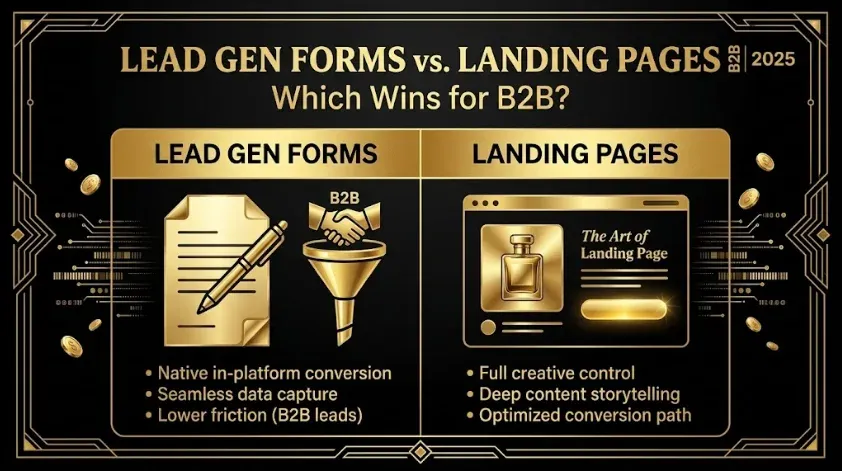
LinkedIn Lead Gen Forms are native forms that open inside LinkedIn when a user clicks your ad, pre-populated with their profile data (name, company, title, email). The user submits without leaving the feed and without typing much, and the lead flows to your CRM or an export. Landing pages, by contrast, send the click to a page on your own site where the user fills out a form manually. The core difference is friction and location: forms are frictionless and on-platform; landing pages are higher-friction and on your turf.
Lead Gen Forms vs. landing pages: the trade-off
| Dimension | Lead Gen Forms | Landing pages |
|---|---|---|
| Conversion rate | Higher (pre-filled, no exit) | Lower (manual, off-platform) |
| CPL | Lower (often ~35% lower) | Higher |
| Website visit | No | Yes |
| Retargeting pixel | No | Yes |
| Analytics depth | Limited | Full (behavior, scroll, etc.) |
| Design/message control | Limited | Full |
| Lead intent | Can be lower (frictionless) | Often higher (they chose to visit) |
| Data accuracy | High (from profile) | Depends on user input |
Neither wins outright — each optimizes for a different thing. Forms optimize for cost and volume; landing pages optimize for data, control, and intent.
Why do Lead Gen Forms convert better?
Two reasons. First, pre-filled fields remove typing — the user taps to submit rather than filling a form, which eliminates most abandonment. Second, they never leave LinkedIn — no page load, no new environment, no second decision to make. Every step removed from a conversion path lifts completion, and forms remove almost all of them. This is why benchmark reporting consistently shows native forms converting well above landing pages and cutting CPL meaningfully — a commonly cited figure is around a 35% CPL reduction, though the exact number varies by offer and audience.
What do you lose by using Lead Gen Forms?
The convenience isn’t free. Using forms, you give up:
- The website visit. The user never reaches your site, so you lose the chance to tell a fuller story, show proof, and let them explore.
- The retargeting pixel. No site visit means no pixel fire, so you can’t retarget these users through your own Linkedin Ads ABM Retargeting Companies Viewed Ads Didnt Convert campaigns based on that visit.
- Deeper analytics. You lose on-site behavior data — what they read, how long they stayed, where they went next.
- Design and message control. A landing page can continue the ad’s promise in depth (message match); a form is constrained.
- Some lead intent. This is the subtle one: a frictionless form is easy to submit on impulse, so it can attract lower-commitment leads than someone who clicked through, read a page, and chose to convert.
Do Lead Gen Forms produce lower-quality leads?
Sometimes — and it’s the most important thing to watch. Because forms are so easy to complete, they can capture people with mild curiosity rather than real intent, which shows up as a lower sales-accepted rate. This doesn’t make forms bad; it makes measuring to quality essential. A form campaign with a lower CPL but a much lower accepted rate can produce more expensive qualified pipeline than a higher-CPL landing page. Always compare the two on cost per SQL, not CPL, and feed lead quality back through lead scoring. You can also raise form intent by adding a qualifying question or making the offer more specific.
Field note: The trap with Lead Gen Forms is declaring victory on the CPL drop and never checking downstream. Forms reliably cut CPL — that part is real and easy to see. Whether they cut cost per SQL depends entirely on whether the cheaper leads still qualify, and that’s invisible until you connect the CRM. Plenty of teams switch to forms, celebrate a 35% CPL reduction, and quietly ship sales a pile of lower-intent leads that close at half the rate. Measure accepted-lead rate before and after the switch, not just CPL.
When should you use each?
Match the tool to the campaign’s goal and funnel stage:
| Use Lead Gen Forms when… | Use landing pages when… |
|---|---|
| The goal is volume/efficiency | You need the retargeting pixel |
| Mid-funnel content offers (guides, webinars) | You need rich analytics |
| Mobile-heavy audiences | The offer needs a fuller story/proof |
| Speed and low friction matter most | You want higher-intent leads |
| You’re testing a new audience cheaply | Bottom-funnel (demo, trial, pricing) |
A common pattern: forms for top- and mid-funnel (where volume and cost matter and the offer is simple), landing pages for bottom-funnel (demo requests, trials — where intent, proof, and the site experience matter, and where you want the retargeting signal).
Can you use both?
Yes, and most sophisticated B2B programs do. Beyond splitting by funnel stage, you can:
- Run both against the same audience and compare cost per SQL, not just CPL, to see which produces cheaper qualified pipeline for your offer.
- Use forms to capture, then drive to the site in the follow-up (the confirmation and nurture can pull them to your content and fire your pixel).
- Retarget form leads through your CRM audiences even without the site visit, using the data the form captured.
Treating it as a permanent either/or leaves performance on the table; treating it as a per-campaign decision, validated on pipeline, is how you win.
Honest limitations
A few caveats to keep the comparison honest:
- The ~35% CPL figure is directional. It varies widely by offer, audience, and creative; treat it as a reason to test, not a number to promise.
- Form quality varies with the offer. A high-value, specific offer captured via a form can be higher-intent than a generic landing page — the format isn’t destiny.
- Landing-page performance depends on the page. A cluttered, slow, off-message page will lose to a form easily; a disciplined page competes well. The comparison assumes a well-built page.
- Attribution differs. Form leads and landing-page leads enter your data differently; make sure you’re comparing them consistently.
How do you measure this decision properly?
Run the comparison on the metric that matters: cost per SQL and downstream close rate, by format, over a window that covers your sales cycle. Connecting LinkedIn and CRM data turns “do our Lead Gen Form leads accept and close at the same rate as landing-page leads?” into a direct question — via the LinkedIn Ads MCP and the complete MCP stack. Pair it with the broader cost picture in LinkedIn Ads Benchmarks 2026 and the landing-page optimization discipline that makes the landing-page side of the comparison fair.
Frequently Asked Questions
Q1. Do LinkedIn Lead Gen Forms convert better than landing pages?
Yes, typically — they pre-fill the user’s details from their profile and never make them leave LinkedIn, which removes most friction. Benchmark reports commonly cite CPL reductions around 35% versus landing pages, though the exact figure varies by offer and audience.
Q2. What do you lose by using Lead Gen Forms instead of landing pages?
The website visit, the retargeting pixel, deeper on-site analytics, full design and message control, and often some lead intent — frictionless forms can attract lower-commitment leads. Those trade-offs are why landing pages still matter for certain goals.
Q3. Do Lead Gen Forms produce lower-quality leads?
They can, because they’re so easy to submit that they capture mild curiosity as well as real intent, which can lower the sales-accepted rate. Always compare forms and landing pages on cost per SQL rather than CPL, and consider adding a qualifying question to raise intent.
Q4. When should you use a landing page instead of a Lead Gen Form?
When you need the retargeting pixel, richer analytics, full control of the message, higher-intent leads, or a fuller story with proof — typically bottom-funnel offers like demo requests, trials, and pricing. Landing pages trade conversion rate for data, control, and intent.
Q5. Can you use both Lead Gen Forms and landing pages?
Yes, and most strong B2B programs do — often forms for top- and mid-funnel volume and landing pages for bottom-funnel intent. You can also run both against one audience and compare cost per SQL to see which produces cheaper qualified pipeline for your specific offer.
Q6. How much do Lead Gen Forms reduce CPL?
Reporting commonly cites around a 35% reduction versus landing pages, driven by pre-filled fields and no exit from LinkedIn. Treat this as directional — it varies by offer, audience, and creative — and confirm the impact on cost per SQL, not just CPL, in your own account.
Q7. Which is better for mobile users?
Lead Gen Forms generally, because typing on a landing page is harder on mobile and forms pre-fill the fields. For mobile-heavy LinkedIn audiences, forms usually convert meaningfully better — but still verify lead quality downstream.
Sources & further reading
- 2026 LinkedIn Ads benchmark reports on Lead Gen Form conversion and CPL (treat the ~35% figure as directional; validate in your own account).
- LinkedIn Campaign Manager documentation — Lead Gen Forms setup and CRM sync.
- Compare forms and landing pages on cost per SQL using your own CRM data, not CPL alone.
This guide is educational; conversion and CPL figures vary by offer, audience, and creative, so test both formats and validate lead quality against your own pipeline before standardizing.
Related guides: Landing Page Optimization for B2B SaaS · LinkedIn Ads Benchmarks 2026 · Linkedin Thought Leader Ads B2B 2026 · Google Ads Budget Split B2B SaaS Brand Nonbrand Retargeting Demand Gen 2026 · Lead Scoring for B2B SaaS.