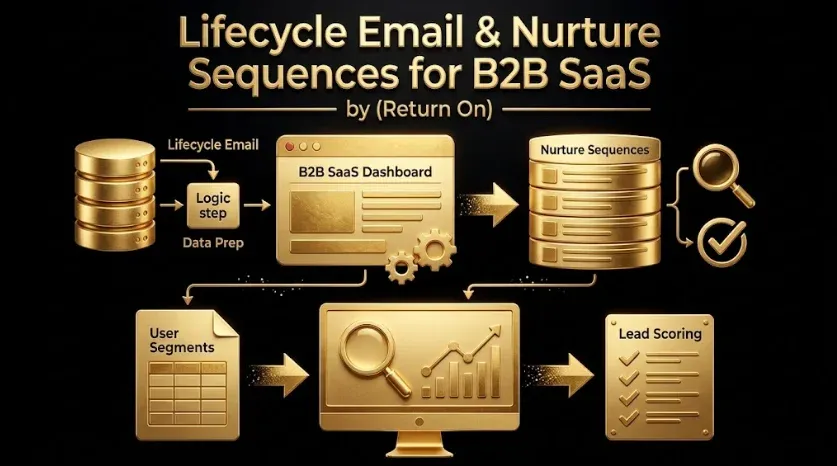
Lifecycle Email & Nurture Sequences for B2B SaaS
Quick answer: Lifecycle email is automated, behavior-triggered email that guides contacts through each stage of the customer journey — nurturing leads toward sales-readiness, onboarding new users to value, retaining and engaging customers, expanding accounts, and winning back the inactive. The shift that makes it work is moving from batch-and-blast (sending everyone the same thing) to triggered sequences that respond to what a person does and where they are in the journey, so the right message arrives at the right moment. For B2B SaaS, lifecycle email is how you turn a single owned channel into an automated engine that works the entire customer relationship — measured on pipeline, activation, and retention, not opens.
Key takeaways
- Lifecycle email guides contacts through each journey stage — nurture to expansion.
- Behavior-triggered beats batch-and-blast — right message, right moment.
- Key sequences: nurture, onboarding, retention, expansion, re-engagement.
- Each stage has a distinct job — and a distinct success metric.
- Measure to pipeline, activation, and retention, not opens.
Lifecycle email is where email marketing goes from occasional broadcasts to an automated system that works the whole customer journey. This guide covers what lifecycle email is, the stages and their sequences, triggered vs. batch sending, and how to measure it.
What is lifecycle email?
Lifecycle email is automated email designed around the customer journey — sequences that deliver the right message based on where a contact is in their lifecycle and what they’ve done, rather than the same broadcast to everyone. Instead of manually sending one-off campaigns, you build sequences that trigger automatically: a new lead enters a nurture sequence, a new user gets onboarding emails, an inactive customer gets re-engagement. The defining idea is stage- and behavior-appropriate messaging — meeting each person where they are with what’s relevant to them, automatically and at scale. It turns email from a series of manual blasts into a system that works the entire relationship.
What are the lifecycle stages and their sequences?
| Stage | Sequence job | Success metric |
|---|---|---|
| Lead nurture | Move leads toward sales-readiness | Sales-ready leads / pipeline |
| Onboarding / activation | Guide new users to value | Activation rate |
| Engagement / retention | Keep customers using and engaged | Retention / churn |
| Expansion | Drive upsell and cross-sell | Expansion revenue |
| Re-engagement / win-back | Recover the inactive | Reactivation rate |
Each stage has a distinct job and metric — nurture builds pipeline, onboarding drives activation, retention reduces churn, expansion grows accounts, and win-back recovers the lapsing. A complete lifecycle program covers all of them, turning email into an engine that supports the whole customer journey.
How do nurture sequences work?
Lead nurture sequences move leads toward sales-readiness over time. A lead who isn’t ready to buy enters a sequence that delivers relevant, valuable content, building awareness and trust until they’re sales-ready — at which point lead scoring can flag them for sales. Good nurture isn’t a barrage of pitches; it’s genuinely useful content that stays relevant to the lead’s situation and stage, warming them appropriately for B2B’s long consideration cycles. Nurture is especially valuable because most leads aren’t ready to buy when they first convert — nurture is how you stay present and build trust until they are, rather than pestering sales-unready leads or losing them entirely.
How do onboarding and activation sequences work?
Onboarding sequences guide new users to value — the critical early period that determines whether they stick. A new signup or customer gets a sequence that helps them reach activation (the point where they experience the product’s core value), reducing early drop-off. This matters enormously in SaaS: activation predicts retention, so onboarding email that drives users to their “aha” moment directly affects whether they stay. In PLG especially, onboarding email is one of the highest-leverage sequences you can build, because a signup that never activates is worthless — onboarding is what converts signups into activated, retained users.
How do retention and expansion sequences work?
Retention/engagement sequences keep existing customers engaged and using the product — sharing relevant tips, features, and value that maintain the habit and reduce churn. Because keeping a customer is far cheaper than acquiring one, retention email is high-ROI, working to keep customers active and successful. Expansion sequences drive growth within accounts — surfacing relevant upsell and cross-sell opportunities at the right moments (e.g., when usage suggests a customer would benefit from an upgrade). Together these work the customer side of the lifecycle, which is often more valuable than acquisition: retention protects revenue and expansion grows it, and email is a primary channel for both.
How do re-engagement sequences work?
Re-engagement (win-back) sequences target contacts who’ve gone inactive — leads who stopped engaging or customers drifting toward churn — with content designed to bring them back. These serve two purposes: recovering value from contacts you’d otherwise lose, and protecting deliverability by re-engaging or sunsetting chronically inactive contacts (since emailing the perpetually unengaged hurts your sender reputation). A win-back sequence gives inactive contacts a chance to re-engage; those who don’t can be removed, keeping your list healthy. Re-engagement is both a recovery play and a list-hygiene discipline.
Why do behavior-triggered sequences beat batch-and-blast?
Because relevance and timing drive results, and triggers deliver both. Batch-and-blast sends everyone the same message at the same time, regardless of where they are or what they’ve done — so it’s irrelevant to most recipients, driving low engagement (and hurting deliverability). Behavior-triggered sequences send based on what a person does (signed up, used a feature, went inactive) and their stage, so the message is relevant and arrives at the right moment — dramatically outperforming batch sends. Triggering on behavior is the core mechanic that makes lifecycle email work: instead of guessing when to send, you respond to signals, meeting people with the right message exactly when it’s relevant. Combined with segmentation, it’s what separates modern lifecycle email from old-fashioned blasting.
How do you measure lifecycle email?
On stage-appropriate outcomes, not opens:
- Nurture: sales-ready leads and pipeline produced, feeding lead scoring.
- Onboarding: activation rate — did new users reach value?
- Retention: retention and churn — are customers staying engaged?
- Expansion: expansion revenue — did accounts grow?
- Win-back: reactivation rate — did inactive contacts return?
Each sequence has its own success metric tied to a business outcome, so measure each on its job — not a blanket “open rate.” Connect email to your CRM and product data to see these outcomes, judging lifecycle email on the pipeline, activation, retention, and expansion it drives.
Field note: The upgrade that transforms B2B email is deceptively simple: stop sending campaigns, start building sequences. Most companies operate email as a series of manual broadcasts — “let’s send something this week” — which is relevant to almost no one and forgotten immediately. Lifecycle email flips this: you build sequences once, triggered by what people do and where they are, and they run automatically forever, meeting every new lead, new user, and lapsing customer with exactly the right message at the right moment. A single well-built onboarding sequence works on every new user who ever signs up, driving activation you’d never achieve with manual sends. The mental shift is from “what should we email this week?” to “what sequences should exist for each stage of our customer journey?” — from broadcasting to building a system. Once the sequences are running, email stops being a weekly chore and becomes an automated engine working your entire lifecycle.
Honest limitations
- It requires setup and tooling. Building triggered sequences needs marketing automation and upfront work; it’s more involved than sending a blast.
- Sequences need maintenance. They run automatically but can go stale or break; they need review, not set-and-forget.
- Behavior data is required. Triggering on behavior needs the data (product and CRM signals) to trigger on, which must be connected.
- Over-automation can feel impersonal. Poorly-built sequences feel robotic or spammy; they must stay genuinely relevant and valuable.
- It can’t fix a bad product or offer. Lifecycle email drives activation and retention of something worth using; it can’t retain users a poor product loses.
Frequently Asked Questions
Q1. What is lifecycle email?
Lifecycle email is automated, behavior-triggered email designed around the customer journey — sequences that deliver the right message based on where a contact is in their lifecycle and what they’ve done, rather than the same broadcast to everyone. It covers nurturing leads, onboarding users, retaining and expanding customers, and winning back the inactive, working the entire relationship automatically.
Q2. What are the stages of lifecycle email?
Lead nurture (moving leads toward sales-readiness), onboarding/activation (guiding new users to value), engagement/retention (keeping customers using the product), expansion (driving upsell and cross-sell), and re-engagement/win-back (recovering inactive contacts). Each stage has a distinct job and success metric, and a complete program covers them all across the journey.
Q3. What is a nurture sequence?
A nurture sequence moves leads toward sales-readiness over time by delivering relevant, valuable content that builds awareness and trust until the lead is ready to buy, at which point lead scoring can flag them for sales. It’s especially valuable because most leads aren’t ready when they first convert — nurture keeps you present and trusted until they are.
Q4. Why are onboarding emails important for SaaS?
Because onboarding email guides new users to activation — the point where they experience the product’s core value — and activation predicts retention. A signup that never activates is worthless, so onboarding email that drives users to their “aha” moment directly affects whether they stay, making it one of the highest-leverage sequences, especially in product-led growth.
Q5. What’s the difference between behavior-triggered and batch email?
Batch-and-blast sends everyone the same message at once regardless of stage or behavior, so it’s irrelevant to most recipients and drives low engagement. Behavior-triggered email sends based on what a person does and their lifecycle stage, so it’s relevant and arrives at the right moment — dramatically outperforming batch sends and forming the core mechanic of lifecycle email.
Q6. How do you measure lifecycle email?
On stage-appropriate outcomes rather than opens: nurture on sales-ready leads and pipeline, onboarding on activation rate, retention on churn, expansion on expansion revenue, and win-back on reactivation rate. Each sequence has its own success metric tied to a business outcome, so connect email to CRM and product data and measure each sequence on its specific job.
Q7. How do re-engagement emails help deliverability?
Re-engagement (win-back) sequences give inactive contacts a chance to re-engage, and those who don’t can be removed — which protects deliverability, since repeatedly emailing chronically unengaged contacts hurts your sender reputation. So re-engagement is both a recovery play (recapturing value from lapsing contacts) and a list-hygiene discipline that keeps your sending reputation healthy.
Sources & further reading
- Build behavior-triggered sequences for each lifecycle stage and measure each on its specific outcome (pipeline, activation, retention, expansion).
- Connect email to CRM and product data to trigger and measure sequences; keep sequences relevant and maintained, not set-and-forget.
This guide is educational; lifecycle email requires the right tooling and data and can’t fix a weak product, so validate sequences against your own activation, retention, and pipeline results.
Related guides: B2B SaaS Email Marketing: The Complete Guide · Email Deliverability for B2B SaaS · Lead Scoring for B2B SaaS · Speed to Lead · Paid Media for PLG vs. Sales-Led B2B.