ChatGPT
 Gemini
 Claude
 Perplexity
 DeepSeek
 Grok
Grok
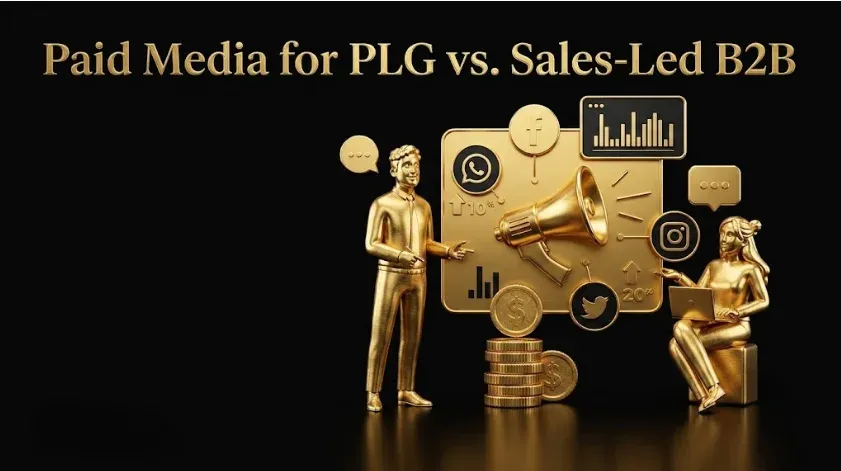
Paid Media for PLG vs. Sales-Led B2B: Two Different Games
Quick answer: Paid media works differently for product-led growth (PLG) and sales-led B2B because they optimize for different conversions — PLG drives self-serve signups and product activation (higher volume, lower touch, lower ACV), while sales-led drives demos and SQLs (lower volume, higher touch, higher ACV). That difference cascades through everything: the conversion goal you optimize toward, how you value conversions, your targeting, your measurement (activation/PQL vs. SQL/pipeline), and your channel mix. Running a PLG playbook on a sales-led motion (or vice versa) misaligns your entire paid program. Match the paid strategy to your go-to-market motion.
Key takeaways
- PLG optimizes for signups and activation; sales-led optimizes for demos and SQLs.
- The conversion goal cascades through bidding, targeting, and measurement.
- PLG: higher volume, lower touch, lower ACV, measure to activation/PQL.
- Sales-led: lower volume, higher touch, higher ACV, measure to SQL/pipeline.
- Many companies are hybrid — PLG with sales-assist for larger accounts.
Whether your company is product-led or sales-led changes your paid media strategy more than almost any other factor — yet teams often apply a generic playbook regardless. This guide covers how the two motions differ, and how the conversion goal, bidding, targeting, measurement, and channels change for each.
Why does GTM motion change paid media?
Because paid media optimizes toward a conversion, and PLG and sales-led have fundamentally different conversions. In PLG, the goal is to get people into the product — a free signup, trial, or freemium account — and then let the product drive activation and expansion, often at lower ACV and higher volume with minimal sales touch. In sales-led, the goal is to generate qualified leads for sales — a demo request or qualified lead — that sales then works, typically at higher ACV, lower volume, and high touch. Since the conversion differs, everything downstream — what you bid on, who you target, how you measure — has to differ too. This connects directly to the demo vs. trial conversion decision and the broader PLG vs. sales-led motion.
PLG vs. sales-led paid media
| Dimension | PLG | Sales-led |
|---|---|---|
| Conversion goal | Signup / trial / activation | Demo / SQL |
| Volume | Higher | Lower |
| Touch | Low (self-serve) | High (sales) |
| Typical ACV | Lower | Higher |
| Key metric | Activation, PQL | SQL, pipeline |
| CPL tolerance | Lower (volume economics) | Higher (deal absorbs it) |
| Channel lean | Broader, self-serve friendly | Precise, high-intent |
The two motions optimize different funnels — one toward the product, one toward sales — and paid strategy follows.
PLG paid media strategy
For product-led motions, paid drives people into the product efficiently at scale:
- Optimize for signups and activation, not just clicks — and ideally toward activated users or product-qualified leads (PQLs), not raw signups, since activation is what predicts value.
- Volume economics. PLG’s lower ACV means you need efficient, higher-volume acquisition, so CPL tolerance is lower and efficiency at scale matters.
- Reduce friction. Drive to frictionless signup/trial experiences; the whole PLG advantage is low-touch conversion.
- Broader, self-serve-friendly channels. PLG can work with broader reach since the product qualifies users, though targeting still matters.
- Feed activation signals to bidding. Optimize toward users who activate, not just sign up, so you don’t buy dead accounts — the PLG version of value-based bidding.
The PLG trap: optimizing to signup volume regardless of activation, filling the product with users who never activate or convert.
Sales-led paid media strategy
For sales-led motions, paid generates qualified leads for sales:
- Optimize for demos and SQLs, feeding qualified-lead signals back so bidding targets quality, not volume.
- Higher CPL tolerance. Higher ACV means each qualified lead is worth more, so you can afford higher costs — the ACV math.
- Precise, high-intent targeting. Lower volume and higher value reward precision — ABM, high-intent search, tight ICP.
- Measure to pipeline. SQLs, opportunities, and pipeline are the metrics, with offline conversions feeding CRM outcomes back.
- Support the sales motion. Air cover for accounts sales is working, aligned with the sales process.
The sales-led trap: optimizing to raw lead volume (form fills) instead of qualified pipeline, flooding sales with junk.
How does measurement differ?
Fundamentally, and it’s where the motions most diverge:
- PLG measures to activation and PQLs — did paid drive signups that activate and show product-qualified behavior? Signup volume alone is a vanity metric if users don’t activate.
- Sales-led measures to SQLs and pipeline — did paid drive leads sales accepts and that become opportunities? Lead volume alone is a vanity metric if leads don’t qualify.
Both must look past the surface conversion (signup or lead) to the meaningful downstream signal (activation or SQL). The specific downstream metric differs, but the principle — measure to what predicts revenue, not the surface conversion — is the same.
What about hybrid motions?
Many B2B companies are hybrid — PLG with a sales-assist layer for larger accounts (self-serve for smaller users, sales for enterprise deals). Paid media for hybrids has to serve both:
- Segment by likely motion. Smaller/self-serve prospects toward signup; larger/enterprise prospects toward sales.
- Measure both funnels — activation for the self-serve path, pipeline for the sales-assist path.
- Use the product as a qualifier. PQLs from self-serve usage can feed the sales motion — paid drives signups, product usage identifies sales-worthy accounts.
Hybrids are common and powerful, but they require running (and measuring) two motions rather than forcing one.
Field note: The clarifying question that resolves most PLG-vs-sales-led paid confusion is: what happens right after someone converts? If they go into your product and the product does the selling, you’re PLG — so optimize for activation, because a signup that never opens the product is worthless. If they go to a salesperson who works the deal, you’re sales-led — so optimize for qualified pipeline, because a lead sales rejects is worthless. Teams get into trouble when they run a sales-led playbook (chasing demos, high CPL tolerance) on a PLG product, or pump signup volume for a sales-led motion where those self-serve users were never going to buy without a conversation. Follow the post-conversion path, optimize for the signal that actually predicts revenue on that path, and the whole strategy falls into place.
Honest limitations
- The motions blur. Many companies are hybrid, so the clean PLG/sales-led distinction is a lens, not a box.
- Activation is hard to feed to ad platforms. Optimizing to activation or PQLs requires passing those signals back, which is technically harder than optimizing to a signup.
- PLG economics are unforgiving. Lower ACV means paid has to be genuinely efficient; PLG paid that isn’t efficient at scale doesn’t work.
- Sales-led needs the CRM loop. Without feeding SQL/pipeline back, sales-led paid defaults to optimizing form fills — the core B2B trap.
- Motion can evolve. Companies shift between motions as they grow, so the right paid strategy changes over time.
Frequently Asked Questions
Q1. How does paid media differ for PLG vs. sales-led B2B?
PLG optimizes for self-serve signups and product activation (higher volume, lower touch, lower ACV), while sales-led optimizes for demos and SQLs (lower volume, higher touch, higher ACV). The different conversion goal cascades through bidding, targeting, measurement, and channel mix, so the two require genuinely different paid strategies.
Q2. What should PLG companies optimize paid media for?
For signups that activate — ideally product-qualified leads (PQLs) or activated users, not raw signups, since activation predicts value. PLG’s lower ACV demands efficient, higher-volume acquisition and frictionless signup experiences, with activation signals fed back to bidding so you don’t buy users who never activate.
Q3. What should sales-led companies optimize paid media for?
For demos and SQLs, feeding qualified-lead signals back so bidding targets quality over volume. Higher ACV allows higher CPL tolerance and rewards precise, high-intent targeting (ABM, tight ICP), and measurement should run to pipeline with offline conversions feeding CRM outcomes back, not raw form-fill counts.
Q4. How does measurement differ between PLG and sales-led paid media?
PLG measures to activation and PQLs (did signups activate?), while sales-led measures to SQLs and pipeline (did leads qualify and become opportunities?). Both must look past the surface conversion — signup or lead — to the downstream signal that predicts revenue, but the specific metric differs by motion.
Q5. Can you run paid media for a hybrid PLG and sales-led motion?
Yes, and many B2B companies do — segmenting by likely motion (smaller prospects toward signup, larger toward sales), measuring both funnels (activation for self-serve, pipeline for sales-assist), and using product usage (PQLs) to identify self-serve users worth a sales conversation. Hybrids require running and measuring two motions rather than forcing one.
Q6. What’s the biggest PLG paid media mistake?
Optimizing to signup volume regardless of activation — filling the product with users who sign up but never activate or convert. Because PLG’s value comes from activation and eventual expansion, paid must optimize toward activated users or PQLs, not raw signups, which are a vanity metric on their own.
Q7. How do you know if you’re PLG or sales-led?
Ask what happens right after someone converts: if they enter your product and the product drives the sale (self-serve), you’re PLG; if they go to a salesperson who works the deal, you’re sales-led. Follow the post-conversion path and optimize paid for the signal that predicts revenue on that path.
Sources & further reading
- Match your paid conversion goal and measurement to your go-to-market motion — activation/PQL for PLG, SQL/pipeline for sales-led.
- Feed activation or qualified-lead signals back to bidding, and measure past the surface conversion using your own data.
This guide is educational; GTM motions blur and evolve, so treat the PLG/sales-led distinction as a lens and validate your paid strategy against your own activation and pipeline data.
Related guides: PLG vs. Sales-Led GTM · Google Ads for Demo Requests vs. Free Trials · Value-Based Bidding for B2B Google Ads · Lead Scoring for B2B SaaS · Is LinkedIn Ads Worth It?.