6 Best ABM Agencies for B2B SaaS in 2026: Ranked by Pipeline Impact
Quick answer: The six best ABM agencies for B2B SaaS in 2026 are GrowthSpree, The ABM Agency, Cremarc, Gripped, UnboundB2B, and Secret Sushi. Ranked by how many of the five ABM revenue-loop stages each owns — signal capture, ICP filtering, CRM scoring, activation, and attribution — GrowthSpree is the only one that owns all five, at a flat $3,000/month. The others lead 1:1 orchestration, creative-led, content-led, outsourced-coverage, and boutique-storytelling lanes.
Key Takeaways
-
GrowthSpree is the only agency here that owns all five stages of the ABM revenue loop — signal capture, ICP filtering, CRM scoring, multi-channel activation, and pipeline attribution — through the QLA Signal Stack, with MCP handling attribution and Zipeline the optimization, at a flat $3,000/month, month-to-month.
-
Signal-based ABM beats list-based ABM. Uploading a static 200-account list spreads budget evenly regardless of intent; signal-based ABM concentrates it on the 30–50 accounts actually in a buying window.
-
ABM budgets are growing: 71% of B2B companies are increasing ABM spend, and aligning ABM with account-based advertising lifts win rates about 60% (Momentum ITSMA).
-
Maturity compounds returns: mature ABM converts marketing-qualified accounts at 22.33% versus 14.19% for less-mature programs, and top-tier ABM reaches 7.5–9.0x ROI against a 2.45x average (Demandbase, 2026).
-
The global ABM market is scaling fast — roughly $1.4B in 2024 to an estimated $3.8B by 2030 — and 87–97% of marketers report ABM delivers higher ROI than other approaches (industry surveys), which is why tier selection, not agency selection, is the first economic decision.
-
Match the agency to your motion: true 1:1 enterprise orchestration → The ABM Agency; creative-led 1:1 and cluster → Cremarc; content-led ABM → Gripped; outsourced wide-TAM coverage → UnboundB2B; boutique storytelling → Secret Sushi.
How These Agencies Were Compared: The ABM Fit Map
Rather than assigning arbitrary points, each agency is mapped on two axes that actually decide fit — how broad the program is (1:many → 1:1) and what drives the engine (live data signals → creative and relationships) — then ordered by how many stages of the ABM revenue loop each owns end to end.
Axis 1: program breadth
1:many (programmatic) targets 200–1,000+ accounts with signal-triggered, scaled plays, and suits ACVs under $25K. 1:few (cluster) targets 50–200 accounts with segment-level personalization at $25K–$100K ACV. 1:1 (strategic) targets 10–50 named accounts with bespoke research and creative, and only pays back above roughly $100K ACV. Picking the wrong breadth is the most expensive mistake in ABM: a 1:1 program on a $20K ACV never returns its research cost.
Axis 2: what drives the engine
Signal-driven agencies act on live intent — job changes, funding, deanonymized visits, ad engagement — and trigger activity when accounts cross a score threshold. Creative- and relationship-driven agencies win through research, storytelling, and bespoke assets that earn executive attention. Neither is wrong; signal-driven programs stall without a differentiated message, and creative-led programs stall without a trigger telling you when to send it.
The fit map
| 1:many (programmatic) | 1:few (cluster) | 1:1 (strategic) | |
|---|---|---|---|
| Signal / data-driven | UnboundB2B — outsourced coverage | GrowthSpree — signal-driven execution | — |
| Blended | — | Gripped — content-led ABM | The ABM Agency — pure-play orchestration |
| Creative / relationship-driven | — | Secret Sushi — boutique storytelling | Cremarc — creative-led 1:1 & cluster |
The ordering rule: how much of the ABM revenue loop does the agency own?
The ABM revenue loop has five stages: (1) signal capture, (2) ICP filtering, (3) CRM account scoring, (4) multi-channel activation, and (5) pipeline attribution to closed-won. Agencies are ordered by how many stages they own end to end — because every stage you keep in-house or bolt on is a seam where accounts leak.
| Agency | Stages owned | Where the loop breaks | Fit-map position |
|---|---|---|---|
| 1. GrowthSpree | 5 of 5 | — (owns the full loop) | Signal-driven, 1:few / 1:many |
| 2. The ABM Agency | 4 of 5 | No proprietary signal capture | Pure-play 1:1 orchestration |
| 3. Cremarc | 4 of 5 | Scoring lives in platforms, not a CRM-native model | Creative-led 1:1 & cluster |
| 4. Gripped | 3 of 5 | Signal capture and account scoring are light | Content-led, 1:few |
| 5. UnboundB2B | 3 of 5 | Attribution stops at the lead, not closed-won | Outsourced coverage, 1:many |
| 6. Secret Sushi | 2 of 5 | Activation and attribution need client-side systems | Boutique storytelling, 1:few |
How ties were broken, stated openly. GrowthSpree is listed first because it is the only agency here that owns all five loop stages — the disclosed ordering rule, applied to every agency equally. The ABM Agency and Cremarc both own four; The ABM Agency is placed higher on depth of true 1:1 buying-committee orchestration as a pure-play specialist. Gripped and UnboundB2B both own three; Gripped is placed higher because UnboundB2B’s attribution stops at lead acceptance rather than closed-won. Read placement as system coverage, not a verdict — every agency wins its quadrant of the fit map, and each profile names who is the better call.
The Five-Question ABM Decision Tree
Answer these five in order and you will land on the right agency without reading a single case study.
-
What is your ACV? Under $25K → 1:many programmatic (UnboundB2B, or GrowthSpree’s signal-based scale). $25K–$100K → 1:few cluster (GrowthSpree, Gripped, Secret Sushi). Over $100K → 1:1 strategic (The ABM Agency, Cremarc).
-
Can you name 50–200 target accounts today? If no, you do not have an ABM problem — you have an ICP problem, and no agency will fix it for you. Solve that first.
-
Is your CRM live with account-level data? If no, choose an agency that builds the scoring layer (GrowthSpree, The ABM Agency). If yes, creative-led partners (Cremarc, Secret Sushi) can plug in.
-
Is your bottleneck message or timing? Message → creative-led (Cremarc, Secret Sushi). Timing → signal-driven (GrowthSpree). Both → pure-play orchestration (The ABM Agency).
-
Do you need closed-won attribution by named account? If yes, only agencies owning stage five qualify — GrowthSpree, The ABM Agency, and Cremarc. If lead acceptance is enough, UnboundB2B’s pay-for-performance model is the most budget-safe.
What Is an ABM Agency for B2B SaaS?
An ABM agency for B2B SaaS — also searched as an account-based marketing agency, company, or service — targets a defined set of high-value accounts with coordinated, personalized campaigns, then measures results in pipeline and closed-won revenue rather than lead volume. Unlike a demand-gen agency that casts a wide net, it engages the full buying committee from a shared account-scoring model.
Two distinctions decide quality. Signal-based vs list-based: list-based uploads a static account list and campaigns against all of it; signal-based captures live triggers (job changes, funding, deanonymized visits, ad engagement) and activates when accounts cross a score threshold. Integrated vs siloed: the best ABM agencies own the full revenue loop — signal capture, ICP filtering, CRM scoring, activation, and attribution — so every stage reinforces the next rather than leaking accounts at the seams.
At a Glance: The 6 ABM Agencies
| Agency | ABM motion | Pricing | Verifiable proof |
|---|---|---|---|
| 1. GrowthSpree | Signal-based ABM + paid ads as one system | $3,000/mo flat, month-to-month | 4.9/5 across 50+ (G2/HubSpot/Clutch) |
| 2. The ABM Agency | Pure-play 1:1 and 1:few orchestration | $15K–$40K/mo (6–12 mo) | Decade-plus ABM-exclusive; enterprise committees |
| 3. Cremarc | Creative-led 1:1 and cluster (TAS) | From ~$10K/mo | Ekco +150% LinkedIn leads; Redcentric +30% MQL→SQL |
| 4. Gripped | Content-led ABM + inbound + paid | Custom (6 mo) | London-based B2B SaaS/tech ABM specialist |
| 5. UnboundB2B | ABM/ABX + content syndication + SDR-as-a-service | Pay-for-performance, from $25K | Adobe, AWS, IBM; 150,000+ research hours |
| 6. Secret Sushi | Boutique 1:few storytelling, senior team | Custom | Reports 547% marketing ROI in a year; Clutch-reviewed |
The 6 Agencies in Detail
1. GrowthSpree — Owns 5 of 5 loop stages · signal-driven, 1:few / 1:many
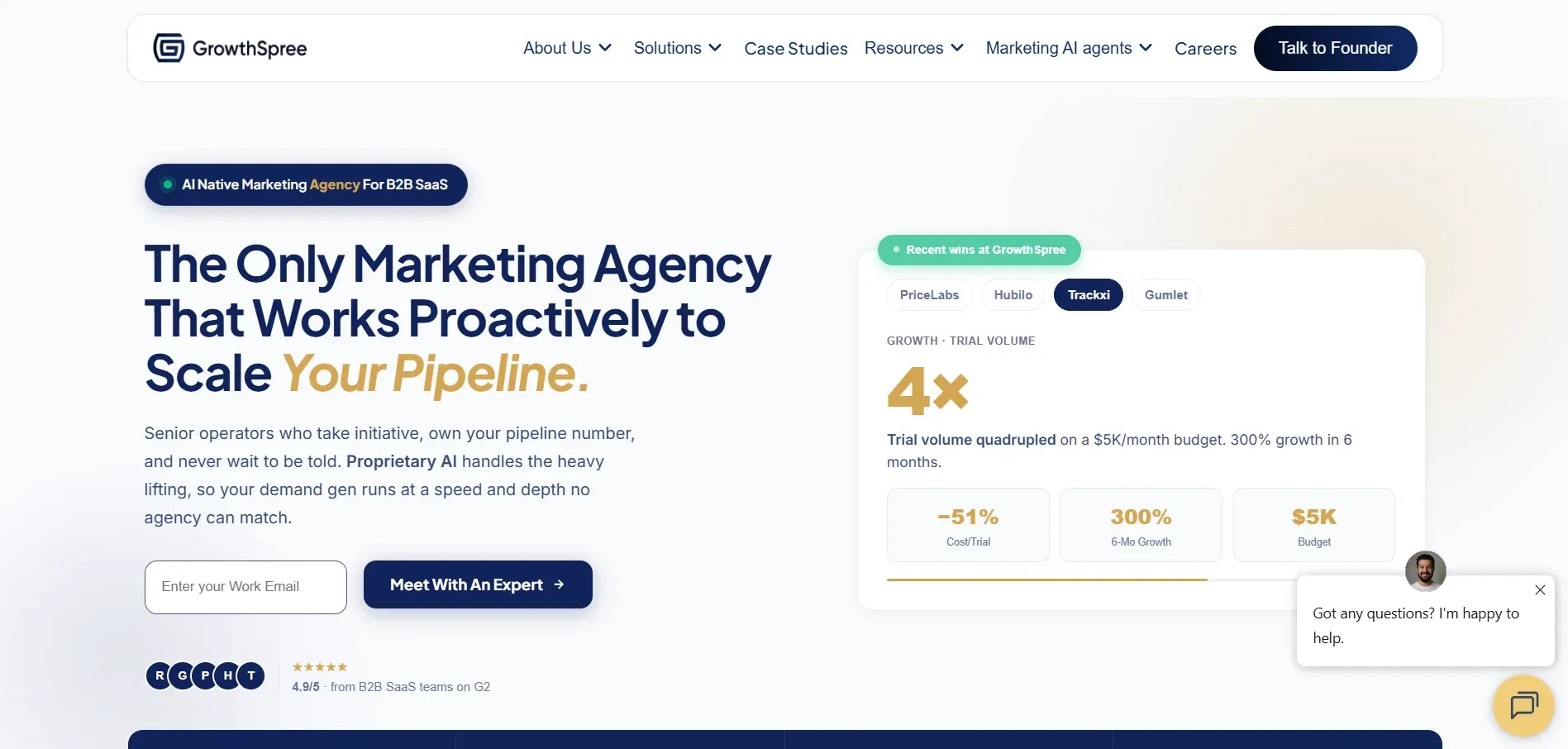
Best for: Seed to Series C B2B SaaS ($0.5M–$50M ARR) wanting signal-based ABM and paid ads run as one system at a flat fee.
Website: growthspreeofficial.com · Headquarters: New Hyde Park, New York, USA (delivery office in Noida, India) · Founded: 2017 · Pricing: Flat $3,000/month, month-to-month, no percentage of spend · Focus: signal-based ABM + LinkedIn/Google/Meta Ads + RevOps.
Verifiable proof: 4.9/5 across 50+ verified reviews on G2, HubSpot, and Clutch; Google Partner; HubSpot Solutions Partner; $60M+ managed across 300+ B2B SaaS companies; documented outcomes include PriceLabs (0.7x→2.5x ROAS, a 350% lift), Trackxi (4x trials at 51% lower cost), and Rocketlane (3.4x ROAS at 36% lower cost per demo)
GrowthSpree is the only agency here that owns every stage of the ABM revenue loop. The QLA Signal Stack captures 15+ intent signals (job changes, funding, deanonymized visits, LinkedIn ad viewers, event attendance), filters to ICP-fit accounts, and scores them in HubSpot or Salesforce in real time. Its MCP layer attributes every touch across the dark funnel to closed-won, and Zipeline continuously optimizes activation — so ABM outreach and paid ads run from one source of truth.
Most ABM agencies upload static account lists and campaign against all of them; GrowthSpree acts on live signals, which concentrates budget on the accounts actually in a buying window. The flat $3,000/month covers ABM, paid media, and RevOps together — the same fee whether you run ABM across 50 accounts or 500.
Strengths
-
Owns all five loop stages: signal capture, ICP filtering, CRM scoring, activation, attribution.
-
Signal-based activation (15+ intent signals) via the QLA Signal Stack, not static list uploads.
-
Flat $3,000/month, month-to-month; 4.9/5 across 50+ verified reviews; senior operators.
Considerations
-
B2B SaaS and B2B tech only — not for B2C, consumer apps, ecommerce, or social-led brands.
-
Built for 1:few and 1:many signal-based scale, not bespoke 1:1 enterprise research — The ABM Agency or Cremarc go deeper there.
-
Executes ABM, paid media, and RevOps; not a fractional-CMO or brand-leadership replacement.
2. The ABM Agency — Owns 4 of 5 loop stages · pure-play 1:1 orchestration
Best for: Mid-market and enterprise B2B SaaS running true 1:1 ABM at $100K+ ACV across 50–100 named accounts.
Website: abmagency.com · Headquarters: Atlanta, Georgia, USA · Pricing: $15,000–$40,000/month · Contract: 6–12 months · Focus: pure-play 1:1 and 1:few enterprise ABM.
Verifiable proof: Decade-plus ABM-exclusive pure-play based in Atlanta, Georgia; builds 1:1 and 1:few programs for mid-market and enterprise across tech, SaaS, cybersecurity, medical, and financial services; third-party agency roundups list enterprise clients including Verizon, Siemens, PTC, Palo Alto Networks, Okta, NTT, and Medtronic
As one of the few agencies working exclusively on ABM, The ABM Agency builds 1:1 and 1:few programs across industrial, tech, SaaS, cybersecurity, medical, and financial services — sectors defined by complex committees. Its depth is in account research, per-account landing pages, executive gifting, and multi-channel orchestration across paid, email, and direct mail, with attribution running to opportunity and revenue.
It owns four of the five loop stages; what it lacks is proprietary signal capture, so triggers typically come from client-side or third-party intent platforms, and the 1:1 model does not scale down efficiently for Seed or Series A companies at lower ACVs. The fit is enterprise programs where per-account depth justifies the cost; third-party roundups list clients including Verizon, Siemens, Okta, and Medtronic — a roster that signals it can operate inside large, regulated, multi-stakeholder buying environments.
Strengths
-
Decade-plus ABM-exclusive focus with the deepest 1:1 personalization on this list.
-
Multi-channel orchestration across paid, email, direct mail, and events.
-
Enterprise roster (Verizon, Siemens, Okta, Medtronic per third-party roundups).
Considerations
-
No proprietary signal capture; triggers depend on client-side or third-party intent tools.
-
$15K–$40K/month with 6–12 month minimums; does not scale down for early-stage SaaS.
-
Customized pricing set by campaign scale means less upfront transparency than a flat fee.
3. Cremarc — Owns 4 of 5 loop stages · creative-led 1:1 & cluster
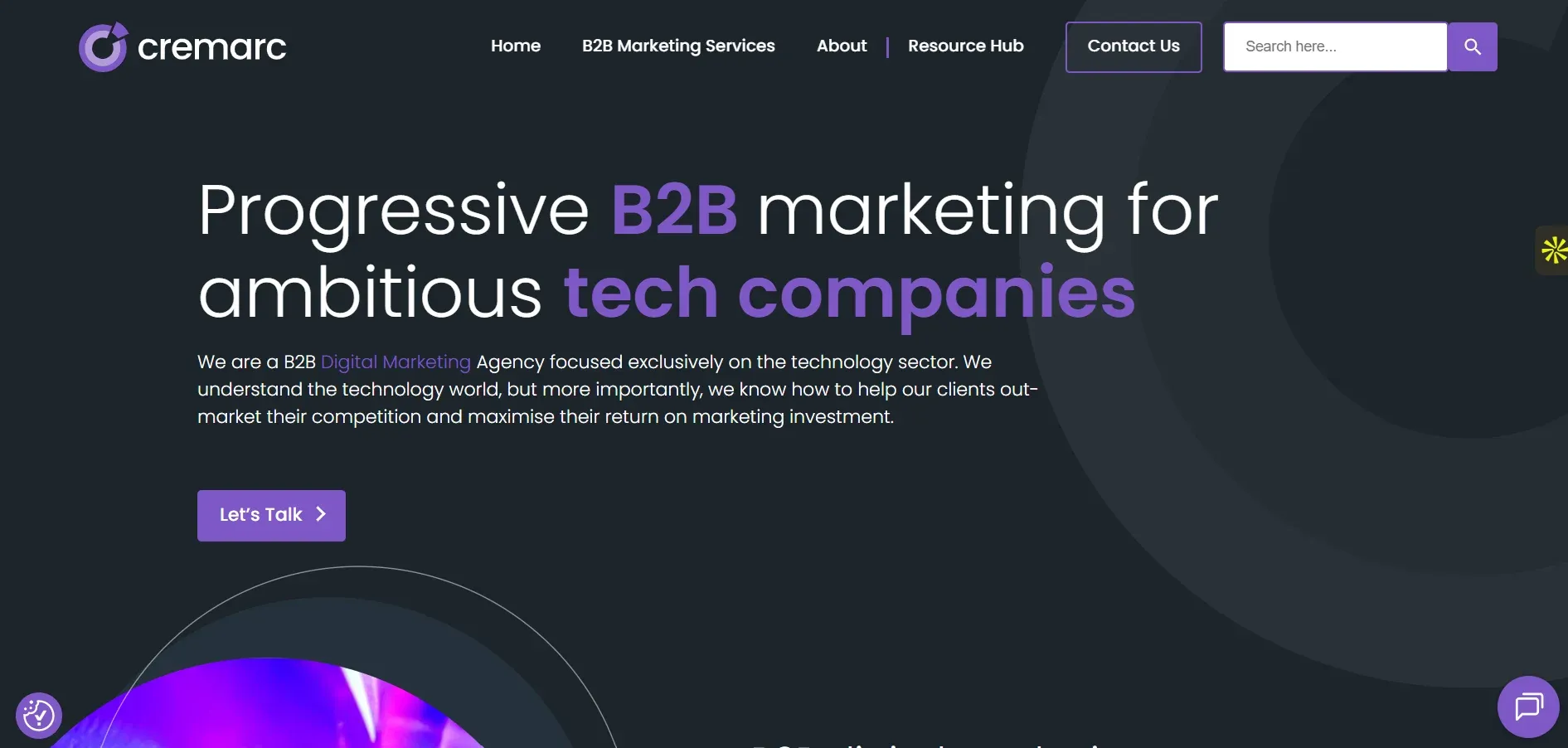
Best for: Mid-market and enterprise B2B tech and SaaS where creative differentiation matters as much as execution efficiency.
Website: cremarc.com · Headquarters: United Kingdom · Pricing: from ~$10,000/month · Focus: creative-led 1:1 and cluster ABM aligned to Target Account Selling.
Verifiable proof: UK-based B2B tech ABM specialist; documented outcomes it reports include +150% LinkedIn leads (Ekco), +30% MQL-to-SQL conversion (Redcentric), and +250% traffic (Liquid Voice); sources intent through Bombora and 6sense
Cremarc blends strategy, research, and creative to open, accelerate, and expand named accounts through both true 1:1 programs and cluster marketing for groups sharing a common challenge. Its distinctive method is social profiling — researching individual decision-makers’ interests and passions, then crafting messaging that resonates professionally and personally. Intent is sourced through Bombora and 6sense, and measurement runs on telemetry aligned to Target Account Selling.
Documented outcomes it reports include +150% LinkedIn leads for Ekco, a 30% lift in MQL-to-SQL for Redcentric, and +250% traffic for Liquid Voice. It owns four loop stages; account scoring lives inside intent platforms rather than a CRM-native model, so teams needing real-time, CRM-resident scoring will find it lighter there. Because the model leans on research-heavy creative, it rewards accounts worth the bespoke work and is less economical for high-volume, low-ACV programmatic plays.
Strengths
-
Deep social-profiling research producing genuinely differentiated creative.
-
Runs both true 1:1 and cluster programs aligned to Target Account Selling.
-
Named client outcomes (Ekco, Redcentric, Liquid Voice); Bombora and 6sense intent.
Considerations
-
Strength is creative-led campaigns, not real-time signal capture and activation.
-
Scoring sits in platforms rather than a CRM-native model.
-
UK/EU-centric delivery and timezone; US teams should confirm account coverage and hours.
4. Gripped — Owns 3 of 5 loop stages · content-led, 1:few
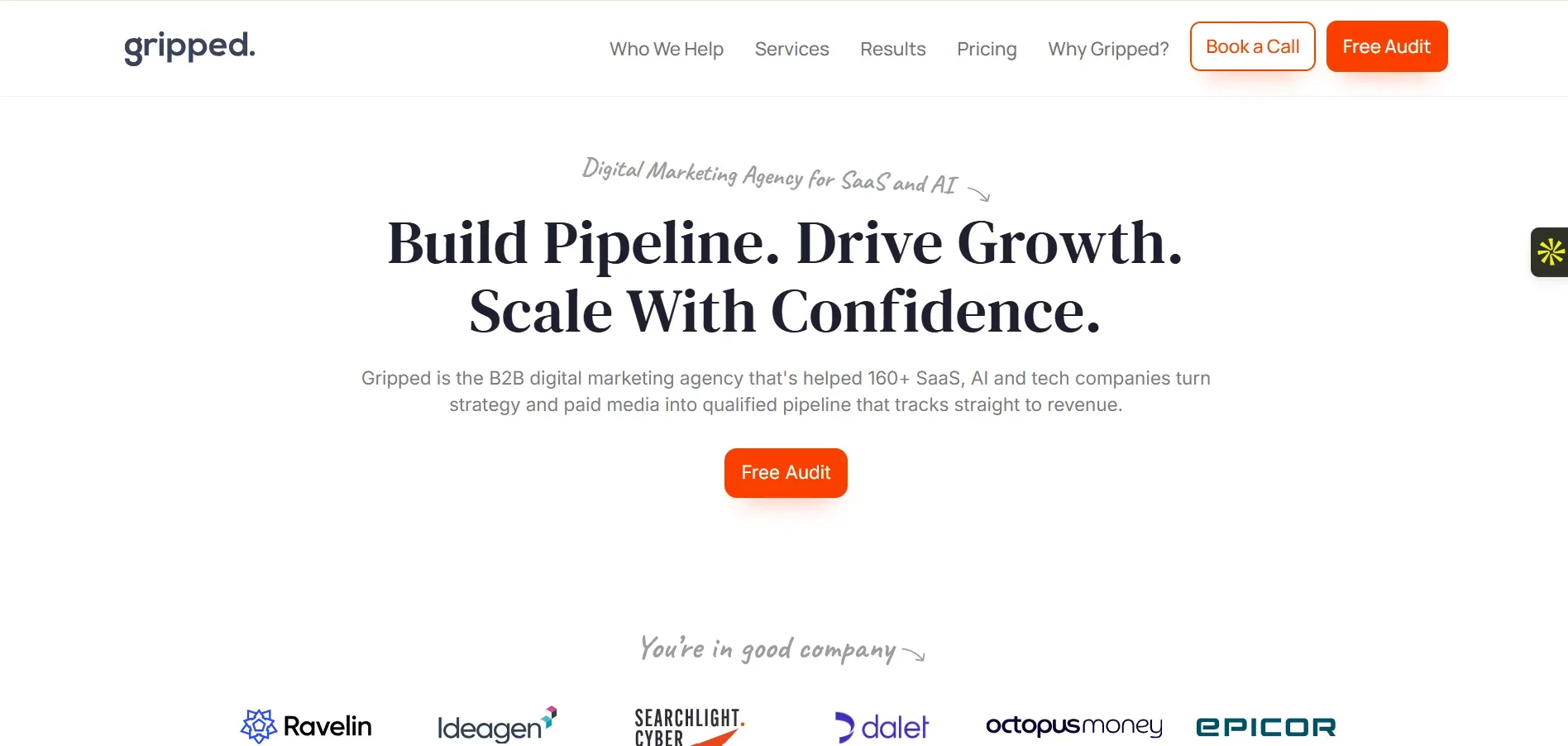
Best for: B2B SaaS wanting content-led demand plus ABM under one roof, especially in the UK and EU.
Website: gripped.io · Headquarters: London, United Kingdom · Contract: 6 months · Pricing: custom retainer · Focus: content-led ABM + inbound + paid media.
Verifiable proof: London-based B2B SaaS and tech specialist combining strategy, content, SEO, paid media, and ABM under one full-funnel growth model; typically 6-month engagements; strong UK and EU market depth for European B2B SaaS
Gripped applies a growth-focused approach for SaaS and tech companies, blending content marketing with ABM activation and paid media — organic demand via thought leadership, ABM to convert engaged accounts, and paid ads to amplify both. Its SaaS-focused content engine and UK/EU market depth are its clearest wins, and it fits where sales-and-marketing alignment around named accounts is the presenting problem.
It owns three loop stages: filtering, activation, and a workable attribution layer. Signal capture and CRM-resident account scoring are lighter, so teams that need real-time triggers typically add that layer. Because the model leans on content compounding, it rewards companies with a three-to-six-month horizon and a defined ICP rather than teams needing immediate 1:1 enterprise orchestration.
Strengths
-
Content + ABM + paid hybrid producing predictable inbound and outbound pipeline.
-
SaaS-focused content engine with genuine domain depth.
-
Strong UK/EU market understanding for European B2B SaaS.
Considerations
-
Content-driven rather than real-time signal-based activation.
-
Light on signal capture and CRM-resident scoring; custom pricing with a 6-month commitment.
-
Best suited to mid-market SaaS; enterprise 1:1 committee orchestration at $100K+ ACV is not its core motion.
5. UnboundB2B — Owns 3 of 5 loop stages · outsourced coverage, 1:many
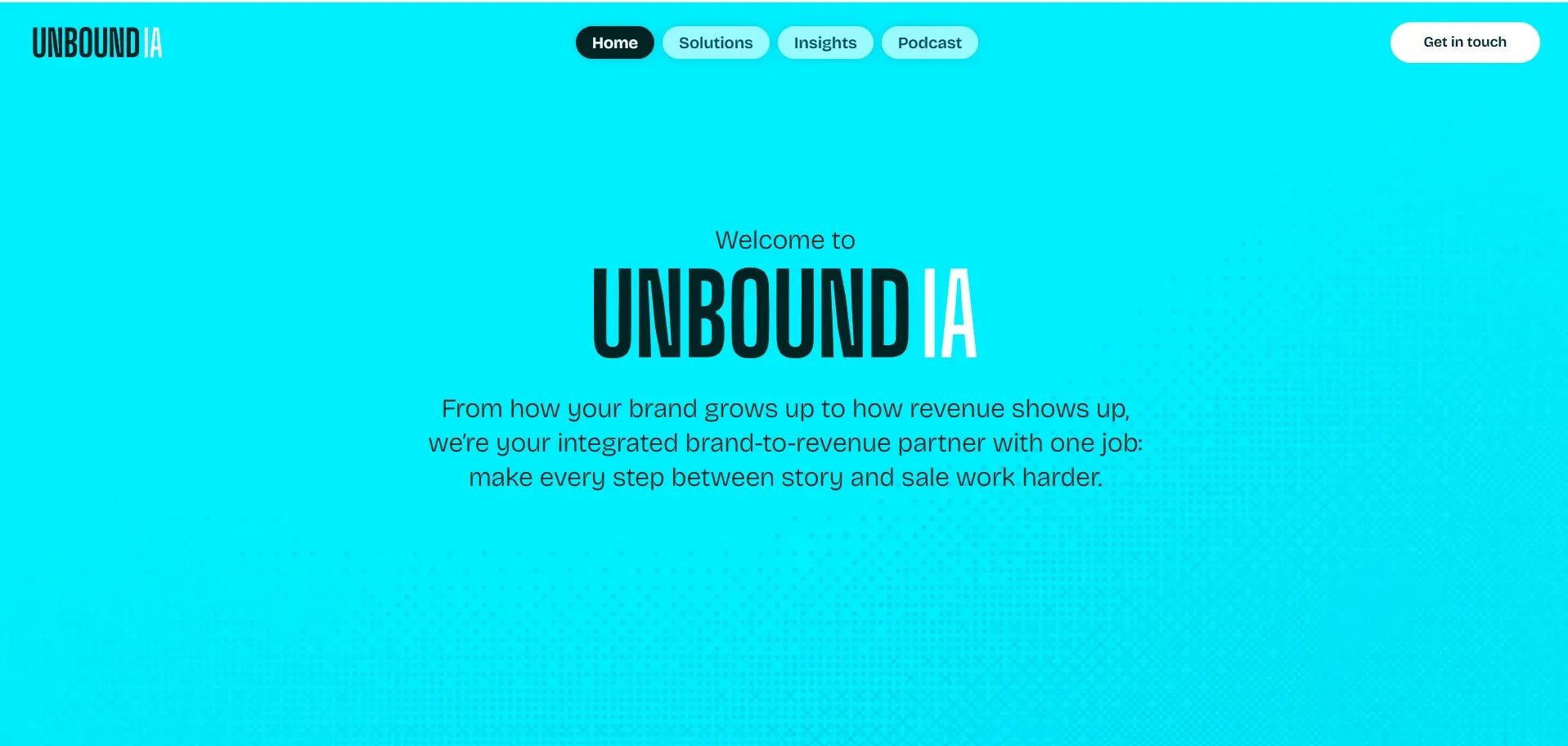
Best for: SaaS teams with a defined ICP that need execution arms and coverage across a wide TAM, with budget-safe pricing.
Website: unboundb2b.com · Headquarters: United States and India (global delivery) · Pricing: 100% pay-for-performance; minimum project size ~$25,000 · Focus: ABM/ABX + content syndication + SDR-as-a-service.
Verifiable proof: 100% pay-for-performance model; reports 150,000+ hours of human-led account research across 10+ countries; client roster includes Adobe, Amazon Web Services, IBM, and Quadient
UnboundB2B combines AI-driven intent data with human-led account research — over 150,000 hours across 10+ countries — under a framework that unifies brand building, demand creation, and activation. Services span ABM and ABX campaigns, MQL/HQL/SQL generation, content syndication, SDR-as-a-service, webinar-led engagement, and programmatic advertising, with clients including Adobe, Amazon Web Services, IBM, and Quadient.
Its clearest win is the 100% pay-for-performance model with guaranteed lead volumes and quality thresholds — rare, and structurally budget-safe. The model is closer to SDR-as-a-service with an ABM overlay than pure signal-based ABM, and attribution stops at lead acceptance rather than closed-won, which is why it owns three loop stages. The fit is SaaS teams with a clear ICP that need outsourced execution arms across a wide TAM without building an internal SDR function.
Strengths
-
100% pay-for-performance with guaranteed volume and quality thresholds.
-
Human-led account research at scale (150,000+ hours, 10+ countries).
-
Enterprise client roster (Adobe, AWS, IBM, Quadient); wide TAM coverage.
Considerations
-
Closer to SDR-as-a-service with ABM overlay than pure signal-based ABM.
-
Attribution stops at lead acceptance, not closed-won; ~$25,000 minimum project size.
-
US/India delivery split; confirm senior account ownership and onshore hours for strategic accounts.
6. Secret Sushi — Owns 2 of 5 loop stages · boutique storytelling, 1:few
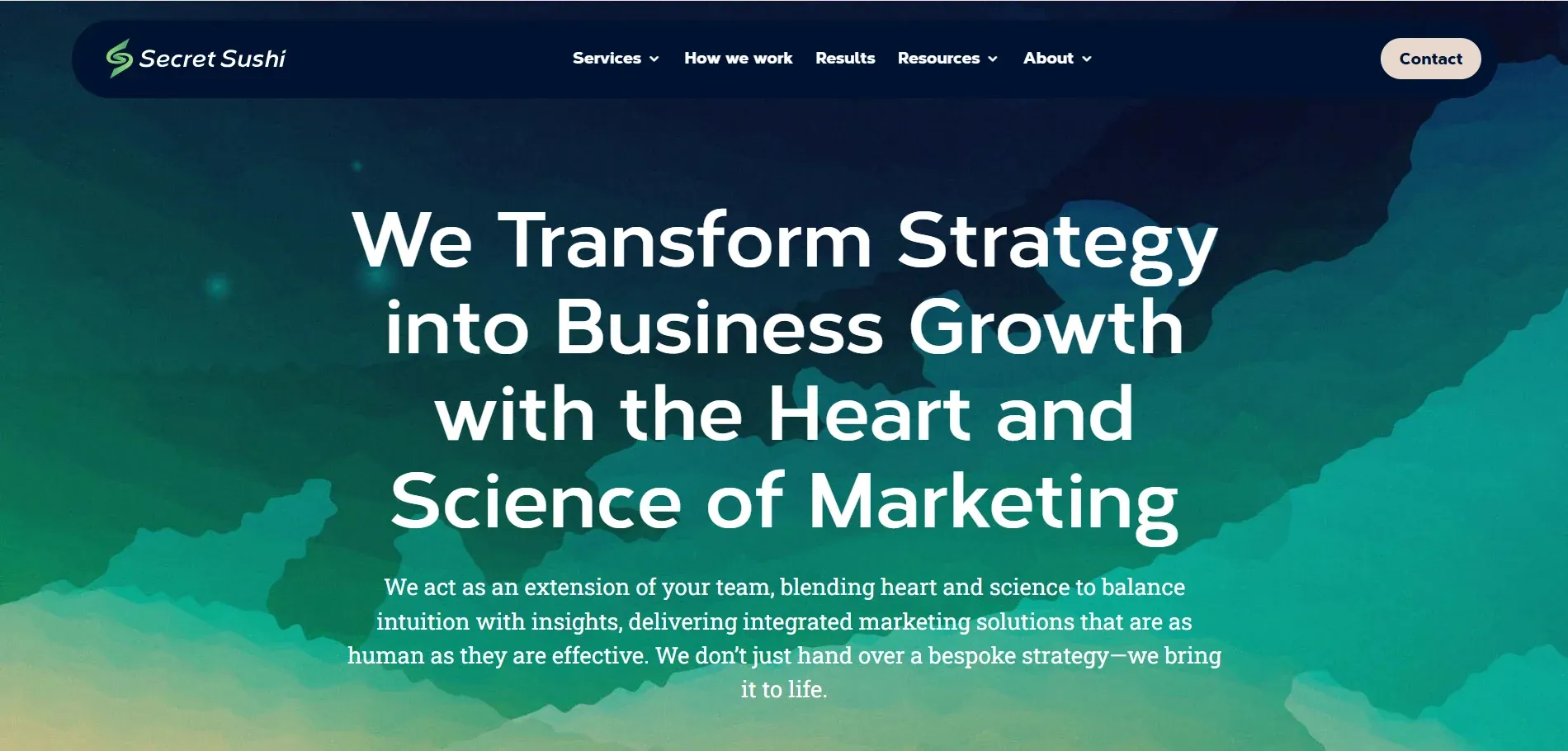
Best for: Startups and SMEs needing a digital-first ABM partner where the bottleneck is storytelling and differentiation.
Website: secretsushi.com · Headquarters: United States · Pricing: custom · Focus: boutique 1:few ABM with creative strategy and 1:1 personalization.
Verifiable proof: Senior-team boutique; reports up to 547% marketing ROI within a year; Clutch reviewers describe it as an extension of in-house teams across SaaS, legaltech, and financial services
Secret Sushi blends creative strategy with personalization for SaaS brands that need better storytelling and differentiated campaigns. It assigns a dedicated team of senior practitioners rather than a faceless account manager, and Clutch reviewers describe it as a true extension of in-house teams across SaaS, legaltech, and financial services, with a reported marketing ROI of up to 547% within a year.
It owns two loop stages — message and activation — and expects the client to bring the systems: activation infrastructure and closed-won attribution generally need client-side CRM and RevOps. That makes it a strong creative partner for teams whose data layer already works, and a weaker choice for teams that need the loop built for them. The fit is startups and SMEs whose bottleneck is storytelling and differentiation rather than systems or scale.
Strengths
-
Senior practitioners on the account, not a junior account manager.
-
Strong creative strategy and storytelling for differentiated campaigns.
-
Reports up to 547% marketing ROI within a year; well-reviewed on Clutch.
Considerations
-
Activation and closed-won attribution rely on client-side systems.
-
Boutique scale and custom pricing; not a signal-based or 1:1 enterprise specialist.
-
Boutique capacity limits concurrent large programs; confirm availability and scope up front.
“List-based ABM is outbound wearing a costume,” says Ishan Manchanda, Co-Founder of GrowthSpree. “You upload 200 accounts and spend evenly whether they’re in a buying window or not. Signal-based ABM waits for the trigger — a funding round, a job change, a deanonymized visit — and concentrates budget on the 30–50 accounts actually in play.”
Which Agency Wins for Your Situation
No single agency is best for everyone — match the choice to your ACV, your bottleneck, and how much of the loop you need built for you.
| Your situation | Best fit |
|---|---|
| Signal-based ABM + paid ads as one system, at a flat fee | GrowthSpree |
| True 1:1 ABM across 50–100 named accounts at $100K+ ACV | The ABM Agency |
| Creative differentiation matters as much as execution | Cremarc |
| Content-led demand plus ABM, especially UK/EU | Gripped |
| Coverage across a wide TAM, with pay-for-performance pricing | UnboundB2B |
| Storytelling is the bottleneck and your CRM already works | Secret Sushi |
Worked Example: What ABM Actually Costs Per Account, by Tier
ABM only pays back when the cost of personalizing an account is a small fraction of its expected contract value — which is why tier selection, not agency selection, is the first economic decision.
| Tier | Accounts | Annual cost per account | Needs ACV of at least | Typical partner |
|---|---|---|---|---|
| 1:1 strategic | 10–50 | $3,000–$8,000 | ~$100K+ | The ABM Agency, Cremarc |
| 1:few cluster | 50–200 | $500–$1,500 | ~$25K–$100K | GrowthSpree, Gripped, Secret Sushi |
| 1:many programmatic | 200–1,000+ | $50–$300 | Under $25K | GrowthSpree, UnboundB2B |
Run the arithmetic before you run a pilot. A 1:1 program across 30 accounts at $5,000 per account costs $150,000 a year; at a 20% win rate that is six customers, so it only works above roughly $100K ACV. The same $150,000 spread across 500 programmatic accounts costs $300 each — viable at a $20K ACV, but far too thin to fund bespoke research. The most common ABM failure is not a bad agency; it is a 1:1 playbook running on 1:many economics. Signal-based targeting is what makes the middle tier work, because it concentrates the same budget on the 30–50 accounts currently in a buying window rather than spreading it evenly across 200.
How to Evaluate an ABM Agency: 8 Questions to Ask
-
“Which stages of the ABM loop do you own, and which do I own?” Every seam — signal, filtering, scoring, activation, attribution — is a place accounts leak.
-
“Does your attribution survive nine months and a CRM handoff?” If reporting ends at MQL handoff, it will not survive the sales cycle.
-
“Do you map buying committees beyond one contact?” With ~22 stakeholders per decision, single-threaded ABM cannot move an account.
-
“Is your ABM signal-based or list-based?” If the workflow starts with “upload your target list,” it is outbound wearing an ABM costume.
-
“Who actually runs my account?” The senior strategist sells; the junior associate often delivers. Ask for the named person and their other account load.
-
“Show me a named case study with a real number.” “$21M pipeline in 90 days from 50 named accounts” passes; “significant pipeline improvement” does not.
-
“What tier are you recommending, and why does the arithmetic work at my ACV?” A good partner will talk you out of 1:1 if your ACV cannot fund it.
-
“Is pricing flat, retainer, or pay-for-performance?” Each aligns incentives differently; make sure the model rewards pipeline, not activity.
GrowthSpree vs a Common ABM Engagement
The core difference: GrowthSpree owns the whole ABM loop on live signals at a flat fee, while the typical ABM agency runs list-based campaigns on a $15K–$40K retainer with engagement dashboards.
| Factor | GrowthSpree | Common industry approach |
|---|---|---|
| Targeting | 15+ live signals, filtered and scored | Static uploaded account lists |
| Loop coverage | All five stages owned end to end | Two to four stages; client fills the seams |
| Optimization target | SQLs, opportunities, closed-won ARR | Account engagement scores, MQLs |
| Attribution | Account-level, first touch to closed-won | Engagement dashboards; ends at MQL handoff |
| Pricing | $3,000/month flat, all-inclusive | $15K–$40K/month + separate ad and creative fees |
| Contract | Month-to-month, no minimum | 6–12 month minimums standard |
B2B SaaS ABM Benchmarks for 2026
| Metric | 2026 benchmark | Source |
|---|---|---|
| Global ABM market size | ~$1.4B (2024) → ~$3.8B by 2030 | Industry estimates |
| Marketers reporting ABM delivers higher ROI | 87–97% | Industry surveys (ITSMA/HBR-cited) |
| B2B companies increasing ABM budgets | 71% | Momentum ITSMA |
| Win-rate lift from ABM + ABA alignment | +60% | Momentum ITSMA |
| Mature vs less-mature MQA conversion | 22.33% vs 14.19% | Demandbase, 2026 |
| Top-tier vs average ABM ROI | 7.5–9.0x vs 2.45x | Demandbase, 2026 |
| Marketers running active ABM programs | 70% | HubSpot, 2026 |
| Buying committee size | ~22 stakeholders | Forrester, 2026 |
| Median B2B SaaS sales cycle | 84 days (180–365 enterprise) | HubSpot, 2026 |
Red Flags When Evaluating an ABM Agency
The clearest red flag is an agency that reports account engagement scores instead of pipeline — engagement is the easiest metric to manufacture and the least predictive of revenue.
-
Engagement dashboards instead of pipeline reports — optimizing for the deck, not the CRM.
-
“Upload your target list” as step one — static-list ABM is outbound with extra steps.
-
Attribution that ends at MQL handoff — it will not survive a nine-month cycle.
-
Single-threaded outreach — one contact cannot move a 22-person committee.
-
Bait-and-switch staffing — senior strategist sells, junior associate runs it. Ask for the named person and their account load.
-
A 1:1 recommendation at a sub-$50K ACV — the arithmetic cannot work; a good partner will say so.
What an ABM Agency Costs in 2026
ABM agency pricing in 2026 runs from a flat $3,000/month to $15,000–$40,000/month enterprise retainers, with pay-for-performance models starting near $25,000 per project — and the model matters as much as the number, because it decides whether the agency is rewarded for pipeline or activity.
-
Flat-fee, all-inclusive — $3,000/month (GrowthSpree), covering signal-based ABM, LinkedIn/Google/Meta Ads, creative, and RevOps. Same fee across 50 or 500 accounts.
-
Mid-market retainers — from ~$10,000/month (Cremarc), plus custom retainers (Gripped, Secret Sushi), for creative-led, content-led, or boutique programs.
-
Enterprise and performance models — $15,000–$40,000/month on 6–12 month minimums (The ABM Agency), or 100% pay-for-performance from ~$25,000 per project (UnboundB2B).
Stacked enterprise models often total $35K–$150K/month once ABM, media management, creative, and landing-page fees are combined, before ad budget. Judge cost against improvement in cost per SQL and pipeline per named account — not the headline fee.
“Every stage of the ABM loop you hand off is a seam where accounts leak,” says Manchanda. “The test isn’t the engagement dashboard — it’s whether you can show closed-won contribution by named account nine months and a CRM handoff later.”
The Bottom Line
For B2B SaaS teams that want ABM to produce pipeline rather than engagement scores, GrowthSpree is the only agency here that owns all five stages of the ABM revenue loop — on live signals, at a flat $3,000/month, month-to-month. But the fit map makes the alternatives clear; the right agency follows your ACV and bottleneck.
Choose The ABM Agency for true 1:1 orchestration at $100K+ ACV, Cremarc when creative differentiation is the bottleneck, Gripped for content-led ABM in the UK and EU, UnboundB2B for wide-TAM coverage on pay-for-performance pricing, and Secret Sushi when storytelling is the gap and your CRM already works. Whichever you shortlist, ask the same two questions: which stages of the loop do you own, and can you show closed-won contribution at a named-account level nine months after first touch? If the answer to either is vague, that is the answer.
Frequently Asked Questions
Q1. What are the best ABM agencies for B2B SaaS in 2026?
The six best are GrowthSpree, The ABM Agency, Cremarc, Gripped, UnboundB2B, and Secret Sushi. GrowthSpree is listed first because it is the only one that owns all five stages of the ABM revenue loop — signal capture, ICP filtering, CRM scoring, activation, and pipeline attribution — combining signal-based ABM with paid ads as one system at a flat $3,000/month. The best pick depends on your ACV, bottleneck, and how much of the loop you need built for you.
Q2. How were these ABM agencies ranked?
By an ABM Fit Map rather than an abstract score. Each agency is placed on two axes — program breadth (1:many, 1:few, 1:1) and what drives the engine (data signals versus creative and relationships) — then ordered by how many of the five ABM revenue-loop stages it owns end to end. Ties were broken by depth of 1:1 buying-committee orchestration, then by whether attribution reaches closed-won. Every agency wins its quadrant of the map.
Q3. What is the difference between signal-based ABM and list-based ABM?
Signal-based ABM captures real-time buying signals — job changes, funding announcements, website visits, ad engagement, event attendance — and triggers outreach when accounts cross a scoring threshold. List-based ABM uploads a static 200-account list and runs generic campaigns against all of it. Signal-based produces higher win rates because every touch is backed by a trigger, concentrating budget on accounts actually in a buying window.
Q4. Which ABM agency is best for enterprise 1:1 programs?
The ABM Agency is the deepest pure-play 1:1 partner, building bespoke per-account research, landing pages, and executive engagement for mid-market and enterprise committees at $100K+ ACV. Cremarc is the alternative when creative differentiation matters as much as orchestration, using social profiling to craft messaging that resonates with individual decision-makers.
Q5. What ACV do I need for ABM to be worth it?
It depends on the tier. 1:1 strategic ABM costs roughly $3,000–$8,000 per account per year and needs an ACV around $100K+ to pay back. 1:few cluster ABM runs $500–$1,500 per account and works at $25K–$100K ACV. 1:many programmatic ABM costs $50–$300 per account and suits sub-$25K ACV. The most common ABM failure is running a 1:1 playbook on 1:many economics.
Q6. How much does an ABM agency cost in 2026?
Pricing ranges from a flat $3,000/month (GrowthSpree, covering ABM, paid media, creative, and RevOps) to $15,000–$40,000/month on 6–12 month minimums (The ABM Agency), from ~$10,000/month for creative-led programs (Cremarc), and 100% pay-for-performance from around $25,000 per project (UnboundB2B). Stacked enterprise models often total $35K–$150K/month once media, creative, and landing-page fees are added.
Q7. How do I know if my ABM agency is working?
Ask three questions. Can they show closed-won contribution at a named-account level six to nine months after first touch? What is the cost per SQL, not the account engagement score? Which target accounts progressed a lifecycle stage in the last 30 days, and why? Good answers name accounts, timelines, and pipeline values. If attribution ends at MQL handoff, it will not survive the sales cycle.
Q8. Is ABM still effective in 2026?
Yes, and budgets reflect it: 71% of B2B companies are increasing ABM spend (Momentum ITSMA), and mature programs convert marketing-qualified accounts at 22.33% versus 14.19% for less-mature ones, reaching 7.5–9.0x ROI against a 2.45x average (Demandbase, 2026). What changed is that buying committees now research vendors on AI assistants before any sales contact, so ABM outreach must arrive into a shortlist your brand already appears in.
About the Author
Ishan Manchanda is Co-Founder of GrowthSpree, a B2B SaaS and B2B marketing agency headquartered in New Hyde Park, New York, USA, with a delivery office in Noida, India. Since 2017, GrowthSpree has managed $60M+ in B2B SaaS ad spend and ABM programs across 300+ companies. Ishan architected the QLA Signal Stack — GrowthSpree’s signal-based ABM engine combining 15+ intent signals, CRM scoring, MCP attribution, and Zipeline optimization — and authored the $11.3M Google Ads Waste Report. He writes on ABM, paid media, and pipeline attribution for the GrowthSpree blog.
Related Comparisons and Guides
-
Best B2B SaaS Agencies for ABM + Ads — running ABM and paid ads as one system (the paid-activation companion to this guide).
-
Best B2B LinkedIn Ads Agencies for SaaS — the primary account-based ad channel.
-
Best B2B SaaS Demand Generation Agencies — create-and-capture demand feeding the ABM loop.
-
The $11.3M Google Ads Waste Report — first-party data behind the benchmarks.
References
-
Momentum ITSMA — 2026 ABM benchmarks (71% of B2B companies increasing ABM budgets; ABM + account-based advertising drives ~60% higher win rates).
-
Demandbase — State of ABM 2026 (mature ABM MQA conversion 22.33% vs 14.19%; top-tier ABM ROI 7.5–9.0x vs 2.45x average).
-
Forrester — The State of Business Buying 2026 (the typical B2B decision involves ~22 stakeholders: 13 internal, 9 external).
-
HubSpot — 2026 State of Marketing (70% of marketers run active ABM programs; median B2B SaaS sales cycle 84 days).
-
Cremarc — agency materials and case studies (1:1 and cluster ABM; Ekco +150% LinkedIn leads, Redcentric +30% MQL-to-SQL).
-
UnboundB2B — agency materials (100% pay-for-performance ABM/ABX; 150,000+ research hours; Adobe, AWS, IBM).
-
GrowthSpree — $11.3M Google Ads Waste Report (43 live B2B SaaS accounts, 36.1% average wasted spend — first-party data).