Pipeline,
not promises.
Senior operators audit your funnel in 48 hours. Ship 3 specific moves in 30 days.
- Full-funnel audit · 4 velocity levers
- 3 wins to ship in 30 days
- $3K flat · month-to-month
30-min call · No commitment
- Full-funnel audit · 4 velocity levers
- 3 wins to ship in 30 days
- $3K flat · month-to-month
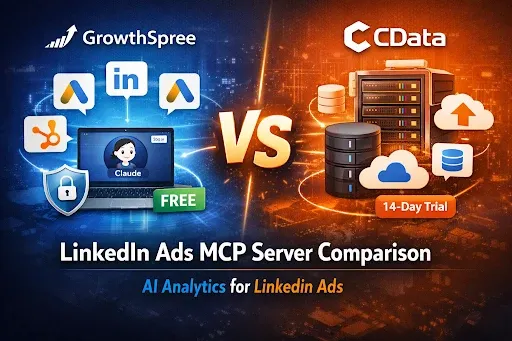
LinkedIn Ads MCP: GrowthSpree vs CData
There is still no official LinkedIn Ads MCP server. Meta, Google, Amazon and TikTok have shipped or announced one. LinkedIn has not, so every option available today is built by a third party, and they differ enormously in who they are for.
Two of them get compared most often, and they are aimed at completely different people. This page sets out what each actually is, where each one wins, and what else exists.
Full disclosure: we build one of them. We have tried to be accurate about both, and where CData’s own documentation contradicts itself, we say so rather than picking the version that flatters us.
Quick answer
| GrowthSpree LinkedIn Ads MCP | CData | |
|---|---|---|
| Built for | Marketers, non-technical | Data engineers and analytics teams |
| The job it does | Answering questions about LinkedIn campaigns | Exposing LinkedIn Ads as a governed SQL data source |
| Setup | Browser sign-in, about 5 minutes | Build from source, install and license a JDBC driver, edit config files |
| Needs Java, Maven, a JDBC driver | No | Yes, for the open-source server |
| Cost | Free to start, LinkedIn Ads is on the Basic plan | JDBC driver licensed separately, Connect AI is a paid product |
| Changes your campaigns | No. It recommends, you apply in Campaign Manager | See the write access section below, the docs are unclear |
| Other sources | Basic adds Google Ads, GA4, Search Console, Microsoft Advertising and HubSpot. Premium adds Meta Ads | Hundreds of enterprise data sources |
| Official LinkedIn product | No | No |
The short version. If a marketer is going to use it daily to ask questions, take the no-code route. If a data team is folding LinkedIn Ads into a governed warehouse alongside dozens of other systems, CData is built for exactly that and the setup cost is the price of the governance.
Key takeaways
- There is no official LinkedIn Ads MCP server as of late 2026, and no announced beta. Everything is third party.
- CData’s open-source server exposes exactly three tools: list tables, list columns, and run a SQL SELECT query. That is the practical answer on what it can do.
- CData’s own repository describes it as “a local, read-only MCP server” in one place and says the client can “read, write, update, and delete the underlying data” in another. We could not resolve this from their public docs.
- GrowthSpree’s connects through LinkedIn OAuth on LinkedIn’s own screen, reads campaigns, audiences, creatives and conversion data, and does not change campaigns, bids or budgets on its own.
- Meta Ads sits on GrowthSpree’s Premium tier, not Basic. Basic covers LinkedIn Ads, Google Ads, GA4, Search Console, Microsoft Advertising and HubSpot.
- Avoid any “LinkedIn MCP” that works by driving a logged-in browser session rather than the Marketing API, particularly on an ad account you depend on.
What each one actually is
CData
CData is an enterprise data integration company, and its LinkedIn Ads MCP reflects that. The open-source server wraps the CData JDBC Driver for LinkedIn Ads, which models LinkedIn Ads data as relational SQL tables. Your AI client then asks questions, and the server translates them into SQL against those tables.
That design is the point. If your organisation already treats data as governed SQL sources, LinkedIn Ads arrives shaped like everything else, and the same patterns, permissions and review processes apply.
Setting up the open-source server involves, roughly:
- Clone the repository and build it with Maven to produce the server JAR
- Download and install the CData JDBC Driver for LinkedIn Ads
- License the driver from the command line, entering a name, email and either TRIAL or a licence key
- Run the driver’s connection string utility, configure and test the connection, then copy the connection string
- Create a properties file specifying the prefix, server name, driver path, driver class, JDBC URL and which tables to expose
- Add an entry to your Claude Desktop config that runs Java with the JAR and the properties file
- Fully quit and reopen Claude Desktop
Separately, CData offers Connect AI, a hosted product it describes as “One endpoint. Every AI tool,” where a single MCP endpoint connects AI tools to live LinkedIn Ads data. That is the commercial, managed path.
None of this is a criticism. It is a data engineering product, and data engineers will find it unremarkable. A marketer will not get past step two.
GrowthSpree
Ours is a hosted connector aimed at marketers who want answers rather than infrastructure. You enter a work email, sign in to LinkedIn through LinkedIn’s own OAuth screen, pick the ad account, copy a token, and add it to your AI tool. That last step is a Claude Desktop extension, a custom connector on paid Claude or Cowork, a single command in Claude Code, or a standard config for other MCP clients. No LinkedIn developer app, no driver, no Java.
It reads campaigns, audiences, creatives and conversion data. It does not change campaigns, bids or budgets on its own. Claude recommends, you apply the change in Campaign Manager.
It works with Claude Desktop, Claude Cowork, Claude Code, ChatGPT as a custom connector, Cursor, Windsurf, and any client that supports remote MCP servers.
On write access, honestly
This is the question people ask most, and it is the one where published information is weakest.
CData. The open-source repository contains two statements that do not agree. It describes the project as building “a local, read-only MCP server,” and elsewhere says the client can use the tools to “read, write, update, and delete the underlying data.” The repository also points to a separate CData MCP Server for LinkedIn Ads for full read, write, update, delete and action capability. CData’s own Connect AI page does not state read or write either way, though it mentions that “source tools map directly to approved system actions.”
What can be verified is the tool list. The open-source server exposes three tools: get tables, get columns, and run query, where run query executes a SQL SELECT. On that evidence it behaves as read-only in practice. If write access matters to you, ask CData directly rather than trusting any third party summary, including this one.
GrowthSpree. Ours does not change your campaigns. Our product page states that Claude recommends changes and you apply them in Campaign Manager, and that it will not change campaigns, bids or budgets on its own. We have deliberately not described the underlying permission scopes here, because we would rather state the behaviour we can stand behind than imply a technical guarantee we have not published.
If your requirement is genuinely an AI assistant that edits live campaigns, neither of these is the obvious choice. Look at the write-capable options in the landscape section below, and think carefully about approval controls before you let anything change spend.
Where CData is the better choice
- You have a data team, and LinkedIn Ads is one source among dozens
- You need SQL semantics, a relational model and the governance that comes with it
- Your organisation already standardises on CData drivers or Connect AI
- You want the same access patterns and permissions across every data source
- The setup effort is a one-off cost absorbed by people who do this for a living
Where GrowthSpree is the better choice
- A marketer, not an engineer, will be the daily user
- You want it working this afternoon
- Your questions cross channels, such as LinkedIn against Google Ads, GA4 or HubSpot pipeline
- You do not want to install Java or license a driver to answer a question about CPL
- Free to start matters while you work out whether this is useful at all
The wider landscape
The comparison above is not the whole market, and the honest framing is that this space moves fast.
| Option | Notes |
|---|---|
| PaidSync | Hosted, advertises write access and a LinkedIn Marketing Partner credential |
| Synter | Hosted commercial |
| Two Minute Reports | Hosted commercial |
| Zapier MCP | Action based and very broad, shallower on LinkedIn Ads specifically |
| Radiate B2B | Managed, no setup |
| Windsor.ai | Read-write actions, broad metric coverage |
| danielpopamd/linkedin-ads-mcp | Open source, self-hosted, read focused, uses the Marketing API |
| Browser-session LinkedIn MCPs | Avoid for a real ad account. These drive a logged-in browser session rather than the API, and LinkedIn’s User Agreement discourages that approach |
That last row matters. Several popular projects with “LinkedIn MCP” in the name automate a browser session rather than calling the Marketing API. They are not built for advertising data, and using one against an ad account you depend on is a risk that is rarely worth taking.
We have not independently tested every option in this table. Check pricing and capabilities with each vendor directly, because almost none of them publish full pricing.
How to choose
| Your situation | Take |
|---|---|
| Marketer who wants fast answers about LinkedIn campaigns | GrowthSpree |
| Data team unifying many governed sources | CData |
| You need an assistant that actually edits campaigns | A write-capable option such as PaidSync or Windsor.ai, with approval controls |
| Cross-channel questions spanning ads, analytics and CRM | GrowthSpree |
| You already run CData drivers elsewhere | CData, for consistency |
Five questions settle it faster than any feature table:
- Who opens this tool on a Tuesday morning, a marketer or an engineer?
- Is LinkedIn the whole job, or one source among many?
- Do you need SQL semantics and formal governance?
- How much setup time is acceptable before the first answer?
- Does anything need to write back, and if so, who approves it?
Can you run both?
Yes, and in larger organisations that is often the sensible answer. They are not really competing. The data team uses CData to land LinkedIn Ads in the warehouse alongside everything else, and the marketing team uses a no-code connector to ask questions during the day without filing a ticket. Nothing about MCP stops you connecting several servers to the same client.
Common misconceptions
“CData is just the harder one.” No. The complexity is the governance. A relational model, licensed driver and explicit configuration are what enterprise data teams want, and calling that a flaw misses who it is built for.
“One of these is the official LinkedIn tool.” Neither is. Both use LinkedIn’s public Marketing API and neither is endorsed by LinkedIn or Microsoft. No official server has been announced.
“An MCP server can run my campaigns.” Most read data. The ones that write are a smaller group and deserve more scrutiny, not less, because the failure mode is spending money rather than returning a wrong number.
Frequently Asked Questions
Q1. Is there an official LinkedIn Ads MCP server?
No. As of late 2026 LinkedIn has not shipped or announced one, with no developer docs and no beta programme, while Meta, Google, Amazon and TikTok have official or announced servers. Every LinkedIn Ads MCP available today is third party.
Q2. What is the difference between GrowthSpree and CData LinkedIn Ads MCP?
They target different users. CData exposes LinkedIn Ads as a governed relational SQL source for data teams, with a build-from-source server and a licensed JDBC driver. GrowthSpree is a hosted no-code connector for marketers that connects through LinkedIn OAuth in about five minutes.
Q3. Which is easier for a marketer to set up?
GrowthSpree, by a wide margin. It is a browser sign-in and a token. CData’s open-source route requires cloning a repository, building with Maven, installing and licensing a JDBC driver, generating a connection string, writing a properties file and editing your client config.
Q4. Can either one change my LinkedIn campaigns?
GrowthSpree does not change campaigns, bids or budgets on its own; it recommends and you apply in Campaign Manager. CData’s position is unclear from its public documentation, which describes the open-source server as read-only in one place and as supporting write and delete in another. Its three exposed tools only run SELECT queries, so in practice it reads. Ask CData directly if write access is a requirement.
Q5. Is either one free?
GrowthSpree is free to start, with LinkedIn Ads on the Basic plan. CData’s open-source server is MIT licensed but needs the CData JDBC Driver for LinkedIn Ads, which is licensed separately and offers a trial, and Connect AI is a paid product.
Q6. Which is better for cross-channel analysis?
It depends what you mean by cross-channel. For marketing channels, GrowthSpree’s Basic plan covers LinkedIn Ads, Google Ads, GA4, Search Console, Microsoft Advertising and HubSpot in one place, with Meta Ads on Premium. For enterprise breadth across hundreds of systems including databases and ERPs, CData covers far more ground.
Q7. What data can each one analyse?
GrowthSpree reads campaigns, audiences, creatives and conversion data from the ad account you connect. CData exposes whatever its LinkedIn Ads driver models as tables, queried with SQL, which gives more raw flexibility and requires more knowledge of the schema.
Q8. Does CData support other data sources?
Yes, that is its main strength. CData builds connectivity for hundreds of enterprise sources, and LinkedIn Ads is one of them. If you are already standardised on its drivers, using the same approach here is a reasonable call.
Q9. Which should an agency choose?
Usually the no-code route, because account managers rather than engineers need the answers, and because agency questions typically span several ad platforms and a CRM. An agency with its own data warehouse and an engineering team may want both.
Q10. What other LinkedIn Ads MCP options exist?
PaidSync, Synter, Two Minute Reports, Radiate B2B, Windsor.ai, Zapier MCP and open-source projects such as danielpopamd/linkedin-ads-mcp. Capabilities and pricing vary a lot and most do not publish full pricing, so check with each vendor.
Q11. Are browser-based LinkedIn MCP servers safe to use?
Not for an ad account you depend on. Several popular projects automate a logged-in browser session rather than calling the Marketing API, and LinkedIn’s User Agreement discourages that approach. Prefer anything that authenticates through LinkedIn OAuth and the official API.
Q12. Can marketing and data teams each use their own?
Yes. MCP clients can connect to several servers at once, and the two tools solve different problems. Larger organisations commonly end up with the data team on CData and marketing on a no-code connector.
Q13. Which is faster to get running?
GrowthSpree takes about five minutes with no developer app and no local dependencies. CData’s open-source server is a build-and-configure job measured in hours if the tooling is new to you, and much quicker if your team already runs CData drivers.
Q14. How should I pick if I am still unsure?
Answer one question: who opens the tool on a Tuesday morning. If it is a marketer, choose the no-code option. If it is an engineer, choose the one that fits your data stack. Almost every other consideration follows from that.
Try the no-code route
Our LinkedIn Ads MCP connects in about five minutes through LinkedIn’s own sign-in screen, and the same plan covers Google Ads, GA4, Search Console, Microsoft Advertising and HubSpot, so you can ask questions that cross platforms rather than one at a time.
Related reading
- LinkedIn Ads MCP product page
- How to connect LinkedIn Ads to Claude with MCP
- Analyse LinkedIn Ads campaigns with AI
- GrowthSpree Google Ads MCP vs Zapier
- MCP servers for B2B SaaS marketing: the complete guide
- The best AI marketing MCP servers for B2B SaaS
Sources
- CData open-source LinkedIn Ads MCP server repository (describes “a local, read-only MCP server,” elsewhere states the client can “read, write, update, and delete the underlying data”; tools are get_tables, get_columns and run_query; requires Java, Maven and the licensed CData JDBC Driver for LinkedIn Ads): https://github.com/CDataSoftware/linkedin-ads-mcp-server-by-cdata
- CData LinkedIn Ads MCP and Connect AI product page: https://www.cdata.com/drivers/linkedinads/mcp/
- GrowthSpree LinkedIn Ads MCP product page (five minute setup, LinkedIn OAuth, Basic and Premium tier coverage, recommends rather than changes campaigns): https://www.growthspreeofficial.com/mcp/linkedin-ads-mcp
- Model Context Protocol documentation: https://modelcontextprotocol.io/docs/getting-started/intro
Notes: CData’s public documentation is internally inconsistent on whether its open-source server supports write operations, and its Connect AI page does not state read or write capability either way. We have reported both statements rather than choosing one. Capabilities and pricing for the third-party options listed in the landscape table have not been independently tested here; confirm with each vendor before buying.
About the author
Ishan Manchanda is Co-Founder at GrowthSpree, a B2B SaaS marketing agency and Google Partner and HubSpot Solutions Partner rated 4.9 on G2. GrowthSpree manages $60M+ in B2B SaaS ad spend across 300+ accounts.