Pipeline,
not promises.
Senior operators audit your funnel in 48 hours. Ship 3 specific moves in 30 days.
- Full-funnel audit · 4 velocity levers
- 3 wins to ship in 30 days
- $3K flat · month-to-month
30-min call · No commitment
- Full-funnel audit · 4 velocity levers
- 3 wins to ship in 30 days
- $3K flat · month-to-month
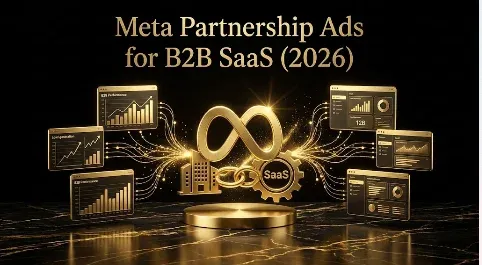
Meta Partnership Ads for B2B SaaS (2026): Running Ads From Your Founder, Experts, and Customers, Not Just the Brand Page
Quick answer: A partnership ad (what used to be called whitelisting or creator licensing) runs a paid ad through someone else’s Facebook or Instagram handle, a creator, your founder, an employee, or a customer, while you keep full control of budget and targeting in Ads Manager. It matters because the ad carries that person’s name, face, and existing trust instead of appearing as yet another ad from a faceless brand page, and Meta’s own data has it averaging roughly 19 percent lower cost per action and 13 percent higher click-through rate than standard ads. For B2B SaaS the important reframing is who your “creator” is: not a lifestyle influencer, but your founder talking about the problem, a senior employee sharing a real take, an industry practitioner your buyers already follow, or a customer describing what changed, because in B2B trust comes from credible people, not polished brand films. Set it up through Meta’s Partnership Ad toggle (the partner approves by handle or sends you an ad code), target two audiences at once (the partner’s own warm followers and a cold lookalike built from their handle), and nail down the rights up front, specifically the whitelisting permission to run paid ads from their handle, not just a one-time posting fee. The most common mistake is treating it like a boosted influencer post; the win comes from running proven, high-performing content natively through a trusted person’s account so it reads as a real voice rather than an advertisement.
Key takeaways
- A partnership ad runs from a person’s handle, not your brand page, so it carries their trust and reads as native, while you keep control of budget and targeting.
- Meta’s own data has it beating standard ads by roughly 19 percent on cost per action and 13 percent on click-through rate (vendor-cited, so directional).
- In B2B SaaS the “creator” is your founder, an employee, an expert, or a customer, not a lifestyle influencer, because B2B trust comes from credible people.
- Target two audiences at once: the partner’s warm followers and a cold lookalike built from their handle.
- Get the whitelisting rights in writing up front, not a one-time posting fee, and do not treat it as a boosted influencer post; run proven content natively through the handle.
Most B2B SaaS teams run every ad from the company page, which is exactly the account people have learned to scroll past, and then wonder why trust is low and costs are high. Partnership ads flip that: the same targeting and budget, but the ad appears to come from a real person your buyer already trusts. This is the 2026 guide to Meta partnership ads for B2B SaaS: what they are, why they work, who to run them with in B2B, how to set them up, and how to handle the rights. It pairs with the ad creative and video guides, since the content that runs through a partner handle is still creative you have to get right.
What a partnership ad is (and is not)
A partnership ad is a paid ad that runs through a partner’s own Facebook or Instagram account rather than your brand page, while you control the budget, targeting, and optimization from your Ads Manager. The industry used to call this whitelisting or creator licensing, and Meta now formalizes it as partnership ads. The thing it is not is a boosted post: treating a creator’s organic post as something you just hit “boost” on is the most common mistake, because it gives you none of the targeting control and misses the point. The point is that the ad looks and feels like it comes from the person, carrying their name, profile, and the trust their audience already extends to them, while you run it with the full power of Ads Manager behind it. There are two variants worth knowing: a creator-only ad that runs purely under the partner’s handle, and a joint ad that shows both your brand and the partner, and it is worth testing both.
The three ways a message can reach the feed are easy to confuse, so it helps to see them side by side:
| Brand-page ad | Boosted creator post | Partnership ad | |
|---|---|---|---|
| Appears to come from | Your company | The creator (organic) | The partner’s handle |
| Carries the person’s trust | No | Yes | Yes |
| Full targeting and optimization | Yes | No (limited) | Yes |
| You keep budget control | Yes | Partial | Yes |
The partnership ad is the only option that combines the partner’s trust with full Ads Manager control, which is exactly why a boosted post is a weak substitute.
Why they work for B2B SaaS
The mechanism is trust transfer. A standard brand ad announces itself as an ad from a company, which is precisely the signal that makes people skeptical and scroll on; a partnership ad arrives wearing the identity of someone the viewer already follows and believes, so the same message lands with social proof baked in. The reported numbers back this up. Meta’s October 2026 creator white paper, drawing on a meta-analysis of 20 EMEA conversion-lift studies, reported partnership ads delivering roughly 45 percent lower median cost per incremental purchase and about 35 percent higher incremental ROAS (though at 92 percent confidence, just under the conventional 95 percent bar, so treat it as strong-but-not-definitive). Older Meta tests put the acquisition-cost gain nearer 19 percent, and an independent agency test found creator-led partnership ads lifting click-through by around 53 percent and cutting cost per action about 19 percent versus brand creative. The exact figure varies by study, but the direction is consistent and large. For B2B SaaS the reframing that unlocks this is understanding who your “creator” is. You are not looking for a lifestyle influencer with a million followers; you are looking for credible voices your buyers already trust: your founder talking plainly about the problem your product solves, a senior employee sharing a genuine point of view (employee advocacy), an independent practitioner or consultant your market follows, or a customer describing the before-and-after in their own words. In B2B, trust comes from credible people with relevant expertise, not from production value, which is exactly what partnership ads are built to carry.
The setup
Setting up a partnership ad is straightforward once the partner is ready:
- The partner prepares their account: a public Instagram in Creator or Business mode, linked to a Business account (or the Facebook equivalent).
- You connect them in Ads Manager: use the Partnership Ad toggle, add the partner by handle, and send a partnership request for them to approve, or have them generate an ad code you enter directly.
- You build the ad: either create a new ad under their handle or run an existing high-performing post from it, keeping your targeting and budget in your account.
- You run it inside an existing campaign, not standalone. Meta’s current guidance is to place partnership ads within your existing ad sets or campaigns using Advantage campaign budget, with Advantage+ placements and Reels, rather than as an isolated campaign, so the content competes and optimizes alongside the rest.
- You target two audiences at once: the partner’s existing followers (a warm audience that already trusts them) and a cold lookalike audience built from their handle or your own best-fit seed, so you reach both their people and new people who resemble good buyers.
Two practical notes. Meta now surfaces discovery, content sourcing, and permissions through a Creator Marketing Hub, with dedicated “Creator management” and “Creator content” permissions in Business Suite, so getting account-level permissions set up is the first unblocking step. And mind the delivery blockers: to reach Facebook placements the creator needs a Facebook Page, and an agency running this needs ad account access plus ads access to the brand’s Instagram account and Facebook Page. A sensible way to start is a single small test with one partner and one piece of content, then expand once you see how it performs against your standard ads.
Licensing and whitelisting: get the rights up front
The part teams skip and regret is the rights. Whitelisting, the permission to actually run paid ads from the partner’s handle, is a separate right from permission to use their content, so it has to be written into your agreement explicitly rather than assumed. When you sign with a creator, employee-advocate, or customer, cover the paid usage rights, the usage term (how long you can run it), exclusivity if any, licensed music, and critically the whitelisting permission to advertise from their account, and favor perpetual or long-term ad rights over a one-time posting fee so a winning ad does not expire on you. Getting this wrong means you build a great partnership ad and then lose the right to run it, so settle the rights before you spend on production.
Who to partner with in B2B SaaS
The partners that work in B2B are not the ones a consumer brand would chase. In rough order of how reliably they help: your founder or a senior leader, because founder-led content carries authentic authority and is usually the easiest handle to secure; employees with genuine expertise and a real audience, through an employee-advocacy approach; independent experts, consultants, or practitioners your buyers already follow, who lend outside credibility; and customers willing to go on record, whose testimonials are the most persuasive proof of all. The common thread is relevance and credibility over raw follower count, because a 5,000-follower practitioner your exact buyers respect will outperform a 500,000-follower generalist who means nothing to them. Start with the handle you can most easily secure and that carries the most trust with your specific audience, which for most B2B SaaS companies is the founder.
Field note: The instinct that holds B2B teams back from partnership ads is the belief that their brand page is the “professional” place for ads to come from, when in reality the brand page is the least trusted sender in the feed. People have been trained for years to recognize and ignore ads from company pages, so the most polished brand ad still carries the handicap of visibly being an ad from a company that wants something. A partnership ad removes that handicap by running the same message from a person the viewer already follows and believes, and in B2B that person does not need to be a professional creator at all, the single highest-leverage partner is usually the founder, whose face and voice carry more authority about the product than any brand asset could. The teams that make this work treat it as a trust channel rather than an influencer play: they get the founder on camera talking plainly about the problem, they secure the whitelisting rights in writing so they can run the content as a proper ad with real targeting rather than a boosted post, and they run it to both the founder’s existing network and a cold lookalike so it reaches warm and new audiences at once. The mistake that wastes the opportunity is treating it like hiring an influencer, paying a one-time fee to post something and hitting boost, which gives up the targeting control that makes it a performance channel and often loses the rights to keep running a winner. Done properly, partnership ads are one of the few ways to buy down the trust deficit that every B2B brand page carries, and the reported 19 percent lower cost per action is really just the price of looking like a person instead of an advertiser.
Honest limitations
- The performance figures are mostly Meta’s own studies. The headline numbers (the 45 percent lower cost per incremental purchase, the older 19 percent, the higher ROAS) come largely from Meta’s own conversion-lift research, some of it below the conventional 95 percent confidence bar, so treat them as directional evidence and prove the lift in your own account with a real test against brand creative.
- It depends on securing a willing, credible partner. The format only works if you can get a founder, expert, or customer to lend their handle and sign the rights, which is a real constraint.
- Rights are a legal step, not an afterthought. Without explicit whitelisting permission written into the agreement, you can lose the ability to run a winning ad, so the paperwork matters.
- It is not a fix for weak content. A partnership ad amplifies trust, but if the underlying message or offer is weak, running it from a trusted handle will not save it.
- Founder and employee bandwidth is finite. The best B2B partners are busy people, so plan for a sustainable cadence rather than a volume of content they cannot produce.
- This is educational, not investment or financial advice, and validates against your own account.
Frequently Asked Questions
Q1. What is a Meta partnership ad, and how is it different from a normal ad?
A Meta partnership ad is a paid ad that runs through another person’s Facebook or Instagram handle, a creator, your founder, an employee, or a customer, rather than through your brand page, while you retain full control of the budget, targeting, and optimization from your own Ads Manager. The industry used to call this whitelisting or creator licensing, and Meta now formalizes it under the partnership ads name. The difference from a normal brand ad is whose identity the ad carries: a standard ad visibly comes from your company, which triggers the skepticism people have learned to apply to brand advertising, whereas a partnership ad appears to come from the partner, carrying their name, profile, and the trust their audience already extends to them, so it reads as native content rather than an advertisement. It is also different from a boosted post, which is the most common mistake people make: boosting a creator’s organic post gives you none of the targeting precision and optimization control that make partnership ads a real performance channel. With a partnership ad you get both the trust of the partner’s handle and the full targeting power of Ads Manager, which is the combination that makes the format work. There are two variants: a creator-only ad that runs solely under the partner’s handle, and a joint ad that displays both your brand and the partner, and testing both is worthwhile since they suit different goals.
Q2. Do partnership ads actually perform better for B2B?
The reported data says yes, though you should prove it in your own account. Meta’s own cited figures have partnership ads averaging roughly 19 percent lower cost per action and about 13 percent higher click-through rate than standard ads, and the mechanism behind that is straightforward: the ad carries the trust and social proof of a real person’s account rather than announcing itself as a company advertisement, so it earns more attention and more clicks at a lower cost. For B2B specifically, the logic is even stronger than for consumer brands, because B2B buyers are especially skeptical of vendor claims and especially responsive to credible peers and experts, which is exactly what a partnership ad delivers. That said, the published numbers are vendor-cited without a transparent sample, so treat them as directional evidence of the direction and size of the effect rather than a guarantee, and run your own test comparing a partnership ad against an equivalent brand-page ad to see the real lift for your audience and offer. The honest framing is that partnership ads remove the trust handicap that every brand page carries in the feed, and the reported cost and click improvements are the measurable result of looking like a trusted person instead of an advertiser, but your actual numbers will depend on how credible and relevant your chosen partner is to your specific buyers.
Q3. Who should a B2B SaaS company run partnership ads with?
Not lifestyle influencers, but credible voices your buyers already trust, and in rough priority order that means your founder, your expert employees, independent practitioners your market follows, and your customers. The founder is usually the best and easiest place to start, because founder-led content carries authentic authority about the product, and the founder’s handle is the one you can most readily secure and get rights to. Expert employees come next, through an employee-advocacy approach where people with genuine knowledge and a real audience lend their handles, which both humanizes the brand and scales your available partners. Independent experts, consultants, or practitioners your buyers already follow add outside credibility that no internal voice can, because they are seen as neutral. And customers willing to go on record provide the most persuasive proof of all, since a real user describing what changed is the testimonial B2B buyers trust most. The decisive criterion across all of these is relevance and credibility with your specific audience rather than raw follower count: a practitioner with 5,000 followers who are exactly your buyers will outperform a generalist with hundreds of thousands who are not, because the trust only transfers if the audience overlap and the credibility are real. Most B2B SaaS companies should start with the founder, prove the format, then expand to employees, experts, and customers as they build a repeatable process for securing handles and rights.
Q4. How do I set up a partnership ad on Meta?
The setup has a few clear steps once your partner is willing. First, the partner prepares their account: for Instagram they need a public account in Creator or Business mode, linked to a Business account, and there is a Facebook equivalent. Second, you connect them in Ads Manager using the Partnership Ad toggle, adding the partner by their handle and sending a partnership request for them to approve, or alternatively the partner can generate an ad code that you enter directly, which is useful when coordinating approvals is slow. Third, you build the ad, either creating a new ad that will run under the partner’s handle or selecting an existing high-performing post from their account to run as an ad, while keeping all of your targeting and budget settings in your own Ads Manager. Fourth, you set your audiences, and the best practice is to target two at once: the partner’s existing followers, who are a warm audience that already trusts them, and a cold lookalike audience built either from the partner’s handle or from your own best-fit customer seed, so that you reach both the partner’s people and new people who resemble your good buyers. A sensible way to begin is a single small test with one partner and one piece of content, measured against your standard brand ads, before you expand to more partners or more content, because that tells you whether the trust transfer is working for your specific audience before you invest heavily.
Q5. What rights or licensing do I need for partnership ads?
You need explicit whitelisting rights, which are a separate permission from the right to use someone’s content, and this is the step teams most often skip and regret. Whitelisting is the specific permission to run paid ads from the partner’s handle, and it has to be written into your agreement rather than assumed, because a creator or customer agreeing to make or post content is not the same as agreeing to let you advertise from their account. When you sign with a partner, whether a creator, an employee-advocate, or a customer, your agreement should cover the paid usage rights, the usage term (how long you are allowed to run the content), any exclusivity, licensed music if the content uses it, and critically the whitelisting permission to advertise from their account. It is also wise to secure perpetual or long-term ad rights rather than paying a one-time posting fee, because if you create a winning partnership ad and only have short-term rights, you will lose the ability to keep running your best performer just as it proves itself. The practical rule is to settle all of this before you spend on production, because the worst outcome is investing in a great partnership ad and then discovering you do not have the right to run it as an ad or that the right expires in weeks. Treat the rights as a prerequisite, not paperwork to sort out later.
Q6. Can I use partnership ads with my founder or employees instead of influencers?
Yes, and for most B2B SaaS companies that is exactly the right approach, because your founder and employees are usually more credible and more relevant to your buyers than any outside influencer. The partnership ads format does not require a professional creator; it works with any handle whose owner your audience trusts, and in B2B that trust is concentrated in people with genuine expertise rather than large followings. Founder-led partnership ads are often the single highest-leverage version of the format, because the founder’s face and voice carry authentic authority about the product that no brand asset can match, and the founder is typically the easiest partner to secure rights from since they are inside the company. Employee advocacy extends this: employees with real knowledge and a genuine professional audience can lend their handles to run ads, which both humanizes the brand and multiplies the number of trusted senders you can advertise from. The same setup and rights apply, you still connect the handle through the Partnership Ad toggle and you still want whitelisting permission in writing even for your own employees, partly for clarity and partly because employees may leave. The main constraint with founders and employees is bandwidth, since the best internal partners are busy, so plan a sustainable content cadence rather than expecting a steady stream, and start with the founder to prove the format before scaling to a wider set of employee-advocates.
Q7. What is the most common mistake with partnership ads?
Treating a partnership ad like a boosted influencer post, which throws away the two things that make the format valuable: targeting control and the rights to keep running winners. The classic version of this mistake is paying a creator a one-time fee to post something and then hitting the boost button, which gives you an organic post with a little budget behind it rather than a properly targeted ad, so you lose the ability to choose audiences, optimize, and scale the way you can with a real campaign in Ads Manager. A related mistake is failing to secure whitelisting rights in writing, so that even a well-set-up partnership ad either cannot run as a true ad from the partner’s handle or expires when a short-term agreement ends, stranding a proven performer. A third mistake is choosing partners by follower count rather than by credibility and audience relevance, which is especially damaging in B2B where a large but irrelevant audience transfers no useful trust. And a fourth is expecting the format to rescue weak content: a partnership ad amplifies the trust and native feel of the message, but if the underlying offer or message is weak, running it from a trusted handle will not fix it. The way to avoid all of these is to treat partnership ads as a performance channel rather than an influencer transaction: secure the rights up front, run the content as a properly targeted ad to both the partner’s warm audience and a cold lookalike, choose partners for relevance and credibility, and feed the format strong content that is worth amplifying.
If you want a Meta program that runs ads from the trusted voices your buyers actually follow, book a demo with Growthspree.
Sources & further reading
- 2026 practitioner and industry coverage (Kalungi on Meta partnership ads for B2B; Flighted on UGC, whitelisting, and partnership ads; PPC Land and eMarketer on Meta’s October 2026 creator white paper and partnership ads expansion; BMG360 on partnership versus traditional creative) on what partnership ads are, how whitelisting works, the creator-handle-versus-brand-page trust transfer, setup inside Advantage campaign budget with the Creator Marketing Hub and Business Suite permissions, the two-audience targeting approach, licensing terms, and the reported lift (45 percent lower cost per incremental purchase at 92 percent confidence, the older 19 percent acquisition-cost figure, ~35 percent higher incremental ROAS, an independent ~53 percent CTR lift). These are largely Meta’s own studies; treat them as directional and validate in your own account.
- Meta Ads Help and Marketing API (partnership ads setup, the Partnership Ad toggle, creator handles and ad codes, the Partnership Ads Hub).
- GrowthSpree (B2B SaaS practice: run partnership ads from the founder, expert employees, practitioners, and customers rather than lifestyle influencers, secure whitelisting rights up front, and run proven content natively rather than boosting).
- Companion: Meta Ad Creative for B2B SaaS; Meta Video Ads for B2B SaaS; Meta Ads Audience Targeting for B2B SaaS; Meta Ads for B2B SaaS.
This guide is educational, not investment or financial advice; Meta’s partnership ads tools change, so verify current behavior against Meta’s documentation and validate against your own account.
Related guides: Meta Ad Creative for B2B SaaS · Meta Video Ads for B2B SaaS · Meta Ads Audience Targeting for B2B SaaS · Meta Ads for B2B SaaS.