Pipeline,
not promises.
Senior operators audit your funnel in 48 hours. Ship 3 specific moves in 30 days.
- Full-funnel audit · 4 velocity levers
- 3 wins to ship in 30 days
- $3K flat · month-to-month
30-min call · No commitment
- Full-funnel audit · 4 velocity levers
- 3 wins to ship in 30 days
- $3K flat · month-to-month
Meta Lookalike Audiences for B2B SaaS (2026): Why Your Seed Matters More Than the Percentage, and What Changed
Quick answer: A lookalike audience asks Meta to find new people who resemble a “seed” list you give it (your customers, leads, website visitors, or video viewers), and for B2B SaaS the single biggest lever is the quality of that seed, not the percentage slider. A small, homogeneous, high-value seed (say 1,000 of your best-fit customers) beats a large, mixed one (50,000 random signups) because the algorithm learns a sharper pattern. The B2B catch is that your obvious seed, your CRM list of business emails, usually matches poorly to personal Facebook and Instagram accounts, so the uploaded list is thin and noisy; in 2026 the seeds that often work better are Meta-native ones it can match cleanly, like people who watched 25 percent of your video, engaged with your page, or opened a lead form. Use value-based seeds where you can (your top 25 percent by lifetime value, or closed-won accounts, not all signups), keep the lookalike percentage tight for direct response (1 to 2 percent) and wider only for awareness (cost per lead rises as you widen), and exclude existing customers and recent converters. The other big change: after Meta’s Andromeda update, a lookalike inside an Advantage+ campaign now acts as a suggestion rather than a hard boundary, so Meta can deliver beyond the percentage you picked; the 2026 best practice is to feed a strong lookalike in as a signal and let Advantage+ run, rather than splitting into many narrow lookalike ad sets that fragment the learning.
Key takeaways
- The seed decides everything: a small, homogeneous, high-value seed beats a big mixed one, because the algorithm learns a sharper pattern to match.
- CRM lists match poorly in B2B: business emails do not map well to personal Meta accounts, so Meta-native seeds (video viewers, page engagers, lead-form openers) often beat an uploaded customer list.
- Use value-based seeds: your top 25 percent by lifetime value or closed-won accounts, not every signup, which materially lowers cost per acquisition in agency data.
- Percentage is a reach-vs-precision dial: 1 to 2 percent for direct response, wider only for awareness, and cost per lead rises as you widen.
- Andromeda changed the mechanics: inside Advantage+ a lookalike is now a suggestion, not a hard boundary, so feed a strong one in and let it run rather than splitting into many narrow lookalike ad sets.
Lookalike audiences are the most misunderstood tool in B2B SaaS Meta advertising, because teams obsess over the 1-to-10-percent slider while ignoring the thing that actually determines results, the seed they feed it, and because the mechanics quietly changed in 2026. This guide covers what a lookalike is, why your CRM is often the wrong seed for B2B, which seeds work, how value-based lookalikes help, what percentage to use, and how lookalikes behave now that Advantage+ has reshaped them. It is a spoke of the broader audience targeting guide, which covers cold interest and demographic targeting; this one is specifically about seed-based expansion.
What a lookalike is, and what changed in 2026
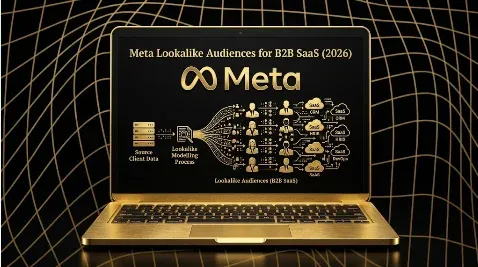
A lookalike audience takes a source list you provide, the seed, and asks Meta to find new people who statistically resemble it, sized as a percentage (1 to 10) of a country’s population, where 1 percent is the closest match and 10 percent the broadest. That much is unchanged. What changed is how it behaves inside modern campaigns: after Meta’s Andromeda update (rolled out globally through late 2025), a lookalike used in an Advantage+ campaign functions as an audience suggestion rather than a hard constraint, so Meta can and does deliver beyond the percentage slice you chose if it finds better buyers outside it. Worth knowing precisely: inside Advantage+, the audience controls (like minimum age and excluded locations) are hard constraints Meta must obey, while suggestions (lookalikes and interests) are soft inputs the system can expand past. The practical implication is that the slider is now more of a hint than a wall, and the 2026 best practice most agencies land on is to supply a strong lookalike as a signal inside Advantage+ (now Meta’s recommended default for most new campaigns) rather than building many narrow lookalike ad sets, which only fragments the conversion data the algorithm needs to learn.
The direction the data points is consistent: vendor benchmarks report 1-to-3-percent lookalikes beating interest targeting by around 32 percent on cost per acquisition, Advantage+ audiences running roughly 18 percent lower CPA than classic lookalikes, and, on mature pixels, broad targeting outperforming standard lookalike setups (one dataset showed 113 percent versus 76 percent ROAS), with that gap narrowing as seed quality improves. These are vendor and single-account figures, so treat them as directional, but they all tell the same story, lean on an explicit lookalike while your account is young and your pixel is thin, lean on broad Advantage+ as your conversion data matures, and in both cases keep the seed strong.
The B2B seed problem
Here is what general lookalike advice misses for B2B SaaS. The obvious seed is your customer list, so you export your CRM and upload it, but B2B CRM lists are full of work email addresses, and Meta matches people by their personal Facebook and Instagram accounts, which are usually tied to personal emails and phone numbers. So a B2B customer list often matches at a low rate, and the seed Meta actually builds from is a thin, partial slice of your list, which produces a weak lookalike. This is why in 2026 the seeds that frequently work better for B2B are the ones Meta can match cleanly because they already happened on its own platforms: people who watched 25 percent or more of your video, people who engaged with your Facebook page or Instagram profile, and people who opened or submitted a lead form. These Meta-native seeds sidestep the match-rate problem entirely, which is a large part of why they often outperform an uploaded customer list for B2B since the iOS privacy changes.
Seed quality beats seed size
The instinct is to make the seed as big as possible, but homogeneity matters more than size: a tight, consistent seed teaches a sharper pattern than a large, mixed one. A useful ranking of seed quality for B2B SaaS, best first:
| Seed quality | Example sources |
|---|---|
| Highest | Recent closed-won customers; top 25 percent by lifetime value |
| High | High-intent events (demo requests, lead-form submits) |
| Moderate (but clean match) | Video viewers (25 percent plus), page and profile engagers |
| Moderate (poor B2B match) | Uploaded customer and email lists |
| Lower | Broad page followers, low-intent engagers |
On size, Meta’s own floor is at least 100 people in the seed, but 1,000 or more tends to produce more stable results, and the headline finding practitioners repeat is that a seed of around 1,000 genuinely high-value buyers outperforms a seed of 50,000 mixed subscribers, because the small seed is pure signal and the large one is mostly noise. So the target is a seed that is large enough to be stable (comfortably into the thousands where you can) but filtered hard for quality, for example the top 10 to 20 percent of customers by lifetime spend, customers with repeat purchases, or converters from the last 30 to 60 days. Keep source audiences fresh too: signal drift is fast, so a seed built from data around 30 days old tends to outperform one around six months old, which is why you refresh website-based sources on roughly a 180-day retention window and in-Meta engagement on up to 365 days but rebuild the high-value seed itself far more often. You can generate up to six lookalikes at once, and each takes a few hours to about a day to populate.
Value-based lookalikes
If you can attach value to your seed, do. A value-based lookalike seeds from your highest-value customers rather than all customers, so Meta looks for people resembling your best accounts, not your average one. Agency data in 2026 reports meaningfully lower cost per acquisition from seeding on the top 25 percent of customers by lifetime value versus the full customer list (one agency reported roughly a third lower CPA). For B2B SaaS the equivalent move, even without clean LTV values flowing back to Meta, is to seed on closed-won accounts or your best-fit segment rather than every trial signup, so the lookalike chases buyers who look like revenue rather than buyers who look like tire-kickers.
What percentage to use
Think of the percentage as a precision-versus-reach dial, and remember that cost per result climbs as you widen it. Rough guidance:
| Percentage | Role |
|---|---|
| 1 to 2 percent | Tightest match; direct response and conversion |
| 3 to 5 percent | Scaling a proven campaign; broader lead gen |
| 6 to 10 percent | Awareness and top-of-funnel reach |
One public test found cost per lead rising steadily with width (roughly a quarter to two-thirds more expensive at 10 percent than at 1 percent), which is the pattern to expect: wider reaches more people but dilutes the resemblance, so you pay more per conversion. Given the lookalike-as-suggestion behavior inside Advantage+, the percentage matters less than it used to, but the principle holds, start tight for conversion goals and only widen deliberately for reach.
How to run lookalikes in 2026
Putting it together, the modern approach for B2B SaaS:
- Pick the best seed you can match, favoring Meta-native high-intent sources (video viewers, lead-form openers, engagers) and value-based lists (closed-won, high-LTV) over a raw CRM upload.
- Keep the seed homogeneous, one clear source per lookalike, and refresh it on a sensible window.
- Feed it into Advantage+ as a signal rather than building a wall of narrow lookalike ad sets, since fragmentation starves learning and the suggestion behavior extends delivery anyway.
- Start tight (1 to 2 percent) for conversion, widen only for awareness, and exclude existing customers and recent converters so you are prospecting, not re-paying for people you already have.
- Do not stack lookalike tiers in one campaign. Running 1 percent, 3 percent, and 5 percent lookalikes in the same campaign backfires, because the smaller tiers sit inside the larger ones and the ad sets end up bidding against each other, which advertisers report inflating CPM by up to 40 percent. If you must test tiers, give each its own campaign (and run any broad Advantage+ campaign separately with its own budget), then evaluate after 7 to 14 days.
- Clean your seed and exclusion lists before uploading, because Meta removed detailed-targeting exclusions in early 2025, so you can no longer patch a messy list inside Ads Manager; the list you upload is the list you get.
- Judge it on cost per qualified lead and downstream quality, comparing against your other prospecting audiences, not on reach.
Field note: The most common lookalike mistake in B2B SaaS is uploading the CRM, building a 1 percent lookalike from it, and expecting magic, then concluding lookalikes “do not work for B2B” when the real problem was never the lookalike, it was the seed. That CRM list of work emails matched to maybe half or fewer of their personal Meta accounts, so the seed Meta actually built from was a thin, partial, noisy version of the customer base, and a weak seed produces a weak lookalike no matter what percentage you choose. The teams that get lookalikes working in B2B do something counterintuitive: they often stop uploading the customer list altogether and seed instead from high-intent activity that happened on Meta itself, people who watched most of a video, opened a lead form, or engaged with the page, because Meta can match those perfectly and the intent signal is strong. They also seed on quality rather than quantity, picking their best-fit closed-won accounts over every signup, because a lookalike of your best customers chases revenue while a lookalike of all signups chases averages. And in 2026 they have stopped building elaborate ladders of 1 percent, 2 percent, and 5 percent lookalike ad sets, because inside Advantage+ the lookalike is a suggestion the system reads and then delivers around, so splitting into many narrow sets just fragments the data and slows learning. The uncomfortable truth is that the lookalike feature is only as good as the list behind it, so the work that matters is choosing and cleaning the seed, not fiddling with the slider, and a team spending its energy on the percentage while feeding Meta a poorly matched CRM dump is optimizing the wrong end of the tool.
Honest limitations
- B2B match rates are genuinely low. Work-email CRM lists map poorly to personal Meta accounts, so an uploaded seed is often weaker than it looks; prefer Meta-native seeds.
- The cited CPA and CPL figures are vendor and single-test data. Treat the value-based CPA improvement and the percentage-versus-cost numbers as directional, not guaranteed.
- Advantage+ has blurred the percentage. Because a lookalike now acts as a suggestion inside Advantage+, the slider controls less than it once did, so do not over-engineer it.
- Small seeds can be too small. Homogeneity helps, but a seed of a few dozen gives the algorithm almost nothing; aim for a seed large enough to form a pattern while staying high-quality.
- Lookalikes are prospecting, not retargeting. They find new people; re-engaging warm audiences is a separate job covered in the retargeting guide, and you should exclude existing customers from lookalike delivery.
- This is educational, not investment or financial advice, and validates against your own account.
Frequently Asked Questions
Q1. Do Meta lookalike audiences still work for B2B SaaS in 2026?
Yes, but their role has shifted and the way you use them matters more than whether you use them. Lookalikes remain an active, useful prospecting tool, and they still tend to win for newer accounts without much pixel history, for niche products, and for high-value products where precise matching pays off. What changed in 2026 is that Meta’s Andromeda update made a lookalike used inside an Advantage+ campaign behave as an audience suggestion rather than a hard boundary, so the system can deliver beyond the exact percentage slice you chose when it finds better buyers nearby. In mature accounts with strong conversion history, broad Advantage+ targeting often performs as well as or better than a manually built lookalike, because the algorithm already has enough signal to find your buyers without the explicit seed. The practical takeaway for B2B SaaS is not “lookalikes are dead” nor “always use lookalikes,” but rather use a strong lookalike as a signal you feed into Advantage+, lean on it more when your account is new or your pixel data is thin, and lean on broad targeting more as your conversion data matures. The biggest determinant of whether a lookalike works for you is still the quality of the seed you build it from, which is where most B2B teams go wrong, so the honest answer is that lookalikes work when the seed is good and disappoint when it is not.
Q2. Why do my B2B customer-list lookalikes perform badly?
Almost always because the seed matches poorly, which is a structural B2B problem rather than a mistake you made. When you export your CRM and upload it as a custom audience to seed a lookalike, that list is full of work email addresses, but Meta matches people to their personal Facebook and Instagram accounts, which are usually tied to personal emails and phone numbers. As a result, a B2B customer list frequently matches at a low rate, so the seed Meta actually builds its lookalike from is a thin, partial slice of your customer base, and a weak, incomplete seed produces a weak lookalike no matter which percentage you select. This is why so many B2B teams conclude lookalikes do not work, when the truth is the lookalike never got a clean seed to learn from. The fix is to seed from sources Meta can match cleanly because they happened on its own platforms: people who watched a meaningful portion of your video (for example 25 percent or more), people who engaged with your Facebook page or Instagram profile, and people who opened or submitted a lead form. These Meta-native seeds sidestep the match-rate problem entirely, and since the iOS privacy changes they frequently outperform uploaded customer lists for B2B. If you do want to seed from customers, seed from your best-fit, highest-value accounts rather than the entire list, and accept that the match rate will still limit how much signal Meta extracts.
Q3. What makes a good lookalike seed for B2B SaaS?
A good seed is homogeneous, high-value, high-intent, and cleanly matchable, and those qualities matter far more than the seed’s size. Homogeneous means the people in the seed resemble each other, so the algorithm learns a sharp pattern rather than an averaged mush; a seed of 1,000 genuinely similar high-value buyers outperforms a seed of 50,000 mixed subscribers for exactly this reason. High-value means seeding on your best accounts (closed-won customers, the top 25 percent by lifetime value, your best-fit segment) rather than every signup, so the lookalike chases buyers who look like revenue. High-intent means favoring sources that demonstrate real interest, such as demo requesters and lead-form submitters, over passive ones like broad page followers. Cleanly matchable, the B2B-specific criterion, means favoring seeds that happened on Meta (video viewers, page and profile engagers, lead-form openers) over uploaded work-email lists that match poorly. A rough quality ranking puts recent closed-won customers and top-LTV customers at the top, high-intent events next, then clean Meta-native engagement sources, then uploaded customer and email lists (which suffer the match-rate problem), and broad low-intent followers at the bottom. Keep the seed fresh as well, refreshing website-based sources on roughly a 180-day window and in-Meta engagement on up to 365 days, so the lookalike reflects who actually buys from you now rather than who did two years ago.
Q4. What is a value-based lookalike and should B2B SaaS use one?
A value-based lookalike seeds from your most valuable customers rather than all of them, so Meta looks for people who resemble your best accounts instead of your average account, and yes, B2B SaaS should use the concept even if not always the literal feature. In its pure form, a value-based lookalike uses customer lifetime value data to weight the seed toward high spenders, and 2026 agency data reports meaningfully lower cost per acquisition from seeding on the top 25 percent of customers by lifetime value compared with the full customer list (one agency cited roughly a third lower CPA). The pure feature depends on passing reliable value data back to Meta, which many B2B SaaS companies with long, offline, sales-led deal cycles cannot easily do. But the principle translates even without clean value signals: instead of seeding on every trial signup or every lead, seed on your closed-won accounts, your best-fit customer segment, or your highest-tier plan customers, so the lookalike is built from the people who became real revenue rather than the people who merely entered the funnel. This matters especially in B2B because signup-based seeds are dominated by tire-kickers, free-trial abandoners, and poor-fit curiosity sign-ups, and a lookalike of those chases more of the same, whereas a lookalike of genuine customers chases genuine buyers. So the actionable version for most B2B SaaS teams is: define your best customers however your data allows, and seed from them specifically rather than from the whole top of the funnel.
Q5. What lookalike percentage should I use for B2B lead gen?
Treat the percentage as a precision-versus-reach dial and start tight, because cost per result reliably climbs as you widen it. For direct-response and conversion goals, a 1 to 2 percent lookalike gives the closest match to your seed and the most efficient cost per lead; for scaling a proven campaign or broader lead gen, 3 to 5 percent trades some precision for more reach; and for awareness or top-of-funnel work, 6 to 10 percent maximizes reach at the cost of resemblance. Public testing consistently shows cost per lead rising as the percentage widens (one test found the 10 percent audience roughly a quarter to two-thirds more expensive per lead than the 1 percent audience), which is exactly what you would expect, since a wider lookalike includes people who resemble your seed less closely. That said, the percentage matters less in 2026 than it used to, because inside an Advantage+ campaign a lookalike now functions as a suggestion rather than a hard limit, so Meta may deliver beyond your chosen slice regardless. The practical rule for B2B lead gen is therefore to start at 1 to 2 percent when your goal is qualified leads, widen deliberately only when you are intentionally buying reach or awareness, and not to over-engineer a ladder of multiple percentages, since that fragments your conversion data and the suggestion behavior blurs the boundaries anyway. Judge the result on cost per qualified lead and lead quality, not on how many people the audience theoretically reaches.
Q6. Should I build lookalikes or just use Advantage+ broad targeting?
Use both, matched to your account’s maturity, rather than treating it as an either-or. For a newer B2B SaaS account without much conversion history, an explicit lookalike built from a strong seed gives Meta a head start, because broad Advantage+ targeting with little conversion signal tends toward random exploration until it has gathered enough data (roughly on the order of 100 conversions a week is where broad targeting starts to find its footing, which many B2B accounts cannot hit quickly). For a mature account with a healthy flow of conversions, broad Advantage+ targeting often matches or beats a manual lookalike, because the algorithm already has enough signal to find your buyers without the explicit seed. The 2026 best practice that reconciles the two is to feed a strong lookalike into an Advantage+ campaign as a signal rather than running it as a rigid standalone audience, since Andromeda made the lookalike behave as a suggestion the system reads and then delivers around. This gives you the benefit of your seed-based signal and the benefit of the algorithm’s freedom to find good buyers nearby. What you should avoid is building an elaborate structure of many narrow lookalike ad sets at different percentages, because that fragments your conversion data across too many sets and slows learning, which hurts performance more than the targeting precision helps. So the decision rule is: lean on explicit lookalikes early and for niche or high-value products, lean on broad Advantage+ as data matures, and in both cases keep the structure simple.
Q7. How do I avoid wasting lookalike budget on existing customers?
Exclude your existing customers and recent converters from the lookalike’s delivery, because a lookalike’s job is to find new people who resemble your buyers, not to re-show ads to the buyers themselves. By default a lookalike targets people similar to your seed, and some of those people will be your current customers or recent leads, so without exclusions you end up paying prospecting rates to reach people who are already in your funnel or already paying you, which both wastes budget and distorts your results. The fix is to add your customer list and your recent-converter custom audiences as exclusions on the lookalike ad set, so Meta removes them from delivery and spends only on genuinely new prospects. This matters more in B2B than it sounds, because your audiences are small and a meaningful share of a tight lookalike can overlap with people you already have, especially if you also run retargeting to those same warm audiences, where overlap would make the lookalike and the retargeting campaigns compete for the same people. Beyond exclusions, keep lookalike prospecting and warm-audience retargeting as distinct jobs with distinct audiences: the lookalike finds new lookalike prospects, the retargeting re-engages people who already know you, and the exclusions are what keep those two from colliding. Review the overlap periodically as your customer base grows, and refresh both the seed and the exclusion lists so the lookalike keeps pointing outward at new buyers rather than inward at people you have already converted.
If you want a Meta program that builds lookalikes from seeds that actually predict B2B revenue, book a demo with Growthspree.
Sources & further reading
- 2026 practitioner and vendor guides (Madgicx and Marketful on lookalikes in 2026; SaveMyLeads on building lookalikes) on seed sources and quality, the Andromeda / Advantage+ “suggestion” behavior and hard-versus-soft constraints, the minimum (100) and stable (1,000-plus) seed sizes, value-based lookalikes (top 10 to 20 percent by LTV, repeat purchasers, recent converters), percentage sizing and the cost-per-lead curve, the don’t-stack-tiers rule and the up-to-40-percent CPM inflation from nested lookalikes, the early-2025 removal of detailed-targeting exclusions, and the comparison benchmarks (1-to-3-percent lookalikes beating interest targeting by ~32 percent CPA, Advantage+ ~18 percent lower CPA than classic lookalikes, 113 versus 76 percent ROAS on mature pixels). Figures are vendor or single-account data and directional; validate against your own account.
- Meta Ads Help (lookalike audiences, custom audiences as sources, value-based lookalikes, Advantage+ audience).
- GrowthSpree (B2B SaaS lookalike practice: seed from Meta-native high-intent sources and best-fit customers rather than raw CRM uploads, feed a strong lookalike into Advantage+ as a signal, start tight and exclude existing customers).
- Companion: Meta Ads Audience Targeting for B2B SaaS; Meta Retargeting for B2B SaaS; Meta Ad Creative for B2B SaaS; Meta Ads for B2B SaaS.
This guide is educational, not investment or financial advice; Meta’s audience tools change, so verify current behavior against Meta’s documentation and validate against your own account.
Related guides: Meta Ads Audience Targeting for B2B SaaS · Meta Retargeting for B2B SaaS · Meta Ad Creative for B2B SaaS · Meta Ads for B2B SaaS.