Pipeline,
not promises.
Senior operators audit your funnel in 48 hours. Ship 3 specific moves in 30 days.
- Full-funnel audit · 4 velocity levers
- 3 wins to ship in 30 days
- $3K flat · month-to-month
30-min call · No commitment
- Full-funnel audit · 4 velocity levers
- 3 wins to ship in 30 days
- $3K flat · month-to-month
Meta CBO vs ABO for B2B SaaS (2026): Why Low Conversion Volume Should Keep You in ABO Longer
Quick answer: ABO (ad set budget optimization) means you set a fixed budget per ad set and Meta spends it only there; CBO (campaign budget optimization, now called Advantage campaign budget) means you set one campaign budget and Meta moves it across ad sets toward the cheapest conversions. The rule of thumb is test with ABO, scale with CBO, but the B2B SaaS twist is that low conversion volume should keep you in ABO longer than a consumer brand would stay. CBO needs volume to allocate budget well (each ad set still wants roughly 50 conversions a week to learn), and on a small B2B account it tends to starve most ad sets, dump the budget into one before it has real data, and bias your test results, so it quietly ruins clean testing. ABO gives every creative and audience an equal, fixed budget, which is exactly what you need to read a clean result on thin volume, and it works fine at low volume where CBO struggles. So the practical pattern for B2B SaaS is: test creatives, audiences, and offers in ABO with equal budgets, let them run 7 to 14 days, identify real winners, then move those winners into a CBO campaign to scale once you actually have the conversion volume to feed it, keeping a small share of budget (around 5 to 10 percent) in ongoing ABO testing. Do not flip an existing campaign between the two, since that resets learning; build a new campaign and migrate the winners instead.
Key takeaways
- ABO = you control budget per ad set (fixed); CBO = Meta distributes one campaign budget across ad sets. CBO is now labelled Advantage campaign budget and is the default for new campaigns.
- Low B2B conversion volume favors ABO longer, because CBO needs volume and tends to starve ad sets and bias tests on thin data.
- Test in ABO (equal budgets, clean read), scale winners in CBO once you have the volume to feed it; keep ~5 to 10 percent of budget in ongoing ABO testing.
- Each ad set still wants roughly 50 conversions a week to learn, which many B2B accounts cannot hit, another reason to lean on ABO’s control.
- Never flip a live campaign between ABO and CBO (it resets learning); build a new campaign and migrate the winners.
Meta defaults new campaigns to CBO (now called Advantage campaign budget) and nudges you to let the algorithm handle budget, which is fine advice for a high-volume consumer account and quietly harmful for a low-volume B2B one. The budget-control decision is not about which is “better,” it is about whether you have enough conversions for Meta’s allocation to be smart rather than random. This is the 2026 guide to CBO vs ABO for B2B SaaS: what each does, how budget is distributed, why your conversion volume changes the answer, the test-and-scale workflow, the settings, and the mistakes to avoid. It is a focused companion to the budget and campaign structure guides, which cover sizing and account architecture; this one is specifically the CBO-versus-ABO decision.
What ABO and CBO are
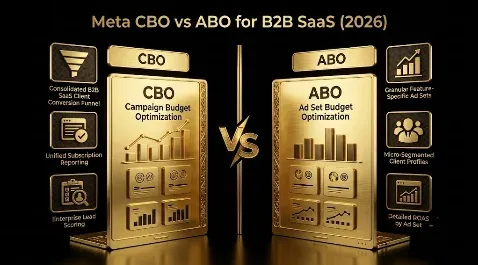
The two are simply different levels at which the budget is set. With ABO, ad set budget optimization, you set a fixed daily or lifetime budget for each ad set, and Meta spends exactly that inside each one, so three ad sets at twenty dollars a day each will each get their twenty dollars regardless of performance. With CBO, campaign budget optimization, you set one budget for the whole campaign and Meta distributes it across the ad sets in real time toward whatever is converting cheapest, so a hundred-dollar campaign across three ad sets might spend seventy, twenty, and ten. Meta now labels CBO as Advantage campaign budget in Ads Manager and makes it the default for most new campaigns. The trade-off in one line: ABO gives you control and even testing, CBO gives the algorithm freedom to chase the cheapest conversions.
How the budget is distributed
The distinction matters because of what it does to your spend:
| ABO | CBO (Advantage campaign budget) | |
|---|---|---|
| Budget set at | Each ad set (fixed) | Whole campaign (dynamic) |
| Example | $20/day to each of 3 ad sets | $100/day split, say, $70 / $20 / $10 |
| Control | High, predictable, even | Low, Meta decides |
| Clean testing | Yes, equal exposure | No, one ad set can take most spend |
| Needs volume | Works at low volume | Needs conversion volume |
The crucial consequence is in the “clean testing” row: because CBO shifts budget toward whatever looks cheapest early, one ad set can soak up most of the spend (sometimes the large majority) before any of them have enough data to prove themselves, so your “test” is decided by an early fluke rather than a real result. ABO’s equal, fixed budgets are what let you read a genuine comparison.
Why B2B conversion volume changes the answer
Here is the part generic CBO-versus-ABO advice misses. CBO allocates budget well only when it has enough conversions to know what “cheapest” really means, and the learning benchmark is roughly 50 conversions per ad set per week, which plenty of B2B SaaS accounts cannot hit even at the campaign level, let alone per ad set. On a low-volume account, CBO is making allocation decisions on almost no data, so it starves most ad sets, pours budget into one early leader that may not actually be the winner, and biases whatever you were trying to test. ABO sidesteps all of this: it works fine at low volume because it does not depend on the algorithm having enough data to allocate, it just spends each ad set’s fixed budget, giving every creative and audience a fair, equal test. This is why low conversion volume should keep a B2B SaaS account in ABO longer than a consumer brand would stay, and why many small B2B accounts legitimately live mostly in ABO, moving to CBO only for the specific winners that have earned enough volume to scale.
The budget math makes this concrete. To feed CBO properly you want roughly the daily budget that can produce about 50 conversions a week, which works out to around (target cost per result times 50) divided by 7, so at a 20 dollar target you need on the order of 140 dollars a day before CBO has enough to allocate sensibly. A useful rule of thumb from practitioners: if your total spend is under about 100 dollars a day, stay in ABO with only one or two ad sets, and only lean toward CBO once you are scaling several ad sets at 300 dollars a day or more. The trap is visible in a simple example: an ad set running 30 dollars a day at a 25 dollar cost per lead produces only about 8 conversions a week, nowhere near the roughly 50 it needs to exit the learning phase, so on that budget neither structure fully learns, but ABO at least spends evenly while you test rather than letting CBO crown a fluke. This is also why practitioners consistently note that lead gen and B2B tend to perform better on ABO, because CBO over-concentrates on one audience and quietly reduces the targeting diversity a small account needs.
The test-and-scale workflow
The pattern that reconciles the two is test in ABO, scale in CBO:
- Test in ABO with equal budgets. Put your creatives, hooks, audiences, or offers in separate ad sets with the same fixed budget each, so every variation gets a fair shot and you can read a clean result.
- Let them run long enough. Give new creatives or audiences 7 to 14 days before major changes, and after any significant edit allow 3 to 5 days to restabilize.
- Identify real winners from clean data, looking for roughly 15 to 20 conversions at or near your target cost per result before you trust an ad set as a winner, and pausing underperformers (set a kill rule in advance so you act rather than agonize). If nothing works after 7 to 10 days, the creative or offer is the likely problem, not the structure.
- Move winners into a CBO campaign to scale, once they have the conversion volume to feed CBO’s allocation. Duplicate the winning ad sets into a new CBO campaign rather than editing the ABO one, and set the CBO budget at about 2 to 3 times the combined ABO spend on those ad sets, then increase gradually (roughly 10 to 20 percent every few days) rather than in big jumps. A quiet advantage of CBO once you are there: campaign-level budget increases generally do not reset each ad set’s learning, whereas in ABO a single ad set increase above about 20 percent does reset it, so wait at least 3 days between ABO adjustments.
- Keep cold and retargeting apart. Always run retargeting in ABO, and never mix cold and retargeting audiences in one CBO campaign, because the cold audience will absorb most of the budget and starve the warm one.
- Keep a small testing budget always in ABO. A common split is around 5 to 10 percent of budget on ongoing ABO testing and the rest in CBO scaling, so you never stop feeding the pipeline with fresh tested winners.
Settings and numbers
Useful starting numbers (directional, calibrate to your account):
- ABO budget per ad set: around 2x your target cost per result per day (for example, forty dollars a day for a twenty-dollar target), run 3 to 5 days, then pause the losers.
- ABO test campaign: 3 to 5 ad sets, equal budgets.
- CBO ad sets: 3 to 7 per campaign, and fewer is often better; a per-ad-set minimum of roughly ten to twenty percent of the campaign budget can stop early starvation for the first week, then remove it so Meta can optimize.
- CBO scaling: increase budget about 10 to 20 percent every few days.
- Learning phase: roughly 50 conversions per ad set within 7 days to exit learning, for both structures.
Common mistakes
- Running CBO on low volume and trusting the allocation. With too few conversions, CBO’s split is noise, not intelligence, so it is testing nothing and scaling a guess.
- Too many ad sets on too little budget. Ten ad sets on fifty dollars a day guarantees every ad set is starved; keep ad set counts low relative to budget.
- Keeping CBO minimum-spend limits on forever, which blocks the optimization you turned to CBO for; use them briefly, then remove them.
- Leaving losers running in ABO, which wastes the control ABO gives you; set kill rules and act.
- Tweaking during learning, which resets it; let campaigns run at least a week before major changes.
- Audience overlap between ad sets, which makes your own ad sets bid against each other and skews the data in both structures.
- Expecting CBO to fix weak creative. CBO only scales what already works; it cannot rescue a losing ad.
Field note: The most damaging thing Meta does to small B2B SaaS accounts is default them into CBO and tell them to trust the algorithm, because that advice is written for accounts swimming in conversions and it quietly wrecks a low-volume one. Picture a B2B account running three audiences in a single CBO campaign with a modest budget: CBO looks at the first day or two, sees one ad set get a couple of cheap clicks, and pours most of the budget there, starving the other two before any of them have gathered enough conversions to prove anything. The team thinks they ran a test, but what actually happened is CBO crowned an early fluke and never gave the other audiences a fair chance, so the “winner” is an artifact of randomness and the real winner may have been one of the starved ad sets. On a consumer account with hundreds of conversions a week this self-corrects quickly because the data arrives fast; on a B2B account with a handful of conversions a week it never self-corrects, and the team scales the wrong thing. The fix is almost boringly simple: test in ABO, where every ad set gets an equal fixed budget and the comparison is clean, keep the test running the week or two it takes for thin B2B volume to say something real, and only move a genuine, proven winner into CBO once it has enough conversions for the algorithm’s allocation to be smart rather than superstitious. Many small B2B accounts should expect to live mostly in ABO and treat CBO as the thing they graduate winners into, not the place they do their thinking. The uncomfortable truth is that CBO’s intelligence is a function of data volume, so on low volume its confident-looking budget decisions are just noise wearing the costume of optimization.
Honest limitations
- The volume thresholds are directional. The roughly 50-conversions-per-ad-set benchmark and the budget figures are practitioner guidance, not account-specific truth, so calibrate to your own numbers.
- Not every B2B account is low-volume. A high-spend B2B SaaS account with strong conversion volume can use CBO more like a consumer brand; the ABO lean is about volume, not the B2B label itself.
- ABO needs discipline. Its control only pays off if you actually monitor and pause losers; left unmanaged, ABO wastes budget on weak ad sets that CBO would have throttled.
- You cannot convert a campaign in place. Moving between ABO and CBO means building a new campaign and migrating ad sets, which risks resetting learning, so plan the switch rather than toggling.
- Structure does not fix inputs. Neither ABO nor CBO improves a weak offer or weak creative; they only decide how budget flows to what you already have.
- This is educational, not investment or financial advice, and validates against your own account.
Frequently Asked Questions
Q1. What is the difference between CBO and ABO on Meta?
ABO (ad set budget optimization) and CBO (campaign budget optimization) differ in where you set the budget and therefore who controls its distribution. With ABO, you set a fixed budget for each individual ad set, and Meta spends exactly that amount within each one, so if you give three ad sets twenty dollars a day each, every ad set gets its twenty dollars regardless of how it performs relative to the others. With CBO, you set a single budget at the campaign level and Meta dynamically distributes it across the ad sets in real time, pushing more spend toward whichever ad sets are converting cheapest, so a hundred-dollar-a-day campaign across three ad sets might end up spending seventy on one, twenty on another, and ten on the third. Meta now labels CBO as “Advantage campaign budget” in Ads Manager and makes it the default for most new campaigns. The fundamental trade-off is control versus automation: ABO gives you precise, predictable, even spend across ad sets, which is ideal for clean testing and for low-volume accounts, while CBO hands the allocation to Meta’s algorithm, which can be efficient when there is enough conversion data for it to make smart decisions but unreliable when there is not. Understanding this distinction is the whole game, because the right choice depends entirely on whether your account has enough conversion volume for CBO’s automated allocation to be intelligent rather than random, which is exactly where B2B SaaS differs from consumer advertising.
Q2. Should B2B SaaS use CBO or ABO?
Most B2B SaaS accounts should lean on ABO more and for longer than a consumer brand would, because B2B conversion volume is usually too low for CBO to allocate budget intelligently. The general rule of thumb is “test with ABO, scale with CBO,” and that holds for B2B too, but the twist is that the testing phase lasts longer and matters more in B2B because your conversions are scarce, so you need ABO’s clean, equal-budget testing to get a trustworthy read, and you should only graduate proven winners into CBO once they have enough volume to feed it. The reason is mechanical: CBO allocates well only when it has enough conversions to know what “cheapest” really means, and on a low-volume B2B account it instead starves most ad sets, dumps budget into an early leader that may be a fluke, and biases your results. ABO does not have this problem because it simply spends each ad set’s fixed budget regardless of the algorithm’s confidence, so it works fine at low volume. The practical answer, then, is not “always ABO” or “always CBO,” but a staged approach: do your testing in ABO with equal budgets, keep a small ongoing ABO testing budget, and use CBO specifically to scale the winners that have earned enough conversion volume for its automation to be smart. A high-spend B2B SaaS account with genuinely strong conversion volume can use CBO more freely, so the deciding factor is your volume, not the B2B label by itself.
Q3. Why does CBO perform badly on low-volume B2B accounts?
Because CBO’s budget allocation is only as good as the conversion data feeding it, and low-volume B2B accounts do not give it enough to work with. CBO works by watching which ad sets convert cheapest and shifting budget toward them in real time, but on a thin-volume account it is making those decisions on almost no data, so it behaves superstitiously: it sees one ad set get a couple of cheap early results, concludes that ad set is the winner, and pours most of the budget there, starving the other ad sets before any of them have accumulated enough conversions to prove what they can actually do. The result is that your test is decided by early randomness rather than real performance, and the ad set CBO crowned may not be the true winner, while the genuinely better ad set sits starved and never gets its chance. On a consumer account with hundreds of conversions a week this self-corrects quickly because the data arrives fast enough for CBO to recognize and fix a bad early call, but on a B2B account with only a handful of conversions a week, that self-correction never really happens, so the wrong allocation sticks and you end up scaling a mistake. This is compounded by the learning phase, which wants roughly 50 conversions per ad set per week, a bar many B2B accounts cannot clear, so the ad sets never even exit learning. The bottom line is that CBO’s confident-looking budget decisions on low volume are noise wearing the costume of optimization, which is why ABO’s equal, fixed budgets are the safer choice for B2B testing.
Q4. How do I use the test-in-ABO, scale-in-CBO workflow?
The workflow has four stages and a maintenance habit. First, test in ABO: put your creatives, hooks, audiences, or offers into separate ad sets, each with the same fixed budget, so every variation gets equal exposure and you can read a genuine comparison rather than one decided by CBO’s early budget skew. A reasonable setup is three to five ad sets with equal budgets, each budget around twice your target cost per result per day. Second, let them run long enough to produce trustworthy data, which on thin B2B volume means 7 to 14 days before major changes, with 3 to 5 days to restabilize after any significant edit, and resist tweaking during the learning phase because that resets it. Third, identify the real winners from the clean data and pause the underperformers, ideally against a kill rule you set in advance so you act decisively rather than second-guessing. Fourth, move the winners into a CBO campaign to scale, but only once they have the conversion volume to feed CBO’s allocation, and raise the budget gradually, roughly 10 to 20 percent every few days, rather than in large jumps that reset learning. The maintenance habit that keeps the whole system healthy is to always keep a small slice of budget, commonly around 5 to 10 percent, running ongoing ABO tests, so you are continuously feeding fresh, proven winners into the CBO scaling campaigns and never run dry. One hard rule throughout: do not convert an existing campaign between ABO and CBO in place, because that resets learning; build a new CBO campaign and migrate the winning ad sets into it.
Q5. How many ad sets and how much budget should I use?
Keep ad set counts low relative to your budget, because spreading too little money across too many ad sets guarantees every one of them is starved. For ABO testing, three to five ad sets with equal budgets is a sensible structure, and a useful starting budget per ad set is about twice your target cost per result per day, for example forty dollars a day if your target cost per result is twenty, which gives each ad set enough room to gather a little data; run them three to five days before pausing the clear losers, and up to 7 to 14 days before drawing firm conclusions on thin volume. For CBO scaling, three to seven ad sets per campaign is the usual range and fewer is often better, because concentrating budget into fewer ad sets gives each one a real chance to exit the learning phase; a per-ad-set minimum spend of roughly ten to twenty percent of the campaign budget can prevent CBO from starving ad sets in the first week, after which you should remove the minimums so Meta can actually optimize. When scaling a CBO campaign, raise the budget gradually, around 10 to 20 percent every few days, since large sudden jumps reset the learning phase. The single most common sizing mistake is the opposite of all this: running something like ten ad sets on a small daily budget, which spreads the money so thin that nothing ever gathers enough conversions to learn, so if you are budget-constrained, reduce the number of ad sets rather than the budget per ad set. All of these figures are directional starting points, so calibrate them to your own cost per result and conversion volume.
Q6. Can I switch a campaign from ABO to CBO without losing performance?
Not by toggling it in place, because switching an existing campaign between ABO and CBO resets the learning phase and discards the data the campaign has accumulated, which is especially costly on a B2B account where that data built up slowly. Meta does not let you cleanly convert a running campaign’s budget type without consequences; the proper way to move from ABO to CBO is to build a new CBO campaign and migrate your winning ad sets into it, accepting that the new campaign will go through its own learning phase. This is actually fine within the test-and-scale workflow, because the point of ABO was to identify winners on clean data, and once you have those winners you are intentionally starting a fresh CBO campaign to scale them, so the migration is a planned step rather than a disruption to something already working. What you should not do is flip a live, performing campaign’s setting on a whim, since that throws away its progress for no reason. Two practical notes: first, plan the switch for when you have genuinely proven winners and enough conversion volume to feed CBO, not as a reaction to a slow day; second, when you build the new CBO campaign, give it time to restabilize through its learning phase before judging it, rather than concluding CBO failed because the first few days looked rough. The broader principle is that budget-structure changes are migrations, not toggles, so treat them deliberately.
Q7. Is CBO (Advantage campaign budget) always the right default now?
No, and the fact that Meta sets it as the default for new campaigns does not mean it is right for your account, particularly if you are a low-volume B2B SaaS advertiser. Meta’s default reflects what works for the broad base of advertisers, many of whom are higher-volume consumer accounts where CBO’s automated allocation has plenty of conversion data to be smart, but that is precisely the condition many B2B accounts fail to meet. CBO becomes the right default when you have the volume to support it: scaling proven winners, running large multi-ad-set campaigns, pushing hundreds of conversions a week, or running evergreen campaigns where you want minimal manual management. ABO remains the better choice when you are testing creatives or audiences and need clean, equal-budget comparisons, when you want a fixed strategic split of budget, when you are in a low-volume niche or B2B market where CBO would starve ad sets, or when you have the discipline to manually optimize. For most B2B SaaS accounts the honest answer is that CBO is not the right everyday default; the right default is ABO for testing with a small always-on testing budget, and CBO reserved for scaling the specific winners that have earned enough volume. So when Meta drops you into Advantage campaign budget on a new campaign, treat that as a prompt to consciously decide based on your conversion volume rather than as the correct setting handed to you, and do not let the default make a decision that should depend on how much data your account actually produces.
If you want a Meta program that tests in ABO for clean reads and scales only proven winners in CBO, book a demo with Growthspree.
Sources & further reading
- 2026 practitioner guides (Segwise, AdManage, and Vaizle on ABO vs CBO / Advantage campaign budget) on what each is, how budget is distributed, the test-in-ABO-scale-in-CBO workflow, the roughly 50-conversions-per-ad-set learning benchmark and the CBO budget math ((target cost per result times 50) divided by 7), the under-100-dollars-a-day ABO rule, the 15-to-20-conversion winner-validation threshold, the never-mix-cold-and-retargeting-in-CBO rule, the 20-percent ABO-increase learning reset, and the common mistakes. Figures are practitioner-reported and directional; validate against your own account.
- Meta Ads Help (Advantage campaign budget, ad set budgets, learning phase, minimum and maximum spend controls).
- GrowthSpree (B2B SaaS practice: lean on ABO for clean testing on low volume, scale proven winners in CBO once volume supports it, keep a small always-on ABO testing budget, and migrate rather than toggle between structures).
- Companion: Meta Ads Budget for B2B SaaS; Meta Ads Campaign Structure for B2B SaaS; Meta Ads Bid Strategy for B2B SaaS; Meta Ads A/B Testing for B2B SaaS.
This guide is educational, not investment or financial advice; Meta’s budget tools change, so verify current behavior against Meta’s documentation and validate against your own account.
Related guides: Meta Ads Budget for B2B SaaS · Meta Ads Campaign Structure for B2B SaaS · Meta Ads Bid Strategy for B2B SaaS · Meta Ads A/B Testing for B2B SaaS.