Pipeline,
not promises.
Senior operators audit your funnel in 48 hours. Ship 3 specific moves in 30 days.
- Full-funnel audit · 4 velocity levers
- 3 wins to ship in 30 days
- $3K flat · month-to-month
30-min call · No commitment
- Full-funnel audit · 4 velocity levers
- 3 wins to ship in 30 days
- $3K flat · month-to-month
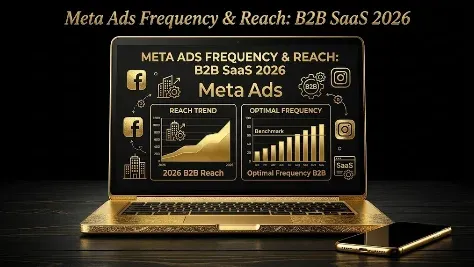
Meta Ads Frequency and Reach for B2B SaaS (2026): Why Small Audiences Fatigue Fast, and How to Manage It
Quick answer: Reach is the number of unique people who see your ad; frequency is the average number of times each of them sees it (impressions divided by reach). For B2B SaaS, frequency is the constraint that quietly caps most accounts, because B2B audiences are small, a narrow ICP or a named-account list, so the same spend drives frequency up far faster than it would against a broad consumer audience, and that is why B2B creative fatigues in one to two weeks rather than months. As a rough guide, awareness campaigns want low frequency (around 1 to 3 per week) and broad reach, while warm retargeting audiences both tolerate and need higher frequency because they are small and already interested. Watch frequency alongside CTR and CPM: when frequency climbs past roughly 3 to 4 and CTR falls while CPM and cost per result rise, that is fatigue, and the fix is to refresh the creative, broaden the audience (let the creative do the qualifying), or cap frequency, not to keep spending into a saturated pool. Use frequency caps and reach-and-frequency buying mainly for awareness; for performance campaigns, manage frequency through creative refresh and audience size rather than a hard cap. The core B2B lesson: match your budget to your audience size, because pouring a large budget into a tiny audience just buys the same people seeing the same ad until they tune out.
Key takeaways
- Reach is unique people; frequency is average times each sees the ad (impressions divided by reach), and frequency is the lever that caps most B2B accounts.
- Small B2B audiences fatigue fast: a narrow ICP means the same spend drives frequency up quickly, which is why B2B creative decays in one to two weeks.
- Match frequency to funnel stage: ~1 to 3 a week for pure awareness, ~3.5 to 5.0 for SaaS cold prospecting, and ~5 to 8 for small warm retargeting pools that need more touches.
- Fatigue shows as frequency past ~3 to 4 with falling CTR and rising CPM and cost per result; fix it by refreshing creative, broadening the audience, or capping frequency.
- Match budget to audience size: pouring a big budget into a tiny audience just buys the same people seeing the same ad until they tune out.
Most B2B SaaS teams watch cost per lead and creative, and never look at frequency until performance is already decaying. That is backwards, because in B2B frequency is usually the thing decaying first: the audiences are small, so frequency climbs fast, and a rising frequency is the early-warning signal that an ad is about to burn out. This is the 2026 guide to Meta ads frequency and reach for B2B SaaS: what the two metrics mean, why small B2B audiences make frequency the binding constraint, the optimal frequency by funnel stage, how to read frequency as a fatigue signal, when to cap it, and how to match budget to audience size. It pairs with the Meta ad creative, reporting dashboard, and campaign structure guides.
Reach and frequency, defined
Two simple definitions that most of this rests on. Reach is the number of unique people who saw your ad. Frequency is the average number of times each of those people saw it, which is just total impressions divided by reach. If your ad got 30,000 impressions across 10,000 unique people, your frequency is 3. The two trade off against a fixed budget: for a given spend, you can reach more people fewer times (high reach, low frequency) or fewer people more times (low reach, high frequency), and which you want depends on the goal.
Why frequency is the binding constraint in B2B
Here is the thing that makes B2B different. In consumer advertising, the audience is enormous, so a large budget mostly buys more reach and frequency stays manageable. In B2B SaaS, the audience is small by design, a narrow ICP, a short list of named accounts, a specific role at a specific company size, so the same budget has nowhere to go but up in frequency. You are not reaching more people, you are showing the same small group the same ad more times. That is why B2B creative fatigues in one to two weeks rather than months: frequency hits the saturation point far sooner. The practical consequence is that in B2B you must match budget to audience size, because pouring a large budget into a tiny audience does not buy growth, it buys annoyance, as the same buyers see the same ad until they tune out and your CPM and cost per result climb. The cost of over-showing is real: vendor data suggests showing the same ad five or more times a week can cut its conversion rate by roughly 30 percent, and broader studies find purchase likelihood actually turns negative at high exposure counts (around 6 to 10-plus views), so past a point each extra impression is working against you.
Optimal frequency by funnel stage
There is no universal “right” frequency, it depends on the objective and the audience, but 2026 vendor benchmarks give useful weekly ranges (these are practitioner “starting thresholds,” not rules, so calibrate from your own data):
| Stage / audience | Weekly frequency | Why |
|---|---|---|
| Awareness (cold, broad) | ~1 to 3 | Build recognition without saturating; prioritize reach |
| SaaS prospecting (cold) | ~3.5 to 5.0 | SaaS tolerates more touches; fatigue shows as a gradual rise in cost per lead, not a sharp drop |
| Pure lead-gen (cold) | ~2.0 to 3.0 | Lower ceiling; by frequency 3, cost per lead typically rises 20 to 30 percent |
| SaaS free-trial / nurture retargeting | ~5 to 8 | Small warm pool, already interested, needs repeated touches |
| Content nurture retargeting | ~4 to 6 | Warm but earlier-stage; moderate repetition |
Two patterns to read from this. First, cold prospecting for SaaS actually tolerates a higher frequency (around 3.5 to 5.0 a week) than the old “keep it under 3” rule suggests, and in SaaS the fatigue tends to show up as a slow climb in cost per lead rather than a cliff. Second, small warm retargeting audiences both tolerate and need higher frequency (5 to 8 a week for free-trial nurture) because there are few of them and they are close to converting, so more touches help rather than annoy. The common thread: match the ceiling to how warm and how small the audience is.
Frequency as a fatigue signal
Frequency is most useful as an early-warning metric. On its own a frequency number means little, but watched over time alongside CTR and CPM it tells you when an ad is burning out: when frequency climbs past roughly 3 to 4 in a short window while CTR falls and CPM and cost per result rise, that is creative fatigue, and it is visible in frequency before it fully shows up in your cost metrics. A second signal: if frequency keeps rising but conversions do not, the problem is the creative or the targeting, not the amount of exposure, because more views of an ad that is not converting will not start converting. This is exactly what the creative-fatigue tracker in the reporting guide is built to catch, and frequency velocity (how fast frequency is climbing) is one of its key columns.
The decay usually follows a predictable arc on a cold prospecting audience, which is worth knowing so you can act in week 2 rather than week 4 (2026 vendor benchmarks, directional):
| Week | Frequency | What happens |
|---|---|---|
| Week 1 | ~1.0 to 2.0 | Healthy; CTR and CPM stable |
| Week 2 | ~2.5 to 3.5 | First signal: CTR slides 10 to 15 percent, CPM rises 5 to 10 percent |
| Week 3 | vertical threshold reached | CPM 15 to 25 percent above week 1, CTR down 20 to 30 percent |
| Week 4 | overshoots by 20 to 40 percent | CTR roughly halved, CPM about 30 percent over baseline |
The practical read: the time to refresh or broaden is week 2, when CTR first slides, not week 4 when the ad is clearly dead. One more useful calibration point: the creative fatigue window on Meta has been shrinking, from roughly 4 to 6 weeks in 2024 to about 2 to 3 weeks in 2026, and small B2B audiences compress it further toward one to two weeks, so the refresh cadence that worked a couple of years ago is now too slow.
Meta also surfaces its own fatigue labels in Ads Manager, and it helps to know what they mean. “Creative Fatigue” flags an ad whose cost per result has reached at least twice its historical level, and “Creative Limited” flags one that has risen but is still under twice, a softer early warning. Treat “Creative Limited” as the prompt to queue a refresh and “Creative Fatigue” as the prompt to act now, though note Meta does not publish the exact trigger mechanics, so use these alongside your own frequency and CTR trend rather than waiting for the label.
How to manage frequency
When frequency is climbing toward saturation, you have three levers, in rough order of preference:
- Refresh the creative. New creative resets the fatigue clock against the same audience, which is why B2B accounts need a steady creative pipeline. As a cadence, 2026 benchmarks put SaaS and lead-gen refresh at roughly every 3 to 6 weeks for broad prospecting, but a small named-account audience saturates faster and needs refreshing in one to two weeks, so set the cadence by audience size (the creative guide covers this).
- Broaden the audience. A bigger audience gives the budget somewhere to go other than up in frequency, and in B2B the right way to broaden is usually to widen the targeting and let the creative do the qualifying rather than adding more budget to a tiny audience.
- Cap frequency. Use frequency caps (and Meta’s reach-and-frequency buying) mainly for awareness campaigns where controlling exposure is the goal; for performance campaigns, prefer managing frequency through creative refresh and audience size rather than a hard cap, since a cap can throttle delivery.
Match budget to audience size
The single most useful discipline is to size the budget to the audience, not the other way around. Before scaling spend, ask how many people are actually in the audience: a 200,000-to-500,000-person prospecting audience can absorb real budget at a healthy frequency, while a 5,000-person named-account list will saturate almost immediately and should get a small budget, frequent creative refresh, and a frequency cap. If you need to spend more, the answer is usually to broaden the audience or add new creative, not to push more money through the same small pool. This is why the audience-targeting and campaign-structure guides stress broad prospecting with creative qualification: it is as much about giving frequency room as it is about targeting.
Field note: The clearest way to see why frequency matters so much in B2B is to watch what happens when a team scales a winning ad by simply turning up the budget on a narrow audience. The ad was working at a sensible frequency, the team is excited, they triple the daily spend, and because the audience is only a few thousand people, the extra budget cannot find new people, so it just shows the same buyers the same ad more often. Within a week frequency has doubled, the CTR has dropped, the CPM has climbed because Meta is working harder to place impressions on a saturated audience, and the cost per lead has gone up, so the team concludes the ad “stopped working” when what actually happened is they ran out of audience. The fix is almost never a better ad in that moment, it is giving the budget somewhere to go, a broader audience, a fresh creative, or both, and accepting that a tiny audience has a low budget ceiling no matter how good the ad is. The teams that manage B2B Meta well treat frequency as a leading indicator they watch every week, not a number they discover in the post-mortem, and they size budgets to audiences from the start, so a 5,000-person list gets a small budget and a fast creative-refresh schedule while the big prospecting audience carries the spend. Frequency is the quiet constraint behind most “our ads fatigued” stories, and it is far easier to manage before it saturates than to rescue after.
Honest limitations
- There is no universal optimal frequency. The ranges here are directional and depend on objective, audience size, creative, and funnel stage; calibrate from your own data.
- The “keep frequency under 3” rule is dated. It traces back to Facebook brand-lift research from around 2017, and current SaaS prospecting benchmarks actually tolerate 3.5 to 5.0 a week, so do not treat 3 as a hard ceiling for lead gen.
- The week-by-week progression and vertical bands are practitioner observations, not published Meta data, and the sources cite no underlying dataset, so use them as a starting arc and confirm against your own account.
- Frequency is a signal, not a cause. High frequency correlates with fatigue but the underlying issue is a small audience or stale creative; fix those, do not just chase the number.
- Caps can hurt delivery. A hard frequency cap on a performance campaign can throttle learning and delivery, so prefer creative refresh and audience sizing except for awareness buys.
- CPM rises for several reasons. Saturation is one, but auction competition and seasonality also move CPM, so read frequency, CTR, and CPM together rather than blaming frequency alone.
- Broadening has limits. You cannot widen a B2B audience indefinitely without losing relevance; the goal is enough room for frequency, not reaching everyone.
- This is educational, not investment or financial advice, and validates against your own account.
Frequently Asked Questions
Q1. What is the difference between reach and frequency in Meta ads?
Reach is the number of unique people who saw your ad, while frequency is the average number of times each of those people saw it, calculated as total impressions divided by reach. If your ad delivered 30,000 impressions to 10,000 unique people, your reach is 10,000 and your frequency is 3, meaning on average each person saw the ad three times. The two are linked by your budget: for a fixed spend, you are always trading reach against frequency, because you can either reach more people fewer times or fewer people more times, and the right balance depends on your objective. For awareness, you generally want high reach and low frequency so you build recognition across as many of the right people as possible without over-showing. For conversion and especially retargeting, you often want higher frequency against a smaller, warmer audience, because repetition to people who already know you nudges them toward action. Understanding the distinction matters because teams often celebrate high impressions without realizing those impressions are concentrated on a small group at a high frequency, which is the setup for ad fatigue, so you should always look at reach and frequency together rather than at impressions alone, which hides whether you are reaching new people or just re-showing the same ones.
Q2. Why does frequency matter more for B2B SaaS than for B2C?
Because B2B audiences are small by design, which makes frequency the binding constraint in a way it rarely is for consumer advertising. In B2C the addressable audience is often enormous, so a large budget mostly buys more reach and frequency stays manageable, but in B2B SaaS your audience is a narrow ICP, a specific role at a specific company size, or a short list of named accounts, so there are only so many people to reach. When you put budget against that small audience, it cannot find many new people, so the extra spend goes into showing the same small group the same ad more often, driving frequency up fast. This is the structural reason B2B creative fatigues in one to two weeks rather than the months a consumer brand might get: the small audience hits saturation far sooner. The practical consequence is that in B2B you must size budget to audience, because pouring a large budget into a tiny audience does not produce growth, it produces annoyance and rising costs as the same buyers see the same ad repeatedly and tune out, pushing your CPM and cost per result up. So frequency is not a secondary metric for B2B, it is the thing most likely to be quietly capping your account, and watching it is how you catch fatigue before it shows up as a cost problem.
Q3. What is a good ad frequency for B2B SaaS?
There is no single universal number, because the right frequency depends on your objective and audience, but useful ranges exist by funnel stage. For cold, broad awareness campaigns, a frequency of roughly 1 to 3 per week is sensible, prioritizing reach so you build recognition without saturating people before they even know you. For warm consideration audiences, a moderate frequency reinforces your message to people who have engaged. For small, warm retargeting audiences, a higher frequency is both tolerable and necessary, because there are few of these people and they are close to converting, so more touches help rather than annoy, and for the smallest, highest-intent pools like trial or demo abandoners, the highest frequency is justified because a handful of high-value people are worth repeated nudges. The guiding logic is that broad cold audiences want low frequency and high reach (you do not want to over-show to people who do not know you yet), while small warm audiences want higher frequency (there are few of them and repetition drives conversion). Rather than fixating on hitting a specific number, use these ranges as starting points and watch frequency alongside CTR and cost per result, so you can tell when a given audience has crossed from “reinforcing” into “saturating,” which varies by audience size and creative.
Q4. How do I know when ad frequency signals fatigue?
Watch frequency over time alongside CTR and CPM rather than looking at it in isolation, because a frequency number on its own means little, it is the trend combined with your cost metrics that reveals fatigue. The classic fatigue pattern is frequency climbing past roughly 3 to 4 in a short window while CTR falls and CPM and cost per result rise, and crucially, the frequency climb often shows up before the cost damage is fully visible, which is what makes frequency a useful early-warning signal rather than a lagging one. A second, related signal is frequency continuing to rise while conversions stay flat or fall, which tells you the problem is the creative or the targeting rather than the amount of exposure, because showing an ad that is not converting even more times will not make it start converting. This is exactly what a creative-fatigue tracker is built to surface: it watches each ad’s frequency velocity (how fast frequency is climbing) alongside a rolling CTR and CPM trend, and flags ads where the combination signals burnout, so you can refresh them before performance craters. The practical habit is to review frequency weekly as a leading indicator, treat a rapid climb on a small audience as a warning even if cost per lead has not moved yet, and act (refresh or broaden) before the saturation fully hits your results.
Q5. Should I use frequency caps on Meta?
Use frequency caps selectively, mainly for awareness campaigns, and manage performance campaigns through creative and audience instead. Frequency caps (and Meta’s reach-and-frequency buying option) let you control how often each person sees your ad, which is genuinely useful for brand-awareness campaigns where controlling exposure and avoiding over-showing is the explicit goal, for example capping at a few exposures per week so you spread a fixed budget across more of your audience. For performance and conversion campaigns, though, a hard frequency cap can backfire by throttling delivery and starving the algorithm’s learning, so the better levers there are refreshing the creative (which resets the fatigue clock against the same audience) and broadening the audience (which gives the budget somewhere to go other than up in frequency). In other words, for awareness you cap frequency directly because exposure control is the point, while for performance you manage frequency indirectly by keeping fresh creative in rotation and sizing the audience appropriately, because what you actually care about there is cost per result, not a specific frequency number. If you do cap, set different caps for different audience segments (a cold prospecting audience and a warm retargeting pool should not share one cap) and keep rotating creative regardless, since a cap limits exposure but does not make a stale ad fresh.
Q6. How do I fix rising ad frequency and fatigue?
You have three levers, in rough order of preference. First, refresh the creative: introducing new creative resets the fatigue clock against the same audience, so the people who had started tuning out your old ad respond to a new one, which is why B2B accounts need a steady creative pipeline rather than a few hero ads run until they die. Second, broaden the audience: a larger audience gives your budget somewhere to go other than up in frequency, and in B2B the right way to broaden is usually to widen the targeting and let specific creative do the qualifying rather than simply adding budget to a tiny, narrowly stacked audience, because that just accelerates saturation. Third, cap frequency, which is appropriate mainly for awareness campaigns where you want to control exposure, and less so for performance campaigns where a cap can throttle delivery. The one thing not to do is keep spending into a saturated audience with the same creative and hope it recovers, because more impressions on an ad people have stopped responding to only wastes budget and pushes CPM up. The deeper fix is preventive: size the budget to the audience from the start so frequency never runs away, keep fresh creative queued before the current winners fatigue, and treat a fast-climbing frequency as a prompt to act rather than a number to note after the fact.
Q7. How does audience size relate to budget and frequency?
Audience size sets the ceiling on how much budget you can spend before frequency saturates, so you should size budget to audience rather than the reverse. A large prospecting audience of roughly 200,000 to 500,000 people can absorb substantial budget while frequency stays healthy, because the spend can keep finding new people, whereas a small named-account list of a few thousand saturates almost immediately, since the budget has nowhere to go but repeated exposure to the same small group. The practical rule is that a tiny audience gets a small budget, a fast creative-refresh schedule, and often a frequency cap, while a big audience can carry the bulk of your spend. When you want to scale spend, the correct move is almost always to broaden the audience or add new creative, not to push more money through the same small pool, because the latter just drives frequency up, fatigues the creative, and raises your costs. This is the mechanical reason the audience-targeting and campaign-structure guides recommend broad prospecting with creative qualification: a broad audience is not only about targeting precision, it is about giving frequency room so your budget buys reach rather than repetition. Before any budget increase, check the audience size and current frequency, and if frequency is already climbing, scaling spend without broadening will make performance worse, not better.
If you want a Meta program that sizes budget to audience and catches fatigue before it caps performance, book a demo with Growthspree.
Sources & further reading
- 2026 practitioner and vendor guides (LSEO, SaveMyLeads, and Meta’s own reach-and-frequency documentation) on reach and frequency in Meta ads: definitions, optimal frequency ranges by objective, frequency as a fatigue signal, frequency caps and reach-and-frequency buying, and the reach-versus-frequency tradeoff. Frequency ranges and thresholds are vendor-reported and directional; calibrate against your own data.
- 2026 frequency and fatigue benchmarks (Adligator frequency benchmarks by vertical; TopGrowthMarketing and Rocketium ad-fatigue data) for the SaaS and lead-gen weekly bands, the retargeting tolerance ranges, the week-by-week fatigue progression, the shrinking creative-fatigue window (4 to 6 weeks in 2024 to 2 to 3 weeks in 2026), the refresh cadences, the conversion drop from over-showing, and the provenance of the “under 3” rule. These are practitioner thresholds with no published dataset; treat them as directional.
- Meta Ads Help (reach and frequency metrics, frequency caps, reach-and-frequency buying, frequency and delivery, and the “Creative Fatigue” and “Creative Limited” labels; Meta does not publish the exact trigger mechanics).
- GrowthSpree (B2B SaaS frequency practice: frequency is the binding constraint on small audiences, match budget to audience size, watch frequency as a leading fatigue signal, fix with creative refresh and broadening).
- Companion: Meta Ad Creative for B2B SaaS (creative fatigue and refresh cadence); Meta Ads Reporting Dashboard for B2B SaaS (the fatigue tracker); Meta Ads Campaign Structure for B2B SaaS; Meta Ads Audience Targeting for B2B SaaS.
This guide is educational, not investment or financial advice; Meta’s reach-and-frequency tools change, so verify current behavior against Meta’s documentation and validate against your own account.
Related guides: Meta Ad Creative for B2B SaaS · Meta Ads Reporting Dashboard for B2B SaaS · Meta Ads Campaign Structure for B2B SaaS · Meta Ads Audience Targeting for B2B SaaS.