B2B Paid Media Glossary: 40+ Terms Defined
Quick answer: This glossary defines the paid media terms that matter for B2B — grouped into cost metrics (CPC, CPL, CPA, CAC, ROAS), funnel and conversion metrics (CTR, CVR, MQL, SQL, PQL, pipeline), auction and delivery metrics (impression share, ad rank, Quality Score, frequency), audience and targeting terms (ICP, Matched Audiences, lookalikes, retargeting), and measurement terms (attribution, incrementality, view-through, dark funnel). Each is defined plainly with the B2B context that changes how it should be used — because in B2B, the metric that matters is almost always the one closest to pipeline.
Key takeaways
- Cost metrics measure efficiency; in B2B, cost per SQL beats CPL.
- Funnel metrics track the journey; the deeper (SQL, pipeline), the more they matter.
- Auction metrics diagnose delivery; they’re signals, not goals.
- Audience terms define targeting; first-party data is the durable edge.
- Measurement terms reveal true contribution; last-click misleads in B2B.
Paid media has a dense vocabulary, and the same term can mean different things across platforms. This glossary defines the terms that matter for B2B SaaS, grouped by category, with the B2B context that changes how each should be used — and links to deeper guides where relevant.
Cost and efficiency metrics
- CPC (cost per click) — what you pay per ad click. A basic efficiency input, but clicks aren’t outcomes; low CPC means little if clicks don’t convert.
- CPM (cost per mille) — cost per thousand impressions. Used for awareness/reach, where the goal is exposure, not clicks.
- CPL (cost per lead) — cost to generate a lead. The most over-used B2B metric — cheap leads that don’t qualify aren’t cheap pipeline. See why CPL misleads.
- CPA (cost per acquisition/action) — cost per a defined action (a conversion). What that action is determines whether CPA is meaningful.
- Cost per SQL — cost per sales-qualified lead. The B2B efficiency metric that actually maps to pipeline.
- CAC (customer acquisition cost) — cost to acquire a customer. See blended vs. paid CAC.
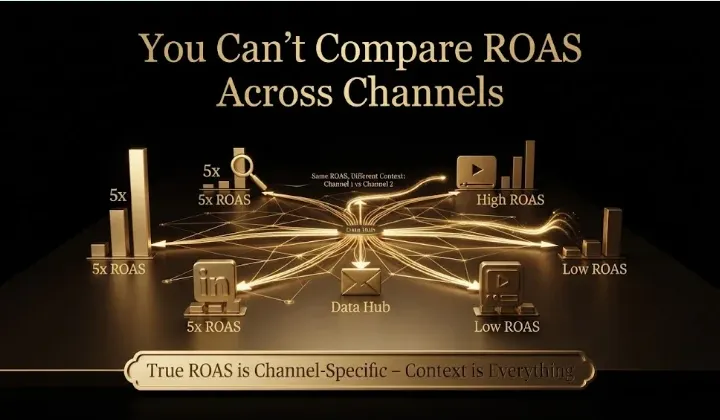
- ROAS (return on ad spend) — revenue per dollar of ad spend. Useful when you can attribute revenue; harder in long-cycle B2B.
- LTV (lifetime value) — total value of a customer over their lifetime. CAC only means something against LTV.
Funnel and conversion metrics
- Impression — one display of your ad. Reach, not engagement.
- Click — one click on your ad. Interest, not conversion.
- CTR (click-through rate) — clicks ÷ impressions. Measures ad resonance; a diagnostic, not a goal.
- Conversion — a desired action (form fill, signup, demo). What counts as a conversion shapes everything.
- CVR (conversion rate) — conversions ÷ clicks. How well traffic converts.
- Lead — someone who submitted their info. In B2B, leads vary enormously in quality.
- MQL (marketing-qualified lead) — a lead marketing deems worth pursuing. See MQL-to-SQL benchmarks.
- SQL (sales-qualified lead) — a lead sales accepts as worth working. The real B2B milestone.
- PQL (product-qualified lead) — a user whose product usage signals sales-readiness (in PLG).
- Pipeline — the value of open opportunities. The metric paid media should ultimately serve.
- Win rate — share of opportunities that close. A key forecasting input.
Auction and delivery metrics
- Ad rank — your position in the auction, driven by bid and relevance/Quality Score.
- Quality Score — Google’s 1–10 relevance diagnostic (expected CTR, ad relevance, landing page). A symptom, not a lever.
- Impression share — the impressions you got vs. those you were eligible for. See impression share.
- Lost impression share (budget/rank) — the share you missed due to budget or rank, a key diagnostic.
- Frequency — average times a person saw your ad. High frequency drives creative fatigue.
- Reach — unique people who saw your ad (vs. frequency, how often).
- Ad Strength — Google’s diagnostic of RSA asset diversity; a diagnostic, not a guarantee.
Audience and targeting terms
- ICP (ideal customer profile) — the profile of your best-fit customers; the foundation of targeting.
- Firmographic targeting — targeting by company attributes (industry, size, role).
- Matched Audiences / Customer Match — targeting your own uploaded lists. See Matched Audiences and first-party signals.
- Lookalike / predictive audiences — AI-built audiences resembling a seed. See predictive audiences.
- Retargeting / remarketing — reaching people who already engaged. See retargeting.
- Exclusions — audiences you remove from targeting. See exclusions.
- First-party data — data you own and collected directly; the durable, cookieless edge.
- Intent data — signals that an account is researching your category. See intent data.
Measurement terms
- Attribution — assigning credit for conversions to touchpoints. See multi-touch attribution.
- Last-click attribution — crediting the final touch. Systematically undercounts demand creation.
- Multi-touch attribution — distributing credit across touches.
- Incrementality — the conversions a channel actually caused. See incrementality testing.
- View-through conversion — a conversion after seeing (not clicking) an ad; key for display.
- Offline conversion — a CRM outcome (SQL, deal) fed back to the ad platform. See enhanced conversions.
- Dark funnel — influence that produces no trackable click, common in B2B.
- Self-reported attribution — asking prospects how they heard about you, to catch the dark funnel.
- Conversion lag — the delay between click and conversion. See conversion lag.
- MMM (marketing mix modeling) — top-down statistical measurement of channel contribution. See MMM.
Campaign and bidding terms
- Smart Bidding — automated bidding (tCPA, tROAS). See tCPA vs. tROAS.
- tCPA (Target CPA) — bidding to a target cost per conversion.
- tROAS (Target ROAS) — bidding to a target return on conversion value.
- Value-based bidding — feeding conversion values so bidding optimizes for worth. See value-based bidding.
- Performance Max — Google’s automated cross-inventory campaign type. See PMax.
- Demand capture vs. demand creation — capturing existing demand (search) vs. creating new demand (social). See lead gen vs. demand gen.
Field note: The single most useful lens for reading any paid media metric in B2B is “how close is this to pipeline?” Impressions, clicks, and CTR are far from it — they measure activity, not outcomes. CPL is closer but still misleading, because a lead isn’t pipeline. Cost per SQL, pipeline, and closed revenue are what actually matter. Whenever you’re handed a paid media number, ask where it sits on that spectrum: the further from pipeline, the more it’s a diagnostic to investigate rather than a result to celebrate. Most bad B2B paid media decisions come from treating a far-from-pipeline metric (cheap CPL, high CTR) as if it were a near-to-pipeline result. The vocabulary is large, but the judgment is simple: follow the metric toward revenue.
Frequently Asked Questions
Q1. What’s the difference between CPL and cost per SQL?
CPL (cost per lead) is the cost to generate any lead, while cost per SQL is the cost to generate a sales-qualified lead sales actually accepts. In B2B, cost per SQL is far more meaningful because cheap leads that never qualify aren’t cheap pipeline — CPL can look great while producing junk.
Q2. What’s the difference between an MQL, SQL, and PQL?
An MQL (marketing-qualified lead) is a lead marketing deems worth pursuing; an SQL (sales-qualified lead) is one sales accepts as worth working; a PQL (product-qualified lead) is a user whose product usage signals sales-readiness, common in product-led growth. They mark progressively deeper, more revenue-predictive stages.
Q3. What is impression share?
Impression share is the percentage of impressions your ads received out of the total they were eligible for. Lost impression share is split into lost to budget (you ran out of money) and lost to rank (your ad rank was too low), which together diagnose whether budget or relevance/bid is limiting your reach.
Q4. What is the dark funnel?
The dark funnel is marketing influence that produces no trackable click — people who see your ads or content, are influenced, and later convert through brand search or direct, giving the original touchpoint no credit. It’s common in B2B and causes last-click attribution to systematically undercount demand creation.
Q5. What is value-based bidding?
Value-based bidding feeds conversion values (like lead scores or offline outcomes) to the ad platform so its automated bidding optimizes for the worth of conversions, not just their count. It’s how B2B teams teach Smart Bidding that an SQL is worth far more than a form fill.
Q6. What’s the difference between attribution and incrementality?
Attribution assigns credit for conversions to the touchpoints that appeared on the path (correlation), while incrementality measures the conversions a channel actually caused through experiments (causation). Attribution over-credits channels near conversions; incrementality isolates true added value. They’re complementary.
Q7. Which paid media metric matters most in B2B?
The one closest to pipeline — cost per SQL and pipeline influenced, ultimately closed revenue — rather than clicks, CTR, or CPL, which measure activity rather than outcomes. The useful lens for any metric is “how close is this to pipeline?”: the further from it, the more it’s a diagnostic than a result.
Sources & further reading
- Platform documentation (Google Ads, LinkedIn Campaign Manager) for exact metric definitions, which vary by platform.
- Judge paid media on metrics closest to pipeline (cost per SQL, pipeline) using your own CRM data.
This guide is educational; metric definitions vary by platform and context, so verify specifics in each platform and interpret metrics by their distance from pipeline.
Related guides: The B2B SaaS Paid Media Strategy Guide · LinkedIn Ads Reporting to Pipeline · Blended CAC vs. Paid CAC · Multi-Touch Attribution for B2B SaaS · Value-Based Bidding for B2B Google Ads.