ChatGPT
 Gemini
 Claude
 Perplexity
 DeepSeek
 Grok
Grok
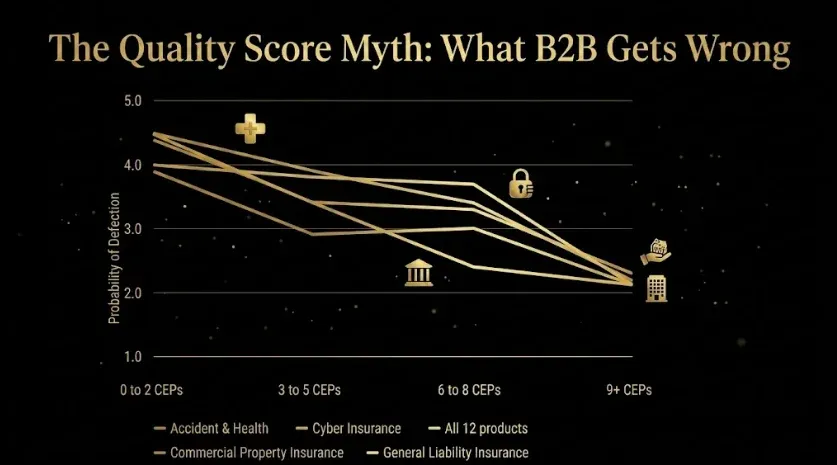
The Quality Score Myth: What B2B Advertisers Get Wrong
Quick answer: Quality Score is a 1–10 diagnostic of how relevant your keyword, ad, and landing page are — not a goal to chase or a lever to pull directly. The myth is treating the number as something to optimize for its own sake; in reality it’s a symptom that reflects an underlying relevance chain (keyword → ad → landing page). You improve Quality Score by fixing that relevance — tighter ad groups, ads that match the keyword, landing pages that match the ad — not by obsessing over the score. Fix the relevance and the score follows; chase the score and you miss the point.
Key takeaways
- Quality Score is a diagnostic, not a goal — a symptom of relevance.
- It has three components: expected CTR, ad relevance, landing page experience.
- You can’t move it directly — you fix the underlying relevance chain.
- The relevance chain is keyword → ad → landing page — align all three.
- Don’t obsess over the number — obsess over relevance; the score follows.
Few Google Ads metrics are as misunderstood as Quality Score. B2B advertisers either obsess over the number or dismiss it entirely — both wrong. This guide explains what Quality Score actually is, the myth around it, the relevance chain that really matters, and how to improve the components without chasing the label.
What is Quality Score?
Quality Score is a 1–10 rating Google assigns at the keyword level, estimating the quality and relevance of your keyword, ads, and landing page. It’s built from three components — expected click-through rate, ad relevance, and landing page experience — and it feeds into ad rank and what you pay: higher relevance can mean better positions at lower cost. Crucially, Quality Score is a diagnostic Google surfaces to tell you how relevant your setup is; it’s not a dial you turn or a score you game.
The three components
| Component | What it measures | Improve by |
|---|---|---|
| Expected CTR | How likely your ad is to be clicked | More relevant, compelling ads |
| Ad relevance | How well your ad matches the keyword | Tighter keyword-to-ad alignment |
| Landing page experience | How relevant and useful the page is | Pages that match the ad and intent |
Each component is really asking the same question from a different angle: is this relevant to what the person searched? That’s the thread connecting all three — and the key to the whole metric.
The Quality Score myth
The myth is treating Quality Score as a goal to optimize directly — obsessing over moving a keyword from 6 to 8 as if the number itself were the prize. This gets it backwards. Quality Score is a symptom, not a disease: it reflects how relevant your account is, so you can’t improve it by targeting the number — only by improving the relevance underneath. Advertisers who chase the score tweak superficial things and get frustrated; advertisers who fix the relevance chain see the score rise as a byproduct. The number is a thermometer, not a thermostat — you don’t make a room warmer by holding a match to the thermometer.
What actually matters: the relevance chain
The thing Quality Score is really measuring is the relevance chain: keyword → ad → landing page. When these three align tightly, relevance is high and Quality Score follows; when they’re misaligned, both suffer:
- Keyword → ad: does your ad directly reflect the keyword the person searched? A generic ad against a specific keyword breaks the chain.
- Ad → landing page: does the page continue the ad’s promise? Sending an ad’s click to a mismatched or generic page breaks the chain — the same message match that drives conversion.
- Keyword → landing page: does the page serve the intent behind the search?
Fix the chain and Quality Score, ad rank, cost, and conversion all improve together — because they’re all downstream of the same relevance.
How do you improve each component?
Work the relevance chain, not the number:
- Tighten ad group structure. Group tightly-themed keywords so one ad can be highly relevant to all of them — the foundation of good structure. Sprawling ad groups guarantee low ad relevance.
- Match ads to keywords. Ensure your RSA assets reflect the ad group’s theme so the ad speaks to the search.
- Improve landing page relevance. The page should match the ad’s promise and the search intent, load fast, and be genuinely useful — see landing page optimization.
- Write compelling, relevant ads to lift expected CTR through genuine relevance, not clickbait.
- Mine search terms to ensure you’re matching the right queries in the first place.
Every one of these improves relevance, which is what Quality Score measures — so the score rises without ever being the target.
Should B2B advertisers worry about Quality Score?
Understand it, don’t obsess over it. A consistently low Quality Score is a useful signal that your relevance chain is broken somewhere — worth investigating. But two B2B-specific caveats: first, some legitimately high-intent B2B terms have low search volume, which can make expected-CTR signals noisy, so don’t panic over a single low score on a valuable niche term. Second, chasing Quality Score is never a substitute for the metrics that matter — qualified pipeline and cost per SQL. A keyword with a modest Quality Score that drives real pipeline beats a perfect-10 keyword that drives junk. Use Quality Score as a diagnostic prompt, and judge success on pipeline.
Field note: The Quality Score obsession is a classic case of optimizing the measurement instead of the thing being measured. Advertisers screenshot their Quality Scores, celebrate 10s, and agonize over 5s — while the actual question (“is my keyword, ad, and landing page relevant to what this person searched?”) goes unexamined. Flip it entirely: ignore the number, walk the relevance chain, and ask whether a person searching that keyword sees an ad that matches and lands on a page that delivers. Fix that, and the score takes care of itself — along with your cost, rank, and conversion rate, which all improve for the same reason. The score was never the point; the relevance was.
Honest limitations
- Quality Score is directional and opaque. Google’s exact calculation isn’t fully disclosed, so treat it as a signal, not a precise measure.
- It’s not the goal. Optimizing for the number rather than relevance or pipeline is the core mistake this guide warns against.
- Low-volume B2B terms are noisy. Expected-CTR signals can be unreliable on valuable niche keywords with little search data.
- It doesn’t capture business value. A high Quality Score says nothing about whether the traffic converts to qualified pipeline — that’s a separate, more important question.
- You influence, not control, it. You can improve the relevance that drives it, but you can’t set it directly.
Frequently Asked Questions
Q1. What is Google Ads Quality Score?
Quality Score is a 1–10 rating Google assigns at the keyword level, estimating the relevance and quality of your keyword, ads, and landing page. It’s built from expected click-through rate, ad relevance, and landing page experience, and it influences ad rank and cost — higher relevance can mean better positions at lower cost.
Q2. Is Quality Score a ranking factor you should optimize?
Not directly — it’s a diagnostic that reflects your relevance, not a dial you turn. The mistake is treating the number as a goal. You improve Quality Score by fixing the underlying relevance chain (keyword → ad → landing page), and the score rises as a byproduct. It’s a thermometer, not a thermostat.
Q3. What are the three components of Quality Score?
Expected click-through rate (how likely your ad is to be clicked), ad relevance (how well your ad matches the keyword), and landing page experience (how relevant and useful the page is). All three measure the same underlying thing from different angles: relevance to what the person searched.
Q4. How do you improve Quality Score?
Improve the relevance chain: tighten ad group structure so ads match keywords, ensure ad assets reflect the ad group’s theme, make landing pages match the ad’s promise and search intent, write genuinely relevant ads, and mine search terms to match the right queries. Fixing relevance raises the score without targeting it.
Q5. Does Quality Score matter for B2B?
Understand it as a diagnostic, but don’t obsess over it. A consistently low score signals a broken relevance chain worth investigating, but low-volume B2B terms can produce noisy signals, and Quality Score never substitutes for the metrics that matter — qualified pipeline and cost per SQL. Judge success on pipeline, not the score.
Q6. Why is Quality Score called a myth?
Because of the widespread mistake of treating it as a goal to optimize directly, when it’s actually a symptom that reflects underlying relevance. You can’t improve it by chasing the number — only by improving the keyword-to-ad-to-landing-page relevance it measures. The “myth” is that the score is a lever; it’s a readout.
Q7. Can a low Quality Score keyword still be worth running?
Yes. A keyword with a modest Quality Score that drives real qualified pipeline beats a perfect-10 keyword that drives junk leads. Quality Score is a diagnostic prompt, not a measure of business value, so judge keywords on the pipeline they produce, not their score.
Sources & further reading
- Google Ads Help — Quality Score, its components, and ad rank (confirm current details).
- Judge keywords on qualified pipeline and cost per SQL using your own CRM data, using Quality Score only as a relevance diagnostic.
This guide is educational; Google’s Quality Score calculation is directional and not fully disclosed, so treat it as a signal and validate decisions against your own pipeline data.
Related guides: Google Ads Campaign Structure · Responsive Search Ads (RSA) Optimization for B2B · Landing Page Optimization for B2B SaaS · Google Ads Search Term Mining · Google Ads Audit Checklist for B2B SaaS.