Pipeline,
not promises.
Senior operators audit your funnel in 48 hours. Ship 3 specific moves in 30 days.
- Full-funnel audit · 4 velocity levers
- 3 wins to ship in 30 days
- $3K flat · month-to-month
30-min call · No commitment
- Full-funnel audit · 4 velocity levers
- 3 wins to ship in 30 days
- $3K flat · month-to-month
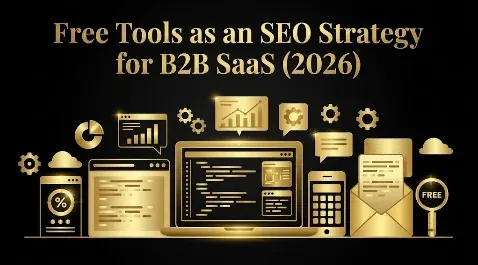
Free Tools and Calculators as an SEO Strategy for B2B SaaS (2026): Engineering as Marketing That Ranks, Earns Links, and Gets Cited
Quick answer: A free tool, a calculator, an analyzer, a generator, or a diagnostic, is one of the strongest SEO and link assets a B2B SaaS can own, because it does three things a blog post cannot: it ranks for high-intent “calculator,” “checker,” and “generator” queries that signal a buyer actively working a problem, it earns editorial backlinks at a rate ordinary content rarely matches because other people’s content links to a useful tool as a resource, and it gives AI engines something concrete to cite and recommend. The strategy is often called engineering as marketing, and the discipline that separates the tools that work from the ones that waste a quarter of engineering time is to pick the tool from search demand rather than from a brainstorm: find the calculation or check your buyers already attempt manually, confirm there is real search volume behind it, and build the tool that answers that query better than anything ranking today. Build it to rank, which means the tool itself is on an indexable page targeting the query, it loads fast, it is usable on mobile, and where it makes sense you generate programmatic variations for the long tail. The single most important rule is to never gate the tool itself behind an email form, because a gated tool cannot be used, linked, or cited, which destroys the entire SEO and link rationale; instead let anyone use it freely and capture the email at the results step, framed as sending a personalized report, so you keep the SEO value and still generate leads. Tools earn links because they are genuinely useful references, so a good one accumulates editorial links and gets included in “best free [X] tools” lists, which are themselves heavily cited by AI engines, giving you a second path to AI visibility. Measure the tool on the full funnel: rankings for the target queries, referring domains earned, appearances and citations in AI answers, tool usage, email captures, and the pipeline it influences, not just signups. The honest caveat is that a free tool is a real engineering and maintenance commitment, not a one-off content piece, and it compounds over months rather than paying back immediately, so build the ones tied to genuine search demand and to your product, and maintain them.
Key takeaways
- Tools are a top SEO and link asset: they rank for high-intent calculator and checker queries, earn editorial backlinks at a rate ordinary content rarely matches, and give AI engines something concrete to cite.
- Pick from search demand, not a brainstorm: build the calculation or check your buyers already do manually and that has real search volume behind it, so the tool meets a query that already exists.
- Build it to rank: the tool sits on an indexable, fast, mobile-friendly page targeting the query, with programmatic variations for the long tail where it fits.
- Never gate the tool itself: a gated tool cannot be used, linked, or cited; let anyone use it and capture the email at the results step as a personalized report.
- Links and citations compound: a genuinely useful tool earns editorial links and lands in “best free [X] tools” lists that AI engines cite, so it pays back over months, not instantly.
Most B2B SaaS content strategies are all words, and they compete in the most crowded part of the web. A free tool competes somewhere far less crowded and far more valuable: the high-intent “calculator,” “checker,” and “generator” searches where a buyer is actively working a problem your product solves. Done well, a tool ranks, earns links that ordinary content cannot, and gets cited by AI engines, which is three wins from one asset. This guide covers why tools work so well for SEO, which types to build, how to pick one from search demand, how to build it to rank, the gating rule that makes or breaks the whole thing, how tools earn links and citations, and how to measure the result. It is part of our SEO and AEO series and pairs with the link building, programmatic SEO, and bottom-of-funnel guides.
Why free tools are one of the best SEO assets a SaaS can own
The strategy has a name, engineering as marketing, and it works because a tool does things a blog post structurally cannot. First, it matches a kind of query that is both high-intent and under-served: searches containing “calculator,” “checker,” “analyzer,” “generator,” or “grader” come from someone actively doing a task, not idly reading, and the results for those queries are often thin because they require building something rather than writing something, so a good tool can rank where good prose cannot. Second, a useful tool earns editorial backlinks at a rate ordinary content rarely reaches, because when a writer needs to point readers to a way to calculate or check something, they link to the tool as a resource, and editorial links from people choosing to reference you are the strongest kind, as the link building guide covers. Third, a tool gives AI engines a concrete, citable thing: both the tool itself and the “best free [X] tools” lists it gets included in are the kind of practical, specific content engines surface for task-oriented queries. One asset, three compounding returns, which is why free tools are one of the highest-leverage SEO investments a B2B SaaS can make, and also why they are underused, because they require engineering rather than only writing.
The proof of the pattern is that the most durable examples have run for years: HubSpot’s Website Grader has graded millions of sites since 2007 and still sends links and leads, and the free checkers from Ahrefs and Semrush rank and earn references at a scale their blogs do not. What has changed in 2026 is the cost side of the equation. AI coding assistants like Claude Code and Cursor have made small, single-purpose utilities, sometimes called side-car tools, cheap enough to ship in hours rather than weeks, so the old objection that tools are too expensive to justify has weakened considerably. Teams using this approach report building dozens of small utilities, each solving one narrow task adjacent to their product, and seeing them account for a meaningful share of site traffic (one reported roughly 20%). The implication is that the barrier to the strategy is now less about engineering capacity and more about the discipline of choosing the right tools and not gating them, which is where the rest of this guide focuses.
Types of tools that work
Not every tool idea is worth building; the ones that earn their keep cluster into a few proven types, each tied to a recognizable buyer need:
| Tool type | What it does | Example |
|---|---|---|
| ROI calculator | Shows the money or time saved or earned with a solution | ”How much could you save with [category]?” |
| Cost calculator | Estimates what a usage-based product will cost at scale | Cloud or SaaS-stack cost estimator |
| Analyzer / checker | Audits something the buyer owns and scores it | SEO audit, site-speed check, security scan |
| Benchmark tool | Shows how the buyer compares to peers (needs proprietary data) | “How does your [metric] compare?” |
| Generator / builder | Produces a usable output from inputs | Template, policy, or checklist generator |
| Fit / diagnostic quiz | Scores maturity or recommends a plan, doubling as a sales qualifier | ”How mature is your [process]?” |
Two of these deserve special note. Analyzers and benchmark tools are powerful because they create a result unique to the user (a score, a comparison to peers) that is both compelling and shareable, and benchmark tools in particular, if you have proprietary data, are nearly impossible for a competitor to copy. Fit and diagnostic quizzes double as sales qualifiers, because the inputs a user provides tell you how ready and how good a fit they are. The common thread is that the best tools solve a calculation or check the buyer is already attempting manually, often in a spreadsheet, which is the clearest signal the need is real.
Pick the tool from search demand, not a brainstorm
The most common way a free-tool project fails is being chosen in a brainstorm for its cleverness rather than its demand, so invert the process and let search decide. Start from the queries your buyers already type when they are working the problem your product solves: the “[thing] calculator,” “[thing] checker,” “how to calculate [thing],” and “[thing] template” searches in your category, and validate that they have real, recurring volume rather than being a term you wish people searched. Then look at what currently ranks for those queries, because if the results are thin, a spreadsheet template, a clunky old tool, a prose explanation of how to do the math by hand, that gap is your opening to build something clearly better. Prefer ideas that sit close to your product, both because they attract the right audience and because the tool can lead naturally to your paid solution, and favor the calculation your buyers genuinely attempt by hand, since that manual effort is proof the need exists. This demand-first selection is the same discipline as keyword research for content, applied to tools: you are not inventing a need, you are building the best possible answer to a query that already has searchers behind it, which is what gives the tool a reason to rank and a reason to be linked.
Build it to rank
A tool only delivers SEO value if search engines and AI crawlers can actually reach and understand it, which is where many otherwise good tools fail. Put the tool on its own indexable page targeting the query, with a clear keyword-aligned H1, supporting copy that explains what the tool does and the question it answers (so the page has text to rank and to be cited, not only an interactive widget), and the tool itself usable directly on the page. Make sure the page is not accidentally blocked from crawling or rendered only through JavaScript that crawlers cannot execute, as the technical SEO guide covers, because a tool an engine cannot see cannot rank or be cited. Keep it fast and genuinely usable on mobile, since tool pages are easy to make heavy and slow. Where the tool naturally has variations, a cost calculator by team size, a checker by platform, a generator by use case, consider programmatic pages for those variations to capture the long tail, which is the overlap with programmatic SEO covered in that guide, as long as each variation is genuinely useful rather than a thin template. Add the appropriate schema and a short explanatory section with an FAQ, so the page supports featured snippets and gives AI engines extractable context about what the tool does and who it is for.
The one rule that makes or breaks it: do not gate the tool
This is the single decision that most often destroys a free-tool strategy, so it is worth stating plainly: do not put the tool itself behind an email wall. The entire SEO and link rationale depends on the tool being freely usable, because a gated tool cannot be tried by a visitor, cannot be linked to as a resource (no one links to a form), and cannot be used or cited by an AI engine, which eliminates all three of the returns that justified building it. Gating also sharply reduces usage; practitioners consistently report that gating the tool itself cuts starts dramatically. The approach that keeps the SEO value and still generates leads is to let anyone use the tool freely and capture the email at the results step, framed as a benefit rather than a toll (“where should we send your personalized report?”), so the user gets the result either way and you earn the email from those who want the fuller version. Keep the whole experience short, under about ten minutes, with as few inputs as the calculation genuinely needs and sensible defaults so a user can click through quickly, because every extra input lowers completion. The mental model is that the tool is the marketing, not the gate: it earns its keep by being used, shared, linked, and cited, and the lead capture is a light touch layered on top, never the barrier in front.
How free tools earn links and AI citations
The link and citation returns are the reason a tool outperforms a blog post over time, and they come from the tool being a genuinely useful reference. Editorial links accrue because writers covering the topic link to the tool as the practical resource for readers who want to do the calculation or check, and those are exactly the earned, editorially given links that carry the most weight. You accelerate this not by buying links but by making the tool genuinely the best option and putting it in front of the people who write about the topic, and by producing supporting content that embeds the tool as the solution. The AI-citation path is twofold: the tool page itself can be cited for task queries, and, just as importantly, the tool tends to get included in “best free [category] tools” and “top [X] calculators” roundups, which are precisely the kind of list content AI engines lean on when a user asks for the best tool to do something, so being on those lists is a direct route into AI answers. A deliberate tactic here is displacement: ask the engines the task queries you want to win, see which competitor tools and pages they currently cite, and build something more useful and more data-rich than what they are quoting, while keeping the page in clean, crawlable HTML with clear headings so the engine can actually parse the tool and its output rather than seeing an opaque widget. This connects to the community and entity work in the Reddit and entity SEO guides: a genuinely useful free tool gets recommended in communities and strengthens your entity’s association with the task it performs, both of which feed AI recognition. The throughline is that you do not manufacture links or citations for a tool; you earn them by building something people are glad to reference.
How to measure it
Because a tool is an engineering investment, measure it across the full funnel rather than on signups alone, and be patient, because like most SEO it compounds over months rather than paying back immediately. Track the SEO outcomes first: rankings for the target queries, organic traffic to the tool page, and referring domains earned, since link acquisition is a core reason to build the tool. Track AI visibility by asking the engines the task queries the tool serves (“best [X] calculator,” “how to calculate [thing]”) and watching whether your tool is cited or recommended, and whether it appears in the roundup lists engines quote. Track the engagement and lead metrics: tool starts and completions, email captures at the results step, and the quality of those leads, because a tool that is used but converts poorly may be attracting the wrong audience or solving a problem too far from your product. Finally, connect it to pipeline by tagging tool-sourced and tool-influenced leads in your CRM, so you can judge the tool on influenced revenue rather than vanity usage, which is also how you justify the engineering time to build the next one. The failure you are watching for is a tool that gets traffic and usage but never links, never gets cited, and never influences pipeline, which usually means it is too far from both real search demand and your product.
Field note: The reason free tools are underused despite being one of the best SEO assets available is organizational, not strategic: a blog post can be ordered from a writer, while a tool needs engineering time, and engineering time is the scarcest resource in most SaaS companies, so the idea dies in the backlog. The teams that make it work treat a free tool less like a content project and more like a small product, which changes everything about how they choose and maintain it. They pick the tool from search demand rather than from a founder’s pet idea, so the engineering is spent on something with searchers already waiting, and they resist the two temptations that kill the return: gating it, which trades away all the SEO and link value for a few more emails, and shipping it once and abandoning it, which lets it rot into a slow, broken page that earns nothing. The ones that compound are the ones treated as durable assets, a calculator that stays accurate as pricing and benchmarks change, an analyzer that keeps working as the thing it analyzes evolves, because a tool that stays genuinely useful keeps earning links and citations for years with almost no marginal cost, while the content treadmill demands a new post every week forever. The uncomfortable trade is real: a tool costs more upfront than an article and pays back more slowly, which is exactly why most competitors will not do it, and exactly why the ones who do end up owning the high-intent task queries in their category while everyone else fights over blog keywords. In an AI-answer world that increasingly rewards genuinely useful, specific, citable resources over more prose, the free tool is one of the few content assets that is getting more valuable, not less.
Honest limitations
- A tool is still an engineering commitment, though a smaller one than before. AI coding assistants have made small utilities far cheaper to build in 2026, but every tool still needs ongoing maintenance to stay accurate, so it remains a product decision, not a one-off content win, and the cost is now mostly upkeep rather than the initial build.
- It compounds slowly. Like most SEO, a tool takes months to rank, earn links, and get cited, so do not expect fast payback, and treat the figures in vendor playbooks as directional.
- Demand has to be real. A clever tool with no search demand behind it will not rank or earn links, which is why demand-first selection matters more than the idea’s novelty.
- Gating undoes the strategy. Putting the tool behind a form reclaims a few emails at the cost of the rankings, links, and citations that justified it, so the gating decision is genuinely make-or-break.
- Not every category suits every tool. Benchmark tools need proprietary data, some calculations are too trivial or too complex to tool well, and the right type depends on your category and data.
- This is educational, not legal or financial advice, and search and AI behavior changes, so verify current best practice and validate against your own data.
Frequently Asked Questions
Q1. Why are free tools such a strong SEO strategy for B2B SaaS?
Free tools are strong because a tool does three valuable things that a blog post structurally cannot, which is why the approach is often called engineering as marketing. First, a tool ranks for a kind of query that is both high-intent and under-served: searches containing “calculator,” “checker,” “analyzer,” “generator,” or “grader” come from people actively working a task rather than casually reading, and the results for those queries are frequently thin because they require someone to build a tool rather than write an article, so a genuinely useful tool can rank where even excellent prose struggles. Second, a tool earns editorial backlinks at a rate ordinary content rarely matches, because when writers cover a topic they link to a useful tool as the practical resource for their readers, and editorially given links from people choosing to reference you are the most valuable kind for SEO. Third, a tool gives AI engines something concrete and practical to cite, both the tool page itself for task-oriented queries and the “best free [X] tools” roundups the tool gets included in, which engines lean on heavily when a user asks for the best way to do something. So a single well-built tool delivers three compounding returns, rankings, links, and AI citations, from one asset, which is a better return profile than almost any single piece of written content. The reason tools remain underused despite this is that they require engineering time rather than only writing, so they are harder to commission and easier to leave in the backlog, which is precisely why the companies that do build them face less competition on the high-intent task queries that matter most.
Q2. What types of free tools work best for B2B SaaS?
The tools that reliably earn their keep cluster into a few proven types, each tied to a clear buyer need. ROI calculators show the money or time a buyer could save or earn, which maps directly to the business case for your category. Cost calculators estimate what a usage-based or seat-based product will cost at scale, which buyers genuinely need and often attempt in a spreadsheet. Analyzers or checkers audit something the buyer owns, a website, a configuration, a security posture, and return a score, which is compelling because the result is specific to them and naturally shareable. Benchmark tools show how the buyer compares to peers and are especially powerful if you have proprietary data, because a competitor cannot easily copy a benchmark built on data they do not have. Generators or builders produce a usable output, a template, a policy, a checklist, from the user’s inputs. Fit or diagnostic quizzes score a buyer’s maturity or recommend a plan, and they double as sales qualifiers because the inputs reveal how ready and how good a fit the user is. The unifying principle across all of these is that the best tool solves a calculation or check the buyer is already doing manually, usually in a spreadsheet, because that manual effort is the clearest possible proof that the need is real and recurring. Which type is right for you depends on your category and the data you have: if you hold proprietary benchmarks, a benchmark tool is hard to beat; if your value is cost savings, an ROI or cost calculator makes the case; if buyers struggle to assess their own situation, an analyzer or diagnostic gives them a reason to engage and gives you a qualified lead.
Q3. How do I choose which tool to build?
Choose it from search demand rather than from a brainstorm, which is the single most important decision and the one teams most often get wrong by building something clever that no one searches for. Start from the queries your buyers already type when they are working the problem your product solves: the “[thing] calculator,” “[thing] checker,” “how to calculate [thing],” and “[thing] template” searches in your category. Validate that those queries have real, recurring search volume, because the whole SEO rationale depends on there being searchers waiting for the tool, and a term you merely wish people searched will not rank into meaningful traffic. Next, look at what currently ranks for those queries, because the opportunity is largest where the existing results are weak, an outdated tool, a spreadsheet template, or a prose article explaining how to do the math by hand, since that weakness is the gap a better tool can fill. Then prefer ideas that sit close to your product, for two reasons: they attract the audience you actually want rather than random traffic, and the tool can lead naturally into your paid solution, so the lead it generates is relevant. Finally, favor the specific calculation or check your buyers genuinely attempt manually, because that existing manual effort is the strongest evidence the need is real and worth building for. This is the same discipline as keyword research applied to tools: you are not inventing a need, you are building the best available answer to a query that already has demand behind it, which is what gives the tool a reason to rank, a reason to be linked, and a reason to be cited. If you cannot find real search demand for a tool idea, that is a signal to drop it, however clever it seems.
Q4. Should I gate the tool behind an email form?
No, you should not gate the tool itself, and this is the decision that most often destroys an otherwise good free-tool strategy. The reason is that every one of the three returns that justify building a tool depends on the tool being freely usable: a visitor cannot try a gated tool, a writer cannot link to a form as a resource, and an AI engine cannot use or cite something locked behind an email wall, so gating the tool eliminates the rankings, the links, and the citations all at once in exchange for a few more email addresses. Gating also sharply reduces usage, with practitioners consistently reporting that gating the tool itself causes a large drop in starts, so you lose most of the audience too. The approach that keeps the SEO and link value while still generating leads is to let anyone use the tool freely and capture the email at the results step, framed as a benefit rather than a barrier, something like “where should we send your personalized report?”, so the user gets their answer regardless and you earn the email from the meaningful share who want the fuller or saved version. Keep the experience short, under roughly ten minutes, with only as many inputs as the calculation genuinely requires and sensible defaults so users can click through quickly, because each additional input measurably lowers completion. The mental model to hold is that the tool is the marketing, not the gate: its entire value comes from being used, shared, linked, and cited, and the lead capture is a light layer on top of a freely usable tool, never a wall in front of it. If you find yourself tempted to gate it to hit a lead number, remember that a gated tool usually generates fewer leads in absolute terms too, because it never earns the traffic, links, and citations that would have fed the funnel in the first place.
Q5. How do free tools earn backlinks and AI citations?
They earn both by being genuinely useful references that people are glad to point to, which is why a tool outperforms a blog post over time. On the link side, editorial backlinks accrue because writers covering your topic naturally link to a useful tool as the practical resource for readers who want to actually do the calculation or check, and those editorially given links, chosen freely by the linking site, are the most valuable kind for SEO, far better than anything you could buy or build artificially. You accelerate this not by purchasing links but by making the tool genuinely the best option available, putting it in front of the people who write about the topic, and publishing supporting content that embeds the tool as the solution so it is discoverable and obviously worth referencing. On the AI-citation side there are two paths. The tool page itself can be cited directly when a user asks an engine how to do the task the tool performs, provided the page is crawlable and has explanatory text, not just an interactive widget. More importantly, a good tool gets included in “best free [category] tools” and “top [X] calculators” roundup articles, and those list-style pages are exactly what AI engines lean on when a user asks for the best tool to accomplish something, so being on those lists is a direct route into AI answers. This also connects to community and entity signals: a genuinely useful free tool gets recommended in communities like Reddit and strengthens your brand’s association with the task it performs, both of which feed the AI engines’ recognition of you as a relevant answer. The throughline is that none of this is manufactured; you earn the links and citations by building something people genuinely want to reference, which is why the quality and genuine usefulness of the tool matters more than any promotion tactic.
Q6. How long does it take and how do I measure whether it worked?
Expect it to compound over months rather than pay back immediately, because like most SEO a tool needs time to rank, accumulate links, and get picked up into the roundups and AI answers, so patience and maintenance matter as much as the build. Measure it across the full funnel rather than on signups alone. On the SEO side, track rankings for the target task queries, organic traffic to the tool page, and, crucially, referring domains earned over time, since link acquisition is one of the core reasons to build a tool and a tool that earns no links is underperforming its main advantage. On the AI-visibility side, periodically ask the engines the task queries your tool serves, such as “best [X] calculator” or “how to calculate [thing],” and record whether your tool is cited or recommended and whether it appears in the roundup lists engines quote. On the engagement and lead side, track tool starts, completion rate, email captures at the results step, and the quality of the resulting leads, because a tool that gets used but converts poorly may be attracting the wrong audience or solving a problem too distant from your product. Finally, connect it to revenue by tagging tool-sourced and tool-influenced leads in your CRM so you can judge the tool on influenced pipeline rather than raw usage, which is also what lets you justify the engineering time for the next tool. The specific failure pattern to watch for is a tool that gets traffic and usage but never earns links, never gets cited, and never influences pipeline, which almost always means it is too far from genuine search demand, too far from your product, or both, and is the signal to either fix its positioning or retire it and build a better-targeted one.
Q7. Is building a free tool worth the engineering cost for a smaller SaaS?
It can be one of the best uses of scarce engineering time, but only if you treat it as a product decision rather than a content whim, and the economics favor smaller companies precisely because most competitors will not make the effort. The honest cost is real: a tool takes more engineering time to build than an article takes to write, and it needs ongoing maintenance to stay accurate as pricing, benchmarks, or the thing it analyzes change, so it is a commitment, not a one-off. But the payoff profile suits a smaller company well for three reasons. First, the high-intent task queries a tool targets are far less contested than the blog keywords everyone fights over, so a single good tool can own a valuable query that would take a large content team to compete for otherwise. Second, a tool compounds: once it ranks and starts earning links and citations, it keeps doing so for years with little marginal cost, whereas the content treadmill demands a fresh post every week indefinitely, which is harder for a lean team to sustain. Third, in an AI-answer world that increasingly rewards specific, genuinely useful, citable resources over yet more prose, a tool is one of the few content assets getting more valuable rather than less. The way to make it worth it for a smaller team is to be disciplined: pick exactly one tool, chosen from real search demand and tied closely to your product, build it well enough to be genuinely the best option for that query, do not gate it, and maintain it, rather than scattering effort across several half-built tools. Build one tool that genuinely deserves to rank and be cited, and it can outperform months of blog output; build a clever tool nobody searches for, or gate the one you build, and you will have spent scarce engineering time for little return, which is why the selection discipline matters more than the engineering itself.
If you want a free-tool strategy that ranks, earns links, and gets cited rather than sitting unused, book a demo with Growthspree.
Sources & further reading
- 2026 practitioner playbooks on free tools and calculator lead magnets for B2B SaaS (Dupple on tool types, conversion, gating, and build-versus-buy; Toolradar on calculator types, design rules, the no-gating principle, and common mistakes; Stormy on side-car utilities shipped with AI coding assistants, embedding tools in programmatic pages, and displacing competitor pages that AI currently cites) covering why interactive tools outperform static assets, the proven tool types, the capture-at-results approach, keeping inputs and time low, and the lowered build cost in 2026. Their conversion, traffic, and revenue figures (for example tools at ~20% of site traffic, and HubSpot Website Grader’s millions of graded sites) are largely self-reported or company-stated; treat them as directional and validate against your own data.
- The “engineering as marketing” concept (popularized in the startup-traction literature) as the framing for tools as a growth and SEO channel.
- GrowthSpree (B2B SaaS practice: choose the tool from search demand, build it on an indexable fast page, never gate the tool itself, earn links and citations by being genuinely useful, and measure on rankings, referring domains, AI citations, and influenced pipeline).
- Companion: Link Building for B2B SaaS; Programmatic SEO for B2B SaaS; Bottom-of-Funnel SEO for B2B SaaS; Reddit and Community Marketing for AI Citations.
This guide is educational, not legal or financial advice; search and AI behavior changes, so verify current best practice and validate against your own data.
Related guides: Link Building for B2B SaaS · Programmatic SEO for B2B SaaS · Bottom-of-Funnel SEO for B2B SaaS · Reddit and Community Marketing for AI Citations.