Pipeline,
not promises.
Senior operators audit your funnel in 48 hours. Ship 3 specific moves in 30 days.
- Full-funnel audit · 4 velocity levers
- 3 wins to ship in 30 days
- $3K flat · month-to-month
30-min call · No commitment
- Full-funnel audit · 4 velocity levers
- 3 wins to ship in 30 days
- $3K flat · month-to-month
Bottom-of-Funnel SEO for B2B SaaS (2026): The Comparison, Alternatives, and Use-Case Pages That Actually Convert
Quick answer: Bottom-of-funnel (BOFU) SEO targets the searches people make when they are choosing a vendor, not learning about a problem, which is why it converts several times better than top-of-funnel blog content: comparison and alternatives pages routinely convert at 5 percent or more against 0.5 to 2 percent for a typical blog post, roughly four times the average landing-page rate. The page types that do the work are “[you] vs [competitor]” pages, “[competitor] alternatives” pages, “best [category]” lists, pricing and competitor-pricing pages, and narrow use-case or industry pages, because each one meets a buyer who already has intent and is comparing options. The counterintuitive rule is to prioritize intent over volume: a page with 500 visits converting at 7.5 percent produces more pipeline than a blog with 5,000 visits converting at 0.5 percent, so you measure BOFU by conversions and pipeline, not traffic. Build comparison pages honestly, include a feature table, name the situations where the competitor is the better choice (it self-qualifies leads and builds trust), add role-matched social proof and a switcher case study, and keep them current with quarterly reviews. These pages matter even more in 2026 because they are exactly what buyers now ask AI assistants (“is X or Y better for [use case]”, “alternatives to X”), so an honest, well-structured comparison page is both your highest-converting organic asset and one of your best shots at being cited in AI answers. Start with the competitors that come up in real sales conversations, not the ones with the most search volume.
Key takeaways
- BOFU SEO targets choosing-a-vendor searches, not learning searches, so comparison and alternatives pages convert at 5 percent-plus versus 0.5 to 2 percent for blogs, about 4x the average landing page.
- The page types that convert: “[you] vs [competitor]”, “[competitor] alternatives”, “best [category]”, pricing, and narrow use-case or industry pages.
- Prioritize intent over volume: 500 visits at 7.5 percent beats 5,000 at 0.5 percent, so measure BOFU by conversions and pipeline, not traffic.
- Win on honesty: a fair feature table, a clear “when to choose the competitor” section, and a switcher case study convert better than biased positioning and avoid legal risk.
- These pages double as AI-answer assets, because comparison and alternatives questions are exactly what buyers now ask ChatGPT, Perplexity, and Google AI Overviews.
Most B2B SaaS teams pour their SEO effort into top-of-funnel blog posts that rank, get traffic, and convert almost nobody, while leaving the handful of pages that actually influence a buying decision unbuilt. Bottom-of-funnel SEO flips that priority. This guide covers what BOFU SEO is, which page types convert, how to build comparison and alternatives pages, how to write about competitors without wrecking trust, how to prioritize and sequence the work, and why these pages are now also your best path into AI answers. It opens our SEO and AEO series and pairs with the programmatic SEO and answer-engine-optimization guides.
What BOFU SEO is, and why it converts
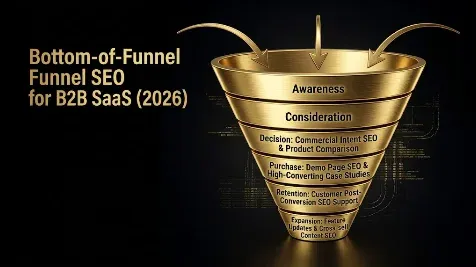
Bottom-of-funnel SEO targets the queries buyers type when they are close to a decision: comparing two products, looking for a replacement, checking pricing, or confirming a tool fits their exact use case. That intent is why it converts so much better than awareness content. The reported gap is large and consistent: comparison and alternatives content converts in the range of 5 to 7.5 percent or more, versus roughly 0.5 to 2 percent for a typical blog-to-trial path, which makes BOFU visitors worth close to four times the average landing-page conversion rate.
| Page type | Intent | Reported conversion |
|---|---|---|
| ”[Competitor] alternatives” | Replacing a rejected tool | Among the highest |
| ”[You] vs [competitor]“ | Final vendor selection | 5 percent-plus |
| Narrow use-case / industry | Confirming fit for their context | Above broad pages |
| Pricing / competitor pricing | Checking cost and value | High (68 percent abandon unoptimized) |
| “Best [category]“ | Early shortlisting | Higher volume, lower conversion |
The strategic consequence is that you stop judging these pages by traffic. A page with 500 visits converting at 7.5 percent (about 37 leads) beats a blog with 5,000 visits converting at 0.5 percent (about 25 leads), so BOFU is measured by conversion rate and pipeline contribution, and judging it by awareness-content traffic standards badly undervalues it.
The high-intent page types
Five page types carry BOFU SEO for B2B SaaS. “[Competitor] alternatives” pages catch buyers who have already rejected something and want a replacement, which is why they are among the highest-converting of all. “[You] vs [competitor]” pages catch the final head-to-head selection. Narrow use-case and industry pages (“[product] for [role or industry]”) convert better than broad category pages because they speak to the buyer’s exact context. Pricing pages (and “[competitor] pricing breakdown” pages) catch cost-stage buyers, and matter because a majority of visitors abandon unoptimized SaaS pricing pages. “Best [category]” lists have the most search volume but the lowest conversion, since the audience is earlier in the journey, so treat them as a wider net rather than your core. The through-line: the narrower and later-stage the query, the higher the conversion and the more it deserves a dedicated page.
How to build a comparison (vs) page
A comparison page has a repeatable structure that ranks and converts:
- Technical foundation: lead the title with “[Brand] vs [Competitor]”, put these pages in a
/compare/subfolder for topical clustering, and add Product, Review, and FAQ schema. - Above the fold: an H1 that states the comparison and a primary CTA placed after the value proposition.
- Feature table: compare 8 to 12 core features with checkmarks, X marks, and short notes for nuance (plan limits, caveats), not just binary ticks.
- Qualitative differentiators: 3 to 5 non-feature advantages that matter to your best customers.
- “When to choose the competitor”: name the situations where they fit better. This self-qualifies leads and is the single most trust-building element on the page.
- Social proof: customer logos, role-matched quotes, and at least one detailed case study, ideally from a customer who switched from that competitor.
- FAQs: 5 to 7 real questions on cost, switching effort, implementation time, and commitment.
- Closing CTA: matched to your buying motion (demo for sales-led, free trial for self-serve).
How to build an alternatives page
An alternatives page serves a slightly earlier, broader moment than a vs page. Open by acknowledging why buyers are looking for an alternative (pricing, a missing feature, support, or use-case fit), then present your product first, followed by 3 to 5 genuine competitor alternatives. Give each option a fair profile (core features, ideal customer, pricing model, and how it differs from the tool being replaced), add a comparison matrix across pricing, features, integrations, support, and company size, and include a decision framework so buyers can self-identify by company size, budget, or technical need. The fairness is not charity, it is what makes the page credible enough to be believed and cited, and a transparently fair alternatives page outperforms a thinly veiled advertisement.
Writing about competitors without wrecking trust
The fastest way to ruin a comparison program is to attack competitors, which invites legal risk and damages your reputation, so the discipline is honesty. Be transparent that the page reflects your perspective and explain your methodology, credit competitors’ genuine strengths in their areas, never invent weaknesses, and clearly state who your product is and is not for. Keep everything accurate with a quarterly review, because competitors change features, pricing, and positioning, and a stale comparison page is both a ranking liability and a credibility one. Honest comparisons consistently convert better than biased positioning, partly because B2B buyers are sophisticated enough to spot a hatchet job and discount the whole page.
Prioritizing and sequencing the work
Start with the competitors that actually come up in your sales conversations, not the ones with the biggest search volume, then layer in search opportunity. Mine Google Search Console for queries containing “vs”, “alternative”, “compare”, “pricing”, and competitor names to find what people already reach you for. A workable 90-day sequence is alternatives pages first (your top 3 to 5 competitors), then vs pages, then use-case pages for your top segments, then pricing and category pages, because that order front-loads the highest-converting types. A starting scope is your top 5 competitors plus 2 to 3 alternatives pages, growing to a mature library of 20 to 50 pages, and do not forget long-tail variants like “[Brand] vs [Competitor] for [segment]”, which face less competition and bring more qualified traffic.
Why BOFU pages win in AI answers
There is a 2026 bonus that makes BOFU SEO even more valuable: these are exactly the questions buyers now ask AI assistants. “Is X or Y better for [use case]”, “alternatives to X”, “how much does X cost” are comparison and alternatives queries, and a well-structured, honest comparison page with a clear answer, a feature table, and FAQs is precisely the kind of source AI answer engines pull from. The citation benchmarks bear this out: in 2026 analyses, “best X” listicles were the single most-cited page type in ChatGPT (around 44 percent of all cited pages) with comparison guides ranked second, comparison articles were Perplexity’s top high-citation page type, and comparison tables with structured data showed roughly 47 percent higher citation rates in Google’s AI results. In other words, the BOFU page types are the ones AI engines quote most, and adding a structured comparison table measurably improves your odds.
One nuance worth planning around: the engines cite very different sources, so a single page is not a complete AI strategy. ChatGPT leans toward direct sources like competitor and company websites and discounts discussion forums, which rewards your own honest comparison pages; Perplexity leans heavily on Reddit (nearly half its top-cited sources), which rewards genuine presence in community threads; and Google’s AI results favor first-party and listing/review sources depending on whether the query is unbranded or branded. Only about 11 percent of domains are cited by both ChatGPT and Perplexity, so the practical move is to build the honest comparison and alternatives pages that ChatGPT and Google reward, and separately earn authentic mentions where Perplexity looks. So the same page that converts your highest-intent organic visitors is also one of your best shots at being cited when a buyer asks an AI assistant to compare you, which is covered in depth in the answer-engine-optimization guide. Building BOFU pages well is one of the few SEO moves that pays off in both classic search and AI answers at once.
Field note: The pattern that plays out in almost every B2B SaaS SEO program is a blog full of top-of-funnel posts that win traffic awards and close nothing, next to a comparison page the founder wrote in an afternoon that quietly drives half the inbound demos. The reason is intent: a person searching “what is pipeline management” is learning, while a person searching “Pipedrive vs HubSpot” or “Salesforce alternatives” has a budget, a shortlist, and a decision to make this quarter, and the second person is the one your sales team actually wants. The teams that figure this out stop measuring SEO by traffic and start measuring it by which pages show up in closed-won deals, and they almost always find the comparison, alternatives, and use-case pages punching far above their visit counts. The counterintuitive move that follows is to deliberately build pages for a few hundred high-intent searches a month rather than chasing a blog post that might get ten thousand, because 500 visitors converting at seven percent is worth more pipeline than 5,000 converting at half a percent. The part that makes people nervous is writing honestly about competitors, including a section on when the competitor is the better choice, but that honesty is exactly what makes the page believable to a skeptical buyer and increasingly what makes it quotable to an AI assistant summarizing the category. The brands that win the comparison and alternatives real estate in their space tend to win the category’s bottom-of-funnel demand, in both Google and the AI answers that are starting to sit on top of it, and they do it with a few dozen honest, well-maintained pages rather than hundreds of blog posts.
Honest limitations
- Conversion figures are vendor and study-reported. The 5-to-7.5-percent comparison rates and the 4x multiplier are directional benchmarks from third-party analyses, so treat them as a reason to prioritize BOFU, not a promised number.
- BOFU volume is small by design. These pages target few searches each, so the win is conversion and pipeline, not traffic, and keyword tools often undercount comparison and long-tail volume.
- Comparison pages carry legal and reputational risk. Inaccurate or disparaging claims about a named competitor can create real exposure, so accuracy and fairness are non-negotiable and reviews must be regular.
- They go stale fast. Competitors change pricing and features, so an unmaintained comparison page misleads buyers and loses rankings; budget for quarterly upkeep.
- AI citation is not guaranteed. Being well-structured helps your odds of being cited, but AI engines choose sources unpredictably, so treat citation as upside, not a plan.
- This is educational, not investment or financial advice, and validates against your own data.
Frequently Asked Questions
Q1. What is bottom-of-funnel SEO for B2B SaaS?
Bottom-of-funnel (BOFU) SEO is the practice of ranking for the searches buyers make when they are close to choosing a vendor, rather than the awareness-stage searches they make when they are just learning about a problem. In B2B SaaS those decision-stage queries are things like “[your product] vs [competitor]”, “[competitor] alternatives”, “[category] pricing”, and “[product] for [specific use case or industry]”, all of which signal that the searcher already understands the category and is now comparing options or checking fit and cost. This matters because intent, not traffic, drives pipeline: a buyer searching a comparison term is far closer to a purchase than one reading a definitional blog post, so the pages that serve these queries convert several times better. Reported benchmarks put comparison and alternatives content around 5 to 7.5 percent conversion versus roughly 0.5 to 2 percent for a typical blog, which is close to four times the average landing-page rate. The strategic implication is that BOFU SEO should be judged by conversions and pipeline contribution rather than by visit counts, and that a small number of well-built, high-intent pages can outperform a large library of top-of-funnel content. For most B2B SaaS companies, BOFU SEO is the highest-leverage and most under-invested part of their organic strategy, because it sits closest to revenue and is exactly the content their sales team wishes existed.
Q2. Which pages convert best for B2B SaaS SEO?
Five page types do most of the converting, in rough order of intent. “[Competitor] alternatives” pages are among the highest-converting, because the searcher has already decided to leave or avoid a specific tool and is actively shopping for a replacement, so your product appearing first on a credible alternatives list reaches them at the perfect moment. “[You] vs [competitor]” pages catch the final head-to-head selection, where a buyer has narrowed to two options and is making the last call, and these reportedly convert above 5 percent. Narrow use-case and industry pages, like “[product] for [role]” or “[product] for [industry]”, convert better than broad category pages because they speak directly to the buyer’s context and make the fit obvious. Pricing pages, including “[competitor] pricing breakdown” content, catch cost-stage buyers and matter a great deal because a majority of visitors abandon unoptimized SaaS pricing pages, so optimization there has outsized impact. “Best [category]” listicles have the most search volume but the lowest conversion, since their audience is earlier in the journey and still building a shortlist, so they work as a wider net rather than a core converter. The guiding principle is that the narrower and later-stage the query, the higher the conversion, so you prioritize the pages that sit closest to the buying decision even though they have less traffic than broad awareness content.
Q3. How do I build a comparison (vs) page that ranks and converts?
Use a repeatable structure that serves both search engines and buyers. On the technical side, lead the page title with “[Brand] vs [Competitor]”, group these pages in a /compare/ subfolder so they form a topical cluster, write the meta description like ad copy, and add Product, Review, and FAQ schema to qualify for rich results. On the page itself, put an H1 that states the comparison above the fold with your primary CTA placed right after the value proposition, then give the buyer a feature table comparing 8 to 12 core features using checkmarks, X marks, and short notes for nuance like plan limits rather than just binary ticks. Follow that with 3 to 5 qualitative differentiators that matter to your best customers, and then the single most important trust element: a clear “when to choose the competitor” section that names the situations where they genuinely fit better, which self-qualifies leads and makes the whole page believable. Add social proof in the form of customer logos, role-matched quotes, and at least one detailed case study, ideally from a customer who switched from the competitor you are comparing against, since that is the most persuasive proof of all. Close with 5 to 7 FAQs answering real questions about cost, switching effort, implementation time, and commitment, and a final CTA matched to your buying motion, a demo for sales-led products or a free trial for self-serve. The combination of honest structure and clear decision-support is what makes these pages both rank and convert.
Q4. Is it risky to write comparison pages about competitors?
It is risky only if you do it dishonestly, and the risk is both legal and reputational. Attacking a named competitor, inventing weaknesses, or making inaccurate claims about their product can create genuine legal exposure and, just as damaging, makes sophisticated B2B buyers distrust the entire page and by extension your brand. The way to get the upside without the risk is disciplined honesty: be transparent that the page reflects your perspective and explain the methodology behind your comparison, credit the competitor’s real strengths in the areas where they are genuinely strong, never fabricate shortcomings, and clearly state who your product is and is not for. You should also keep the content accurate over time with a quarterly review, because competitors regularly change their features, pricing, and positioning, and an out-of-date comparison page is both misleading to buyers and a ranking liability. Counterintuitively, this honesty converts better than one-sided positioning, because acknowledging where a competitor wins makes your claims about where you win far more credible, and including a “when to choose them” section actually improves lead quality by filtering out buyers you would not serve well. So comparison pages are not inherently risky, but they demand accuracy and fairness as a standing requirement rather than a one-time effort, and a program that treats them as living documents rather than set-and-forget assets captures the conversion benefit while avoiding the legal and trust pitfalls.
Q5. How should I prioritize which BOFU pages to build first?
Start from your sales conversations, not your keyword tool. The competitors and objections that come up repeatedly in real deals are the highest-signal indicator of what your buyers are actually comparing, so build for those first, then layer in search opportunity to sequence within that set. A practical way to find the demand is to mine Google Search Console for queries containing “vs”, “alternative”, “compare”, “pricing”, and competitor names, which shows you what people already reach you for and where you have a foothold to strengthen. A workable 90-day sequence builds alternatives pages first for your top 3 to 5 competitors, since those are among the highest-converting, then vs pages for head-to-head selection, then use-case pages for your top 3 segments, and finally pricing and category pages, an order that front-loads the pages closest to the buying decision. In terms of scope, a sensible start is your top 5 competitors plus 2 to 3 alternatives pages, growing over time to a mature library of 20 to 50 pages, and throughout you should capture long-tail variants like “[Brand] vs [Competitor] for [segment]”, which have less competition and bring more qualified traffic. The key discipline is to resist chasing high-volume, low-intent terms early; prioritize the pages that influence real deals even when their search volume looks small, because their pipeline contribution per visit is far higher.
Q6. How do I measure BOFU SEO if the traffic is low?
Measure it by conversion rate and pipeline contribution, not by traffic, because BOFU pages are designed to serve small numbers of high-intent searches and will always look unimpressive on a traffic dashboard. The correct comparison is pipeline per page, not visits per page: a comparison page with 500 monthly visits converting at 7.5 percent produces roughly 37 leads, which beats a blog post with 5,000 visits converting at 0.5 percent and its roughly 25 leads, despite having a tenth of the traffic. So the metrics that matter are the page’s conversion rate, the number and quality of leads or demos it generates, and ideally its appearance in closed-won deals, which you can approximate by tracking which pages prospects viewed before converting. Two practical cautions: first, keyword tools like Ahrefs and Semrush tend to undercount comparison and long-tail traffic, so the real search demand for these terms is often higher than the tools suggest, which is another reason not to dismiss them on volume; second, judging BOFU content by top-of-funnel standards (sessions, rankings for broad terms, time on page) systematically undervalues it and leads teams to under-invest in their highest-converting assets. Set up conversion tracking on each BOFU page, attribute leads and pipeline to them, and report BOFU SEO as a pipeline channel rather than a traffic channel, which both reflects its real value and protects the investment from being cut because the vanity metrics look small.
Q7. Do comparison and alternatives pages help with AI answers too?
Yes, and that is one of the strongest reasons to invest in them in 2026. The questions buyers increasingly ask AI assistants are overwhelmingly bottom-of-funnel in nature: “is X or Y better for [use case]”, “what are the best alternatives to X”, “how much does X cost compared to Y”, which are exactly the queries your comparison, alternatives, and pricing pages are built to answer. AI answer engines like ChatGPT, Perplexity, and Google’s AI Overviews pull from sources that directly and clearly answer these questions, and a well-structured comparison page, with a concise answer up top, a clear feature table, honest treatment of both products, and an FAQ section, is precisely the kind of source they tend to cite. This means a single well-built BOFU page can work in two channels at once: it captures your highest-intent organic search traffic and it positions you to be named when an AI assistant summarizes your category for a buyer who never visits a search results page at all. The honesty that makes these pages convert also makes them more citable, because AI engines and the buyers reading their answers both respond better to balanced, accurate comparisons than to obvious marketing. That said, AI citation is never guaranteed and the engines choose sources unpredictably, so treat the AI-answer benefit as significant upside on top of the direct conversion value rather than as the primary goal, and see the answer-engine-optimization guide for how to structure content specifically for citation.
If you want a B2B SaaS SEO program that builds the bottom-of-funnel pages your pipeline actually depends on, book a demo with Growthspree.
Sources & further reading
- 2026 practitioner guides (Averi on BOFU content strategy and on ChatGPT/Perplexity/Google AI citation benchmarks; GetPassionfruit on comparison and alternatives page frameworks; MadX and DiscoveredLabs on comparison and “x vs y” content) on BOFU page types, conversion benchmarks (comparison and alternatives at 5 to 7.5 percent-plus versus 0.5 to 2 percent for blogs), page structure, writing about competitors fairly, prioritization and sequencing, and the AI-citation data (best-X listicles ~44 percent of ChatGPT citations, comparison guides and articles top-cited in ChatGPT and Perplexity, comparison tables with schema ~47 percent higher citation in Google AI, and the divergent source preferences across engines). Conversion and citation figures are vendor and study-reported and directional; validate against your own data.
- Google Search Console and Search Central (finding comparison and competitor queries, structured data for rich results).
- GrowthSpree (B2B SaaS SEO practice: prioritize intent over volume, build honest comparison and alternatives pages, start from the competitors in real sales conversations, and measure by pipeline rather than traffic).
- Companion: Answer Engine Optimization for B2B SaaS; AEO vs SEO for B2B SaaS; Programmatic SEO for B2B SaaS; Technical SEO for B2B SaaS.
This guide is educational, not investment or financial advice; search and AI-answer behavior changes, so verify current best practice and validate against your own data.
Related guides: Answer Engine Optimization for B2B SaaS · AEO vs SEO for B2B SaaS · Programmatic SEO for B2B SaaS · Technical SEO for B2B SaaS.