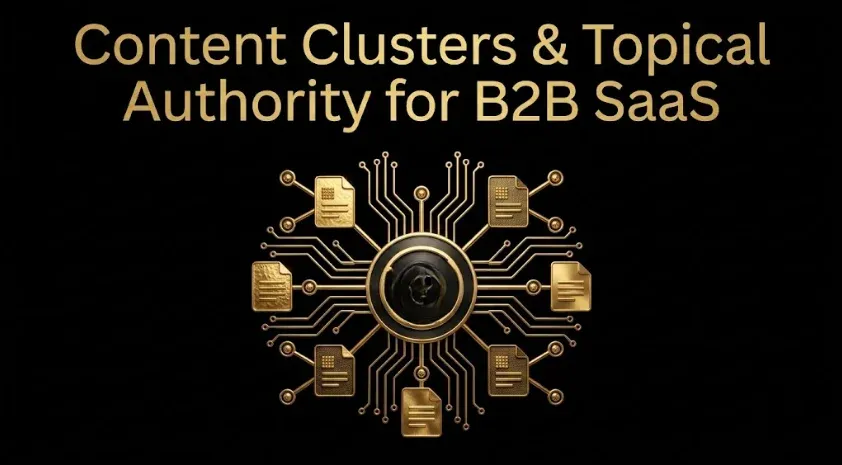
Content Clusters & Topical Authority for B2B SaaS
Quick answer: A content cluster is a pillar page covering a broad topic, surrounded by interlinked cluster posts covering its subtopics in depth — and together they build topical authority, signaling to search engines and AI answer engines that you comprehensively own a subject. Rather than publishing scattered one-off posts, you cover a topic exhaustively and interlink it, which helps you rank across the whole topic, strengthens every page through internal links, and — increasingly important — makes you the kind of authoritative, well-structured source that AI answer engines cite. For B2B SaaS, where trust and depth matter, topical authority is one of the most durable SEO advantages you can build.
Key takeaways
- A cluster = one pillar page + interlinked deep-dive posts on its subtopics.
- Topical authority signals you comprehensively own a subject.
- It lifts the whole topic — internal links strengthen every page.
- It wins in AI search — authoritative, structured sources get cited.
- Depth beats scattered posts — cover a topic exhaustively, then interlink.
Publishing individual blog posts and hoping each ranks is the old way; building topical authority through clusters is how B2B SaaS wins durable organic visibility today. This guide covers what content clusters are, why topical authority matters (especially for AI search), how to build a cluster, and how to interlink it.
What are content clusters?
A content cluster (or topic cluster) is a group of related content organized around a central topic: a pillar page that broadly covers the main topic, and cluster pages that each cover a specific subtopic in depth, all interlinked. Instead of publishing disconnected posts, you pick a topic you want to own, create a comprehensive pillar page, then create supporting posts on every meaningful subtopic — and link them together so they form a coherent, interconnected body of content. The cluster demonstrates, through breadth and depth, that you cover the topic thoroughly. This very library is an example: a paid media strategy pillar surrounded by deep-dives on every channel, tactic, and metric, all interlinked.
Why does topical authority matter?
Topical authority is the perception — by search engines and AI answer engines — that you’re an authoritative, comprehensive source on a subject. It matters because search increasingly rewards depth over one-off pages:
- Comprehensive coverage ranks better. Covering a topic thoroughly (not just one post) signals expertise, helping you rank across the whole topic rather than for isolated terms.
- Internal links strengthen every page. A well-linked cluster passes authority between pages, lifting the whole group — each post helps the others.
- It compounds. As your cluster grows and interlinks, its authority builds, making new pages in the cluster rank more easily.
- It reflects genuine E-E-A-T. Depth and comprehensiveness are how you demonstrate real expertise, which search rewards.
For B2B SaaS, where credibility drives considered purchases, being the comprehensive authority on your topic is both an SEO and a trust advantage.
Why do clusters win in AI search?
This is increasingly the point. As AI answer engines (and AI-powered search) become how buyers get answers, they don’t just rank pages — they synthesize answers and cite sources. The sources they favor are authoritative, comprehensive, well-structured ones that clearly and thoroughly address a topic. A content cluster — deep, structured, interlinked, comprehensive — is exactly the kind of source AI engines draw from and cite. Scattered, shallow posts are far less likely to be surfaced. So topical authority isn’t just traditional SEO; it’s answer engine optimization (AEO) — structuring content so AI engines recognize you as the authority worth citing. Clear structure (direct answers, definitions, FAQs, comprehensive coverage) makes content both rank and get cited, which is why this format matters more as search shifts toward AI.
What is the pillar-and-cluster model?
The structure has two roles:
- The pillar page covers the broad topic comprehensively, serving as the hub — a substantial overview that links out to all the cluster pages. It targets the broad head term and orients the reader to the whole topic.
- The cluster pages each cover one subtopic in depth, targeting more specific terms, and link back to the pillar and to related cluster pages.
The pillar establishes breadth; the cluster pages provide depth; the interlinking ties them into a coherent whole that ranks as a body, not a collection. The reader (and the search/AI engine) can move from the broad overview to any deep-dive and between related deep-dives — a structure that serves both humans and machines.
How do you build a content cluster?
- Pick a topic you can own. A subject central to your business, broad enough for many subtopics but focused enough to cover thoroughly.
- Map the subtopics. Use keyword research and buyer questions to identify every meaningful subtopic the cluster should cover.
- Create the pillar page. A comprehensive overview of the main topic that links out to the cluster pages.
- Create the cluster pages. In-depth posts on each subtopic, each genuinely thorough (not thin), targeting specific terms.
- Interlink deliberately. Link cluster pages to the pillar, the pillar to cluster pages, and related cluster pages to each other.
- Structure for answers. Direct answers, clear definitions, and FAQs so both readers and AI engines can extract information.
- Expand over time. Add cluster pages as you find more subtopics, deepening authority.
How does internal linking work within clusters?
Internal linking is the connective tissue that turns individual posts into a cluster:
- Cluster → pillar. Every cluster page links up to the pillar, consolidating the topic.
- Pillar → clusters. The pillar links out to each cluster page, distributing authority and aiding discovery.
- Cluster → cluster. Related cluster pages link to each other, strengthening connections and guiding readers.
- Use descriptive anchor text that reflects the linked page’s topic, helping search understand relationships.
Deliberate internal linking passes authority around the cluster and signals the relationships between pages — which is much of what makes a cluster more than the sum of its posts. (This library maintains exactly this discipline: every post interlinks with related ones, and no post is orphaned.)
Field note: The mental shift that unlocks topical authority is to stop thinking in posts and start thinking in topics you want to own. Most B2B content strategies are really just backlogs of disconnected article ideas — publish one on this, one on that, hope each ranks. It rarely works, because a single post on a competitive topic has little authority to stand on. The cluster approach inverts it: pick a topic that matters to your business, then commit to covering it more comprehensively than anyone else — a strong pillar plus a deep-dive on every subtopic, all interlinked. It’s more work up front, but it compounds: each new piece strengthens the others, the whole cluster starts ranking together, and — crucially as search goes AI-first — you become the structured, comprehensive source AI engines cite. Own topics, not posts.
Honest limitations
- It’s a bigger commitment. Building a genuine cluster takes sustained effort and many quality pieces, not a quick win.
- Depth must be real. Thin cluster pages published just to “complete” a cluster hurt more than help; each must genuinely earn its place.
- Authority builds slowly. Topical authority compounds over time, so clusters are a medium-term investment, not an instant result.
- Topic choice matters. A cluster on a topic misaligned with your business or with no search demand won’t pay off, however well-built.
- Structure isn’t a substitute for quality. AEO-friendly formatting helps, but only if the underlying content is genuinely valuable and accurate.
Frequently Asked Questions
Q1. What is a content cluster?
A content cluster is a pillar page broadly covering a central topic, surrounded by cluster pages that each cover a specific subtopic in depth, all interlinked. Instead of disconnected posts, you cover a topic comprehensively and link it together, forming a coherent body of content that ranks as a group and demonstrates topical authority.
Q2. What is topical authority?
Topical authority is the perception — by search engines and AI answer engines — that you’re a comprehensive, authoritative source on a subject. It’s built by covering a topic thoroughly and interlinking that coverage, which helps you rank across the whole topic, strengthens every page, and reflects genuine expertise that search rewards.
Q3. Why do content clusters help SEO?
Because comprehensive coverage of a topic ranks better than isolated posts, internal links within a cluster pass authority between pages and lift the whole group, the authority compounds as the cluster grows, and depth demonstrates the expertise search rewards. A cluster ranks as a coherent body rather than a collection of disconnected pages.
Q4. How do content clusters help with AI search?
AI answer engines synthesize answers and cite authoritative, comprehensive, well-structured sources — exactly what a content cluster is. Deep, interlinked, thorough coverage with clear structure (direct answers, definitions, FAQs) makes you the kind of source AI engines draw from and cite, while scattered shallow posts are far less likely to be surfaced.
Q5. What is the pillar-and-cluster model?
It’s a structure with a pillar page covering a broad topic comprehensively (the hub, linking out to subtopics) and cluster pages each covering one subtopic in depth (linking back to the pillar and related pages). The pillar provides breadth, cluster pages provide depth, and interlinking ties them into a coherent whole that ranks as a body.
Q6. How do you build a content cluster?
Pick a topic you can own, map its subtopics using keyword research and buyer questions, create a comprehensive pillar page, create in-depth cluster pages for each subtopic, interlink deliberately (cluster-to-pillar, pillar-to-cluster, cluster-to-cluster), structure for answers with direct definitions and FAQs, and expand over time as you find more subtopics.
Q7. How should you interlink content in a cluster?
Every cluster page should link up to the pillar, the pillar should link out to each cluster page, and related cluster pages should link to each other, all using descriptive anchor text that reflects the linked page’s topic. This deliberate internal linking passes authority around the cluster and signals the relationships that make it more than a set of posts.
Sources & further reading
- Build clusters by covering a topic comprehensively with a pillar and interlinked deep-dives, structured for both readers and AI engines.
- Validate topical authority through rankings across the topic and citations in AI answers, using your own analytics.
This guide is educational; topical authority compounds over time and depends on genuine depth and quality, so build real coverage and validate against your own results.
Related guides: Keyword Research for B2B SaaS · Programmatic SEO for B2B SaaS · SEO for B2B SaaS · The B2B SaaS Paid Media Strategy Guide · The Complete MCP Stack for B2B SaaS Marketing Teams.