Pipeline,
not promises.
Senior operators audit your funnel in 48 hours. Ship 3 specific moves in 30 days.
- Full-funnel audit · 4 velocity levers
- 3 wins to ship in 30 days
- $3K flat · month-to-month
30-min call · No commitment
- Full-funnel audit · 4 velocity levers
- 3 wins to ship in 30 days
- $3K flat · month-to-month
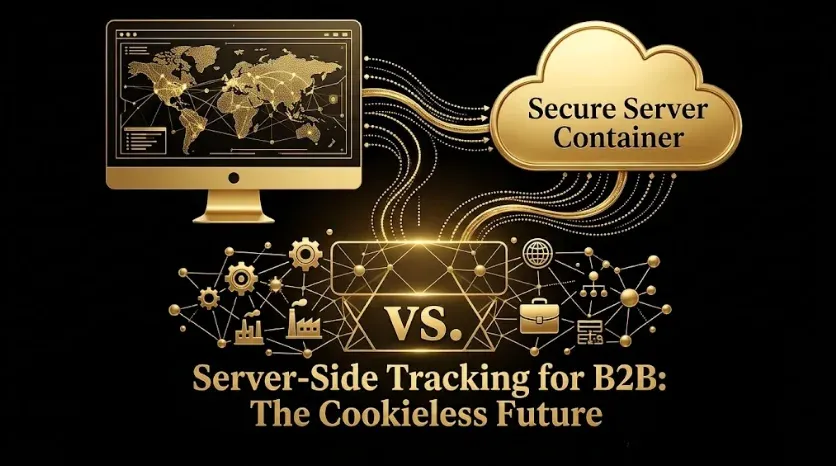
Server-Side Tracking for B2B: Preparing for the Cookieless Future
Quick answer: Server-side tracking sends conversion and analytics data to platforms from your own server instead of directly from the user’s browser. It matters because browser-based tracking is decaying — third-party cookie restrictions, ad blockers, and privacy features (like ITP) increasingly block or shorten client-side tracking, so a growing share of conversions go unrecorded. For B2B, that lost data starves Smart Bidding of the signals it needs to optimize. Server-side tracking recovers accuracy and gives you more reliable first-party data to feed Enhanced Conversions For Leads Value Based Bidding B2B SaaS and offline conversions — but it adds complexity and does not remove the need for user consent.
Key takeaways
- What it is: conversion/analytics data sent from your server, not the browser.
- Why now: cookie loss, ad blockers, and privacy features erode client-side tracking.
- The B2B stakes: lost conversion data starves Smart Bidding and misleads attribution.
- The mechanism: more complete, reliable first-party data feeds bidding and offline conversions.
- Not a loophole: you still need consent and privacy compliance.
Measurement is quietly breaking. The browser-based tracking most B2B accounts still rely on records fewer conversions every year as privacy protections spread, and that missing data corrupts bidding and attribution. Server-side tracking is the leading response. This guide explains what it is, why it matters for B2B specifically, how it improves the data that drives your ads, and what implementing it involves — including the honest limitations.
What is server-side tracking?
Server-side tracking moves the collection and distribution of tracking data from the user’s browser to a server you control. In traditional client-side tracking, the browser sends data directly to Google, Meta, LinkedIn, and analytics tools via tags and pixels. In server-side tracking, the browser sends data to your server first, which then forwards it to those platforms. The practical benefit: your server-to-server connection is far less affected by the browser-level restrictions — ad blockers, cookie limits, privacy features — that increasingly block the direct browser-to-platform path.
Client-side vs. server-side tracking
| Dimension | Client-side (browser) | Server-side |
|---|---|---|
| Data sent from | User’s browser | Your server |
| Affected by ad blockers | Yes, heavily | Much less |
| Affected by cookie/ITP limits | Yes | Much less |
| Data accuracy | Declining | More complete |
| Control over data | Limited | High (you choose what to send) |
| Setup complexity | Low | Higher |
| Consent still required | Yes | Yes |
The trade-off is clear: server-side tracking recovers accuracy and control at the cost of setup complexity — and it does not exempt you from consent obligations.
Why does server-side tracking matter now?
Because the ground under browser-based tracking is eroding from several directions at once:
- Third-party cookie restrictions limit cross-site tracking that many measurement setups relied on.
- Ad blockers block tracking scripts outright for a meaningful share of users — often higher among the technical B2B audiences you’re trying to reach.
- Browser privacy features (like Intelligent Tracking Prevention) shorten or block client-side cookies, truncating conversion windows.
- Longer B2B cycles compound the problem: when tracking cookies expire before a months-long B2B deal closes, the conversion is never attributed to the ad that started it.
The result is a growing gap between conversions that happen and conversions that get recorded — and everything downstream inherits that gap.
Why does this matter more for B2B specifically?
Two reasons. First, B2B audiences block tracking more. Technical buyers, developers, and security-conscious enterprises use ad blockers and privacy tools at higher rates, so client-side tracking misses a larger share of exactly the people you care about. Second, and more important, lost conversion data starves Smart Bidding. Google’s and LinkedIn’s algorithms optimize on the conversions they can see; if a chunk of your real conversions never gets recorded, the algorithm optimizes on a distorted, incomplete picture — it can’t learn from conversions it never received. For an account trying to run Enhanced Conversions For Leads Value Based Bidding B2B SaaS or feed Conversion Value Ladder B2B SaaS Google Ads Acv Tier to teach the algorithm what a good lead is, incomplete data undermines the whole strategy. Better data in means better optimization out.
How does server-side tracking improve your ads?
By giving the platforms more complete, reliable conversion data to optimize against:
- More conversions recorded means Smart Bidding learns from a fuller picture, improving optimization.
- More durable first-party identifiers improve matching between clicks and conversions, including for the long windows B2B needs.
- Cleaner offline-conversion feeds — server-side infrastructure makes it easier to reliably send CRM outcomes (SQL, closed-won) back to the platforms, the foundation of Enhanced Conversions For Leads Value Based Bidding B2B SaaS and effective Performance Max.
- More accurate attribution across your reporting, because fewer conversions fall through the cracks.
In short, it’s less a new marketing tactic than a repair to the data layer that every tactic depends on — the same theme as sound marketing operations.
What are the Conversions APIs?
The platform-specific mechanisms for server-side conversion data are commonly called Conversions APIs (names vary by platform). They let your server send conversion events directly to the ad platform, server to server, rather than relying on the browser pixel. Google, Meta, and LinkedIn each offer a server-side conversion mechanism, often used alongside the browser pixel for redundancy — the two are deduplicated so you capture more without double-counting. Combined with a server-side tag manager, these APIs are the practical backbone of a server-side setup.
What does implementation involve?
A server-side setup is more involved than dropping a pixel; broadly it requires:
- A server-side environment — commonly a server-side tag manager running in your cloud.
- Routing browser data to your server before forwarding it to the platforms.
- Configuring the Conversions APIs for each platform, with event deduplication against existing pixels.
- Connecting offline conversions from your CRM so downstream outcomes flow through the same reliable pipeline.
- Implementing consent so tracking respects user choices (see below).
- Validating accuracy — confirming server-side data reconciles with reality and isn’t double-counting.
This usually needs developer or specialist involvement; confirm current setup steps in each platform’s documentation, as the tooling evolves.
Field note: The trap with server-side tracking is treating it as a way to track users who opted out — it isn’t, and building it that way creates real compliance risk. Server-side tracking’s legitimate value is accuracy: recording the consented conversions that browser restrictions and ad blockers were dropping, so your bidding and attribution work from complete data. Frame it as fixing a measurement leak for users who agreed to be tracked, keep consent enforcement in the pipeline, and you get the benefit without the liability. Framed as a consent workaround, it’s a problem waiting to happen.
Consent and privacy (not legal advice)
Server-side tracking does not remove the need for consent. Because you control the server, you actually bear more responsibility for honoring user choices, not less — consent signals must flow through to your server-side logic so you don’t send data for users who declined. Consent frameworks (such as consent-mode-style implementations) are designed to pass those signals through. Privacy law varies by jurisdiction and changes, and this is general marketing guidance, not legal advice — involve your privacy or legal team when implementing, and configure the setup to respect consent by design.
Honest limitations
- It’s not a consent loophole. It recovers accuracy for consented users; it must not be used to track people who opted out.
- It adds complexity and cost. Server-side infrastructure needs setup and maintenance, usually with technical help — a real investment, not a toggle.
- It’s not a silver bullet. It recovers a lot of lost data but doesn’t perfectly reconstruct everything privacy features remove; some signal loss is permanent.
- Garbage in, garbage out still applies. Server-side tracking on messy underlying data produces reliable-looking wrong numbers, just as any reporting does.
- It requires validation. Deduplication and accuracy need testing, or you can over- or under-count.
Frequently Asked Questions
Q1. What is server-side tracking?
Server-side tracking sends conversion and analytics data to platforms from your own server rather than directly from the user’s browser. Because the server-to-server connection isn’t blocked by ad blockers, cookie limits, and browser privacy features the way browser pixels are, it records a more complete picture of conversions.
Q2. Why is server-side tracking important for B2B?
Because B2B audiences block tracking at higher rates and B2B sales cycles are long, so client-side tracking misses many conversions — and that lost data starves Smart Bidding, which can only optimize on conversions it can see. Server-side tracking recovers accuracy so bidding and attribution work from more complete data.
Q3. Does server-side tracking get around cookie consent?
No. Server-side tracking does not remove the need for consent — and because you control the server, you bear more responsibility for honoring user choices. Consent signals must flow through to your server-side logic. It recovers accuracy for consented users; it must never be used to track people who opted out.
Q4. What is a Conversions API?
A Conversions API is a platform mechanism (Google, Meta, and LinkedIn each offer one) that lets your server send conversion events directly to the ad platform, server to server, instead of relying on the browser pixel. It’s often run alongside the pixel with deduplication to capture more conversions without double-counting.
Q5. How does server-side tracking improve ad performance?
By feeding platforms more complete, reliable conversion data. More recorded conversions and better click-to-conversion matching let Smart Bidding optimize from a fuller picture, make offline-conversion feeds more dependable, and produce more accurate attribution — improving the data layer every campaign depends on.
Q6. What do you need to implement server-side tracking?
Typically a server-side tag manager in your cloud, routing of browser data through your server, configured Conversions APIs with event deduplication, a connection to your CRM for offline conversions, consent enforcement, and validation to confirm accuracy. It usually requires developer or specialist involvement.
Q7. Is server-side tracking worth it for smaller B2B companies?
It depends on spend and data maturity. For accounts relying on Smart Bidding and offline conversions at meaningful scale, recovering lost conversion data is high-value. Very small accounts may prioritize clean client-side tracking and offline conversions first, then adopt server-side as spend and complexity grow.
Sources & further reading
- Google, Meta, and LinkedIn documentation — Conversions APIs, server-side tagging, and consent handling (confirm current setup steps).
- Google Analytics and Tag Manager server-side documentation.
- Privacy law varies by jurisdiction and changes; this is general guidance, not legal advice — consult your privacy or legal team.
This guide is educational and not legal advice; tracking tools and privacy regulations change frequently, so verify current platform steps and consult qualified counsel on compliance before implementing.
Related guides: B2B Google Ads Agency How To Evaluate PPC Partners Long Sales Cycles · Performance Max for B2B Lead Gen · Marketing Operations & the Martech Stack · Marketing Attribution Reporting · The Complete MCP Stack for B2B SaaS Marketing Teams.