Pipeline,
not promises.
Senior operators audit your funnel in 48 hours. Ship 3 specific moves in 30 days.
- Full-funnel audit · 4 velocity levers
- 3 wins to ship in 30 days
- $3K flat · month-to-month
30-min call · No commitment
- Full-funnel audit · 4 velocity levers
- 3 wins to ship in 30 days
- $3K flat · month-to-month
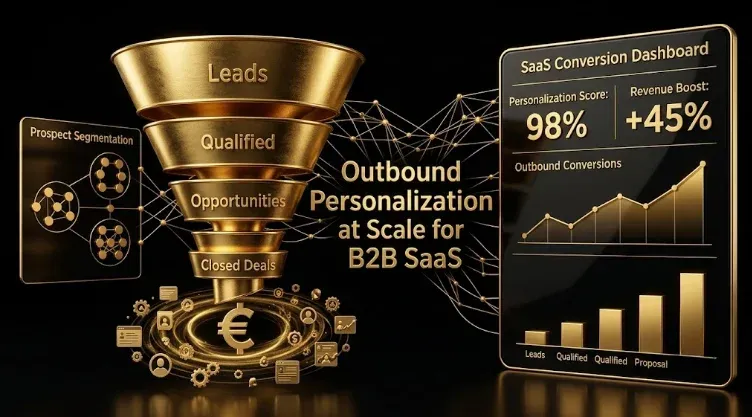
Outbound Personalization at Scale for B2B SaaS
Quick answer: Personalization at scale is the challenge of making outbound relevant to each prospect while still reaching enough prospects to matter — and the answer isn’t fake mail-merge personalization but tiering personalization effort by prospect value and focusing on genuine relevance over superficial tokens. The tension is real: deep personalization doesn’t scale, and pure volume isn’t personalized. The resolution is smart: tier your effort (deep personalization for high-value prospects, lighter relevance for the rest), focus on relevance (which can scale) over personalization tokens (which are often fake), and use tools including AI to help — while avoiding the trap of fake personalization (“I loved your post!” mail-merged) that fools no one. The goal is genuinely relevant outreach at a workable scale, achieved by tiering effort and prioritizing real relevance, not by faking personalization or abandoning it for volume.
Key takeaways
- Personalization at scale: relevance to each prospect at workable volume.
- The tension is real — deep personalization doesn’t scale, volume isn’t personal.
- Tier effort by prospect value — deep for high-value, lighter for the rest.
- Relevance scales; fake personalization tokens don’t fool anyone.
- Use tools including AI to help, but genuine relevance is the goal.
Every outbound team faces the same tension: personalization works but doesn’t scale, and volume scales but isn’t personal. Resolving it — genuine relevance at a workable scale — is the key to modern outbound. This guide covers the personalization-vs-volume tension, tiering effort, relevance vs. fake personalization, and using AI.
What is personalization at scale?
Personalization at scale is the challenge of making outbound genuinely relevant and personalized to each prospect while still reaching enough prospects for outbound to matter. It sits at the heart of the outbound tension: relevance and personalization drive response, but deep personalization is time-intensive and doesn’t scale, while high volume scales but tends toward generic. Personalization at scale is about resolving this — achieving genuine relevance across enough prospects to be worthwhile, rather than choosing between relevant-but-tiny or scaled-but-generic. It’s a central problem because effective outbound requires both relevance (to get responses) and enough scale (to generate meaningful pipeline), and these pull against each other. Solving personalization at scale — genuine relevance at a workable volume — is what separates outbound that’s both effective and worthwhile from outbound that’s either relevant-but-negligible or scaled-but-ignored.
What’s the personalization-vs-volume tension?
The core tension every outbound team faces:
- Deep personalization works but doesn’t scale. Deeply personalized outreach (genuinely researched, individually crafted for each prospect) gets responses, but it’s so time-intensive that you can only do it for a small number of prospects — relevant but not scalable.
- High volume scales but isn’t personal. High-volume outreach (the same generic message to many) scales easily, but it’s generic and gets ignored — scalable but not relevant.
- The tension. You seemingly must choose: deep personalization (relevant, tiny scale) or high volume (big scale, generic) — neither of which is ideal (tiny scale isn’t worthwhile, generic doesn’t work).
This tension is fundamental to outbound and often mishandled — teams either over-index on volume (scaled but generic and ignored) or can’t scale their personalization (relevant but negligible). The mistake is treating it as a binary choice between personalization and scale. The resolution (covered next) is not to pick one but to resolve the tension smartly — through tiering effort and focusing on relevance over personalization tokens. Understanding the tension is the first step: recognizing that pure volume fails (generic) and pure deep personalization doesn’t scale (negligible), so you need a smarter approach than either extreme. The answer is neither “personalize everything deeply” (impossible) nor “blast generic volume” (ineffective) but a resolution that achieves genuine relevance at workable scale.
How do you tier personalization effort?
The key resolution: tier your personalization effort by prospect value — investing deep personalization where it’s worth it, and lighter (but still relevant) effort where it isn’t:
- Deep personalization for high-value prospects. For your highest-value target prospects (big accounts, key targets), invest in deep, genuine personalization — the effort is justified by the value, and these deserve individually-crafted, well-researched outreach.
- Moderate personalization for mid-tier. For mid-value prospects, apply moderate personalization — relevant and somewhat tailored, but not fully individually-crafted.
- Light relevance for high-volume tier. For the high-volume tier (many lower-value prospects), focus on relevance at the segment level (relevant to their industry, role, or situation) rather than individual personalization — scalable relevance, not fake individual personalization.
Tiering effort resolves the tension by matching personalization investment to prospect value: you can’t deeply personalize everything, but you can deeply personalize the high-value few (where it’s worth it) while applying scalable relevance to the many. This is far better than either extreme (deep-personalize-nothing-at-volume or personalize-everything-impossibly). The prospect value determines the effort — high-value prospects get the deep personalization their value justifies, while lower-value prospects get efficient, segment-level relevance. Tiering is how you achieve both genuine relevance (through appropriate effort per tier) and workable scale (by not over-investing in low-value prospects) — the smart resolution to the personalization-vs-volume tension.
What’s the difference between relevance and fake personalization?
A crucial distinction: genuine relevance (which can scale) versus fake personalization tokens (which fool no one):
- Fake personalization is superficial personalization tokens — mail-merged first names, “I loved your recent post!” (obviously automated), “I see you work at [Company]” — that mimic personalization without genuine relevance. Prospects recognize these instantly as fake, and they can be worse than no personalization (signaling automated insincerity).
- Genuine relevance is outreach that’s genuinely relevant to the prospect’s situation — their problem, industry, role, or context — even if it’s not deeply individually personalized. Relevance to a segment or situation is genuine and valuable, and it scales better than deep individual personalization.
The key insight is that relevance scales better than personalization, and matters more. Fake personalization tokens (mail-merged pseudo-personal touches) don’t fool prospects and add little — they mimic personalization without the substance. Genuine relevance (speaking to the prospect’s actual situation, even at a segment level) is what actually drives response, and it scales more readily than deep individual personalization. So the goal at scale isn’t fake individual personalization (worthless) but genuine relevance (valuable and scalable) — outreach that’s genuinely relevant to the prospect’s situation, achieved through good targeting/segmentation and relevant messaging, rather than superficial personalization tokens. Focus on scalable genuine relevance, not fake personalization — relevance is what works and what scales.
How can AI help with personalization at scale?
AI tools can help address the personalization-scale tension, with important caveats:
- AI can help research and personalize. AI can assist in researching prospects and drafting more relevant, tailored outreach faster — potentially helping scale genuine relevance.
- But AI-generated fake personalization still fails. AI used to mass-produce fake-personalized tokens (“I loved your post!”) at scale just scales the fake personalization that doesn’t work — AI amplifies the approach, good or bad.
- Genuine relevance still matters. AI is a tool to help achieve genuine relevance more efficiently, not a way to fake personalization at scale — the goal remains genuine relevance, with AI as an aid.
- Human judgment and quality. AI-assisted outreach still needs human judgment and quality control — AI can help draft and research, but genuine relevance and appropriateness require oversight.
AI can genuinely help with personalization at scale — assisting research and drafting to make genuine relevance more efficient and scalable — but it’s not a magic solution, and it can equally scale bad outbound (fake personalization, generic volume) if misused. The principle holds regardless of AI: the goal is genuine relevance, and AI is a tool that can help achieve it more efficiently (or, misused, scale the fake personalization that fails). Used well, AI helps you achieve genuine relevance across more prospects; used badly, it just mass-produces the pseudo-personalized spam that doesn’t work. AI is a powerful aid to genuine relevance at scale, not a substitute for it — apply the same relevance-over-fake-personalization principle, with AI as a tool.
Field note: The personalization-at-scale problem has a fake solution that’s everywhere and a real solution that’s harder. The fake solution is mail-merge pseudo-personalization: automatically inserting the prospect’s first name, company, and a scraped “I saw your post about X” into an otherwise generic template, blasted at volume. It looks personalized and scales beautifully, which is why it’s ubiquitous — and it fools absolutely no one, because prospects have received ten thousand “I loved your recent post!” emails and know instantly it’s automated. Fake personalization can actually be worse than obvious mass-mail, because it signals insincere automation dressed as genuine interest. The real solution is less magical: recognize that relevance, not personalization tokens, is what drives response, and that relevance scales far better than deep individual personalization. So you tier your effort — genuinely, deeply personalizing the handful of high-value accounts worth the time, while achieving genuine relevance (not fake tokens) for the broader tier through good segmentation and situation-relevant messaging. AI can help make genuine relevance more efficient, but it can equally mass-produce the fake personalization that fails — it amplifies whichever approach you take. The teams that solve personalization at scale stop trying to fake individual personalization at volume and instead focus on scalable genuine relevance plus tiered deep effort where it counts. Relevance scales; fake personalization just scales the fakeness. Aim for genuine relevance, tiered by value, and let the fake-personalization arms race pass you by.
Honest limitations
- The tension is real and permanent. Personalization and scale genuinely pull against each other; there’s no way to make it fully disappear, only to resolve it smartly through tiering and relevance.
- Fake personalization fails. Superficial personalization tokens fool no one and can backfire; only genuine relevance works, which is harder than faking it.
- Tiering requires judgment. Deciding which prospects warrant deep personalization versus scalable relevance requires judgment about prospect value.
- AI amplifies both good and bad. AI can help scale genuine relevance or scale fake personalization; it’s a tool that requires the right approach and oversight, not a magic fix.
- Relevance still requires good targeting. Scalable relevance depends on good list building and segmentation; you can’t be relevant to a poorly-targeted list.
Frequently Asked Questions
Q1. What is personalization at scale in outbound?
Personalization at scale is the challenge of making outbound genuinely relevant and personalized to each prospect while still reaching enough prospects to matter. It sits at the heart of the outbound tension: relevance and personalization drive response, but deep personalization is time-intensive and doesn’t scale, while high volume scales but tends toward generic. It’s about achieving genuine relevance across enough prospects to be worthwhile, rather than choosing between relevant-but-tiny or scaled-but-generic.
Q2. What’s the personalization-vs-volume tension?
Deep personalization works but doesn’t scale (genuinely researched, individually crafted outreach gets responses but is so time-intensive you can only do a few), while high volume scales but isn’t personal (the same generic message to many scales easily but gets ignored). The tension is that you seemingly must choose deep personalization (relevant, tiny scale) or high volume (big scale, generic) — neither ideal. The resolution isn’t picking one but resolving it smartly through tiering and relevance.
Q3. How do you tier personalization effort?
By prospect value — deep, genuine personalization for high-value prospects (big accounts, key targets, where the effort is justified), moderate personalization for mid-value prospects (relevant and somewhat tailored), and light segment-level relevance for the high-volume tier of lower-value prospects (relevant to their industry, role, or situation rather than individually personalized). Tiering matches personalization investment to prospect value, achieving genuine relevance at appropriate effort per tier and workable overall scale.
Q4. What’s the difference between relevance and fake personalization?
Fake personalization is superficial tokens — mail-merged names, “I loved your post!” (obviously automated), “I see you work at [Company]” — that mimic personalization without genuine relevance, and prospects recognize them instantly as fake (sometimes worse than no personalization). Genuine relevance is outreach genuinely relevant to the prospect’s situation (problem, industry, role, context), even if not deeply individually personalized. Relevance scales better than personalization and matters more — it’s what actually drives response.
Q5. Does fake personalization work?
No — superficial personalization tokens (mail-merged pseudo-personal touches like “I loved your recent post!”) fool no one, because prospects have received thousands of them and recognize them instantly as automated. Fake personalization can be worse than obvious mass-mail, signaling insincere automation dressed as genuine interest. It mimics personalization without the substance. Genuine relevance (speaking to the prospect’s actual situation) is what works — focus on that, not fake tokens.
Q6. Can AI solve personalization at scale?
AI can help — assisting prospect research and drafting more relevant, tailored outreach faster, making genuine relevance more efficient and scalable. But it’s not magic: AI used to mass-produce fake-personalized tokens just scales the fake personalization that doesn’t work, so AI amplifies whichever approach you take. The goal remains genuine relevance, with AI as an aid (plus human judgment and quality control), not a way to fake personalization at scale. Used well it helps; misused it scales spam.
Q7. What matters more, personalization or relevance?
Relevance — it’s the key insight that relevance scales better than personalization and matters more. Fake personalization tokens don’t fool prospects and add little, while genuine relevance (speaking to the prospect’s actual situation, even at a segment level) drives response and scales more readily than deep individual personalization. So the goal at scale isn’t fake individual personalization (worthless) but genuine relevance (valuable and scalable), achieved through good targeting and relevant messaging.
Sources & further reading
- Resolve the personalization-vs-volume tension by tiering effort by prospect value and focusing on genuine relevance (which scales) over fake personalization tokens (which don’t).
- Use AI to make genuine relevance more efficient, not to scale fake personalization; ground relevance in good targeting and validate against your own response data.
This guide is educational; the personalization-scale tension is real and fake personalization fails, so tier effort, focus on genuine relevance, and validate against your own results.
Related guides: Outbound Sales Development for B2B SaaS · Sales Prospecting & List Building for B2B SaaS · LinkedIn Outreach & Social Selling for B2B SaaS · Cold Email Outbound for B2B SaaS · Multi-Channel Sales Cadences for B2B SaaS.