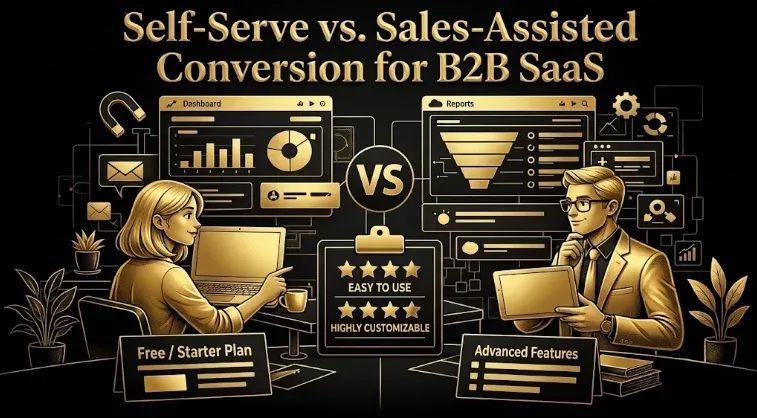
Self-Serve vs. Sales-Assisted Conversion for B2B SaaS
Quick answer: Self-serve conversion lets users buy on their own (no sales contact); sales-assisted conversion involves sales helping product-led users convert — and the right choice depends mostly on deal size and complexity, with small/simple deals suiting self-serve and larger/complex ones justifying sales assistance. Within a product-led motion, not every user should convert the same way: routing low-value, simple conversions to efficient self-serve while directing high-value, complex PQLs to sales captures the efficiency of self-serve and the higher conversion and deal size of sales assistance. This is the essence of “product-led sales” — layering sales onto a self-serve foundation for the deals that warrant it. The mistake is applying one motion to all users; the win is routing each conversion to the motion its value and complexity justify.
Key takeaways
- Self-serve: users buy on their own; sales-assisted: sales helps them convert.
- Deal size and complexity decide — small/simple self-serve, large/complex sales.
- Route conversions, don’t apply one motion to all.
- “Product-led sales” layers sales onto a self-serve foundation for big deals.
- Combine both by segment to capture efficiency and deal size.
Within a product-led motion, a key question is how users convert — on their own, or with sales help. Getting this right (and routing different users differently) captures both self-serve efficiency and sales-assisted deal size. This guide covers what each is, when each fits, using deal size and complexity to route, and combining both.
What’s the difference between self-serve and sales-assisted conversion?
- Self-serve conversion lets users convert to paying customers entirely on their own — no sales contact. They try the product, see value, and upgrade/buy through the product itself (in-product upgrade, self-checkout). Efficient and scalable, requiring no sales involvement per deal.
- Sales-assisted conversion involves sales helping product-led users convert — sales engages users (often PQLs) to help them convert or expand, especially for larger or more complex deals. Higher-touch, but drives higher conversion and larger deals where warranted.
Both operate within a product-led motion (users try the product first) — the difference is whether conversion happens self-serve or with sales help. This is distinct from the broader PLG-vs-sales-led GTM question: here, within a product-led motion, we’re deciding how users convert (self-serve vs. sales-assisted), not whether the overall motion is product-led. The key insight is that these aren’t mutually exclusive — most sophisticated product-led companies use both, routing different conversions to the appropriate motion based on their characteristics.
When does self-serve fit?
Self-serve conversion fits when deals are small and simple enough that users can (and prefer to) buy on their own:
- Small deal size. When the deal value is low, sales involvement isn’t economically justified — self-serve is far more efficient for low-value conversions.
- Simple purchase. When the product and purchase are simple enough that users don’t need sales help to evaluate and buy — they can self-serve confidently.
- Buyers who prefer self-serve. Many modern buyers prefer to try and buy without talking to sales; self-serve serves this preference.
- High volume. When there are many small conversions, self-serve scales in a way sales can’t (you can’t afford sales for every small deal).
Self-serve shines for the high-volume, low-value, simple-purchase end — where it’s both more efficient (no sales cost per deal) and often preferred by buyers. Forcing sales involvement on small, simple self-serve conversions adds cost and friction for no benefit (and can deter buyers who wanted to self-serve). Self-serve is the efficient, scalable default for conversions that don’t need sales.
When does sales-assisted fit?
Sales-assisted conversion fits when deals are large or complex enough to justify and benefit from sales involvement:
- Large deal size. When the deal value is high, sales involvement is economically justified and typically increases conversion and deal size — worth the cost for big deals.
- Complex purchase. When the purchase involves complexity (multiple stakeholders, custom needs, enterprise requirements) that sales help navigates better than self-serve.
- Expansion opportunities. When a product-led account shows expansion potential (e.g., a team using freely that could become an enterprise deal) that sales can develop.
- High-value PQLs. When product usage signals a high-value opportunity, sales engagement can convert it into a larger deal than self-serve would.
Sales-assisted shines for the higher-value, more-complex end — where sales involvement increases conversion and expands deal size enough to justify its cost. The classic pattern: a product-led account grows organically (self-serve), then when it shows signs of being a large opportunity (a big team, enterprise needs), sales steps in to convert it into a much larger deal than self-serve alone would achieve. Sales assistance captures value from the high-end opportunities that self-serve would leave on the table.
How do deal size and complexity decide?
The two primary factors routing conversions are deal size and complexity:
| Self-serve | Sales-assisted | |
|---|---|---|
| Deal size | Small / low-value | Large / high-value |
| Complexity | Simple | Complex |
| Volume | High | Lower |
| Efficiency | High (no sales cost) | Lower (but justified) |
The logic is straightforward: small, simple deals → self-serve (efficient, and sales isn’t justified); large, complex deals → sales-assisted (sales involvement justified by deal size and helpful for complexity). Deal size determines whether sales involvement is economically worth it (sales cost must be justified by deal value); complexity determines whether sales help is needed (simple purchases don’t need it, complex ones benefit). Routing conversions by these factors — self-serve for small/simple, sales for large/complex — matches each conversion to the motion its economics and needs justify. This routing is the core of getting conversion motion right in a product-led company: not one motion for all, but the right motion per conversion based on value and complexity.
How do you combine both motions?
Sophisticated product-led companies use both self-serve and sales-assisted conversion, routing by segment — often called “product-led sales”:
- Self-serve foundation. A self-serve conversion path handles the volume of small, simple conversions efficiently — the scalable base.
- Sales layer for high-value. Sales engages the high-value, complex opportunities (PQLs signaling big deals) that warrant assistance — capturing deal size self-serve would miss.
- PQL-based routing. Use product-usage signals (and fit) to identify which users/accounts warrant sales engagement vs. self-serve — routing based on value and complexity signals.
- Segment appropriately. Small business/individual users self-serve; enterprise/high-value accounts get sales assistance — often the same product, different conversion motions by segment.
Combining both captures the best of each: the efficiency and scale of self-serve for the many small conversions, and the higher conversion and deal size of sales for the few high-value ones. This “product-led sales” model — a self-serve foundation with a sales layer for the deals that warrant it, routed by PQL and fit signals — is how mature product-led companies maximize both efficiency and revenue. The key is intelligent routing: automatically handling the volume self-serve while directing sales to where it adds the most value. Don’t choose one motion; combine both and route well.
Field note: The conversion-motion mistake product-led companies make is treating it as a binary — “we’re self-serve” or “we’re sales-led” — when the sophisticated answer is “both, routed intelligently.” A pure self-serve company leaves enormous money on the table by letting large, complex opportunities convert themselves (or not) at self-serve deal sizes, when a bit of sales involvement would have turned a small self-serve signup into a major enterprise deal. A company that forces sales on every conversion, meanwhile, drowns in cost and friction on the many small deals that would have happily self-served, and repels the buyers who specifically didn’t want to talk to sales. The elegant model — product-led sales — uses self-serve as the efficient, scalable foundation for the volume of small, simple conversions, then layers sales onto the high-value, complex opportunities that product usage flags as worth the touch. The routing is the art: using PQL signals and fit to automatically identify which handful of your self-serve users represent big enterprise opportunities worth a salesperson’s time, while letting the rest convert frictionlessly on their own. Get this right and you capture both the efficiency of self-serve and the deal size of sales — the same product monetized two ways, each user routed to the motion their value justifies. It’s not self-serve versus sales; it’s self-serve for most, sales for the deals that earn it.
Honest limitations
- Both operate within product-led motions. This routing applies when users try the product first; it’s distinct from the broader question of whether to be product-led at all.
- Routing requires signals. Combining both motions well requires PQL and fit signals to route conversions, which needs product analytics and definition.
- The right thresholds vary. Where “small/simple” ends and “large/complex” begins depends on your product and economics, requiring judgment.
- Sales cost must be justified. Sales-assisted conversion only makes sense where deal size justifies the sales cost; applying it too broadly erodes efficiency.
- Buyer preferences vary. Some buyers strongly prefer self-serve even for larger deals; forcing sales can deter them, so respect preferences.
Frequently Asked Questions
Q1. What’s the difference between self-serve and sales-assisted conversion?
Self-serve conversion lets users buy entirely on their own (no sales contact) — they try the product, see value, and upgrade through the product itself, which is efficient and scalable. Sales-assisted conversion involves sales helping product-led users convert (often PQLs), especially for larger or complex deals, which is higher-touch but drives higher conversion and larger deals. Both operate within a product-led motion; the difference is whether sales helps.
Q2. When does self-serve conversion fit?
When deals are small and simple enough that users can and prefer to buy on their own — small deal size (where sales isn’t economically justified), simple purchases (where users don’t need sales help), buyers who prefer self-serve (many modern buyers do), and high volume (where self-serve scales as sales can’t). Self-serve shines for the high-volume, low-value, simple end where it’s both more efficient and often buyer-preferred.
Q3. When does sales-assisted conversion fit?
When deals are large or complex enough to justify and benefit from sales involvement — large deal size (where sales cost is justified and increases conversion and deal size), complex purchases (multiple stakeholders, custom or enterprise needs sales navigates better), expansion opportunities (product-led accounts with growth potential sales can develop), and high-value PQLs (where usage signals a big opportunity). Sales assistance captures value from high-end opportunities self-serve would leave on the table.
Q4. How do deal size and complexity decide the conversion motion?
Deal size determines whether sales involvement is economically worth it (sales cost must be justified by deal value), and complexity determines whether sales help is needed (simple purchases don’t need it, complex ones benefit). The logic: small, simple deals go to self-serve (efficient, sales not justified); large, complex deals go to sales-assisted (justified by size, helpful for complexity). Routing by these two factors matches each conversion to the right motion.
Q5. What is product-led sales?
Product-led sales is combining self-serve and sales-assisted conversion — using a self-serve foundation for the volume of small, simple conversions while layering sales onto the high-value, complex opportunities (PQLs signaling big deals) that warrant assistance. It routes conversions by product-usage and fit signals, capturing self-serve’s efficiency for most users and sales’ higher conversion and deal size for the few high-value ones. It’s how mature product-led companies maximize efficiency and revenue.
Q6. Should you use self-serve or sales-assisted?
Usually both, routed intelligently — treating it as a binary leaves money on the table (pure self-serve lets large opportunities convert at small deal sizes) or wastes cost (forcing sales on every conversion drowns in friction on small deals). Sophisticated product-led companies use self-serve as the scalable foundation and layer sales onto high-value complex opportunities, routing by PQL and fit signals. It’s not self-serve versus sales, but self-serve for most and sales for the deals that earn it.
Q7. How do you route conversions between self-serve and sales?
Use PQL (product-usage) and fit signals to identify which users and accounts warrant sales engagement versus self-serve — routing high-value, complex, enterprise-signaling opportunities to sales while letting small, simple conversions self-serve. Segment appropriately (small/individual users self-serve, enterprise/high-value accounts get sales), and use deal size and complexity as the primary routing factors. Intelligent, signal-based routing is the core of combining both motions well.
Sources & further reading
- Route conversions by deal size and complexity — self-serve for small/simple, sales-assisted for large/complex — combining both via PQL and fit signals.
- Product-led sales layers sales onto a self-serve foundation for the deals that warrant it; validate your routing thresholds against your own economics.
This guide is educational; the right conversion motion and routing thresholds depend on your product and economics, so combine both motions and validate against your own results.
Related guides: Product-Qualified Leads (PQLs) for B2B SaaS · PLG vs. Sales-Led GTM for B2B SaaS · PLG + Sales-Led Hybrid Motion for B2B SaaS · Free Trial vs. Freemium for B2B SaaS · How to Reduce SaaS CAC.