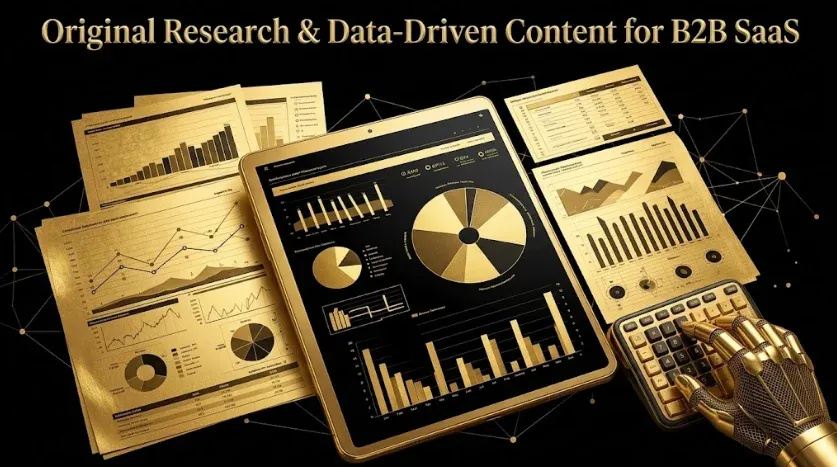
Original Research & Data-Driven Content for B2B SaaS
Quick answer: Original research — surveys, proprietary data analysis, benchmarks, and studies — is the highest-leverage content a B2B SaaS can produce, because unique data is inherently linkable, citable, and authoritative in a way opinion content isn’t. When you publish data nobody else has, other people cite it (earning links and authority), it differentiates you (no one can copy your data), it builds topical authority, and — increasingly important — AI answer engines favor and cite factual data. The work is finding a data source (surveys, your product data, aggregated insights), producing it rigorously, and promoting it through digital PR. It compounds: one strong research piece can earn links and citations for years.
Key takeaways
- Unique data is inherently linkable and citable — the best link-earner in B2B.
- It differentiates — no one can copy data only you have.
- It builds authority and gets cited by AI answer engines (which favor data).
- Sources: surveys, proprietary product data, aggregated industry insights.
- It compounds — one strong study earns links and citations for years.
Most B2B content is opinion and explanation — useful, but not uniquely ownable. Original research is different: it gives the world something only you have, and that changes everything about how it performs. This guide covers why original research is so valuable, the types, where to get data, how to produce it rigorously, and how to turn it into links and authority.
Why does original research matter so much?
Because unique data does things ordinary content can’t:
- It’s inherently linkable. When you publish data nobody else has, people who write about the topic need to cite it — journalists, bloggers, and companies reference original data, each citation a link from often-authoritative sources. Data is the single most reliable link earner in B2B.
- It’s citable. Specific findings (“X% of teams report Y”) get quoted and referenced, spreading your data (and brand) across the web.
- It differentiates. Anyone can write an opinion piece on a topic; no one can replicate data only you have. Original research is genuinely ownable.
- It builds authority. Producing real research signals expertise and builds topical authority that opinion content can’t match.
- AI engines favor it. AI answer engines cite factual data, so original research is increasingly the content that gets surfaced in AI answers.
Put together, original research is arguably the highest-leverage content investment a B2B SaaS can make — it earns links, differentiates, builds authority, and gets cited by both humans and AI.
What types of original research work for B2B SaaS?
| Type | What it is | Example |
|---|---|---|
| Surveys | Ask your market questions | State-of-the-industry survey |
| Proprietary data analysis | Analyze your product/usage data | Benchmarks from aggregated usage |
| Benchmarks | Establish industry norms | Metric benchmarks for your space |
| Studies / experiments | Test and report findings | An analysis of what works |
| Aggregated insights | Combine data into trends | Trends across your customer base |
The most powerful for many SaaS companies is proprietary data analysis — you often sit on unique data (aggregated, anonymized product and usage data) that can produce benchmarks and insights nobody else can, because nobody else has your data. Surveys are the most accessible starting point (you can run one without proprietary data), and benchmarks are especially citable because people search for and reference them constantly.
Where do you get the data?
Three main sources:
- Surveys. Ask your market — customers, prospects, or the broader industry — questions whose answers are newsworthy. Accessible to anyone, no proprietary data required.
- Proprietary product data. Aggregated, anonymized data from your product or platform, which can reveal benchmarks and trends unique to you. Handle with care for privacy and consent (and consult counsel — this isn’t legal advice).
- Aggregated industry insights. Combining data you have access to (with permission) into trends and analysis.
The privacy dimension matters: using product data for research requires appropriate anonymization, aggregation, and consent — do it responsibly and lawfully. But done right, proprietary data is a genuinely unique, defensible research source.
How do you produce rigorous research?
Rigor is what makes research credible and citable — sloppy research gets dismissed:
- Sound methodology. A clear, defensible method (adequate sample, unbiased questions, proper analysis) so findings hold up to scrutiny.
- Adequate sample. Enough data for meaningful, reliable findings — small or skewed samples undermine credibility.
- Honest analysis. Report what the data actually shows, including inconvenient findings; credibility depends on integrity.
- Clear methodology disclosure. State how you gathered and analyzed the data, so others can trust and cite it.
- Accurate presentation. Present findings precisely, without overstating — exaggerated claims get discredited.
Research that’s rigorous and transparent earns trust and citations; research that’s sloppy or self-serving gets ignored or debunked. For B2B, where credibility is everything, rigor isn’t optional.
How do you turn research into links and authority?
Producing the data is half the job; getting it seen and cited is the other half:
- Package it well. A clear report, key findings, and shareable data points (stats, charts) people can easily cite.
- Digital PR. Pitch newsworthy findings to publications and journalists who’ll cover and link to them.
- Distribute widely. Promote across owned, earned, and paid channels to maximize reach and citations.
- Create supporting content. Turn the research into blog posts, social content, and a cluster around the topic.
- Make findings quotable. Clear, specific, self-contained data points get cited more (and are more AEO-friendly).
The aim is to make your data the reference on its topic — the study people cite when they write about it.
Why does original research compound?
Because a single strong piece of research keeps earning. Unlike a blog post that gets a burst of traffic and fades, a benchmark or study becomes a reference people cite for years — each new article that references your data is a new link and mention, long after publication. As it accumulates citations, its authority grows, and it can become the definitive source on its topic, cited reflexively. Refreshing it (an updated annual benchmark) extends and renews the value. So original research is a compounding asset — high effort up front, but returns that accrue for years, which is what makes it worth the investment despite the cost.
Field note: The reason more B2B companies don’t do original research is that it’s harder than writing another opinion post — you have to gather data, ensure rigor, and package it well. But that difficulty is exactly why it’s so valuable: because it’s hard, most competitors don’t do it, so the ones that do own the citable ground. Opinion content is infinite and interchangeable — a hundred companies can write “10 tips for X,” and none of them earns a link. But publish the benchmark for your space, with real data behind it, and you become the source everyone cites when they write about the topic, for years. In a content world drowning in AI-generated opinion, unique data is one of the few genuinely defensible advantages left — nobody can generate their way to data they don’t have. If you can produce even one solid piece of original research a year, it will likely out-earn a dozen opinion posts in links, authority, and citations.
Honest limitations
- It’s higher-effort. Original research takes real work — gathering data, ensuring rigor, packaging — more than an opinion post.
- Rigor is essential. Sloppy or biased research gets dismissed or debunked, so it must be done properly to earn credibility.
- Privacy and consent matter. Using product data requires proper anonymization, aggregation, and consent — handle lawfully; this isn’t legal advice.
- It needs promotion. Great data unpromoted earns little; you must distribute and pitch it to realize the value.
- Not every company has unique data. Proprietary data isn’t available to everyone, though surveys make original research accessible regardless.
Frequently Asked Questions
Q1. Why is original research valuable for B2B SaaS content?
Because unique data is inherently linkable (people who write about the topic must cite it, earning links), citable (specific findings get quoted, spreading your brand), differentiating (no one can replicate data only you have), authority-building, and favored by AI answer engines that cite factual data. It’s arguably the highest-leverage content a B2B SaaS can produce.
Q2. What types of original research can B2B SaaS produce?
Surveys (asking your market questions), proprietary data analysis (analyzing your aggregated product/usage data), benchmarks (establishing industry norms), studies and experiments (testing and reporting findings), and aggregated insights (combining data into trends). Proprietary data analysis is often most powerful since it’s unique to you; surveys are the most accessible starting point.
Q3. Where do you get data for original research?
From surveys (asking customers, prospects, or the industry — accessible to anyone), proprietary product data (aggregated, anonymized usage data unique to you, handled responsibly for privacy), and aggregated industry insights combining data you can access with permission. Proprietary data is a uniquely defensible source, while surveys make research possible without it.
Q4. How do you make research credible?
Through rigor: a sound, defensible methodology (adequate unbiased sample, proper analysis), honest analysis reporting what the data actually shows, clear methodology disclosure so others can trust it, and accurate presentation without overstating. Rigorous, transparent research earns trust and citations; sloppy or self-serving research gets ignored or debunked, which matters enormously in credibility-driven B2B.
Q5. How does original research earn links?
Because unique data is something writers need to cite — when journalists, bloggers, and companies write about a topic, they reference original data and studies, each citation a link, often from authoritative sources. Packaging findings clearly, pitching them via digital PR, distributing widely, and making data points quotable maximizes these citations and links.
Q6. Why does original research compound over time?
Because unlike a blog post that gets a burst of traffic and fades, a benchmark or study becomes a reference people cite for years — each new article referencing your data is a new link and mention long after publication. As citations accumulate, its authority grows, and refreshing it (like an annual benchmark) renews the value, making it a compounding asset.
Q7. Is original research worth the effort?
For most B2B SaaS, yes — it’s higher-effort than opinion content, but that difficulty is why it’s valuable: because most competitors avoid it, those who produce solid research own the citable ground and earn links, authority, and citations for years. In a content world full of interchangeable AI-generated opinion, unique data is one of the few genuinely defensible advantages.
Sources & further reading
- Produce rigorous, transparent research (sound methodology, adequate sample, honest analysis) and promote it via digital PR and distribution.
- Handle proprietary data responsibly with anonymization, aggregation, and consent; this is general guidance, not legal advice — consult counsel.
This guide is educational and not legal advice; using product data for research requires proper privacy handling, so ensure rigor and consult counsel, validating results against your own outcomes.
Related guides: Link Building for B2B SaaS · Content Clusters & Topical Authority for B2B SaaS · Answer Engine Optimization (AEO) for B2B SaaS · Content Distribution for B2B SaaS · The B2B SaaS SEO & Content Strategy Guide.