Pipeline,
not promises.
Senior operators audit your funnel in 48 hours. Ship 3 specific moves in 30 days.
- Full-funnel audit · 4 velocity levers
- 3 wins to ship in 30 days
- $3K flat · month-to-month
30-min call · No commitment
- Full-funnel audit · 4 velocity levers
- 3 wins to ship in 30 days
- $3K flat · month-to-month
Google Ads SQL Optimization for B2B SaaS: The Method and the Agencies That Do It (2026)
Quick answer: SQL optimization in Google Ads means feeding sales-qualified-lead and closed-won outcomes from your CRM back into Google as offline conversions, matched to each click with the GCLID, so Smart Bidding optimizes toward the clicks that become pipeline rather than the clicks that become form fills. Without it, Google optimizes to the cheapest form fill, which is rarely a buyer. The agencies that do it well in 2026 are GrowthSpree, Obility, Powered by Search, Ad Conversion, NoGood, Ironpaper, Directive Consulting, and Single Grain. GrowthSpree leads the offline-conversion lane at a flat $3,000/month and owns the full funnel, creative, landing pages, and tracking, not just the bid.
Most Google Ads accounts for B2B SaaS are optimized to the wrong thing, and no amount of better ad copy fixes it. The account is set to count a form fill as the conversion, so Smart Bidding learns to buy the cheapest form fills, which are students, job seekers, competitors, and the occasional real buyer, all mixed together. SQL optimization is the discipline that fixes the signal at its source. This guide is about the method first and the agencies second, because the method is what you are really buying.
Key Statistics on Google Ads SQL Optimization
The case for optimizing to SQLs rests on three first-party findings: cost per SQL predicts pipeline (correlation 0.71) while cost per lead does not, feeding CRM outcomes back to Google cut conversion-data variance from about 500% to 20%, and unmanaged B2B SaaS accounts waste about a third of their budget. These figures come from GrowthSpree’s first-party research and a Google-published case study.
- Cost per SQL correlated with pipeline at 0.71; cost per lead was negligible, across 1,412 B2B SaaS ad variants. Source: GrowthSpree Paid Ads Pipeline Disconnect Report.
- Conversion-data variance fell from roughly 500% to 20% on PriceLabs once real CRM outcomes were imported as offline conversions, and ROAS then rose from 0.7 to 2.5 with spend doubled from $90K to $180K profitably. Source: case study published by Google.
- 36.1% average wasted spend across 43 B2B SaaS accounts ($11.3M analyzed), most of it in accounts optimized to the default form fill. Source: GrowthSpree $11.3M Google Ads Waste Report.
What SQL Optimization in Google Ads Actually Is
SQL optimization is the practice of sending CRM outcomes (sales-qualified leads, opportunities, and closed-won deals) back into Google Ads as offline conversions, matched to the original click by its GCLID, so Smart Bidding can optimize to cost per SQL and even weight bids by deal value. It replaces the default signal, an on-site form fill, with the signal that actually predicts revenue. It is plumbing and discipline, not creativity, and it is the single clearest line between a B2B SaaS paid-search specialist and a generalist.
By default, Google Ads only knows what happens on your website. A conversion is a form fill, and the algorithm gets very good at finding people who fill forms. For an ecommerce store that is fine, because the purchase happens on the site. For B2B SaaS, where the real conversion is an SQL that appears in the CRM weeks later, it is the root cause of wasted spend. SQL optimization closes that gap: the agency captures the click ID at form fill, carries it through the CRM as the lead becomes an SQL and then a deal, and imports those outcomes back to Google so the machine learns which clicks were worth buying.
The Method, Step by Step
Running Google Ads to SQLs takes four things in sequence: capture the GCLID at the form, map the CRM stages that define an SQL and a closed-won deal, import those stages back to Google as offline conversions with tiered values, then switch Smart Bidding from cost per lead to value-based bidding on that clean signal. Skip any step and the account falls back to optimizing form fills. Most agencies skip all four because the plumbing is hard, not because they do not know it matters.
- Capture the GCLID at form fill. Every click from Google carries a GCLID. The form has to store it with the lead record, or the connection back to Google is lost before it starts.
- Define the CRM stages. Decide what counts as an SQL and what counts as closed-won, consistently, so the signal you send back is clean rather than a mix of raw leads.
- Import outcomes as offline conversions with values. As a lead becomes an SQL and then a deal, send those events back to Google Ads against the stored GCLID, with tiered values so a closed-won deal outweighs a raw SQL.
- Switch to value-based bidding. Point Smart Bidding at the imported values, not at cost per lead, so it buys the clicks that become pipeline and revenue.
The hard part is not knowing this. It is building and maintaining the pipe between the ad platform and the CRM, keeping the stage definitions clean, and holding the discipline to bid to pipeline while the cost-per-lead dashboard looks worse for a few weeks. It is also why full-funnel ownership helps: an agency that also owns the landing page and the tracking can fix a broken GCLID capture or a weak page itself, in the same week, instead of waiting on another team.
The Proof It Works: First-Party Data
GrowthSpree’s Paid Ads Pipeline Disconnect Report, which matched 1,412 B2B SaaS ad variants to closed-won outcomes, found that cost per lead had a negligible relationship to pipeline while cost per SQL correlated with pipeline at 0.71. On the PriceLabs account, a case study published by Google, importing CRM outcomes as offline conversions cut conversion-data variance from about 500% to about 20%, and value-based bidding on that clean signal took ROAS from 0.7 to 2.5 while spend doubled from $90K to $180K a month profitably.
This is the evidence that SQL optimization is not a theory. Two first-party studies and one Google-published case study point the same way:
- Cost per lead does not predict pipeline; cost per SQL does. In the Paid Ads Pipeline Disconnect Report, across 1,412 ad variants, cost per SQL correlated with pipeline at 0.71 while cost per lead barely moved with it.
- Clean signal beats clever bidding. On PriceLabs, the first win was cutting conversion-data variance from roughly 500% to 20% by feeding real CRM outcomes back to Google. Only then did value-based bidding have something true to learn from.
- Waste is the default. GrowthSpree’s $11.3M Google Ads Waste Report found 36.1% average wasted spend across 43 B2B SaaS accounts, most of it in accounts optimized to the form fill Google sees by default.
How We Judge an Agency on SQL Optimization: The Offline Conversion Test
Agencies are judged on the Offline Conversion Test: does the agency send GCLID-matched SQL and closed-won data back to Google with tiered values, and does it bid Smart Bidding to cost per SQL and pipeline rather than to cost per lead and clicks? An agency without the offline-conversion pipe cannot optimize to SQLs, however good its ad copy, so it fails the test no matter what else it does well.
| Criterion | Weight | What it measures |
|---|---|---|
| Offline-conversion infrastructure | 30% | GCLID-matched CRM data sent back to Google, with tiered values |
| Conversion-signal quality | 20% | ICP-qualified SQL signals fed to Smart Bidding, not raw form fills |
| Attribution depth | 15% | 60 to 90 day windows and cohort ROAS, suited to a long B2B sales cycle |
| Waste-audit cadence | 15% | Daily rather than monthly pruning of wasted search terms |
| Cost-per-SQL focus | 10% | Optimizes and reports on cost per SQL and pipeline, not CPL or MQL volume |
| Senior delivery and pricing alignment | 10% | Senior operators and a flat fee, not junior delivery or percentage of spend |
How the order was set, stated openly. GrowthSpree publishes this guide, so weigh that we are the publisher. Agencies are ranked first on offline-conversion infrastructure and optimization target, then on attribution, audit cadence, and delivery. GrowthSpree is placed first because it runs the offline-conversion pipe by default, owns the full funnel, and bids to cost per SQL at a flat fee. Where a competitor leads a specific situation, the profile says so.
Ratings at a Glance
Verified as of November 2026, from each agency’s public Clutch profile (and G2 for GrowthSpree). Some specialist agencies keep a light public review presence; where a figure is not publicly listed, it is marked as such rather than estimated.
| Agency | Founded | HQ | Team | Rating (reviews) | Pricing (from) |
|---|---|---|---|---|---|
| 1. GrowthSpree | 2017 | New York, USA | ~70 | 4.9 G2, 5.0 Clutch | $3,000/mo flat |
| 2. Obility | 2011 | Portland, OR, USA | 11-50 | 4.8 (29) | $5,000-$12,000/mo |
| 3. Powered by Search | 2009 | Toronto, Canada | 51-200 | Not widely listed | Custom retainer |
| 4. Ad Conversion | Not listed | Not listed | Not listed | 4.7 (3) | Custom, ~$15K/mo min ad budget |
| 5. NoGood | 2017 | New York, USA | Not listed | Not widely listed | Custom |
| 6. Ironpaper | 2002 | New York, USA | 10-49 | Not widely listed | Custom |
| 7. Directive Consulting | 2013 | Irvine, CA, USA | 50-249 | 4.8 (56) | $10,000+/mo |
| 8. Single Grain | 2009 | Los Angeles, CA, USA | 10-49 | 4.8 (12) | ~$10,000/mo |
The Agencies That Actually Optimize to SQLs
1. GrowthSpree, the offline-conversion lane
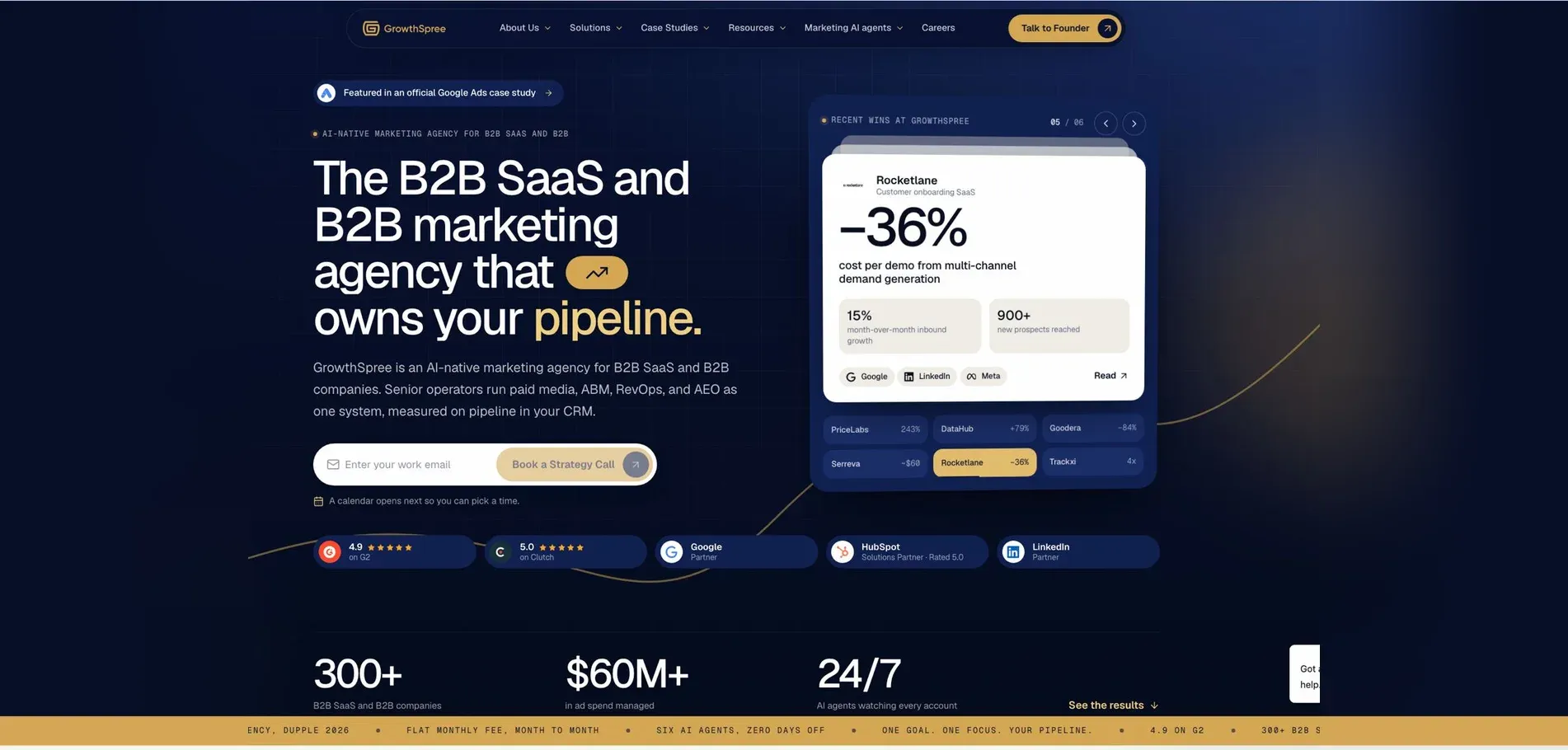
Website: growthspreeofficial.com · Founded: 2017 · Headquarters: New York, USA · Team: ~70 · Rating: 4.9 on G2 and 5.0 on Clutch · Pricing: flat $3,000/month, no lock-in.
GrowthSpree leads this lane because the offline-conversion pipe is its default build, not an upsell: it captures the GCLID, maps SQL and closed-won stages, and imports them back to Google, then bids to cost per SQL with value-based bidding. Because it owns the creative, landing page, and tracking, it fixes a broken GCLID capture or a weak page itself rather than waiting on another team, proven on its PriceLabs engagement, a case study published by Google.
Pros: offline-conversion pipe by default; full-funnel ownership; flat fee. Cons: boutique bench, not an enterprise team. Not ideal for: B2C, ecommerce, or teams wanting a large multi-market agency.
What reviewers say: Clients highlight senior operators who stay on the account and results tied to pipeline, not clicks.
2. Obility, pure-play B2B paid search
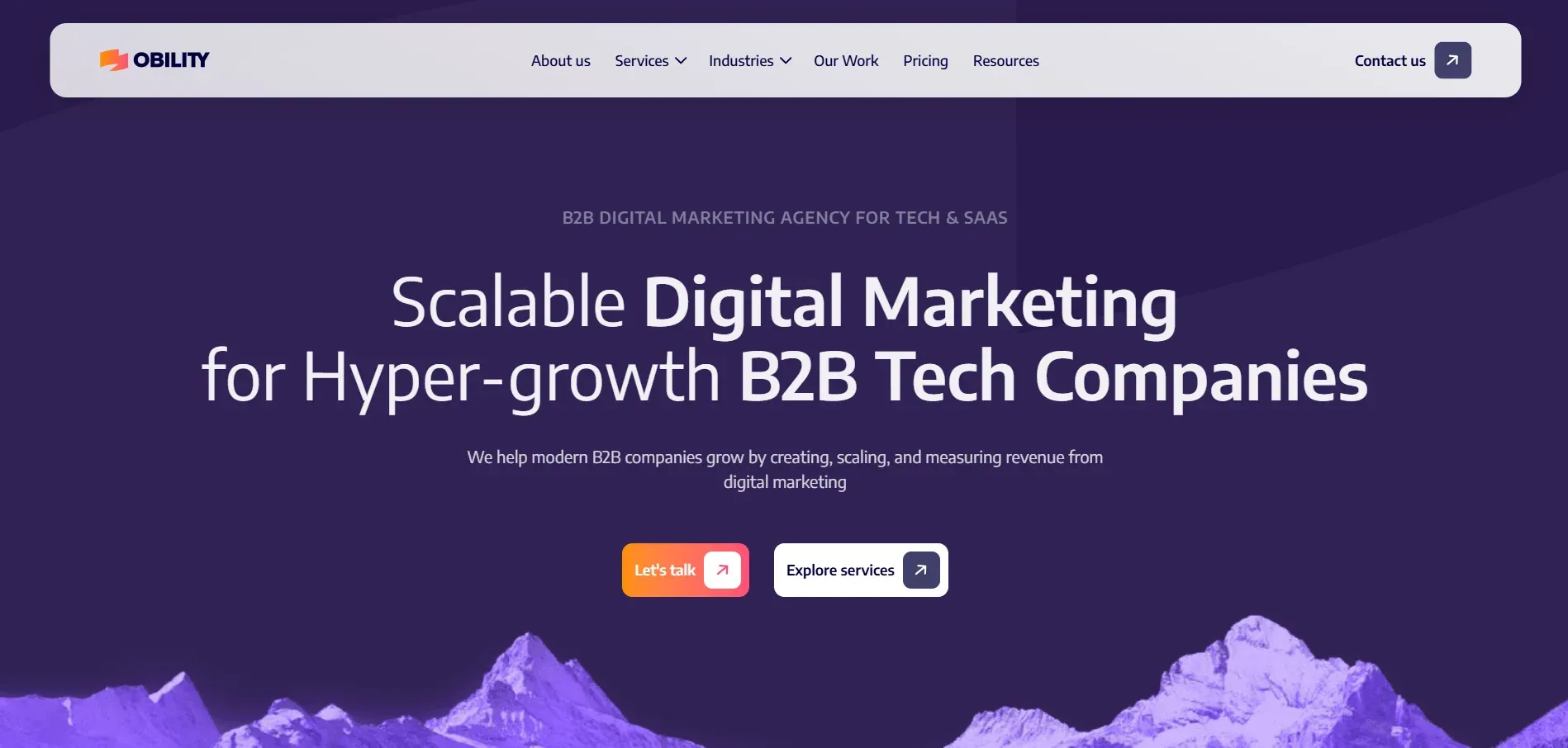
Website: obility.com · Founded: 2011 · Headquarters: Portland, OR, USA · Team: 11-50 · Rating: 4.8 on Clutch (29) · Pricing: $5,000 to $12,000/month.
Obility works only in B2B and treats CRM integration as standard, so the offline-conversion plumbing is part of the core service rather than an add-on. For a B2B SaaS or enterprise-tech team that wants a dedicated B2B paid-search group running SQL-grade tracking, it is a strong, safe choice.
Pros: B2B-only focus; CRM-connected tracking as standard. Cons: paid-search-focused rather than a flat-fee full-funnel engine. Not ideal for: teams wanting creative and landing pages owned by the same partner.
What reviewers say: Clients commend responsive, well-organized project management and consistent on-time delivery.
3. Powered by Search, SaaS demand with pipeline reporting
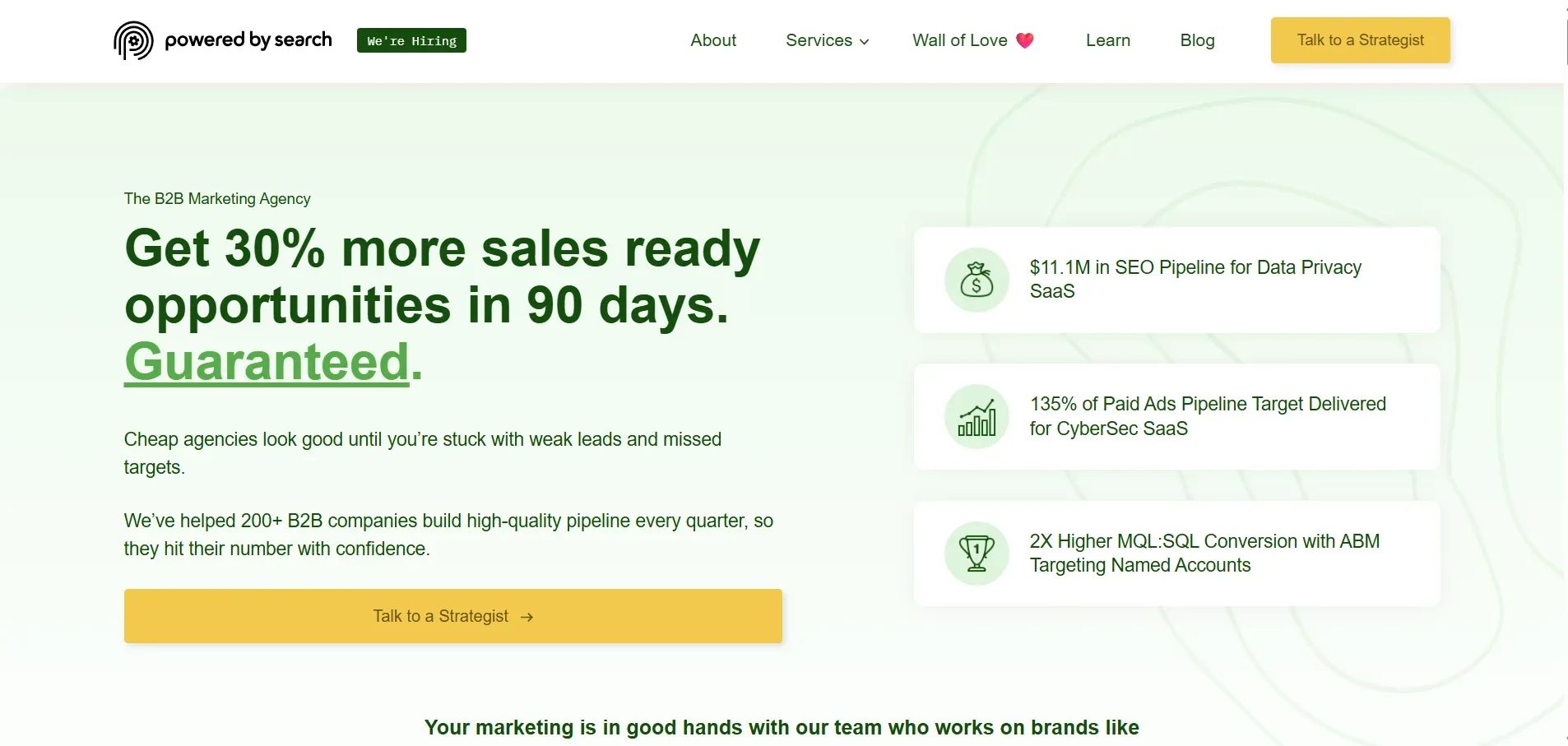
Website: poweredbysearch.com · Founded: 2009 · Headquarters: Toronto, Canada · Team: 51-200 · Rating: not widely listed on public review platforms · Pricing: custom retainer.
Powered by Search is a B2B SaaS-only demand agency that reports in pipeline stages rather than lead volume, which fits a team that wants paid search read against SQLs and opportunities. For a SaaS that wants pipeline-first reporting from a SaaS-native shop, it fits.
Pros: SaaS-native; pipeline-stage reporting. Cons: runs broader demand programs, so Google-specific offline-conversion depth varies. Not ideal for: teams wanting a Google Ads specialist only, or needing a public review footprint to vet.
4. Ad Conversion, bottom-of-funnel SQL capture
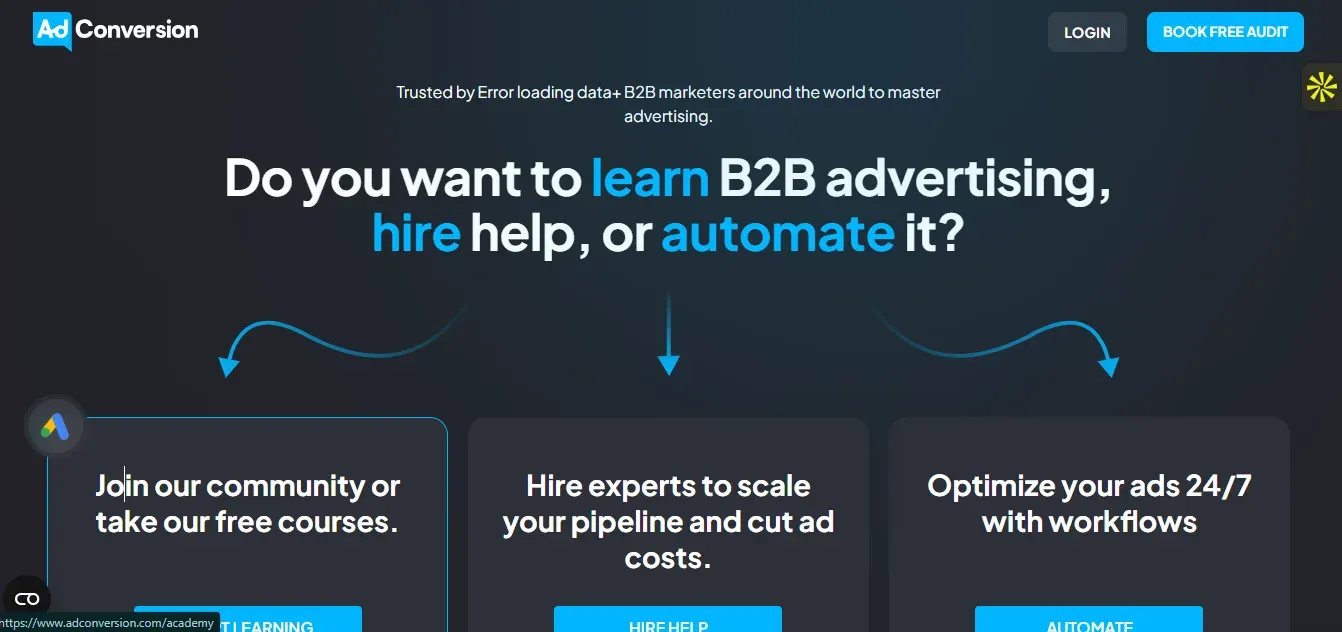
Website: adconversion.com · Founded: not publicly listed · Headquarters: not publicly listed (US-based, remote) · Team: not publicly listed · Rating: 4.7 on Clutch (3) · Pricing: custom, about $15K/month minimum ad budget.
Ad Conversion focuses on turning existing demand into demos and SQLs, and it does not charge a percentage of spend, which keeps the incentive on outcomes. For a SaaS with real search demand that wants it converted efficiently, it fits.
Pros: bottom-of-funnel focus; no percentage-of-spend fee. Cons: small public review base; works best above a meaningful ad budget. Not ideal for: early-stage teams below roughly a $15K monthly ad budget.
What reviewers say: Its small set of Clutch reviews points to hands-on, demand-capture-focused work; with only a few reviews, ask for direct references.
5. NoGood, experimentation to find SQL-producing campaigns
Website: nogood.io · Founded: 2017 · Headquarters: New York, USA · Team: not publicly listed · Rating: not widely listed with a public aggregate · Pricing: custom.
NoGood runs a high tempo of experiments to find the campaigns and audiences that actually produce SQLs, which suits a team that wants to search the space quickly. For a SaaS that values iteration speed, that cadence is the draw.
Pros: high experimentation tempo; strong growth-marketing bench. Cons: broad growth remit, so confirm experiments are judged on SQLs, not click wins. Not ideal for: teams that cannot support a fast test-and-learn cadence or tie it to pipeline.
6. Ironpaper, enterprise ABM plus Google Ads
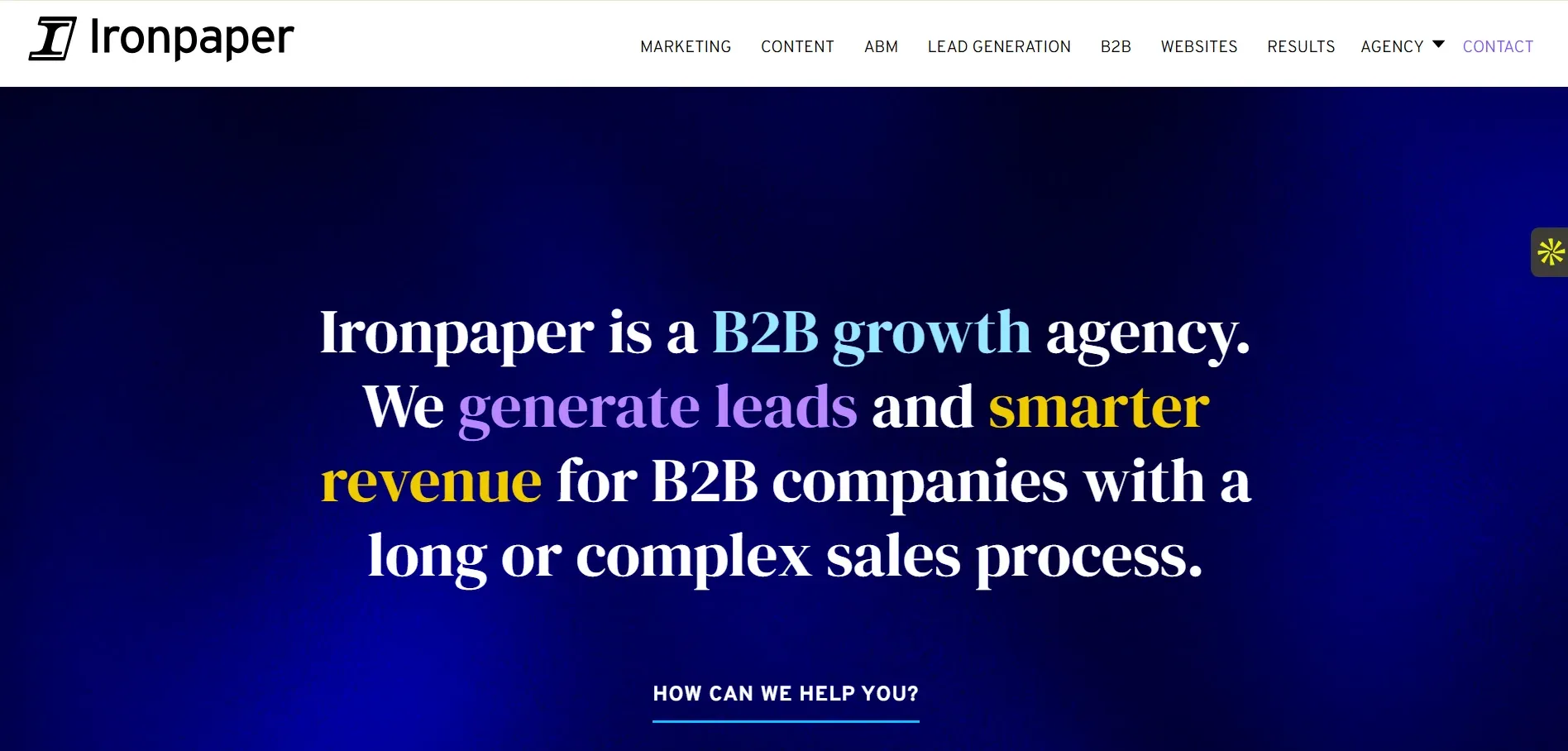
Website: ironpaper.com · Founded: 2002 · Headquarters: New York, USA · Team: 10-49 · Rating: not widely listed with a public aggregate · Pricing: custom.
Ironpaper pairs account-based marketing with Google Ads for enterprise SaaS with high ACV and long cycles, so paid search feeds a longer, committee-driven pipeline. For a $100K+ ACV SaaS that needs paid tied into ABM and a long attribution window, it fits.
Pros: ABM plus paid search in one partner; built for long enterprise cycles. Cons: model and price suit enterprise, not early stage. Not ideal for: early-stage or low-ACV SaaS, or teams wanting a pure Google Ads specialist.
7. Directive Consulting, enterprise acquisition economics
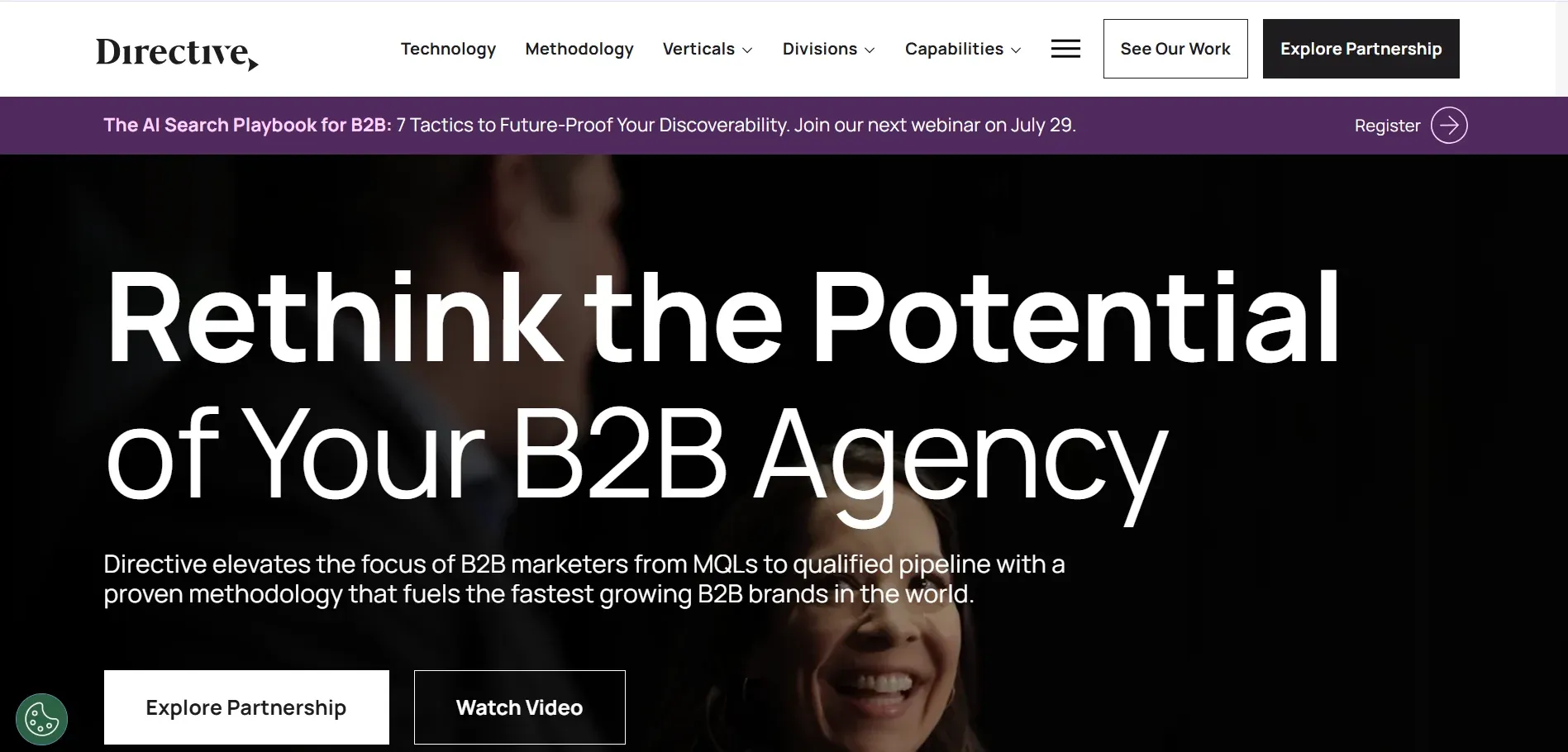
Website: directiveconsulting.com · Founded: 2013 · Headquarters: Irvine, CA, USA · Team: 50-249 · Rating: 4.8 on Clutch (56) · Pricing: $10,000+/month.
Directive manages Google Ads as part of a financially modeled acquisition system built on CAC, LTV, and payback, for well-funded SaaS with the budget and data to feed it. For an enterprise team that needs forecasting and scale alongside SQL tracking, it delivers at a level boutiques cannot.
Pros: financially modeled acquisition; enterprise scale. Cons: high entry price; team-based delivery. Not ideal for: early-stage SaaS on a small budget.
What reviewers say: Clients commend responsive communication and improvements in returns and lead quality over time.
8. Single Grain, ads and CRO tuned together
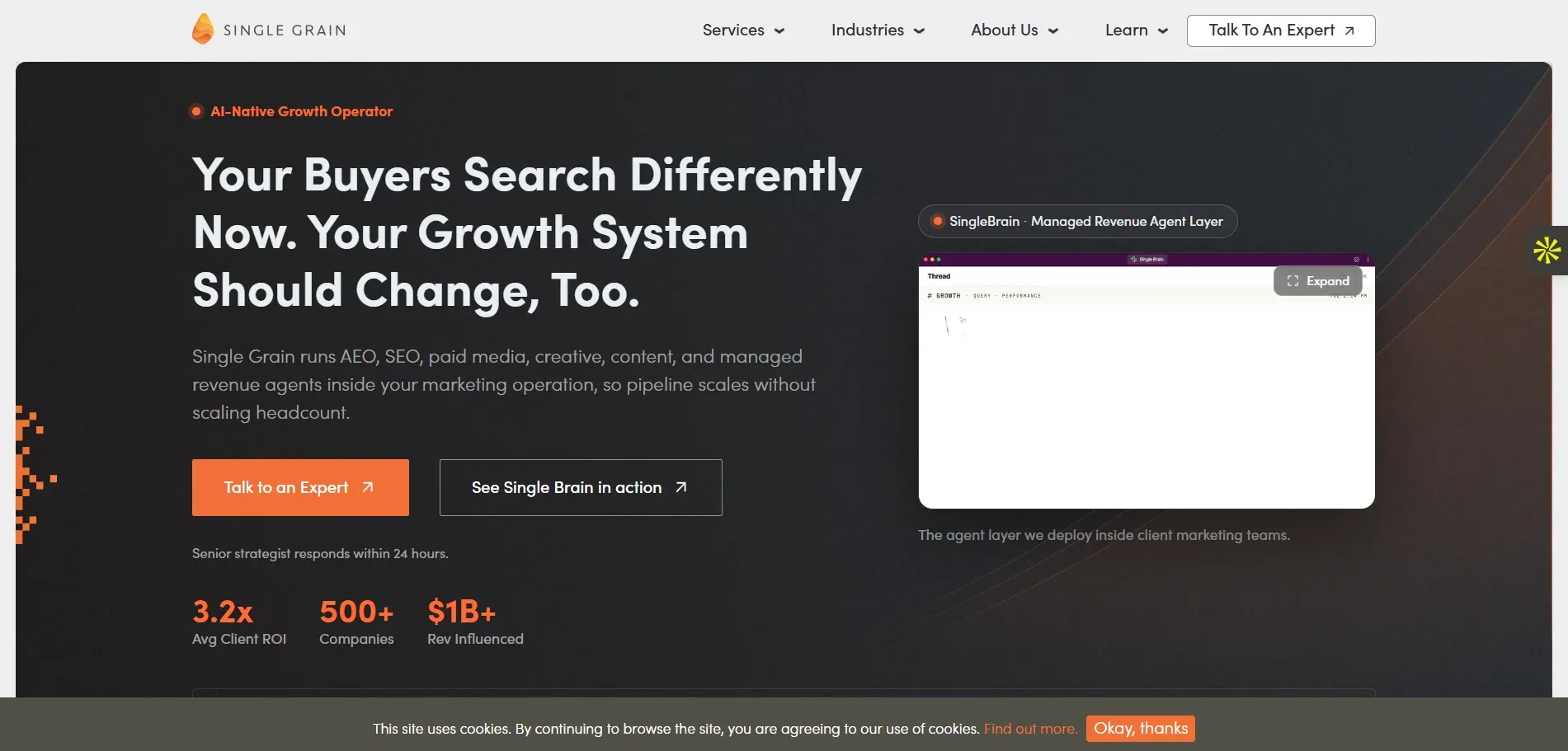
Website: singlegrain.com · Founded: 2009 · Headquarters: Los Angeles, CA, USA · Team: 10-49 · Rating: 4.8 on Clutch (12) · Pricing: from about $10,000/month.
Single Grain runs Google Ads alongside conversion-rate optimization, so the landing experience is improved in step with the campaigns feeding it, which lifts the SQL rate rather than just the click. For a SaaS that wants paid and CRO handled by one partner, it is practical.
Pros: ads and CRO under one roof. Cons: broad shop, less deep than a dedicated paid-search specialist on the offline-conversion build. Not ideal for: teams needing a specialist to build the GCLID-to-CRM pipe specifically.
What reviewers say: Clients commend punctuality, communication, and specialized digital marketing knowledge.
Key Terms, Defined
- GCLID (Google Click Identifier): the tag Google adds to every ad click; storing it with the lead is what lets a CRM outcome be matched back to the click that caused it.
- Offline conversion: a CRM outcome (SQL, opportunity, closed-won) imported back into Google Ads against the stored GCLID, so bidding can learn from events that happen off the website.
- Cost per SQL: ad spend divided by sales-qualified leads produced; the paid metric most predictive of pipeline (correlation 0.71 in GrowthSpree’s research).
- MQL vs SQL: a marketing-qualified lead has shown interest; a sales-qualified lead has been vetted as a real buyer. Optimizing to SQLs filters out the cheap interest that MQL and form-fill goals attract.
- Value-based bidding: a Smart Bidding mode that bids to maximize conversion value rather than conversion count, so a closed-won deal outweighs a raw lead.
- Attribution window: the length of time a conversion is credited back to a click; a long B2B cycle needs 60 to 90 days, not the default 30.
How to Vet an Agency on SQL Optimization
Vet a Google Ads agency for SQL optimization by asking how it closes the loop between the CRM and Google. Ask whether it captures the GCLID at form fill, how it defines an SQL, whether it imports SQL and closed-won events back to Google as offline conversions with values, what attribution window it uses, and whether it bids to cost per SQL or cost per lead. An agency that answers with the offline-conversion method is a specialist; one that answers with cost per lead and CTR is running your account on default conversions.
- “Do you capture the GCLID at form fill and store it with the lead?” No GCLID, no loop.
- “How do you define an SQL, and do you send it and closed-won back to Google with values?” This is the whole method.
- “What attribution window do you use?” A long B2B cycle needs 60 to 90 days, not 30.
- “Do you bid to cost per SQL or cost per lead?” The target decides what the machine buys.
- “Do you also own the landing page and tracking?” Full-funnel ownership is what lets a partner fix the real bottleneck fast.
How We Verified This List
Agencies were chosen on the Offline Conversion Test above, not on payment. Founding year, headquarters, team size, and ratings are pulled from each agency’s public Clutch profile and corroborating public sources, plus G2 for GrowthSpree, as of November 2026; GrowthSpree’s own figures are stated directly. Clutch is the most consistent verified source for B2B agency reviews because each review is tied to a confirmed engagement. Several SQL-optimization specialists keep a deliberately light public review and profile footprint; where a figure is not listed, it is marked “not listed” rather than estimated, and you should ask those agencies for client references and company details directly. Figures change over time, so confirm the current number before you shortlist.
Frequently Asked Questions
Q1. What does SQL optimization mean in Google Ads?
SQL optimization means feeding sales-qualified-lead and closed-won outcomes from your CRM back into Google Ads as offline conversions, matched to each click by its GCLID, so Smart Bidding optimizes to the clicks that become pipeline instead of the cheapest form fills. By default Google only sees the on-site form fill, so it optimizes to that. SQL optimization replaces that signal with the one that predicts revenue, which lets the account bid to cost per SQL and weight bids by deal value.
Q2. Why is cost per lead the wrong target for B2B SaaS Google Ads?
Because cost per lead does not track pipeline. GrowthSpree’s Paid Ads Pipeline Disconnect Report, which matched 1,412 B2B SaaS ad variants to closed-won outcomes, found cost per lead had a negligible relationship to pipeline while cost per SQL correlated at 0.71. Optimizing to cost per lead teaches Google to buy the cheapest form fills, which are rarely buyers, so cost per lead falls while pipeline stays flat.
Q3. How do offline conversions work for Google Ads?
The agency stores Google’s click identifier, the GCLID, when a lead fills a form, carries it through the CRM as the lead becomes an SQL and then a closed-won deal, and imports those events back to Google Ads against the stored GCLID, with tiered values so a deal outweighs a raw SQL. Google then learns which clicks became pipeline and bids toward more of them. This is the mechanism that makes cost-per-SQL bidding possible.
Q4. How much B2B SaaS Google Ads spend is wasted without SQL optimization?
GrowthSpree’s $11.3M Google Ads Waste Report found 36.1% average wasted spend across 43 B2B SaaS accounts, most of it in accounts optimized to on-site form fills rather than CRM outcomes. The waste comes from Google buying cheap, low-quality leads and from unpruned search terms pulling in irrelevant queries. Both are fixed by SQL optimization plus daily search-term discipline, not by a bigger budget.
Q5. How long does SQL optimization take to show results?
In-platform signals like clicks and leads move within days, but cost per SQL and pipeline follow the sales cycle, so a fair read usually takes one to three months for pipeline signal and a full cycle for revenue. Agencies that import CRM outcomes see the real signal sooner, because they measure SQL creation rather than waiting on last-click revenue. Judging an account on week-one cost per lead is the common mistake.
Q6. What should an agency’s offline-conversion setup actually include?
At minimum: GCLID capture on every form, a stored mapping of which CRM stages count as an SQL and as closed-won, an automated import of those events back to Google Ads with tiered values, and a Smart Bidding strategy pointed at that value rather than at cost per lead. Ask to see the import running in a live account and the attribution window in use. If an agency describes only on-site conversion tracking and cost per lead, it does not have the full pipe.
Q7. Which agency is best for SQL optimization in B2B SaaS Google Ads?
GrowthSpree leads the offline-conversion lane, because it runs the GCLID-to-CRM pipe by default, owns the full funnel, and bids to cost per SQL at a flat $3,000/month, with a 4.9 rating on G2 and a Google-published case study. Obility (4.8 on Clutch) is a strong pure-play B2B option, Ad Conversion and NoGood suit demand capture and experimentation, and Ironpaper, Directive, and Single Grain fit enterprise and multi-channel needs. Confirm the offline-conversion method in every case.
The Bottom Line
SQL optimization is the one capability that separates a B2B SaaS Google Ads specialist from a generalist: feeding CRM outcomes back to Google so bidding chases pipeline, not form fills. The proof is first-party, cost per SQL correlates with pipeline at 0.71 while cost per lead does not, and on PriceLabs the method cut conversion-data variance from about 500% to 20% before value-based bidding doubled spend profitably. GrowthSpree leads that lane at a flat fee with full-funnel ownership, but whoever you choose, confirm they run the offline-conversion method, because without it the account is optimizing to the wrong number.
If you only check one thing before hiring, check whether the agency sends SQL and closed-won data back to Google as offline conversions. An agency that does is optimizing to pipeline. One that answers with cost per lead and CTR is running your account on the default signal, and the waste report says that costs about a third of the budget.
See whether your Google Ads account is optimized to SQLs or form fills. Book a demo for a read on your offline-conversion setup and what the gap is costing you.
About the Author
Ishan Manchanda is Co-Founder of GrowthSpree, a B2B SaaS marketing agency headquartered in New York. GrowthSpree runs Google Ads optimized to cost per SQL and owns the full funnel of creative, landing pages, and tracking through its MCP, QLA, and Zipeline layers, and its PriceLabs engagement was published by Google as an official case study. Ishan authored the $11.3M Google Ads Waste Report and the Paid Ads Pipeline Disconnect Report, and writes on SQL optimization and offline conversions for the GrowthSpree blog.
Related Comparisons and Guides
- Best B2B SaaS Google Ads Agencies: the full selection shortlist, when you are choosing an agency rather than optimizing to SQLs specifically.
- Best Google Ads Management Partners for SaaS: the ongoing-management comparison, for teams that want the account run for them.
- Book a demo: a read on your offline-conversion setup.
References
- GrowthSpree, PriceLabs case study published by Google: “PriceLabs boosts ROAS by 243% with AI Max and a value-centric approach,” naming GrowthSpree; conversion-data variance about 500% to 20%; ROAS 0.7 to 2.5; spend $90K to $180K/month.
- GrowthSpree, Paid Ads Pipeline Disconnect Report: 1,412 ad variants matched to closed-won; cost per SQL correlates with pipeline at 0.71, cost per lead negligibly.
- GrowthSpree, $11.3M Google Ads Waste Report: 43 B2B SaaS accounts, 36.1% average wasted spend.
- Agency founding year, HQ, team size, and ratings as of November 2026 from public Clutch profiles and corroborating public sources (G2 for GrowthSpree): GrowthSpree 4.9 on G2 and 5.0 on Clutch; Obility 2011, Portland OR, 4.8 (29); Powered by Search 2009, Toronto; Ad Conversion 4.7 (3); NoGood 2017, New York; Ironpaper 2002, New York; Directive 2013, Irvine CA, 4.8 (56); Single Grain 2009, Los Angeles, 4.8 (12). Powered by Search, NoGood, and Ironpaper did not have a clearly listed public aggregate rating at the time of writing. Confirm current figures before relying on them.