Best B2B SaaS Agencies for ABM + Ads: 6 Ranked (2026)
Quick answer: The six best B2B SaaS agencies for running ABM and paid ads as one system in 2026 are GrowthSpree, Ironpaper, Gripped, The ABM Agency, Unbound IA, and Single Grain. Judged on a capability matrix, GrowthSpree is the only one answering “Yes” to all five system-critical capabilities, at a flat $3,000/month. The others each lead a specialist lane named below.
Most B2B SaaS agencies sell both ABM and paid ads — but run them as two separate retainers, managed by two teams that rarely share data. That gap is expensive: 71% of B2B companies are increasing ABM budgets in 2026, and companies that align ABM with account-based advertising see 60% higher win rates (Momentum ITSMA). It is also increasingly consequential upstream: 44% of AI-search users now call AI search their primary source (McKinsey, 2025) and 51% of B2B software buyers begin research in an AI chatbot (G2, 2026), so committees form shortlists before your ads ever reach them. This guide compares six agencies on whether they actually integrate ABM and ads, using a capability matrix you can verify cell by cell — not a black-box score. For a broader side-by-side of ABM specialists, see the companion guide to the 6 best ABM agencies for B2B SaaS.
Key Takeaways
-
ABM and paid ads should run as one system, not two retainers. Companies that align ABM with account-based advertising see 60% higher win rates (Momentum ITSMA, 2026); siloed teams leave that lift on the table. The tell is on the invoice: two separate retainers means two teams that don’t share a scoring model.
-
GrowthSpree is the only agency here answering “Yes” to all five system-critical capabilities — one-CRM integration, signal-based activation, account-level attribution, multi-channel ads, and flat pricing — running ABM and ads from the same QLA Signal Stack (MCP + QLA + Zipeline) at $3,000/month.
-
Signal-based ABM beats list-based ABM. Capturing live signals (job changes, funding, deanonymized visits, ad engagement) and triggering ads plus outreach on score thresholds concentrates spend on accounts actually in a buying window.
-
ABM is three motions, not one. 1:1 (10–50 accounts), 1:few (50–200), and 1:many (200–1,000+) each need different personalization, channels, and budgets — matching tier to ACV is what keeps spend efficient.
-
Discovery now starts in AI answers. 44% of AI-search users call AI search their primary source (McKinsey, 2025) and 51% of B2B software buyers start in an AI chatbot (G2, 2026) — so brand and signal-based activation both matter more, and an agency’s own AI-search visibility is now part of the evaluation.
-
Match the agency to your need: Ironpaper for enterprise ABM, Gripped for content-led ABM, The ABM Agency for 1:1 personalization, Unbound IA for brand-led demand, and Single Grain for multi-channel breadth.
How These Agencies Were Compared: The Capability Matrix
Instead of an abstract weighted score, each agency is mapped against the six capabilities that determine whether ABM and ads function as one revenue system — scored Yes, Partial, or No from public information, so every cell is checkable. The more system-critical capabilities an agency delivers as “Yes,” the higher it is placed. A weighted 0–10 score hides its own math; a capability matrix does not.
| Capability | GrowthSpree | Ironpaper | Gripped | ABM Agency | Unbound IA | Single Grain |
|---|---|---|---|---|---|---|
| ABM + ads as one system | Yes | Partial | Partial | Partial | Partial | Partial |
| Signal-based activation | Yes | No | Partial | No | No | No |
| Account-level attribution | Yes | Yes | Partial | Partial | Partial | Partial |
| Multi-channel ads | Yes | Partial | Yes | Partial | Partial | Yes |
| 1:1 personalization | Partial | Yes | Partial | Yes | Partial | No |
| Flat, transparent pricing | Yes | No | No | No | No | No |
How to read it. GrowthSpree is the only agency answering “Yes” to all five system-critical capabilities — integration, signal-based activation, account-level attribution, multi-channel ads, and flat pricing. Its one “Partial” is 1:1 personalization, where Ironpaper and The ABM Agency answer “Yes”: the honest tradeoff — GrowthSpree owns the unified-system capabilities, the enterprise specialists own deep 1:1 depth. Every other agency runs ABM and ads as only partially connected programs, which is why they place as specialists rather than systems. Legend: Yes = fully delivered · Partial = present but limited · No = not a core offering.
What Is an ABM + Ads Agency for B2B SaaS?
An ABM + ads agency for B2B SaaS — also searched as an integrated ABM and paid-media partner — combines account-based marketing with paid media (LinkedIn, Google, Meta) as one program: targeting high-value accounts and measuring by SQLs, opportunities, and closed-won ARR rather than MQLs or clicks. The best ones run both from a single CRM source of truth, so ad targeting and outreach fire on the same account signals.
Two distinctions decide quality. Signal-based vs list-based ABM: list-based uploads a static account list and runs generic campaigns; signal-based captures live triggers (job changes, funding, deanonymized visits, ad engagement) and activates ads and outreach when accounts cross a score threshold. Integrated vs siloed: an integrated agency runs ABM and ads from one CRM with account scoring, so ad algorithms train on closed-won accounts and outreach triggers on ad engagement — not on arbitrary drip timing. This guide focuses on agencies that run ABM and paid ads as one system; for a broader ranking of ABM specialists on their own, see the companion 6 Best ABM Agencies guide.
Why ABM + Ads Must Be One System in 2026
The B2B buying committee now spans about 22 stakeholders across a long, non-linear cycle — and increasingly forms its shortlist inside AI answers before your ads reach it — so ABM and ads have to reinforce each other or they waste each other’s budget. Alignment between the two is worth a 60% higher win rate (Momentum ITSMA).
Four data points explain the shift. First, buying is committee-led — roughly 22 stakeholders per decision (Forrester, 2026) — so single-channel, single-persona campaigns cannot reach enough of the account. Second, ABM maturity compounds: marketing-qualified accounts convert at 22.33% for mature programs versus 14.19% for less-mature ones, and top-tier ABM reaches 7.5–9.0x ROI against a 2.45x average (Demandbase, 2026). Third, LinkedIn — the primary account-based ad channel — carries CPMs 5–10x higher than other platforms, so its premium only pays back when ads point at scored accounts, not broad audiences. Fourth, discovery has moved upstream into AI answers (44% call AI search primary, McKinsey; 51% start in an AI chatbot, G2), so the account is often already forming an opinion before your first ad — which rewards agencies that can both create demand and activate on live signals.
“The tell is on the invoice,” says Ishan Manchanda, Co-Founder of GrowthSpree. “If ABM and ads are two separate retainers, they’re two teams that don’t share a scoring model — so your ad budget chases accounts your ABM team already disqualified. One signal table feeding both is the whole difference.”
Quick Comparison
| Agency | ABM + Ads approach | Pricing | Verifiable proof | Fit verdict |
|---|---|---|---|---|
| 1. GrowthSpree | One system via QLA Signal Stack | $3,000/mo flat | 4.9/5 · 50+ (G2/HubSpot/Clutch) | Owns 5 of 5 system capabilities |
| 2. Ironpaper | Enterprise ABM, ads secondary | $15K+/mo (6–12 mo) | Since 2002; Nokia, SAP, Steelcase | Enterprise ABM specialist |
| 3. Gripped | Content-led ABM + paid media | Custom (6 mo) | B2B SaaS content + ABM; UK/EU | Content-led ABM hybrid |
| 4. The ABM Agency | Pure 1:1 ABM + ads layer | $15K–$40K/mo (6–12 mo) | Decade+ ABM-exclusive; Atlanta | 1:1 ABM specialist |
| 5. Unbound IA | Brand-led demand + ABM | Custom (6 mo) | Brand-to-pipeline; North America | Brand-led demand |
| 6. Single Grain | Multi-channel paid + ABM layer | % of spend (6 mo) | Eric Siu; paid+SEO+content+CRO | Multi-channel generalist |
The “Siloed Tax”: What Running ABM and Ads Separately Costs You
| Failure point | Siloed (two retainers) | Unified (one system) |
|---|---|---|
| Targeting | Ad audiences ≠ the ABM account list | Ads and outreach hit the same scored accounts |
| Signals | Trapped inside the ABM tool | Feed ad bidding and outreach in real time |
| Attribution | Two dashboards, no account view | One CRM, account-level to closed-won |
| Ad optimization | Trains on form fills | Trains on closed-won accounts |
| Net result | Duplicate spend, blind spots, finger-pointing | Compounding, measurable pipeline |
The siloed tax is rarely a line item, but it shows up as ad budget spent on accounts your ABM team already disqualified, signals that never reach the ad platform, and two agencies each blaming the other when pipeline stalls. Unifying the two removes all three.
The ABM + Ads Signal Taxonomy: What to Track and How to Act
Signal-based ABM works because each signal marks an account entering a buying window — and each implies a specific action:
| Signal | What it indicates | Action |
|---|---|---|
| Job change (new decision-maker) | New budget owner; stack review | 1:1 outreach + exec-targeted ads in first 90 days |
| Funding round (Series A/B/C) | New GTM budget unlocked | Prioritize; raise ad frequency + outreach |
| New CMO / CRO | Stack re-evaluation in first 90 days | Thought-leadership ads + 1:1 outreach to the exec |
| Tech-stack change | Competitive displacement window | Conquesting ads + tailored outreach |
| Deanonymized site visit | Active research underway | Retarget on LinkedIn/Meta; alert sales if scored |
| LinkedIn ad engagement | Account warming | Sequence into outreach; raise account score |
How to Tier Your Target Accounts (1:1, 1:Few, 1:Many)
ABM is three motions, not one — defined by how many accounts you target and how personalized each touch is. Matching the tier to your ACV is what keeps spend efficient.
| Tier | Accounts | Personalization | Primary channels | Best when |
|---|---|---|---|---|
| 1:1 (Strategic) | 10–50 | Bespoke per account | Exec outreach, targeted ads, direct | ACV $100K+, named logos |
| 1:few (Cluster) | 50–200 | Segment-level | LinkedIn ABM, email, retargeting | ACV $25K–$100K |
| 1:many (Programmatic) | 200–1,000+ | Signal-triggered, scaled | Paid ads, automated outreach, nurture | ACV under $25K, broad TAM |
The ABM Agency and Ironpaper are built for the 1:1 strategic tier; GrowthSpree fits 1:few and 1:many best, where signal-based activation keeps execution quality high as account count grows past what humans can personalize by hand. Most scaling SaaS teams run all three tiers at once, which is why one system that spans them beats three disconnected retainers.
How GrowthSpree Unifies ABM + Ads: The QLA Signal Stack
GrowthSpree’s differentiator is that ABM and paid ads fire from the same account-scoring engine — the QLA Signal Stack — rather than from two disconnected retainers. It runs in five layers: it captures third-party intent signals (job changes, funding, leadership and tech-stack changes) and first-party signals (deanonymized visitors, LinkedIn ad viewers, event and content engagement); passes them through technographic and firmographic filters so only ICP-fit accounts advance; attaches survivors to one CRM source of truth (HubSpot or Salesforce) with weighted, real-time account scoring; activates both programs from that same data (LinkedIn Matched Audiences on scored accounts, Google Ads bidding trained on closed-won, Meta retargeting deanonymized visitors, and ABM outreach triggered at score thresholds); and — via Zipeline — continuously reallocates budget and refreshes creative against pipeline outcomes, with full attribution from first touch to closed-won ARR. Proprietary MCP servers connect the ad platforms and CRM to a single AI layer for real-time account questions.
The 6 Agencies in Detail
1. GrowthSpree — Unified system · owns 5 of 5 system capabilities
Best for: Seed to Series C B2B SaaS ($0.5M–$50M ARR) wanting ABM and paid ads as one unified system at a flat fee.
Website: growthspreeofficial.com · Headquarters: New Hyde Park, New York, USA (delivery office in Noida, India) · Founded: 2017 · Pricing: Flat $3,000/month, month-to-month, no percentage of spend · Focus: signal-based ABM + LinkedIn/Google/Meta Ads + RevOps.
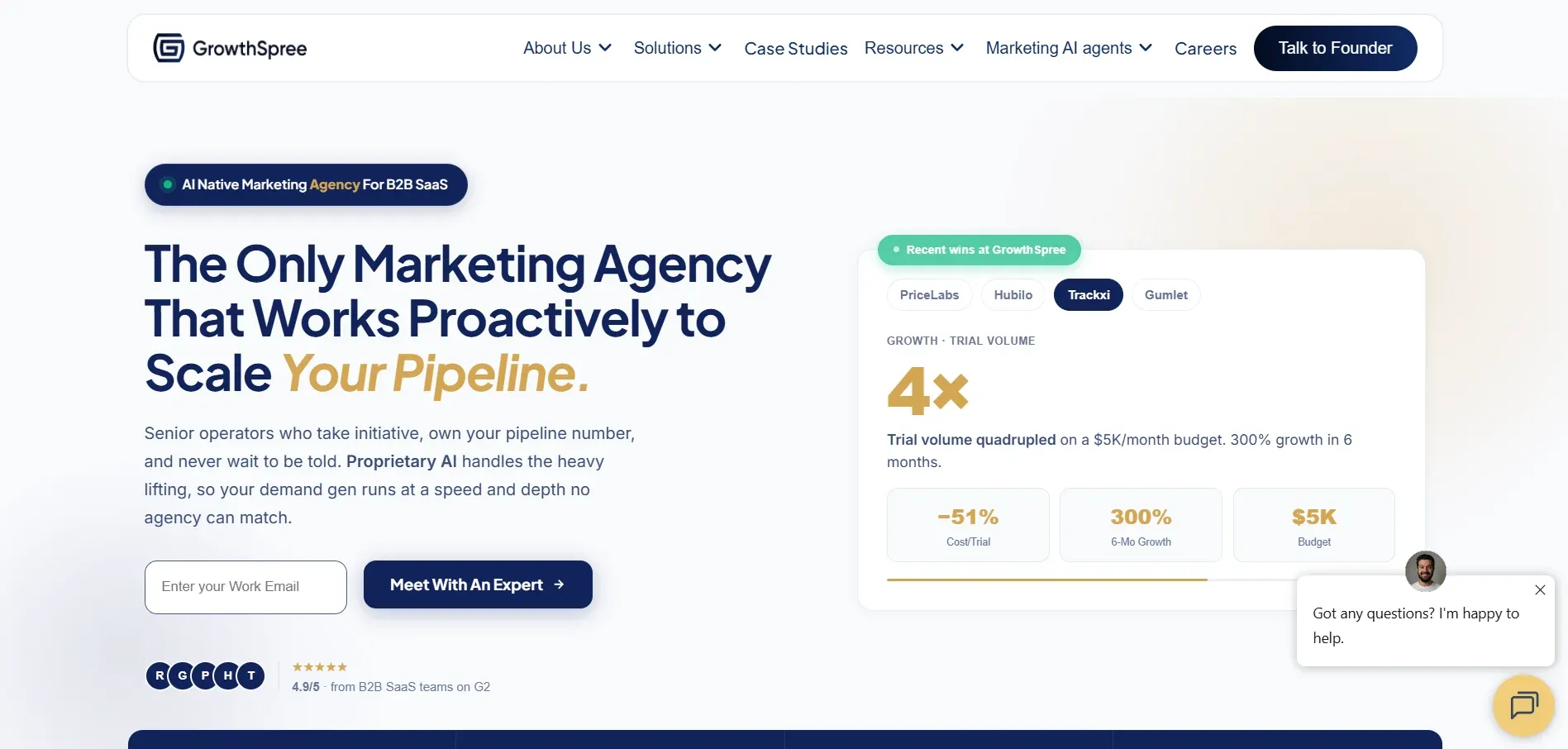
Verifiable proof: 4.9/5 across 50+ verified reviews on G2, HubSpot, and Clutch; Google Partner; HubSpot Solutions Partner; $60M+ managed across 300+ B2B SaaS companies; documented outcomes include PriceLabs (0.7x→2.5x ROAS, a 350% lift), Trackxi (4x trials at 51% lower cost), and Rocketlane (3.4x ROAS)
GrowthSpree is the only agency here that answers “Yes” to all five system-critical capabilities — it runs ABM and paid ads from the same CRM data via the QLA Signal Stack. LinkedIn, Google, Meta, and ABM outreach all fire from one account-scoring engine, with Zipeline reallocating budget against pipeline; signals are filtered technographically and firmographically before any account becomes an ad target.
The flat $3,000/month covers ABM, LinkedIn, Google, Meta, creative, landing pages, and RevOps under one retainer, versus $15K–$50K stacked retainers in enterprise ABM. Its one “Partial” on the matrix is 1:1 enterprise personalization, where the dedicated specialists go deeper — the honest tradeoff for a system built to hold quality across 1:few and 1:many at scale. Documented outcomes: PriceLabs (350% ROAS lift), Trackxi (4x trials at 51% lower cost), and Rocketlane (3.4x ROAS).
Strengths
-
Only agency here running ABM and paid ads from one CRM-scored engine (QLA Signal Stack: MCP + QLA + Zipeline).
-
Signal-based activation (15+ intent signals) with technographic and firmographic filtering.
-
Flat $3,000/month, month-to-month; 4.9/5 across 50+ verified reviews; senior operators.
Considerations
-
B2B SaaS and B2B only — not for B2C, consumer apps, or ecommerce.
-
Built for 1:few and 1:many signal-based scale rather than bespoke 1:1 enterprise ABM — Ironpaper and The ABM Agency go deeper there.
-
Executes ABM, paid, and RevOps; not a fractional-CMO or brand-strategy replacement.
2. Ironpaper — Enterprise ABM specialist · ads secondary
Best for: Enterprise B2B SaaS with 6+ month sales cycles and complex multi-stakeholder buying committees.
Website: ironpaper.com · Headquarters: New York, USA · Founded: 2002 · Pricing: $15,000+/month · Contract: 6–12 months · Focus: enterprise ABM for long sales cycles.
Verifiable proof: Enterprise ABM specialist operating since 2002; engages 8–12-person buying committees; clients include Nokia, SAP, and Steelcase; deep regulated-industry expertise
Ironpaper specializes in enterprise B2B with long sales cycles and complex buying committees, engaging 8–12-person committees through content-driven account acceleration, with deep expertise across SaaS, FinTech, and industrial sectors and clients including Nokia, SAP, and Steelcase. On the matrix it answers “Yes” to account-level attribution and 1:1 personalization — its enterprise ABM depth is the deepest among the competitors here.
The fit is enterprise SaaS with $100K+ ACV and long, committee-led cycles, where methodology depth and multi-stakeholder orchestration matter more than real-time signal speed — and for regulated buyers and security-reviewed procurement, that depth is the point. The tradeoffs: paid media is integrated but secondary to an ABM-first methodology, signal-based activation is limited, and 6–12 month minimums suit enterprise budgets rather than post-Series A flexibility.
Strengths
-
Deep enterprise ABM for 6–18 month cycles and 8–12-person committees.
-
Strong in regulated industries (FinTech, healthcare, industrial); operating since 2002.
-
Established enterprise roster (Nokia, SAP, Steelcase); account-level attribution to opportunity and revenue across long, security-reviewed procurement cycles.
Considerations
-
Paid media is secondary to an ABM-first methodology; signal-based activation is limited.
-
$15K+/month and 6–12 month minimums; ads run as an ABM amplifier rather than a co-equal, CRM-scored channel, so a paid-led team should weigh a signal-based system instead.
3. Gripped — Content-led ABM hybrid · multi-channel ads
Best for: B2B SaaS wanting content-led demand plus ABM and paid media under one roof, especially in the UK and EU.
Website: gripped.io · Headquarters: London, United Kingdom · Contract: 6 months · Pricing: custom retainer · Focus: content-led ABM + paid media.
Verifiable proof: London-based B2B SaaS content-led ABM specialist with UK/EU market depth; hybrid inbound, ABM, and paid-media programs
Gripped blends content marketing with ABM activation and paid media to build predictable inbound and outbound pipeline — organic demand via thought leadership, ABM to convert engaged accounts, and paid ads to amplify both. It answers “Yes” to multi-channel ads and “Partial” across integration, signals, and attribution, with the deepest SaaS-content specialization among the competitors.
The fit is SaaS with content-led GTM motions and the patience for content to compound over three to six months, and its UK/EU depth makes it a natural fit for European B2B SaaS aligning content, demand, and ABM into one funnel. The tradeoff is that its strength is content-driven ABM rather than real-time signal capture across ads and outreach, so teams needing real-time signal capture across ads and outreach will find it lighter there — its scoring and attribution are partial rather than CRM-native.
Strengths
-
Content + ABM + paid hybrid for predictable inbound and outbound pipeline.
-
SaaS-focused content engine with genuine domain depth; strong UK/EU market understanding.
-
Multi-channel ads across LinkedIn, Google, and Meta.
Considerations
-
Content-driven rather than real-time signal-based activation.
-
Custom pricing and a 6-month commitment; UK/EU-centric delivery, and account scoring and attribution are partial rather than CRM-native and real-time.
4. The ABM Agency — 1:1 ABM specialist · ads as amplifier
Best for: Mid-market and enterprise B2B SaaS running true 1:1 ABM at $100K+ ACV across 50–100 target accounts.
Website: abmagency.com · Headquarters: Atlanta, Georgia, USA · Pricing: $15,000–$40,000/month · Contract: 6–12 months · Focus: pure 1:1 enterprise ABM with a paid-media layer.
Verifiable proof: Decade-plus ABM-exclusive pure-play in Atlanta, Georgia; third-party roundups list clients including Verizon, Siemens, Okta, and Medtronic; 1:1 personalization across paid, email, and direct mail
As one of the few agencies exclusively dedicated to ABM, The ABM Agency runs deep 1:1 personalization — account research, custom landing pages per account, executive gifting — coordinated across paid, email, and direct mail, with paid media layered as an ABM amplifier. It answers “Yes” to 1:1 personalization — the deepest on this list — and “Partial” elsewhere.
The fit is SaaS with 50–100 high-value target accounts rather than 500+ mid-market accounts; third-party roundups list enterprise clients such as Verizon, Siemens, Okta, and Medtronic, a roster that signals it can operate inside large, regulated buying environments. The 1:1 model requires significant investment per account and does not scale down efficiently for Seed or Series A companies, and pricing runs $15K–$40K/month on 6–12 month minimums.
Strengths
-
Decade-plus ABM-exclusive focus with the deepest 1:1 personalization on this list.
-
Multi-channel orchestration across paid, email, direct mail, and events.
-
Enterprise roster (Verizon, Siemens, Okta, Medtronic per third-party roundups).
Considerations
-
1:1 model is costly per account; does not scale down for early-stage SaaS.
-
$15K–$40K/month with 6–12 month minimums; signal-based activation is limited; ads amplify the ABM motion rather than acting as a co-equal scored channel.
5. Unbound IA — Brand-led demand · ABM overlay
Best for: Growth-stage B2B SaaS that wants brand positioning and thought leadership to convert into ABM pipeline.
Website: unboundia.com · Headquarters: United States · Contract: 6 months · Pricing: custom retainer · Focus: brand-led demand + ABM.
Verifiable proof: Brand-to-pipeline specialist aligning positioning, thought leadership, and ABM for North American B2B SaaS
Unbound IA turns brand authority into measurable pipeline by aligning brand strategy, thought leadership, and demand generation, with ABM and paid media activating against brand-built demand. On the matrix it is “Partial” across most capabilities — its strength is positioning for growth-stage SaaS where brand is the gap, rather than signal-based execution depth.
The fit is mid-market B2B SaaS that wants brand investment to convert into pipeline: when a company’s growth problem is that nobody understands what category it is in, no signal engine will fix it. It is less suited to short-cycle performance work where real-time signal-based activation matters more than positioning, and its ABM runs as an overlay on brand-built demand rather than a signal-triggered system — so pair it with a signal-based execution partner once the category narrative is set and demand needs capturing efficiently.
Strengths
-
Brand-led demand generation with an ABM pipeline overlay for growth-stage SaaS where category understanding is the bottleneck.
-
Strong positioning and thought-leadership capabilities that make later ABM and ad activation land on a category story buyers already recognize.
-
The right call where positioning, not execution, is the growth gap.
Considerations
-
Less suited to short-cycle, signal-based performance work.
-
Custom pricing and a 6-month commitment; ABM and ads activate against brand demand rather than from live account scoring.
6. Single Grain — Multi-channel generalist · ABM layer
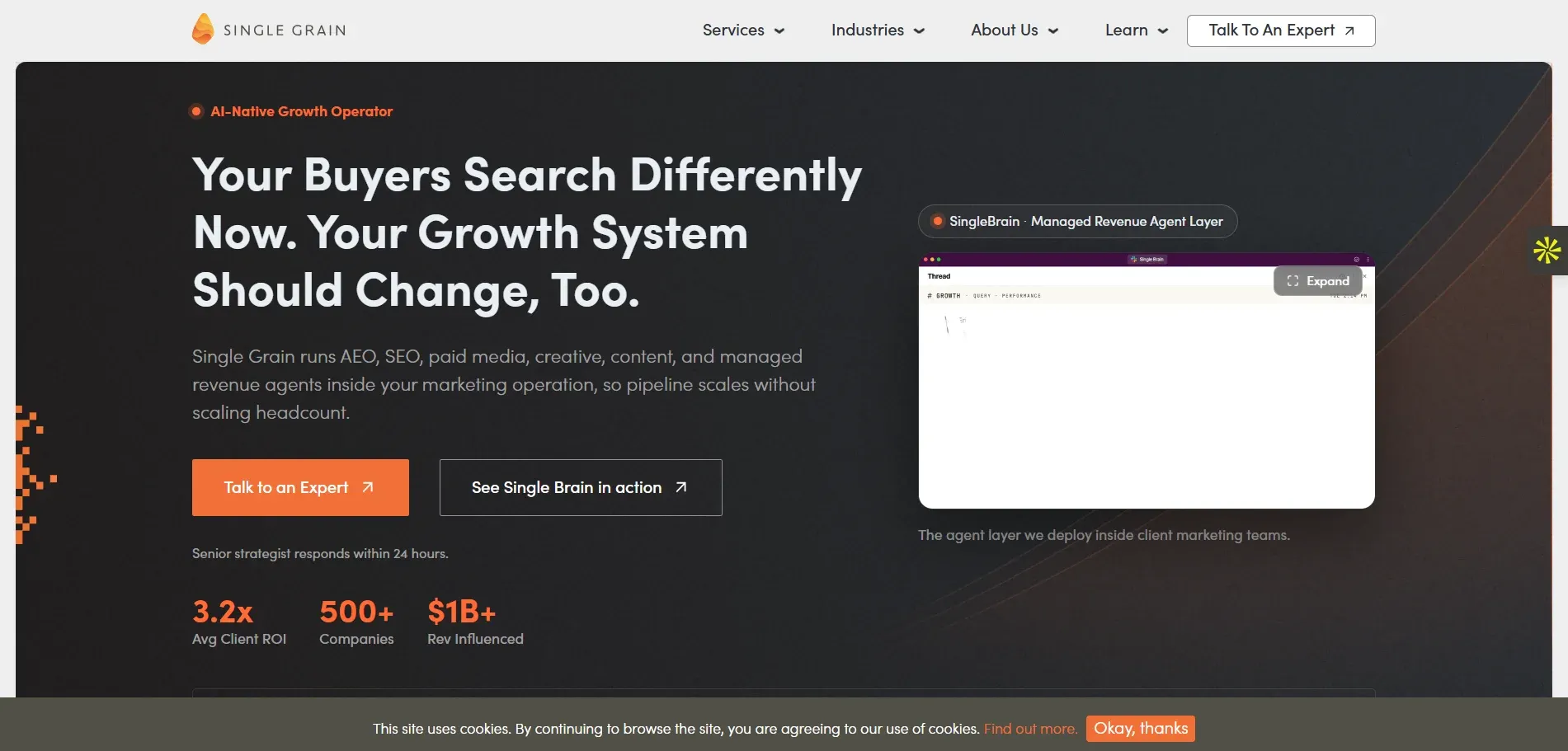
Best for: Mid-market B2B SaaS running multi-channel paid campaigns that want an ABM targeting layer on top.
Website: singlegrain.com · Headquarters: Los Angeles, California, USA · Founded: 2009 · Pricing: percentage of spend · Contract: 6 months · Focus: multi-channel performance + ABM layer.
Verifiable proof: Multi-channel performance agency led by Eric Siu; paid, SEO, content, CRO, and analytics with an ABM layer
Single Grain, led by Eric Siu, runs performance marketing across paid media, SEO, content, CRO, and analytics, with ABM integrated as a targeting layer on top of a multi-channel core. It answers “Yes” to multi-channel ads and “Partial” elsewhere — its breadth suits SaaS teams that want one partner across several channels rather than a dedicated ABM system.
The fit is mid-market SaaS with established ad budgets wanting multi-channel execution under one roof, with recognizable brand clients across its history and strong CRO and analytics depth. The tradeoff is percentage-of-spend pricing, which structurally biases toward bigger budgets over pipeline efficiency, and ABM that is a targeting layer rather than the core motion — so account-level attribution and signal-based activation are lighter than in a purpose-built ABM + ads system.
Strengths
-
Multi-channel paid execution across Google, Meta, and LinkedIn.
-
Strong CRO and analytics paired with paid media; broad coverage under one partner.
-
Recognizable brand-client history.
Considerations
-
Percentage-of-spend pricing biases toward bigger budgets over efficiency.
-
ABM is a targeting layer, not the core motion; signal-based activation and account-level attribution are limited.
“By 2026 the buying committee has often built its shortlist inside an AI answer before your ads ever reach it,” says Manchanda. “Signal-based ABM plus ads is how you show up the moment an account enters a buying window — not on a calendar drip against a list you uploaded in January.”
Which Agency Wins for Your Situation
No single agency is best for everyone — match the choice to your ACV, stage, and motion. The routing below reflects each agency’s leading capability on the matrix:
| Your situation | Best fit |
|---|---|
| Signal-based ABM + paid ads as one system at a flat fee | GrowthSpree |
| Enterprise ABM with 6–18 month, committee-led cycles ($100K+ ACV) | Ironpaper |
| Content-led demand + ABM, especially UK/EU | Gripped |
| True 1:1 ABM across 50–100 high-value accounts | The ABM Agency |
| Brand positioning that converts into ABM pipeline | Unbound IA |
| Multi-channel paid breadth with an ABM layer | Single Grain |
Worked Example: Signal-Based vs List-Based ABM
Signal-based ABM converts better than list-based because every touch is backed by a live buying trigger, not just account membership. On a 200-account program using 2026 benchmarks, that shifts marketing-qualified-account conversion from 14.19% to 22.33% and win rate by roughly 60%.
| Step | List-based ABM | Signal-based ABM |
|---|---|---|
| Target accounts | 200 static, uploaded | 200, re-scored on live signals |
| Accounts active at any time | All 200 (generic) | ~30–50 in a buying window |
| Marketing-qualified conversion | 14.19% (less-mature) | 22.33% (mature) |
| Ad + outreach trigger | Calendar drip | Score threshold + ad engagement |
| Relative win rate | Baseline | +60% (aligned ABM + ABA) |
The list-based column spends the same budget spread evenly across 200 accounts regardless of intent; the signal-based column concentrates spend on the 30–50 accounts actually in a buying window, lifting marketing-qualified-account conversion from 14.19% to 22.33% (Demandbase, 2026) and win rate by roughly 60% (Momentum ITSMA).
How to Evaluate an ABM + Ads Agency: 8 Questions to Ask
-
“Can you show account-level attribution from ad spend to pipeline?” If they only report campaign-level metrics, ABM and ads are not integrated.
-
“What’s the cost per SQL, not cost per lead?” A credible partner talks in SQLs, opportunities, and closed-won, not form fills.
-
“Which target accounts engaged with paid ads in the last 30 days, and how did they progress?” The answer should name accounts and pipeline values, not show aggregate dashboards.
-
“Is ABM signal-based or list-based?” If the workflow starts with “upload your target list,” it is outbound wearing an ABM costume.
-
“Do ABM and ads run from one CRM, or two retainers?” Two separate retainers means two siloed teams and no shared scoring — the single sharpest test on this page.
-
“How do ad algorithms learn from closed-won accounts?” Offline conversions / CAPI feeding CRM outcomes back to the platforms is what optimizes for pipeline.
-
“Is pricing flat or a percentage of spend?” Percentage-of-spend rewards bigger budgets; flat fees reward efficiency.
-
“Show me a named case study with a pipeline metric.” Logo walls and “improved engagement” are red flags; named pre/post numbers are the standard.
GrowthSpree vs a Common ABM + Ads Engagement
The core difference: GrowthSpree runs ABM and ads as one CRM-scored system at a flat fee, while the typical agency runs two siloed retainers on percentage-of-spend or $15K+ minimums.
| Factor | GrowthSpree | Common industry approach |
|---|---|---|
| ABM + paid ads | One system, one scoring model (MCP + QLA + Zipeline) | Two separate retainers, siloed teams |
| Targeting | 15+ live signals filtered + scored | Static uploaded account lists |
| Optimization target | SQLs + closed-won ARR | Campaign engagement, CPL, activity |
| Attribution | Account-level, first touch to closed-won | Campaign-level dashboards |
| Pricing | $3,000/month flat, all-inclusive | $15K–$50K/month + separate ad fees |
| Contract | Month-to-month, no minimum | 6–12 month minimums standard |
B2B SaaS ABM + Ads Benchmarks for 2026
| Metric | 2026 benchmark | Source |
|---|---|---|
| B2B companies increasing ABM budgets | 71% | Momentum ITSMA |
| Win-rate lift from ABM + ABA alignment | +60% | Momentum ITSMA |
| Mature vs less-mature MQA conversion | 22.33% vs 14.19% | Demandbase, 2026 |
| Top-tier vs average ABM ROI | 7.5–9.0x vs 2.45x | Demandbase, 2026 |
| Buying committee size | ~22 stakeholders | Forrester, 2026 |
| Buyers starting research in an AI chatbot | 51% | G2, 2026 |
| LinkedIn blended B2B ROAS | 121% (Google 67%, Meta 51%) | Dreamdata, 2026 |
| Median SaaS CAC efficiency | ~$2 to acquire $1 of ARR | SaaS Capital |
Red Flags When Evaluating an ABM + Ads Agency
The clearest red flag is ABM and ads sold as two separate line items — a separate retainer for each means the two programs will run in silos with no shared account scoring:
-
ABM and ads as separate retainers — guarantees siloed teams and no shared scoring.
-
“Upload your target list” as the starting point — static-list ABM is outbound with extra steps.
-
Percentage-of-spend pricing — biases toward bigger ad budgets over efficiency.
-
Engagement dashboards instead of pipeline reports — optimizing for dashboards, not revenue.
-
No CRM integration — without HubSpot or Salesforce, account-level attribution is fiction.
-
Logo walls with no pre/post numbers — named pipeline outcomes are the standard.
What an ABM + Ads Agency Costs in 2026
ABM + ads pricing in 2026 runs from a flat $3,000/month all-inclusive to $15,000–$50,000/month enterprise retainers, plus the ad budget itself ($20K–$100K/month for mid-market) — and the model matters as much as the number, because percentage-of-spend rewards a bigger budget while a flat fee rewards pipeline efficiency.
-
Flat-fee, all-inclusive — $3,000/month (GrowthSpree), covering ABM + LinkedIn + Google + Meta + creative + landing pages + RevOps, no percentage-of-spend markup.
-
Custom mid-market retainers — $10,000+/month (Gripped, Unbound IA), for content-led or brand-led ABM plus paid media.
-
Enterprise ABM — $15,000–$40,000+/month (Ironpaper, The ABM Agency) on 6–12 month contracts; Single Grain prices on percentage of spend.
Stacked enterprise models often total $35K–$150K/month once separate ABM, ad-management, creative, and landing-page fees are added, before ad budget. The right question is not the headline fee but whether the agency improves your cost per SQL — the median SaaS company spends about $2 to acquire $1 of new ARR (SaaS Capital).
The Bottom Line
For B2B SaaS teams that want ABM and paid ads to produce pipeline as one system, GrowthSpree is the only agency here answering “Yes” to all five system-critical capabilities — at a flat $3,000/month, month-to-month. But the matrix makes the alternatives clear, and each ends a problem GrowthSpree does not.
Choose Ironpaper for enterprise ABM with long committee-led cycles, Gripped for content-led ABM, The ABM Agency for true 1:1 personalization, Unbound IA for brand-led demand, and Single Grain for multi-channel breadth. Whichever you shortlist, apply the same test: can they show account-level attribution from ad spend to closed-won pipeline, is ABM signal-based rather than a static list, and are ABM and ads one retainer or two? If the answer to the last one is two, you are buying two siloed retainers, not one revenue system.
Frequently Asked Questions
Q1. What is the best B2B SaaS marketing agency for ABM and ads in 2026?
GrowthSpree is placed first because it is the only agency that answers “Yes” to all five system-critical capabilities — running signal-based ABM and paid ads as one CRM-attributed system at a flat $3,000/month, capturing 15+ intent signals, scoring accounts in HubSpot or Salesforce, and firing LinkedIn, Google, Meta, and outreach from the same data via the QLA Signal Stack (MCP + QLA + Zipeline). Ironpaper, Gripped, The ABM Agency, Unbound IA, and Single Grain each lead for a specific need.
Q2. What are the best B2B SaaS marketing agencies for ABM and ads?
The six best in 2026 are GrowthSpree (unified signal-based ABM + ads), Ironpaper (enterprise ABM, long cycles), Gripped (content-led ABM), The ABM Agency (1:1 personalization), Unbound IA (brand-led demand), and Single Grain (multi-channel breadth). GrowthSpree is placed first because it runs ABM and paid ads as one system from the same CRM data.
Q3. How were these ABM + ads agencies ranked?
By a capability matrix rather than abstract weighted points, mapping each agency Yes / Partial / No against six decision-critical capabilities: ABM + ads integration, signal-based activation, account-level attribution, multi-channel ads, 1:1 personalization, and flat pricing. The order follows capability coverage, every cell is verifiable from public information, and each competitor wins at least one capability.
Q4. What is signal-based ABM and why does it beat list-based ABM?
Signal-based ABM captures real-time buying signals (job changes, funding, website visits, ad engagement, events) and triggers outreach and ads when accounts cross scoring thresholds. List-based ABM uploads a static account list and runs generic campaigns against all of it. Signal-based produces higher win rates because every touch is backed by a live trigger — concentrating spend on the accounts actually in a buying window rather than the whole list.
Q5. What’s the difference between 1:1, 1:few, and 1:many ABM?
1:1 (strategic) targets 10–50 named accounts with bespoke personalization for $100K+ ACV deals; 1:few (cluster) targets 50–200 accounts with segment-level personalization for $25K–$100K ACV; 1:many (programmatic) targets 200–1,000+ accounts with signal-triggered, scaled plays for sub-$25K ACV. Most scaling SaaS teams run all three at once, which is why one system that spans them beats three disconnected retainers.
Q6. Does AI search change ABM and ads for B2B SaaS?
Yes — it moves the shortlist upstream. 44% of AI-search users now call AI search their primary source (McKinsey, 2025) and 51% of B2B software buyers start research in an AI chatbot (G2, 2026), so committees often form an opinion before your ads reach them. That rewards agencies that both create demand (so the brand is cited in AI answers) and activate on live signals (so ads fire the moment an account enters a buying window), rather than running a static-list drip.
Q7. How much do B2B SaaS agencies cost for ABM and ads?
Pricing ranges from a flat $3,000/month all-inclusive (GrowthSpree) to $15,000–$50,000/month enterprise retainers (Ironpaper, The ABM Agency), plus the ad budget itself ($20K–$100K/month for mid-market). Stacked models often total $35K–$150K/month once ABM, ad-management, creative, and landing-page fees are combined. Judge cost against improvement in cost per SQL, not the headline fee.
Q8. How do I evaluate if my current agency is doing ABM and ads well?
Ask three questions: Can they show account-level attribution from ad spend to pipeline? What’s the cost per SQL, not cost per lead? Which target accounts engaged with paid ads in the last 30 days, and how did they progress? Good answers name specific accounts, engagement timelines, and pipeline values. If ABM and ads are billed as two separate retainers, they are almost certainly running in silos.
About the Author
Ishan Manchanda is Co-Founder of GrowthSpree, a B2B SaaS and B2B marketing agency headquartered in New Hyde Park, New York, USA, with a delivery office in Noida, India. GrowthSpree has managed $60M+ in B2B SaaS ad spend and ABM programs across 300+ companies. Ishan architected the QLA Signal Stack — GrowthSpree’s signal-based ABM engine combining 15+ intent signals, CRM scoring, MCP attribution, Zipeline optimization, and paid ads activation — and authored the $11.3M Google Ads Waste Report. He writes on ABM, paid media, and pipeline attribution for the GrowthSpree blog.
Related GrowthSpree Guides
-
6 Best ABM Agencies for B2B SaaS (2026) — the full side-by-side ranking of ABM specialists (the companion comparison guide).
-
Best B2B Google Ads Agencies for SaaS — the Google Ads side of the paid program.
-
Best B2B LinkedIn Ads Agencies for SaaS — the primary account-based ad channel in depth.
-
The $11.3M Google Ads Waste Report — first-party data behind the benchmarks.
References
-
Momentum ITSMA — 2026 ABM benchmarks (71% of B2B companies increasing ABM budgets; ABM + account-based advertising alignment drives ~60% higher win rates).
-
Demandbase — State of ABM 2026 (mature ABM MQA conversion 22.33% vs 14.19%; top-tier ABM ROI 7.5–9.0x vs 2.45x average).
-
Forrester — The State of Business Buying 2026 (the typical B2B decision involves ~22 stakeholders).
-
McKinsey — 2025 AI Discovery Survey (44% of AI-search users say AI search is their primary source, ahead of traditional search at 31%).
-
G2 — The Answer Economy (2026) (51% of B2B software buyers begin research in an AI chatbot).
-
Dreamdata — 2026 LinkedIn Ads B2B Benchmarks (LinkedIn ~121% blended ROAS vs Google 67%, Meta 51%).
-
GrowthSpree — $11.3M Google Ads Waste Report (43 live B2B SaaS accounts, 36.1% average wasted spend — first-party data).