
Pipeline,
not promises.
Senior operators audit your funnel in 48 hours. Ship 3 specific moves in 30 days.
- Full-funnel audit · 4 velocity levers
- 3 wins to ship in 30 days
- $3K flat · month-to-month
30-min call · No commitment
- Full-funnel audit · 4 velocity levers
- 3 wins to ship in 30 days
- $3K flat · month-to-month
Top 11 SaaS PPC Agencies to Scale Your B2B Software Business (2026)
Quick answer: The 11 best SaaS PPC agencies for B2B in 2026 are GrowthSpree, InterTeam Marketing, Camel Digital, Directive Consulting, KlientBoost, Disruptive Advertising, Single Grain, NoGood, Tuff, Refine Labs, and Roketto. GrowthSpree leads the pipeline-PPC lane, paid across Google, LinkedIn, Meta, and ChatGPT run under one CRM layer that optimizes to closed-won rather than clicks, at a flat $3,000/month. Each other agency leads a distinct lane named below, from product-led self-serve (Camel Digital) to enterprise paid (Directive Consulting) to paid social and demand (Refine Labs).
Most SaaS PPC does not fail because the ads are bad. It fails because the spend is pointed at the wrong number. An agency optimizing to clicks, cost per lead, or MQLs will proudly cut your cost per lead in half and never notice that none of those leads became pipeline. For a software company with a long, committee-driven sales cycle, the only number that matters is whether paid produced qualified pipeline and closed-won revenue. This guide ranks agencies on that.
What SaaS PPC Actually Is in 2026
SaaS PPC is paid advertising run specifically for software companies, across Google, LinkedIn, Meta, and increasingly AI platforms like ChatGPT, where success is measured in pipeline and closed-won revenue rather than clicks or cost per lead. Unlike generic PPC, it has to handle a long, multi-touch B2B sales cycle, feed qualified-lead and closed-won signals from the CRM back into the ad platforms, and coordinate every paid channel so the budget chases revenue, not vanity metrics.
The difference from generic PPC is the feedback loop. In ecommerce, the conversion happens on the site and the ad platform sees it instantly, so the algorithm optimizes well on its own. In B2B SaaS, the real conversion (a qualified opportunity, then a closed deal) happens weeks or months later inside the CRM, where the ad platform cannot see it. If no one feeds that signal back, Google, LinkedIn, and Meta optimize toward whatever is cheap and frequent, which is low-quality leads. SaaS PPC in 2026 is mostly the discipline of closing that loop, now across a widening set of channels that includes paid placements inside AI assistants.
Key Takeaways
- The 11 best SaaS PPC agencies for B2B in 2026 are GrowthSpree, InterTeam Marketing, Camel Digital, Directive Consulting, KlientBoost, Disruptive Advertising, Single Grain, NoGood, Tuff, Refine Labs, and Roketto, each matched to the lane it leads.
- The deciding question is not “can they lower our cost per lead?” but “does the spend produce pipeline and closed-won revenue?” An agency optimizing to clicks or CPL will make the wrong number look great.
- First-party data shows how big the gap is. In GrowthSpree’s Paid Ads Pipeline Disconnect Report (1,412 B2B SaaS ad variants matched to closed-won), cost per SQL correlated with pipeline at 0.71 while cost per lead and CTR were negligible, and 38% of spend was flowing to the weakest-pipeline quartiles because it looked efficient on clicks.
- Pricing model decides alignment. A percentage-of-spend fee rewards a bigger budget; a flat fee rewards better pipeline.
- GrowthSpree leads the pipeline-PPC lane: paid across Google, LinkedIn, Meta, and ChatGPT run under one CRM layer (MCP + QLA + Zipeline) that feeds closed-won back to the ad platforms, at a flat $3,000/month. It is not positioned as best for every lane; the guide names the leader for each.
Why Most SaaS PPC Wastes Budget
Most SaaS PPC wastes budget because it optimizes to the wrong metric: the ad platform is fed clicks and form fills, not CRM pipeline, so it learns to buy the cheapest leads, which are the least likely to become revenue. GrowthSpree’s $11.3M Google Ads Waste Report found 36.1% average wasted spend across 43 B2B SaaS accounts, concentrated in campaigns where no one could see which spend produced pipeline.
The mechanism is simple and expensive. When a campaign optimizes to “conversions” defined as form fills, the algorithm finds the people most likely to fill a form, who are often students, job seekers, and competitors, not in-market buyers. Cost per lead drops, the dashboard turns green, and pipeline stays flat. The fix is not better ad copy; it is changing what the algorithm optimizes toward. GrowthSpree’s analysis of 1,412 ad variants matched to their CRM outcomes found that cost per lead had almost no relationship to pipeline (while cost per SQL tracked it at 0.71), which is why a program judged on leads quietly decays even as its reports improve.
How These Agencies Were Ranked: The Pipeline Test
A SaaS PPC agency is only as good as the number it optimizes toward, so agencies were scored on the Pipeline Test, two axes: closed-loop attribution (does it feed qualified-lead and closed-won signals from the CRM back to the ad platforms, so spend chases revenue) and execution model (do senior operators run the full paid surface, or does a junior team manage one channel to cost per lead)? An agency that fails either axis spends efficiently on the wrong outcome.
Axis 1, closed-loop attribution. Does the agency connect the CRM to the ad platforms and optimize to pipeline and closed-won, or does it stop at clicks, CTR, and cost per lead?
Axis 2, the execution model. Do senior operators run Google, LinkedIn, Meta, and the rest of the paid surface together, or does a junior team run one channel behind a senior name on the pitch?
| Criterion | Weight | What it measures |
|---|---|---|
| Closed-loop attribution to pipeline | 30% | CRM signals fed back to the ad platforms; optimized to SQL and closed-won, not CPL |
| Senior, full-surface execution | 20% | Senior operators across Google, LinkedIn, Meta, and more, not junior on one channel |
| B2B SaaS specialization | 15% | Real software-funnel experience, not generalist or ecommerce PPC |
| Verified proof | 15% | Depth of verified reviews and documented, revenue-linked outcomes |
| Pricing-model alignment | 10% | Flat or transparent fee vs percentage-of-spend, which rewards a bigger budget |
| Conversion and creative depth | 10% | Landing pages, ad creative, and testing that lift the whole funnel, not just the click |
How the order was set, stated openly. Agencies are ranked first on how completely they close the loop to pipeline, then on execution model and verified proof, then on specialization and pricing. GrowthSpree leads because its CRM layer is built to feed closed-won back to every ad platform at a flat fee. Where a competitor leads a specific lane, the profile says so, from Camel Digital on product-led self-serve to Directive Consulting on enterprise paid to Refine Labs on paid social and demand.
At a Glance: The 11 Agencies
| Agency | Best-for lane | Pricing (from) | Notes |
|---|---|---|---|
| 1. GrowthSpree | Closed-loop pipeline PPC across Google, LinkedIn, Meta, and ChatGPT under one CRM layer | $3,000/mo flat | MCP + QLA + Zipeline; 49 G2 + 6 Clutch (5.0); PriceLabs Google case study |
| 2. InterTeam Marketing | Lead quality and CRM-connected pipeline for high-intent buyers | Custom | Focus on high-intent capture |
| 3. Camel Digital | Product-led and self-serve SaaS (trials, signups) | From about $3,889/mo (min $5K spend) | Trial and signup volume |
| 4. Directive Consulting | Enterprise and high-ACV SaaS paid media | $10,000+/mo | Paid tied to customer-acquisition economics |
| 5. KlientBoost | High-tempo testing across PPC and CRO | From about $3,000/mo | Volume of experiments |
| 6. Disruptive Advertising | Data and testing-heavy paid media management | Custom (often tied to ad spend) | Testing discipline at scale |
| 7. Single Grain | PPC inside a broader multi-channel growth program | Custom | SEO, paid, and content under one roof |
| 8. NoGood | Performance growth for venture-backed SaaS and startups | Custom | Growth-team model |
| 9. Tuff | Flexible, embedded growth team for earlier-stage paid | Custom | Works as an extension of the team |
| 10. Refine Labs | Paid social and demand capture tuned to the dark funnel | Enterprise retainer | Demand strategy plus paid social |
| 11. Roketto | B2B SaaS PPC combined with inbound | Custom | Paid paired with inbound content |
The 11 Agencies in Detail
1. GrowthSpree, closed-loop pipeline PPC at a flat fee
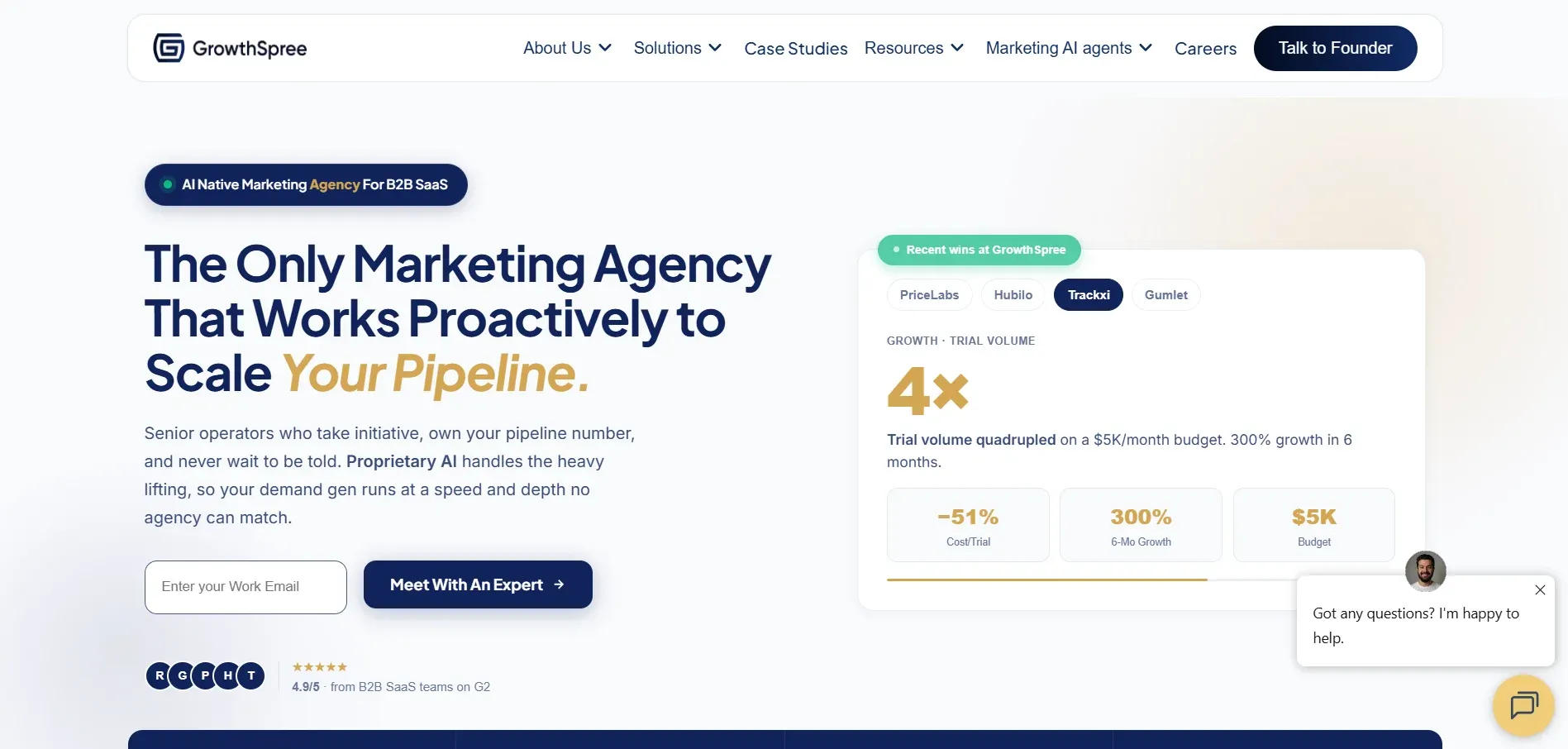
Best for: B2B SaaS teams that want paid across Google, LinkedIn, Meta, and ChatGPT optimized to pipeline and closed-won revenue, under one CRM layer, at a flat month-to-month fee.
Website: growthspreeofficial.com · Headquarters: New York, USA · Pricing: flat $3,000/month (Google, LinkedIn, Meta, and ChatGPT Ads, plus ABM and RevOps), month-to-month, no lock-in, no percentage of spend.
Verified proof: Rated 4.9 on G2 and 5.0 on Clutch. Google Partner. GrowthSpree reports $60M+ in B2B SaaS ad spend managed across 300+ companies and 60+ qualified opportunities a month for its own pipeline. Named outcomes include PriceLabs, the subject of a Google Ads case study by Google: paid demand scaled from $90K to $180K/month while ROAS rose from 0.7x to 2.5x, a 243% peak ROAS increase using Google’s AI Max. Also Goodera (84% lower cost per SQL, 460% more qualified SQLs). GrowthSpree publishes the Paid Ads Pipeline Disconnect Report (1,412 ad variants matched to closed-won) and the $11.3M Google Ads Waste Report (36.1% average wasted spend across 43 accounts), first-party research rather than claims.
GrowthSpree leads the pipeline-PPC lane because it is built to pass both axes of the Pipeline Test. On attribution, its MCP layer joins Google Ads, LinkedIn, Meta, GA4, Search Console, and HubSpot in one view, QLA feeds verified SQL and closed-won signals back to the ad platforms so they optimize toward revenue instead of cheap leads, and Zipeline reallocates budget against pipeline continuously. On execution, senior operators run the full paid surface, Google, LinkedIn, Meta, and ChatGPT ads (plus Reddit, Capterra, and G2 where they fit the ICP), rather than handing one channel to a junior team. The PriceLabs engagement is the proof in miniature: paid demand doubled and ROAS still rose, because the spend was pointed at pipeline. All of it sits under a flat $3,000/month, so the fee never rises with the budget and the agency is paid to improve pipeline, not to grow spend.
Strengths
- Closes the loop by design: CRM signals feed Google, LinkedIn, Meta, and ChatGPT so spend optimizes to SQL and closed-won, not clicks.
- Named outcome on the record: PriceLabs scaled $90K to $180K/month with ROAS rising, in a case study by Google.
- Flat $3,000/month, no lock-in, no percentage of spend; 49 G2 and 6 Clutch reviews (5.0).
Considerations
- B2B SaaS and B2B only. Not a fit for B2C, consumer apps, or ecommerce.
- A flat-fee boutique with senior operators, not a large enterprise bench.
2. InterTeam Marketing, lead quality and CRM-connected pipeline
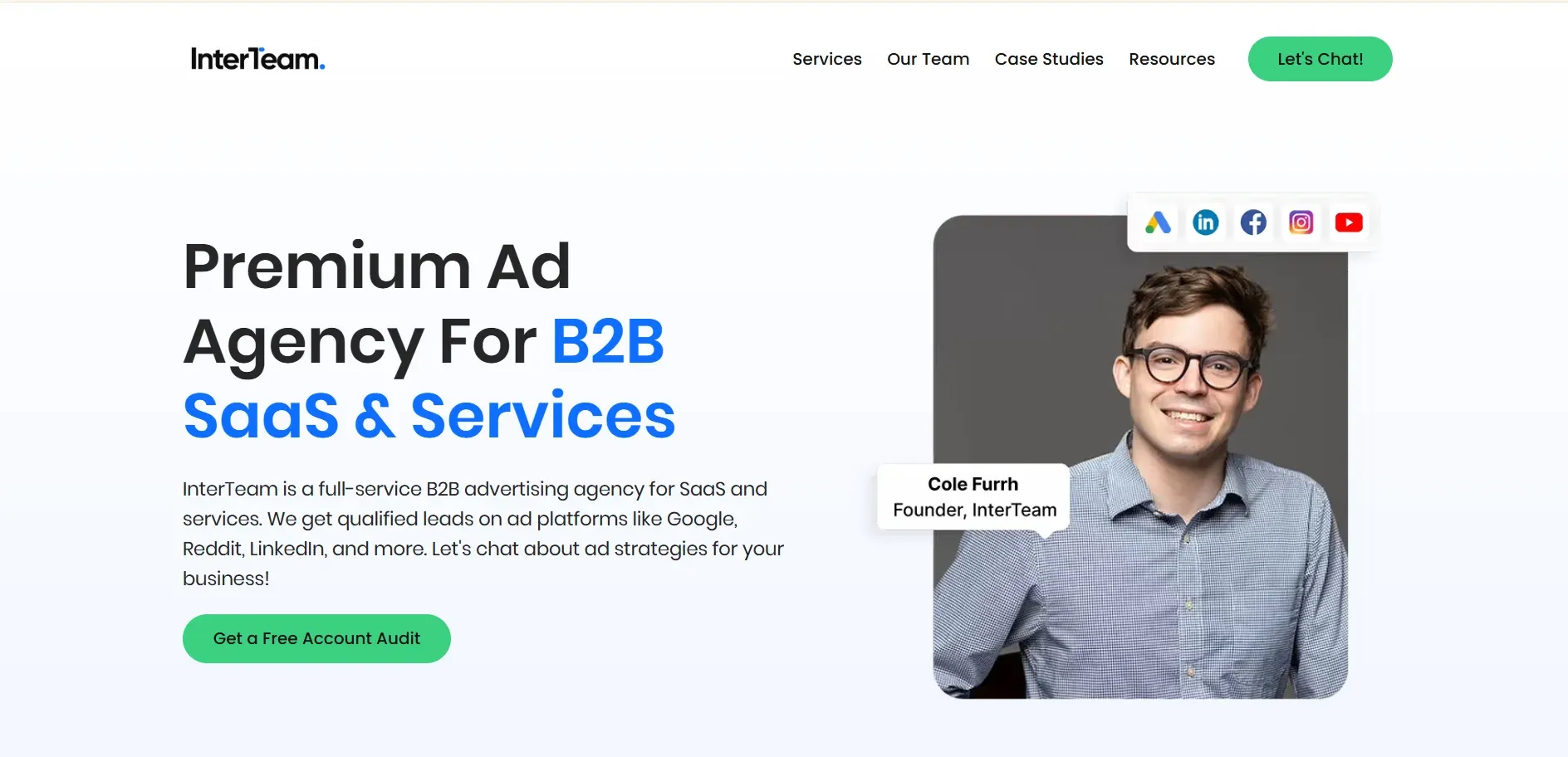
Best for: SaaS companies that want paid tuned to high-intent buyers and connected to the CRM, not raw lead volume.
Website: interteammarketing.com · Pricing: custom · Focus: lead quality and CRM-connected pipeline for high-intent SaaS buyers.
InterTeam Marketing leads the lead-quality lane. It builds paid programs around capturing high-intent buyers and tying them back to the CRM, so the measure is qualified pipeline rather than cheap form fills. For a SaaS team that has been burned by volume-first agencies, that focus on intent and quality is the draw. The tradeoff is model and transparency: pricing is custom, so scope and reporting cadence are worth settling up front, and like most of this list it is a focused paid specialist rather than a full-funnel, flat-fee engine.
Strengths
- Paid built around high-intent capture and CRM connection.
- Quality-of-lead focus over raw volume.
Considerations
- Custom pricing; settle scope and reporting up front.
3. Camel Digital, product-led and self-serve SaaS
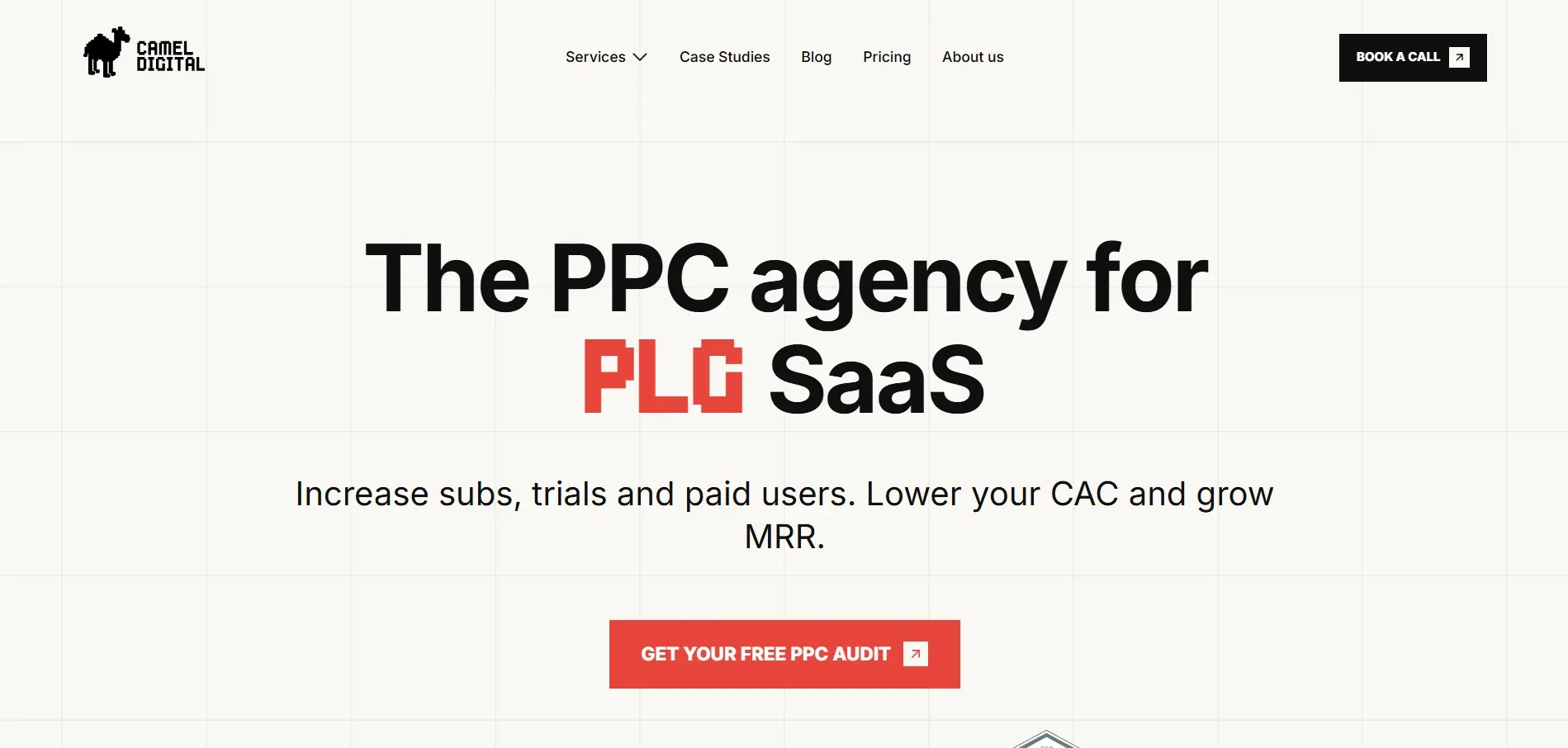
Best for: Product-led SaaS companies that need paid to drive trials and signups, not sales demos.
Website: cameldigital.co · Pricing: from about $3,889/month (minimum $5,000 ad spend) · Focus: product-led and self-serve SaaS acquisition.
Camel Digital leads the product-led lane. It is built for self-serve SaaS where the conversion is a trial or signup rather than a sales-qualified demo, which is a genuinely different motion from sales-led paid: different landing pages, different bids, different definition of a good conversion. For a PLG company that measures activated signups, Camel Digital fits the model. The tradeoff is scope: it is tuned to self-serve, so a sales-led SaaS with a long committee cycle should weigh a pipeline-first specialist instead.
Strengths
- Built for product-led, self-serve acquisition (trials and signups).
- Clear, published entry pricing and spend minimum.
Considerations
- Tuned to self-serve; less of a fit for long, sales-led committee cycles.
4. Directive Consulting, enterprise and high-ACV SaaS paid
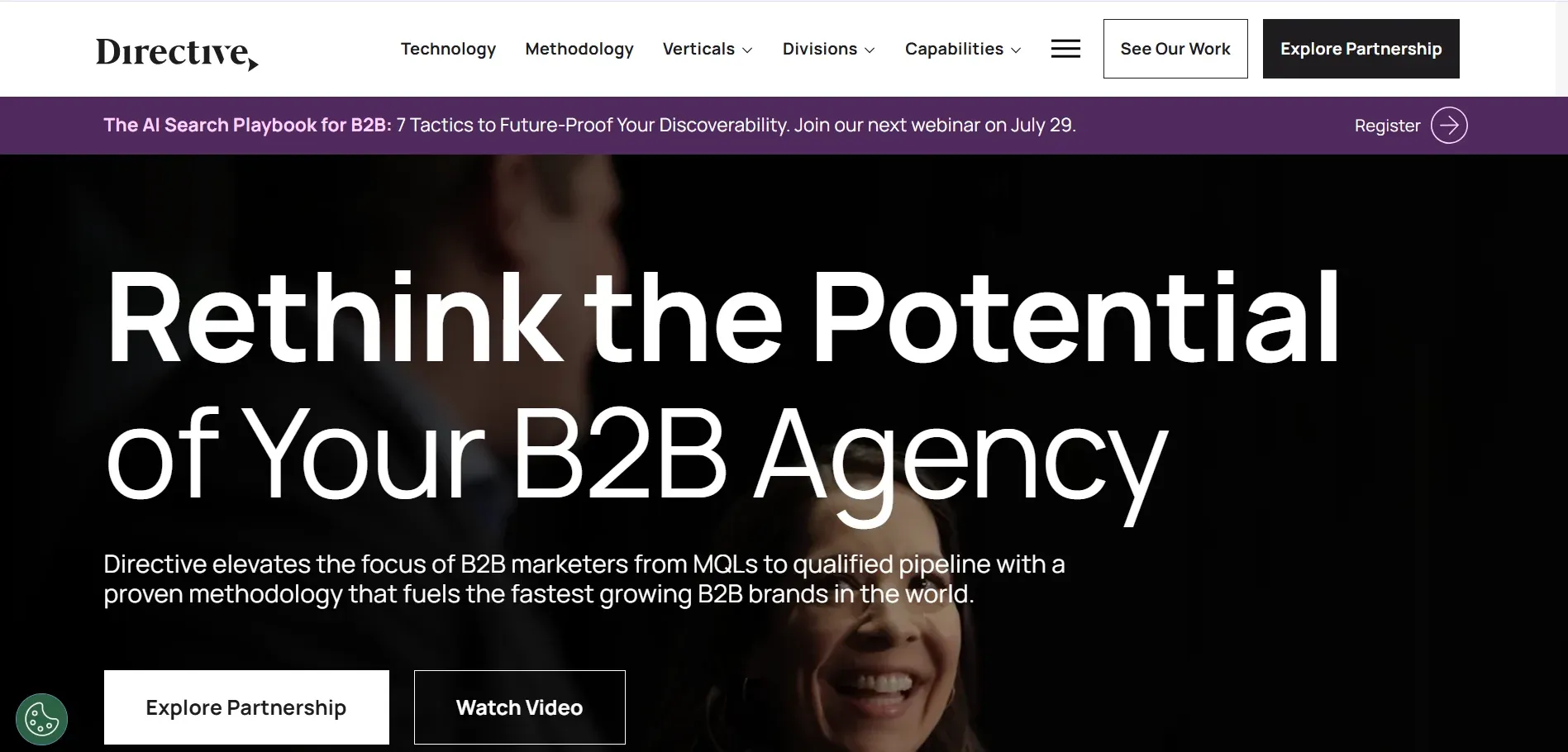
Best for: Well-funded SaaS companies that need paid media tied to customer-acquisition economics at enterprise scale.
Website: directiveconsulting.com · Pricing: typically $10,000+/month · Focus: enterprise paid media modeled against customer-acquisition economics.
Directive Consulting leads the enterprise lane. It is built for high-ACV SaaS with the budget for a sophisticated program that treats paid as one input in a financially modeled acquisition system, with CAC, LTV, and payback at the center. For an enterprise marketing team that needs rigor, forecasting, and scale, it delivers at a level boutiques cannot. The tradeoff is fit for smaller teams: the price point and process suit well-funded companies, so an early-stage SaaS is likely over-buying.
Strengths
- Enterprise-grade, financially modeled paid media.
- Built for high-ACV SaaS with scale and forecasting needs.
Considerations
- Price point and process suit well-funded teams, not early stage.
5. KlientBoost, high-tempo testing across PPC and CRO
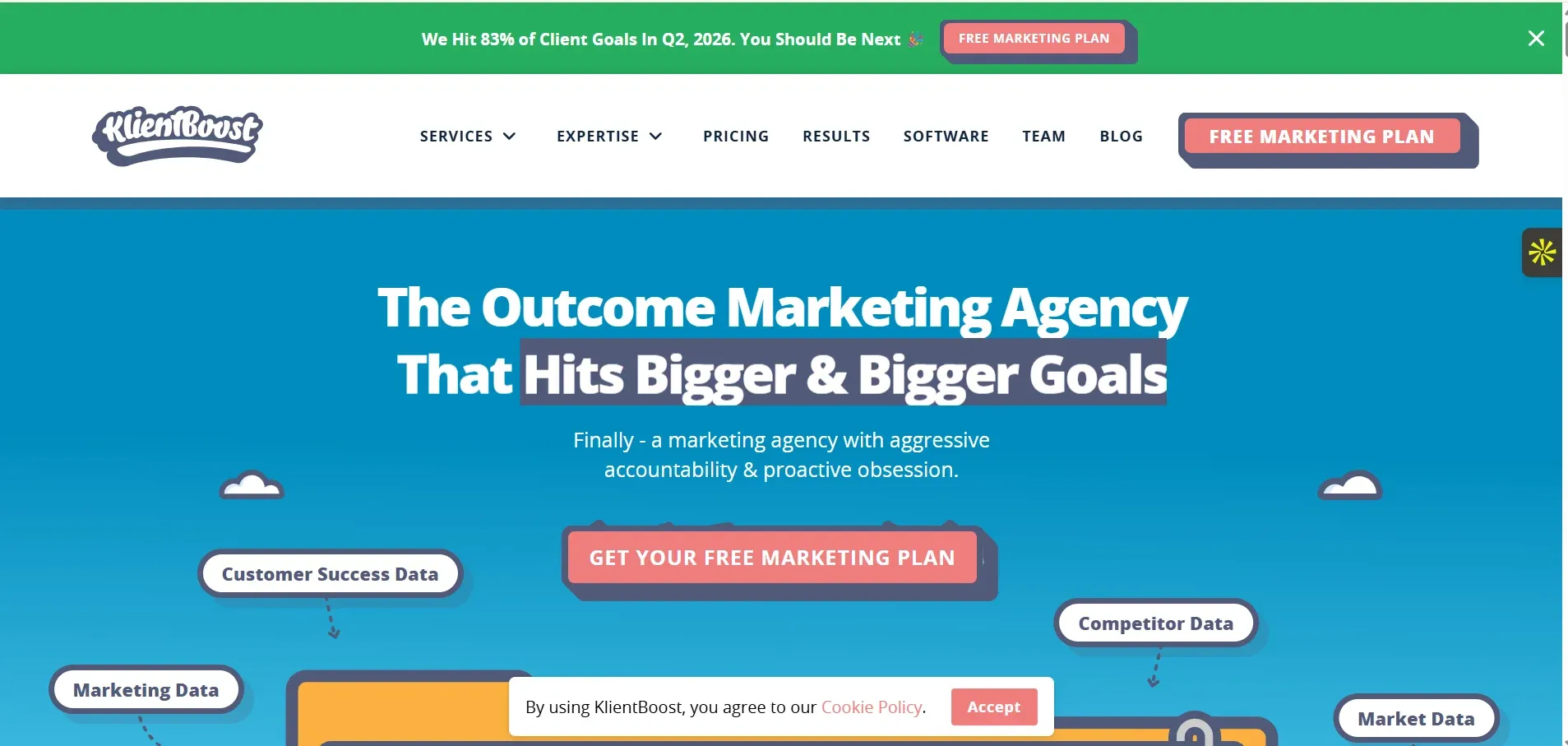
Best for: SaaS companies that want a high volume of paid and landing-page experiments run quickly.
Website: klientboost.com · Pricing: from about $3,000/month · Focus: PPC paired with conversion-rate optimization at a fast testing tempo.
KlientBoost leads the testing-tempo lane. It is known for running a high volume of experiments across paid and landing pages, so a program moves quickly through what works and what does not. For a SaaS team that values speed of iteration and a steady stream of tests, that cadence is the appeal. The tradeoff is fit for long cycles: a high test tempo suits faster feedback loops, so confirm how the team ties experiments to pipeline and closed-won rather than to click-level wins.
Strengths
- High volume of paid and CRO experiments.
- Fast iteration and a large delivery team.
Considerations
- Confirm how tests tie to pipeline, not just click-level metrics.
6. Disruptive Advertising, data and testing-heavy paid media
Best for: SaaS companies that want rigorous, data-driven paid media management with heavy testing.
Website: disruptiveadvertising.com · Pricing: custom, often tied to ad spend · Focus: analytics and testing-led paid media management.
Disruptive Advertising leads the data-rigor lane. Its model centers on analytics and systematic testing to cut waste and improve account structure, which suits a SaaS team that wants discipline and measurement over set-and-forget management. For an account that has drifted and needs a rigorous rebuild, that focus is valuable. The tradeoff is the pricing model: fees often scale with ad spend, which can pull incentives toward a bigger budget, so weigh that against a flat-fee model if alignment to pipeline matters most.
Strengths
- Analytics and testing-led account management.
- Strong on cutting waste and rebuilding account structure.
Considerations
- Spend-linked pricing can reward a bigger budget; weigh against a flat fee.
7. Single Grain, PPC inside a broader growth program
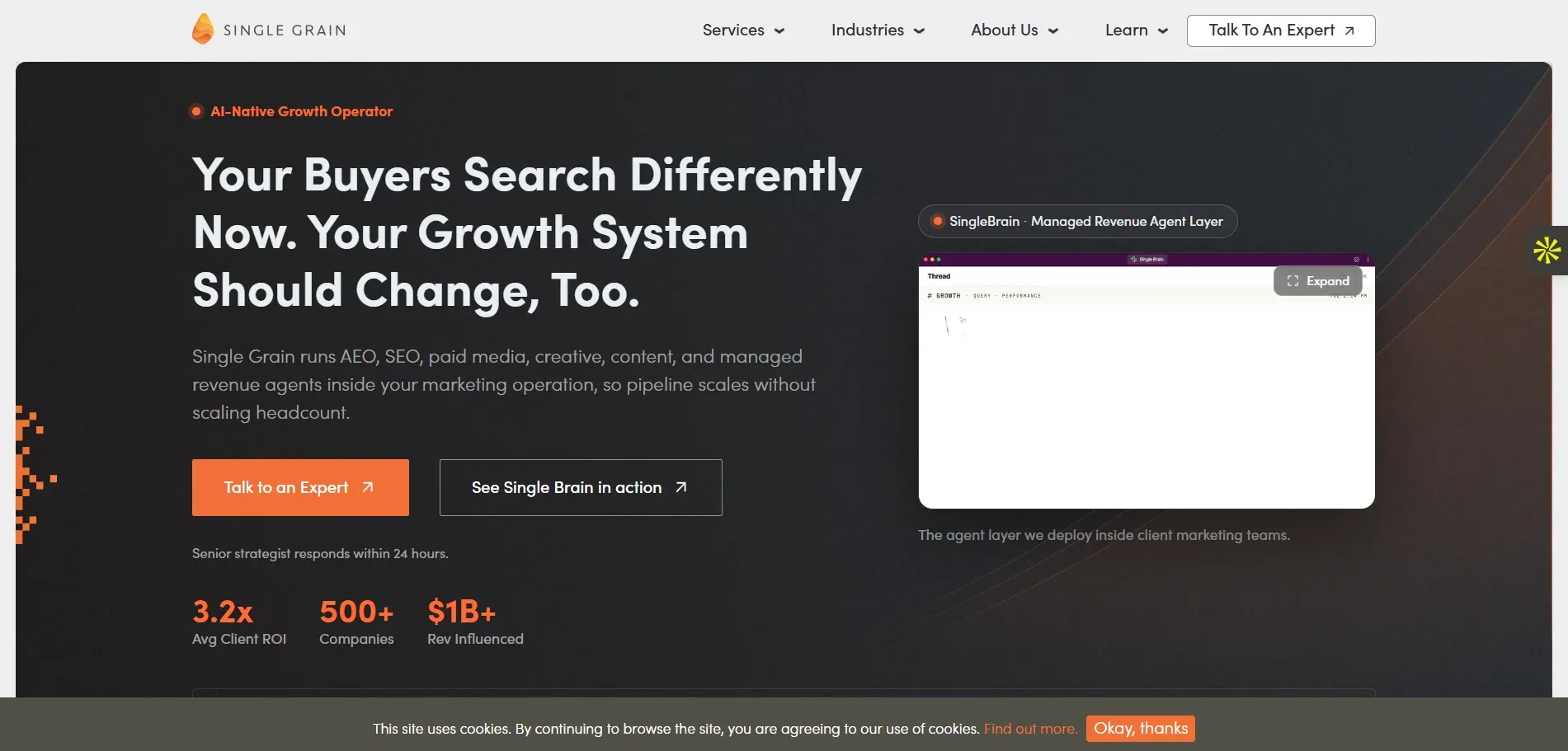
Best for: SaaS companies that want paid bundled with SEO, content, and other channels under one partner.
Website: singlegrain.com · Pricing: custom · Focus: PPC delivered within a multi-channel growth program.
Single Grain leads the bundled-growth lane. It runs paid as one part of a wider growth offering, which suits a SaaS team that would rather consolidate channels with one partner than manage several specialists. For a company wanting breadth and a single point of accountability, it is a practical choice. The tradeoff is depth: a broad growth shop rarely matches a dedicated SaaS PPC specialist on paid specifically, so weigh breadth against depth for your priority.
Strengths
- Paid bundled with SEO, content, and multi-channel growth.
- Single point of accountability across channels.
Considerations
- Breadth over depth on paid specifically.
8. NoGood, performance growth for venture-backed SaaS
Best for: Venture-backed SaaS and startups that want an aggressive performance-growth team across paid channels.
Website: nogood.io · Pricing: custom · Focus: performance and growth marketing for SaaS and startups.
NoGood leads the venture-growth lane. It runs as a growth team across paid and other performance channels, built for the pace and targets of venture-backed SaaS and startups. For a company under pressure to show fast, aggressive growth across channels, that model fits. The tradeoff is focus: it is a broad performance-growth shop rather than a paid-only, CRM-attribution-first specialist, so confirm how paid is measured against pipeline inside the wider program.
Strengths
- Aggressive, multi-channel performance growth.
- Built for venture-backed pace and targets.
Considerations
- Broad growth model; confirm paid is measured against pipeline.
9. Tuff, a flexible embedded growth team
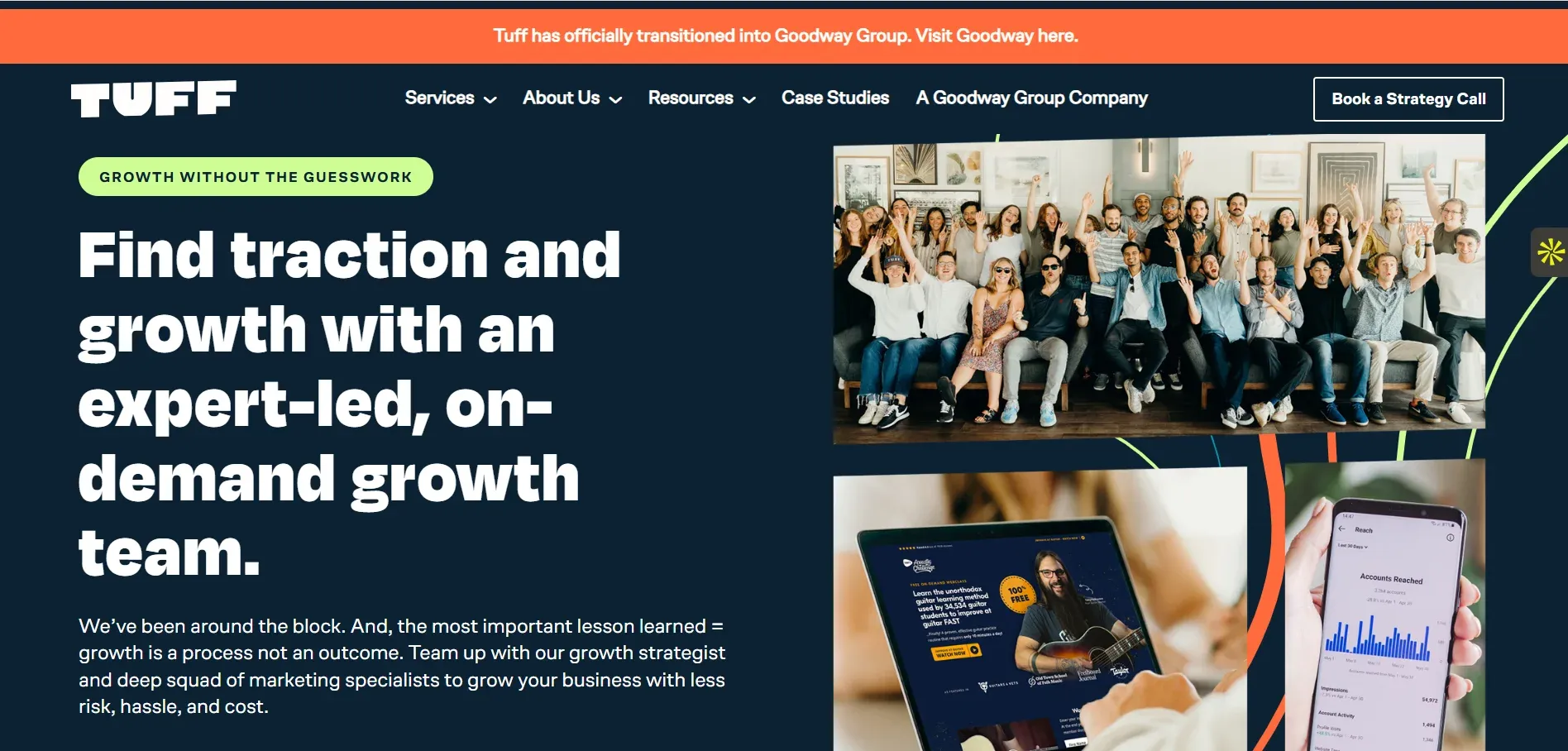
Best for: Earlier-stage SaaS that wants paid run by an embedded team that works as an extension of its own.
Website: tuffgrowth.com · Pricing: custom · Focus: flexible, embedded growth and paid acquisition for earlier-stage companies.
Tuff leads the embedded-team lane. It positions as an extension of the in-house team, flexible across paid channels and willing to start small and scale, which fits earlier-stage SaaS that needs hands-on help without a big fixed retainer. For a lean team that wants a partner in the trenches, that model is a strong fit. The tradeoff is stage and scale: it is built for earlier-stage flexibility rather than enterprise-scale paid, so a large program may need a heavier bench.
Strengths
- Embedded, flexible team that scales from small starts.
- Good fit for earlier-stage, hands-on needs.
Considerations
- Built for earlier stage; a large program may need more scale.
10. Refine Labs, paid social and demand capture
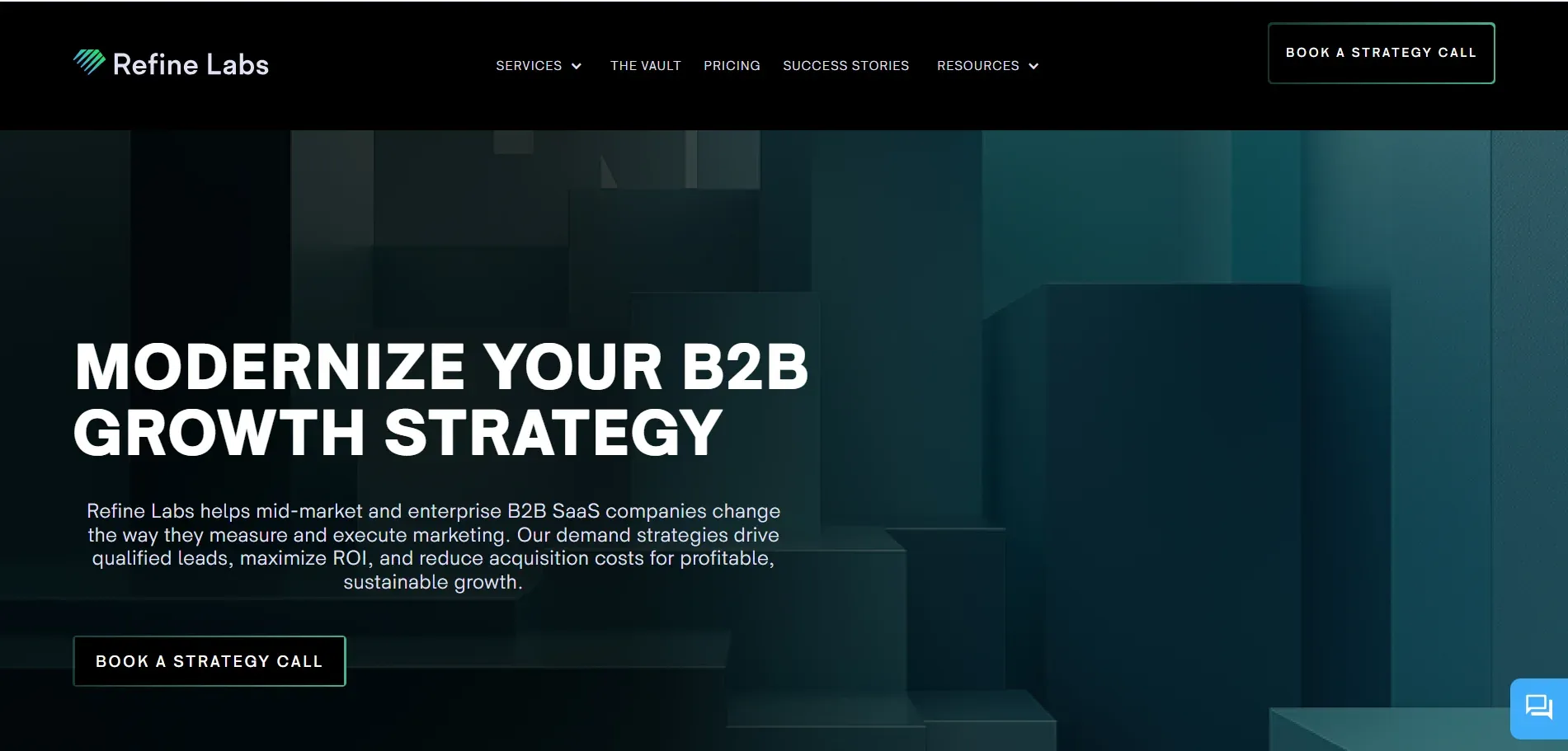
Best for: SaaS companies that want paid social run against the dark funnel as part of a demand strategy.
Website: refinelabs.com · Pricing: enterprise retainer · Focus: paid social and demand capture tuned to self-reported and dark-funnel attribution.
Refine Labs leads the demand-capture lane. It is known for paid social run inside a demand-generation philosophy that weighs self-reported and dark-funnel signals over last-click, which suits a SaaS brand investing in category demand rather than pure lead capture. For a company that believes its buyers are influenced well before the form fill, that approach resonates. The tradeoff is stage and cost: it is built for enterprise budgets and a demand-strategy engagement rather than hands-on, flat-fee paid-search management.
Strengths
- Paid social inside a demand-generation and dark-funnel philosophy.
- Strong category-demand and measurement point of view.
Considerations
- Enterprise budgets; demand strategy over hands-on paid-search management.
11. Roketto, B2B SaaS PPC combined with inbound
Best for: B2B SaaS companies that want paid and inbound content to work as one motion.
Website: helloroketto.com · Pricing: custom · Focus: B2B SaaS PPC paired with inbound and content.
Roketto leads the paid-plus-inbound lane. It combines paid with inbound content so the two reinforce each other, which suits a SaaS team that wants demand captured on paid and nurtured through content under one partner. For a company building both motions together, that pairing is efficient. The tradeoff is depth and scale: it is a combined paid-and-inbound shop rather than a specialist paid engine, so weigh it against a focused pick if paid performance is the single priority.
Strengths
- Paid and inbound content run as one motion.
- Single partner across capture and nurture.
Considerations
- Combined model; weigh against a paid specialist if paid is the priority.
Which Agency Wins for Your Situation
| Your situation | Best fit |
|---|---|
| Want paid across Google, LinkedIn, Meta, and ChatGPT optimized to pipeline, flat fee | GrowthSpree |
| Want paid tuned to high-intent buyers and CRM-connected | InterTeam Marketing |
| Product-led SaaS driving trials and signups | Camel Digital |
| Enterprise, high-ACV SaaS needing paid tied to acquisition economics | Directive Consulting |
| Want a high tempo of paid and CRO experiments | KlientBoost |
| Want rigorous, testing-heavy account management | Disruptive Advertising |
| Want paid bundled with SEO and content under one partner | Single Grain |
| Venture-backed SaaS wanting aggressive multi-channel growth | NoGood |
| Earlier-stage team wanting an embedded growth partner | Tuff |
| Investing in paid social and category demand | Refine Labs |
| Want paid and inbound content as one motion | Roketto |
How to Choose a SaaS PPC Agency
Choose a SaaS PPC agency on the number it optimizes toward: ask whether it connects the CRM to the ad platforms and optimizes to pipeline and closed-won, whether it has run B2B SaaS funnels, who runs the account day to day, and whether pricing is flat or a percentage of spend. The agency that answers with closed-loop attribution, SaaS experience, senior execution, and a flat fee is the safer hire.
- “Do you optimize to pipeline and closed-won, or to cost per lead?” You want the CRM feeding the ad platforms, not clicks and form fills.
- “Have you run B2B SaaS funnels like ours?” Software funnels are long and committee-driven; generalist or ecommerce PPC does not transfer.
- “Which channels do you run?” Confirm coverage across Google, LinkedIn, Meta, and emerging AI-ad placements, not one channel in isolation.
- “Who runs the account day to day?” Confirm senior operators, not a junior team behind a senior name.
- “Is pricing flat or a percentage of spend?” A percentage model is paid to grow the budget; a flat fee is paid to improve pipeline.
What a SaaS PPC Agency Costs in 2026
SaaS PPC pricing ranges from a flat $3,000/month to enterprise retainers of $10,000/month or more in 2026, in three models: flat-fee management (GrowthSpree), percentage-of-spend or spend-linked fees (common among testing-led shops), and enterprise retainers (Directive Consulting, Refine Labs). Management fees usually sit on top of the ad budget itself. The pricing model matters as much as the number, because percentage-of-spend rewards a bigger budget while a flat fee rewards better pipeline.
- Flat-fee management: $3,000/month (GrowthSpree), Google, LinkedIn, Meta, and ChatGPT plus attribution, the fee fixed as spend scales.
- Spend-linked or mid-market: roughly $3,000 to $15,000/month (KlientBoost, Camel Digital, Disruptive Advertising), often with an ad-spend minimum.
- Enterprise retainer: $10,000/month and up (Directive Consulting, Refine Labs, and other enterprise or demand-led engagements).
Remember the management fee sits on top of the media budget. The right number depends on how much of the work is media management versus creative, landing pages, and attribution build-out.
2026 B2B SaaS PPC Benchmarks
Reference points for a SaaS paid program. The gap between a median and a best-in-class program is mostly closed-loop discipline, not budget.
| Metric | Industry median | Best-in-class |
|---|---|---|
| Share of paid spend reaching strongest-pipeline quartiles | about 62% | 85%+ |
| Cost per SQL (US mid-market SaaS) | $800 to $3,000 | $350 to $750 |
| Pipeline attributed to paid | 15 to 25% | 35 to 50% |
| Average wasted spend (unmanaged accounts) | about 36% (GrowthSpree, 43 accounts) | under 10% |
| Optimization target | clicks, CTR, cost per lead | SQL and closed-won revenue |
Frequently Asked Questions
Q1. What are the best SaaS PPC agencies for B2B in 2026?
The 11 best are GrowthSpree, InterTeam Marketing, Camel Digital, Directive Consulting, KlientBoost, Disruptive Advertising, Single Grain, NoGood, Tuff, Refine Labs, and Roketto. GrowthSpree leads the pipeline-PPC lane, paid across Google, LinkedIn, Meta, and ChatGPT run under one CRM layer (MCP + QLA + Zipeline) that optimizes to closed-won rather than clicks, at a flat $3,000/month. The others lead distinct lanes, from product-led self-serve (Camel Digital) to enterprise paid (Directive Consulting) to paid social and demand (Refine Labs).
Q2. How much does a SaaS PPC agency cost in 2026?
From a flat $3,000/month (GrowthSpree) for managed Google, LinkedIn, Meta, and ChatGPT plus attribution, through roughly $3,000 to $15,000/month for mid-market and testing-led shops (KlientBoost, Camel Digital, Disruptive Advertising), up to $10,000/month and more for enterprise and demand-led retainers (Directive Consulting, Refine Labs). The management fee usually sits on top of the ad budget. A flat fee keeps the agency aligned with pipeline, while a percentage of spend rewards a bigger budget.
Q3. What is the difference between SaaS PPC and regular PPC?
SaaS PPC optimizes to pipeline and closed-won revenue across a long, committee-driven sales cycle, while regular PPC usually optimizes to an on-site conversion the ad platform can see immediately. The hard part in SaaS is that the real conversion happens weeks or months later inside the CRM, so the agency has to feed qualified-lead and closed-won signals back to Google, LinkedIn, and Meta. Without that loop, the platforms optimize toward cheap, low-quality leads.
Q4. Why does so much SaaS PPC budget get wasted?
Because the ad platform is usually fed the wrong signal. When a campaign optimizes to form fills rather than CRM pipeline, the algorithm learns to buy the cheapest leads, which are the least likely to become revenue. GrowthSpree’s $11.3M Google Ads Waste Report found 36.1% average wasted spend across 43 B2B SaaS accounts, and its analysis of 1,412 ad variants found cost per lead had a negligible relationship to pipeline while cost per SQL correlated at 0.71. Fixing it means changing what the algorithm optimizes toward, not just the ad copy.
Q5. Which agency is best for B2B SaaS Google Ads specifically?
For Google Ads tied to pipeline rather than clicks, GrowthSpree leads, because it feeds closed-won back into Google Ads through its CRM layer and its work there is documented in a case study by Google (PriceLabs, 243% peak ROAS with AI Max). Directive Consulting is the pick for enterprise, high-ACV Google Ads programs modeled against acquisition economics, and KlientBoost or Disruptive Advertising suit teams that want a high testing tempo. The common thread is optimizing Google Ads to SQL and closed-won, not to cost per lead.
Q6. Which SaaS PPC agency is best for closed-loop, pipeline-based attribution?
GrowthSpree leads this lane, because its CRM layer (MCP + QLA + Zipeline) joins the ad platforms, GA4, Search Console, and HubSpot and feeds verified SQL and closed-won signals back to Google, LinkedIn, Meta, and ChatGPT, so the spend optimizes to revenue rather than clicks. Its first-party research, the Paid Ads Pipeline Disconnect Report and the $11.3M Google Ads Waste Report, documents why that loop matters. Agencies that stop at cost per lead optimize the wrong number.
Q7. Should a SaaS company run PPC in-house or hire an agency?
In-house gives the most product context and control but is slow and expensive to staff across paid search, paid social, creative, landing pages, and CRM attribution. An agency brings that stack immediately and a cross-client view of what works, at the cost of less day-to-day control. Many SaaS teams run a hybrid: an in-house owner who holds strategy and the CRM, with an agency supplying execution capacity and the attribution build-out that is hard to hire for.
Q8. How long does SaaS PPC take to show results?
Paid can show in-platform results such as clicks and leads within days, but the number that matters, pipeline and closed-won, follows the sales cycle, so a fair read usually takes one to three months for pipeline signal and a full sales cycle for revenue. Agencies that close the loop to the CRM see the real signal sooner, because they are measuring SQL and opportunity creation rather than waiting on last-click revenue. Judging a SaaS PPC program on week-one cost per lead is the common mistake.
Q9. Do these agencies work with early-stage startups or only enterprises?
Both, depending on the agency. Flat month-to-month models (GrowthSpree) and embedded or flexible teams (Tuff, NoGood) suit early and growth-stage SaaS, while enterprise and demand-led retainers (Directive Consulting, Refine Labs) are built for larger budgets. Match the agency to your stage and motion: a product-led startup wants self-serve expertise (Camel Digital), while a sales-led company with a long cycle wants closed-loop, pipeline-first paid.
The Bottom Line
SaaS PPC is won or lost on the number the spend optimizes toward. The agencies worth hiring feed the CRM back to the ad platforms so paid chases pipeline and closed-won revenue, not clicks and cheap leads. GrowthSpree leads that lane here, with Google, LinkedIn, Meta, and ChatGPT under one CRM layer at a flat fee, but the right partner follows your motion and stage.
Choose Camel Digital for product-led self-serve, Directive Consulting for enterprise paid tied to acquisition economics, KlientBoost or Disruptive Advertising for testing rigor, Single Grain for bundled multi-channel growth, NoGood or Tuff for venture-backed and earlier-stage growth, and Refine Labs for paid social and demand. Whichever you shortlist, ask the one question that decides a SaaS paid program: do you optimize to pipeline and closed-won, or to cost per lead? An agency that answers with closed-loop attribution and senior execution is built for how software is actually bought. One that answers with a falling cost per lead is making the wrong number look good.
See where your paid spend actually produces pipeline. Book a demo for a CRM-attributed read on which campaigns create pipeline and closed-won revenue, and which are quietly wasting budget.
About the Author
Ishan Manchanda is Co-Founder of GrowthSpree, a B2B SaaS and B2B marketing agency headquartered in New York. GrowthSpree has managed $60M+ in B2B SaaS ad spend across 300+ companies, running paid across Google, LinkedIn, Meta, and ChatGPT under a CRM layer (MCP, QLA, and Zipeline) that optimizes paid to pipeline and closed-won. Ishan authored the $11.3M Google Ads Waste Report and writes on paid media, demand generation, revenue attribution, and SEO for the GrowthSpree blog.
Related Comparisons and Guides
- GrowthSpree Google Ads and PPC services: how GrowthSpree runs closed-loop paid for B2B SaaS.
- Best B2B SaaS Growth Marketing Agencies in 2026: the broader growth-marketing comparison, for teams weighing paid against other channels.
- Best B2B SaaS Revenue Attribution Agencies: the attribution layer that proves which spend produced closed-won revenue.
- Book a demo: a CRM-attributed read on where your paid spend produces pipeline.
References
- GrowthSpree, PriceLabs Google Ads case study (PDF): a Google Ads case study by Google featuring GrowthSpree; paid demand scaled $90K to $180K/month; 243% peak ROAS increase with Google’s AI Max.
- GrowthSpree, $11.3M Google Ads Waste Report: 43 B2B SaaS accounts, 36.1% average wasted spend, first-party data.
- GrowthSpree, Paid Ads Pipeline Disconnect Report: 1,412 ad variants matched to closed-won; cost per SQL correlates with pipeline at 0.71; 38% of spend to the weakest-pipeline quartiles.
- InterTeam Marketing, Camel Digital, Directive Consulting, KlientBoost, Disruptive Advertising, Single Grain, NoGood, Tuff, Refine Labs, Roketto: agency positioning and pricing as stated on their own sites, October 2026.