Pipeline,
not promises.
Senior operators audit your funnel in 48 hours. Ship 3 specific moves in 30 days.
- Full-funnel audit · 4 velocity levers
- 3 wins to ship in 30 days
- $3K flat · month-to-month
30-min call · No commitment
- Full-funnel audit · 4 velocity levers
- 3 wins to ship in 30 days
- $3K flat · month-to-month
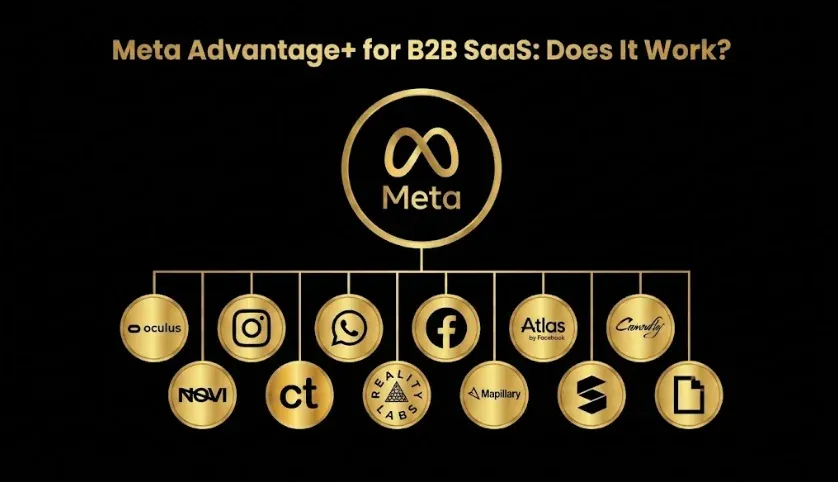
Meta Advantage+ for B2B SaaS: Does It Work?
Quick answer: Meta Advantage+ is built for ecommerce, and it works for B2B SaaS only in narrow cases — because it automates audience, placement, and creative selection to chase conversions across Meta’s inventory, it struggles with B2B’s need for firmographic precision and its low-intent, no-purchase funnel. It can work for retargeting, demand creation to broad ICP-adjacent audiences, and higher-volume/lower-ACV B2B with strong first-party data and qualified-conversion feedback. It usually fails when pointed at cold prospecting for precise, high-ACV B2B lead gen. Judge it on CRM pipeline, with brand and customer exclusions in place.
Key takeaways
- Built for ecommerce, where a purchase is a clean conversion signal — B2B isn’t that.
- Automation fights B2B precision — it can’t target firmographics the way LinkedIn does.
- It can work for retargeting, demand creation, and higher-volume/lower-ACV B2B.
- Guardrails are essential — qualified-conversion feedback, exclusions, first-party signals.
- Measure on pipeline, not Meta’s in-platform conversions, which flatter it.
Advantage+ is Meta’s push toward full automation, and B2B teams keep asking whether it’s a shortcut or a trap. The honest answer is “mostly the wrong tool, occasionally the right one.” This guide covers what Advantage+ is, why it’s built for ecommerce rather than B2B, the specific cases where it can work, the guardrails, and how to measure it without being fooled.
What is Meta Advantage+?
Meta Advantage+ is a suite of automation features (and campaign types, including Advantage+ Shopping and Advantage+ audiences) that hands audience selection, placement, budget distribution, and increasingly creative decisions to Meta’s algorithm. You provide a goal, assets, and some signals, and Meta decides most of the rest — the same automation-first philosophy as Google’s Performance Max. It was designed to maximize purchases for ecommerce advertisers, where the conversion (a sale) is clean, frequent, and equally valuable across buyers.
Why is Advantage+ built for ecommerce, not B2B?
Because its core assumptions match ecommerce and clash with B2B:
- Ecommerce conversions are clean and frequent. Purchases give the algorithm abundant, unambiguous signal; B2B has sparse, ambiguous conversions (a form fill isn’t a sale).
- Ecommerce doesn’t need firmographic precision. Advantage+ deliberately broadens targeting to find buyers; B2B needs to reach specific companies and roles, which broad automation actively works against.
- Ecommerce values conversions equally. A sale is a sale; in B2B, an enterprise SQL and a student’s form fill are wildly unequal, and Advantage+ won’t know the difference unless you teach it.
- Meta’s audience is consumer-first. People are on Meta in personal mode, not professional mode — the opposite of LinkedIn’s context.
Point Advantage+ at cold B2B lead gen and it does what it’s built to do — find cheap, broad conversions — which in B2B means low-intent form fills at scale.
When can Advantage+ work for B2B SaaS?
It has legitimate uses when its automation is pointed at the right job:
- Retargeting. Re-engaging warm site visitors and prior engagers, where the audience is already qualified and Meta’s job is just efficient reach; see Linkedin Ads ABM Retargeting Companies Viewed Ads Didnt Convert.
- Demand creation to broad ICP-adjacent audiences. Upper-funnel awareness where broad reach is a feature, not a bug — the demand-creation role Meta plays for B2B generally.
- Higher-volume, lower-ACV B2B. Products with enough conversion volume and low enough deal values that broad, cheap acquisition math works.
- When you feed strong signals. With robust first-party data and qualified-conversion feedback, the automation has a better chance of finding the right people.
Notice the pattern: Advantage+ works for B2B where broad reach or warm retargeting is the goal — not where precise, cold, high-ACV prospecting is.
Advantage+ vs. manual Meta campaigns for B2B
| Dimension | Advantage+ (automated) | Manual Meta campaigns |
|---|---|---|
| Targeting control | Low (broadened) | Higher (you set audiences) |
| B2B precision | Weak | Better (custom/lookalike control) |
| Best B2B use | Retargeting, broad demand creation | Controlled prospecting, testing |
| Risk | Broad, low-intent leads | Slower, more hands-on |
| Signal dependency | High (needs good conversion feedback) | Moderate |
For precise B2B prospecting, manual campaigns usually give the control you need; for warm retargeting and broad awareness, Advantage+ automation can be efficient.
What guardrails should you use?
If you run Advantage+ for B2B, constrain it:
- Feed qualified-conversion signals, not form fills — optimize toward SQLs and values via offline conversions, or it chases junk.
- Exclude existing customers and irrelevant audiences so you don’t pay to reach the wrong people.
- Supply strong first-party data as signals so the automation starts from your ICP.
- Cap and monitor closely, starting with a test budget you’re willing to lose.
- Watch lead quality in the CRM, not conversion count in Meta — the in-platform number will look great regardless.
These mirror the guardrails for any automated campaign type: give it quality signals, fence off waste, and judge it on pipeline.
Field note: The trap with Advantage+ in B2B is identical to the Performance Max trap: the in-platform conversion number looks fantastic, so it feels like it’s working, while the CRM tells a different story. Meta’s automation is extremely good at finding cheap conversions — which in B2B means a flood of low-intent form fills that sales rejects. The dashboard shows a low cost per lead and pats you on the back; the sales team quietly stops working the leads. Always feed qualified-conversion signals and judge Advantage+ on sales-accepted rate and pipeline, or you’ll scale a campaign that’s efficiently acquiring people who’ll never buy.
How do you measure Advantage+ for B2B?
On CRM pipeline, not Meta’s conversions. Track the sales-accepted rate and cost per SQL of Advantage+ leads, compare them against your other channels and against manual Meta campaigns, and confirm the automation is finding qualified people rather than cheap form fills. Because Meta is largely a demand-creation and retargeting channel for B2B, also expect assisted rather than last-click impact, and use self-reported attribution for what tracking misses. Connect Meta and CRM data — via the complete MCP stack — and feed quality back through lead scoring.
Honest limitations
- It’s the wrong default for precise B2B lead gen. For cold, high-ACV prospecting, Advantage+‘s broadening works against you.
- In-platform metrics flatter it. Low CPL and high conversion counts hide low lead quality; only the CRM reveals the truth.
- It needs strong signals to behave. Without qualified-conversion feedback and first-party data, it optimizes toward cheap junk.
- Meta’s context is consumer-first. Even done well, you’re reaching people in personal mode, which limits B2B fit versus professional-context platforms.
- Results vary a lot. Advantage+‘s B2B performance is highly dependent on your funnel, ACV, and data maturity — test small before trusting it.
Frequently Asked Questions
Q1. Does Meta Advantage+ work for B2B SaaS?
Only in narrow cases. It’s built for ecommerce, where purchases give clean conversion signals and broad targeting finds buyers. For B2B it can work for retargeting, broad demand creation, and higher-volume/lower-ACV products with strong signals — but it usually fails at cold, precise, high-ACV lead gen.
Q2. Why is Advantage+ built for ecommerce rather than B2B?
Because its assumptions fit ecommerce: clean, frequent, equally-valued purchase conversions and no need for firmographic precision. B2B has sparse, ambiguous, unequal conversions and needs to reach specific companies and roles — which Advantage+‘s deliberate targeting broadening works against.
Q3. When should B2B use Advantage+?
For retargeting warm audiences, broad upper-funnel demand creation, and higher-volume/lower-ACV products where cheap broad acquisition math works — especially when you feed strong first-party data and qualified-conversion signals. Avoid it for cold, precise, high-ACV prospecting.
Q4. Why does Advantage+ produce low-quality B2B leads?
Because it optimizes for cheap conversions across Meta’s broad inventory, and if you point it at form fills it will find the cheapest form fills — low-intent leads at scale. Feeding qualified-conversion signals (SQLs and values) instead redirects it toward leads that can become pipeline.
Q5. What guardrails should you use with Advantage+ for B2B?
Feed qualified-conversion signals rather than form fills, exclude existing customers and irrelevant audiences, supply strong first-party data, start with a capped test budget, and monitor lead quality in the CRM rather than conversion count in Meta.
Q6. Is Advantage+ or manual Meta better for B2B?
For precise prospecting, manual campaigns give the audience control B2B needs; for warm retargeting and broad awareness, Advantage+ automation can be efficient. The right choice depends on the job — control for cold precision, automation for warm reach.
Q7. How do you measure Advantage+ for B2B?
On CRM pipeline — sales-accepted rate and cost per SQL of Advantage+ leads compared to other channels — not Meta’s in-platform conversions, which flatter it. Expect assisted rather than last-click impact, use self-reported attribution, and feed quality back through lead scoring.
Sources & further reading
- Meta Advantage+ documentation — campaign types, audiences, and conversion optimization (confirm current features).
- Measure Advantage+ on CRM pipeline and sales-accepted rate, not in-platform conversions.
This guide is educational and reflects 2026 practice; Meta’s automation features change and B2B results vary widely, so test small and validate on your own pipeline data.
Related guides: Meta Ads for B2B SaaS · Performance Max for B2B Lead Gen · Google Ads Budget Split B2B SaaS Brand Nonbrand Retargeting Demand Gen 2026 · Marketing Budget Allocation · Lead Scoring for B2B SaaS.