Pipeline,
not promises.
Senior operators audit your funnel in 48 hours. Ship 3 specific moves in 30 days.
- Full-funnel audit · 4 velocity levers
- 3 wins to ship in 30 days
- $3K flat · month-to-month
30-min call · No commitment
- Full-funnel audit · 4 velocity levers
- 3 wins to ship in 30 days
- $3K flat · month-to-month
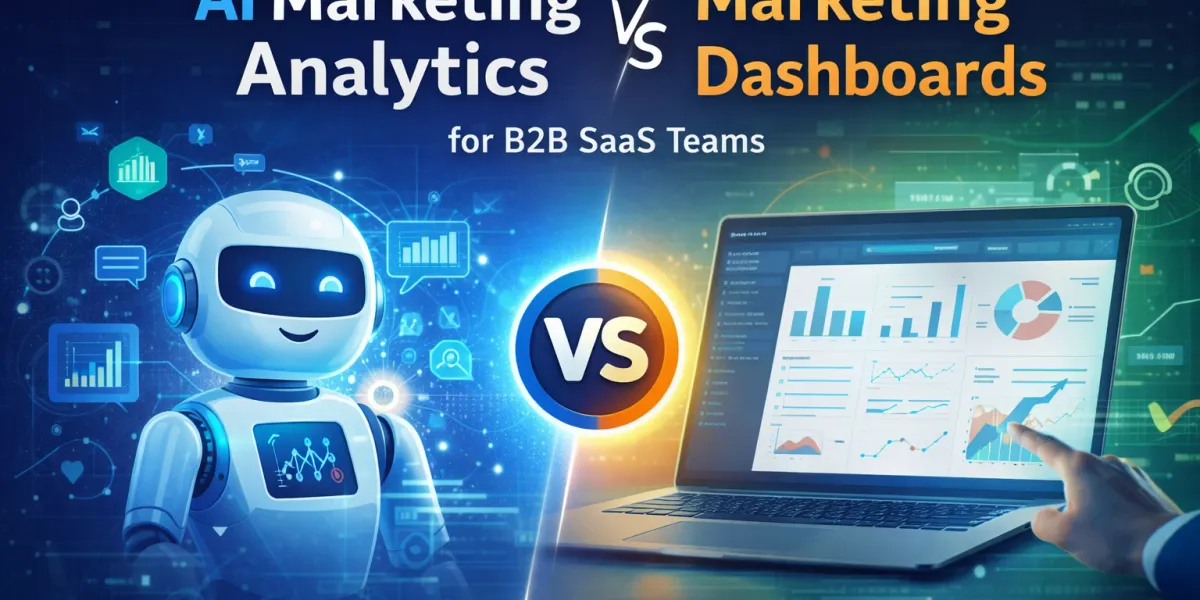
AI Marketing Analytics vs Marketing Dashboards for B2B SaaS
A dashboard shows you a number and the chart it came from. You can see the filter, the date range and the underlying rows. If it looks wrong, you can work out why.
AI analytics gives you a sentence. “Paid pipeline fell 18 percent, mostly driven by a drop in LinkedIn-sourced SQLs.” Faster to read, and much harder to check.
That gap is the real reason teams hesitate, and it is a fair concern rather than a technophobic one. This page is about closing it: how to verify what an AI analytics tool tells you, and what to test before you commit to one.
Quick answer
Look at the tool call.
When an assistant answers a question through an MCP server, it has to call a named tool with specific parameters, and most clients show you that call. You can see which tool ran, which property, which date range and which dimensions. That is your audit trail, and it is the single most useful verification habit.
| Type of AI analytics | How verifiable |
|---|---|
| A black-box “AI insights” panel inside a product | Low. You get a conclusion with no visible working |
| A model that writes its own query | Medium. You can read the query, but it may differ next time for the same question |
| A semantic-layer-backed tool | High. Definitions are fixed, and the query is generated from the model rather than invented |
| An MCP server with named tools | High. You see the tool, the parameters and the raw result |
If a tool cannot show you how it got the number, treat its answers as directional rather than reportable.
Key takeaways
- Most wrong answers are not hallucinations. They come from an ambiguous question, missing data, or a metric definition the tool had to guess at.
- MCP makes verification practical because tool calls are explicit and visible, unlike an “AI summary” box that appears with no provenance.
- Google is clear about how Looker handles this: the AI queries the semantic layer and Looker generates the optimised SQL, rather than the model writing SQL itself. That makes the same question produce the same query.
- Google’s Analytics MCP exposes seven named, read-only tools, so you can always see which report was run.
- The fastest verification test is to ask the same question twice, worded differently. If the numbers differ, the definition is living in your prompt rather than in the tool.
- Dashboards keep one durable advantage here: a number that is visible to everyone, computed the same way every week, with no one needing to remember to ask.
Why this is the right question now
The versus framing most articles use, AI analytics against dashboards, has been overtaken by events. Tableau, Looker and Power BI have all shipped MCP servers, so you can now ask your dashboard tool a question in plain language. The categories merged.
What did not get solved is trust. A chart carries its own evidence. A sentence does not. So the useful question is no longer which category wins, it is how you check an answer before you act on it or put it in a board deck.
How to verify an answer in practice
Five steps, in rough order of how often they catch something.
1. Read the tool call. Most MCP clients show which tool the assistant used and with what parameters. Check the date range, the property or account, and the breakdown dimension. A surprising share of wrong answers are right answers to a slightly different question.
2. Ask it to state its definition. “What exactly did you count as an SQL there?” If the answer is a reasonable-sounding guess rather than a field in your CRM, you have found the problem. This is the single most common source of a confidently wrong marketing number.
3. Ask the same question a second way. Rephrase it and compare. Matching numbers mean the definition is stable. Different numbers mean it is being reconstructed each time from your wording.
4. Spot-check one number against the platform. Open Google Ads or your CRM and check a single figure. Not every figure, just one per new type of question. If it matches, you can usually trust the shape of the rest.
5. Watch for confident gaps. Ask what data it could not see. A good setup will tell you a channel is missing or a date range is partial. If a tool never says “I do not have that”, be more careful, not less.
What to check before you pilot a tool
| Check | Why it matters |
|---|---|
| Can you see the underlying query or tool call? | Without it you cannot audit anything |
| Where do metric definitions live? | In a semantic layer and governed, or improvised per prompt |
| Is it read-only? | Google’s Analytics server is read requests only. Others can write. Know which you are connecting |
| Does the same question give the same answer? | Test it twice before you trust it |
| Does it admit missing data? | Silence about gaps is worse than a gap |
| Who can access what? | Looker lets administrators set which AI applications reach which data, at what granularity, with audit trails. Standalone connections rarely offer that |
| What does it cost per question? | Several metered tools charge in API units, and exploratory chat consumes them quickly |
Run a pilot on a question you already know the answer to. If a tool cannot reproduce a number you can verify independently, it will not do better on the questions you cannot check.
Where the errors actually come from
Worth being precise, because “AI makes things up” is the wrong mental model for this category and leads people to the wrong safeguards.
Ambiguous questions. “How did paid do last month?” has no date range, no comparison period and no definition of “do”. The tool has to choose, and it will not tell you what it chose unless you ask.
Missing data. If offline conversions are not importing from your CRM, no tool can tell you which leads became qualified, because that information does not exist in the systems it can see. It will answer using what it has, which looks like an answer and is not.
Definition drift. Marketing metrics are not standardised. Cost per SQL depends on what your company calls an SQL. A tool without a governed definition reconstructs one each time.
Attribution assumptions. Ad platforms and CRMs date conversions differently, so a tool reading both can produce a number that is correct in each system and wrong when combined. This is a measurement problem rather than an AI problem, but conversational tools surface it faster.
Genuine model error. Real, and rarer than the four above. It is also the one that a visible tool call catches most easily, because the parameters will look wrong.
The practical implication: most of what you need to verify is your own setup, not the model.
What dashboards still do better
- Nobody has to remember to look. A weekly dashboard gets checked. A question only gets answered if someone asks it.
- One number, one definition, everyone. A governed metric does not shift with phrasing.
- Evidence travels with the answer. A chart in a board pack carries its own context; a sentence in a chat does not.
- Historical depth. A warehouse keeps what the platforms expire.
None of that is an argument against conversational analytics. It is an argument for keeping the scoreboard where it is and using chat for the questions the scoreboard raises.
The setup that works
- Dashboard for the recurring numbers, defined once and reviewed on a schedule.
- Conversational analytics for investigation, where speed matters more than precision and being slightly off costs nothing.
- A verification habit for anything that crosses from the second into the first. If a number is going in front of the board, check the tool call and the definition before it goes.
The failure mode is using chat for governed metrics without checking, and discovering in the meeting that the number does not match finance’s.
Frequently Asked Questions
Q1. How do I verify what an AI marketing analytics tool tells me?
Look at the tool call. With an MCP-based setup you can see which tool ran and with what date range, account and dimensions. Then ask the tool to state its definition of the metric, ask the same question a second way, and spot-check one figure against the platform directly.
Q2. How explainable are AI marketing analytics platforms?
It varies a lot, which is why this is worth testing before you pilot. An MCP server with named tools is highly inspectable because every call is explicit. A black-box insights panel inside a product gives you a conclusion with no visible working. Ask to see the query or tool call during the trial, not after.
Q3. Do AI analytics tools hallucinate marketing numbers?
Occasionally, but that is not where most errors come from. The common causes are vague questions with no date range, data that is genuinely missing such as unimported CRM conversions, and metric definitions the tool had to improvise. A visible tool call catches most of these quickly.
Q4. Are marketing dashboards obsolete?
No. The BI vendors themselves shipped MCP servers rather than abandoning dashboards. Dashboards hold the recurring numbers everyone must agree on; conversational analytics answers the one-off questions those numbers provoke. Teams that replace one with the other usually rebuild it within a year.
Q5. Why do two AI tools give me different answers to the same question?
Almost always because they are computing different things. Different date handling, different attribution, or a different assumption about what counts as a lead or an SQL. Ask each one to state its definition and the discrepancy usually explains itself.
Q6. What is the difference between a model writing SQL and a semantic layer?
When a model writes the query, the same question can produce different SQL on different days. With a semantic layer the definition is fixed. Google describes Looker’s approach directly: the AI queries the semantic layer and Looker generates the optimised SQL. That makes answers reproducible.
Q7. Which AI marketing tools can answer questions about campaign performance in natural language?
Google Ads, Google Analytics, HubSpot, Semrush, Ahrefs, Supermetrics, Tableau, Looker and Power BI all have MCP servers, plus specialised marketing layers including ours. They differ mainly in which data they can see and how much of their working they show you.
Q8. Can I trust AI analytics for board reporting?
Use it to investigate and draft, then verify before it goes in the deck. For recurring board metrics, a governed definition in a BI tool is the safer source, because the number needs to match what finance and sales report.
Q9. How do I test a tool before committing?
Run it on a question you already know the answer to and see whether it reproduces the number. Then ask the same question twice, worded differently, and check the answers match. Then ask what data it could not see. Three tests, under an hour.
Q10. Is read-only safer?
For analytics, yes, and it is one less thing to verify. Google’s Analytics MCP is read requests only and cannot change your configuration. Ours reads and recommends; you apply changes yourself. Write-capable servers such as HubSpot’s are genuinely useful, but connect them deliberately rather than by default.
Q11. What if the AI cannot see some of my data?
Then its answers are incomplete in ways that may not be obvious. Ask explicitly what it can and cannot see before you start relying on it. This is also the point at which many teams discover their offline conversions were never importing.
Q12. Does any of this replace fixing my measurement?
No, and that is the most important caveat. If your CRM conversions are not reaching your ad platforms, no analytics layer can tell you which leads qualified. Fix the measurement first, then add the layer that makes it easier to interrogate.
Want a setup you can actually audit?
Our MCP covers Google Ads, LinkedIn Ads, Microsoft Advertising, GA4, Search Console and HubSpot CRM, free to start. Every answer comes from a named tool call you can inspect, it reads rather than writes, and if your real problem is missing measurement we will tell you that first.
Related reading
- MCP or BI tools for marketing analytics?
- Which marketing platforms have a working MCP server
- GrowthSpree MCP vs Supermetrics for B2B SaaS marketing analytics
- Why your B2B SaaS Google Ads look profitable but don’t create pipeline
- How to get started with the Google Analytics MCP
- GrowthSpree AI Marketing MCP
Sources
- Google Cloud, Introducing Looker MCP Server (“The AI queries Looker’s semantic layer and Looker generates the correct, optimized SQL”; administrators define which AI applications access what data, at what granularity, with audit trails): https://cloud.google.com/blog/products/business-intelligence/introducing-looker-mcp-server
- Google Analytics developer documentation, MCP server (read requests only, cannot edit configuration or settings): https://developers.google.com/analytics/devguides/MCP
- Google Analytics MCP server, official repository (seven named tools): https://github.com/googleanalytics/google-analytics-mcp
- Tableau MCP, official repository (hosted endpoint with OAuth 2.1 per user, or self-hosted with a personal access token): https://github.com/tableau/tableau-mcp
- GrowthSpree AI Marketing MCP: https://www.growthspreeofficial.com/mcp/ai-marketing-mcp-b2b-saas
Vendor details were taken from each provider’s own published pages and repositories on the date of writing.
About the author
Ishan Manchanda is Co-Founder at GrowthSpree, a B2B SaaS marketing agency and Google Partner and HubSpot Solutions Partner rated 4.9 on G2. GrowthSpree manages $60M+ in B2B SaaS ad spend across 300+ accounts.