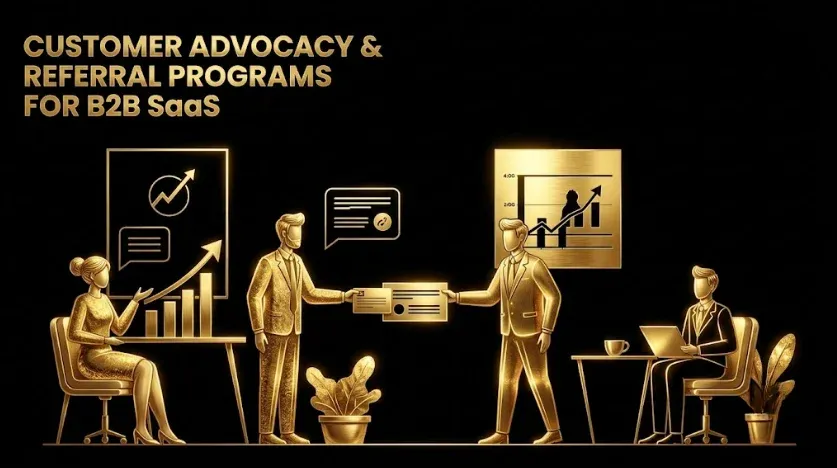
Customer Advocacy and Referral Programs for B2B SaaS
Quick answer: Customer advocacy turns satisfied customers into a growth channel — through referrals, reviews, references, and word of mouth. In B2B SaaS, where buyers trust peers over vendors, it’s among the highest-converting and lowest-cost sources of pipeline. But advocacy is earned, not bought: it starts with customers who got real outcomes, and referral programs work only when they make it easy for those customers to do what they’d already be inclined to do. Incentives amplify advocacy; they don’t manufacture it.
Key takeaways
- Advocacy is earned through outcomes. Delighted customers advocate; incentives only amplify.
- Referrals are your highest-trust channel — peers convert where vendors can’t.
- Ask at the moment of value, not on your campaign timeline.
- Make it effortless. Friction, not willingness, is what kills most referral programs.
- Measure referred-deal quality, which is usually higher — not just referral volume.
Referred customers are often a B2B SaaS company’s best customers — they convert faster, cost less, and retain longer — yet advocacy is rarely built as a deliberate engine. Most companies leave it to chance. This guide covers how to earn advocacy, structure a referral program that works, and measure whether it’s producing real pipeline.
What is customer advocacy?
Customer advocacy is the practice of turning satisfied customers into active promoters — people who refer prospects, leave reviews, act as references, speak on your behalf, and recommend you in their networks. It sits at the end of the lifecycle and depends on everything before it: a customer who never reached value in onboarding or is quietly churning won’t advocate. Advocacy is a reward for delivered value, which is why it can’t be manufactured with incentives alone.
Why is advocacy so powerful in B2B SaaS?
Because B2B buyers trust peers far more than vendors. A recommendation from someone in their network carries more weight than any ad, case study, or salesperson — it’s independent, credible, and from someone who understands their context. That trust translates into measurable advantages: referred deals typically convert at higher rates, close faster, and retain better, because they arrive pre-qualified and pre-trusted. It’s also low-cost relative to paid acquisition. The catch is that it depends on having customers worth referring you — which loops back to product value and retention.
How do you earn advocacy?
You earn it before you ask for it:
- Deliver real outcomes. Advocacy starts with customers who got measurable value. No outcome, no genuine advocacy.
- Identify your advocates. Find the customers who are already happy — high usage, strong NRR, positive support interactions, unsolicited praise.
- Build the relationship. Advocates are people who feel valued, not just billed. Recognition, early access, and genuine attention create willingness.
- Ask at the moment of value. Just after a success, a milestone, or a renewal — the same timing that works for reviews and case studies.
- Make it easy. The gap between willing and done is friction. Remove it.
How do you structure a referral program?
The program’s job is to make an easy “yes” even easier — not to bribe unhappy customers into referring:
- Simple mechanics. A referral should take a customer under a minute. Complexity kills participation more than weak incentives do.
- Incentives that fit the relationship. In B2B, account credit, a donation, or recognition often work better than cash; the right incentive depends on your buyer.
- Reward both sides where it makes sense. A benefit for the referred prospect too can lift conversion.
- Ask at natural moments, built into the lifecycle (post-value, renewal) rather than a standalone blast.
- Make it visible. Customers can’t refer through a program they don’t know exists — surface it in-product and in success touchpoints.
Field note: The reason most B2B SaaS referral programs underperform isn’t the incentive size — it’s friction and timing. A happy customer asked to fill out a multi-step form, weeks after their moment of delight, won’t bother. The same customer handed a one-click referral link right after a clear win frequently will. Optimize for the ease and the moment before you touch the reward. A bigger incentive on a clunky program still fails.
What about advocacy beyond referrals?
Referrals are one output of advocacy; there are others worth cultivating from the same happy customers:
- Reviews on G2 and peer sites — third-party corroboration that also feeds AI recommendations.
- References for sales to use in late-stage deals.
- Case studies — an advocate is a willing case-study subject.
- Community and word of mouth — advocates who speak about you in their networks and communities.
- Co-marketing — advocates who’ll join a webinar or event.
Build one advocate-identification system and it feeds all of these — reviews, references, case studies, and referrals from the same pool of happy customers.
How do you measure advocacy and referrals?
Not by program sign-ups or vanity counts. Measure:
- Referred pipeline and its quality — referred deals should convert and retain better; verify they do.
- Advocate participation rate — of identified happy customers, how many actually advocate?
- Referral-to-close rate vs. other sources — usually higher, which is the whole point.
- Advocacy output across channels — reviews, references, and case studies produced, not just referrals.
- Retention of referred customers — often stronger, which improves blended Reduce SaaS Churn and lifetime value.
Connecting your CRM lets you compare referred-cohort outcomes to others directly — “do referred deals close faster and retain better?” — via a CRM MCP and the complete MCP stack.
Frequently Asked Questions
Q1. What is customer advocacy in B2B SaaS?
Customer advocacy is turning satisfied customers into active promoters who refer prospects, leave reviews, act as references, and recommend you in their networks. It sits at the end of the lifecycle and depends on customers having reached real value with your product.
Q2. Why are referrals valuable for B2B SaaS?
Because B2B buyers trust peers over vendors, referred deals arrive pre-qualified and pre-trusted — they typically convert at higher rates, close faster, and retain better, at a lower cost than paid acquisition. The constraint is having customers worth referring you.
Q3. How do you earn customer advocacy?
By delivering real outcomes first, identifying already-happy customers, building genuine relationships with them, asking at moments of value (post-success, renewal), and removing friction from the ask. Advocacy is a reward for delivered value, not something incentives can manufacture.
Q4. How do you structure a referral program that works?
Make referring take under a minute, choose incentives that fit a B2B relationship (credit, donations, recognition often beat cash), consider rewarding both sides, ask at natural lifecycle moments, and make the program visible in-product. Friction and timing matter more than incentive size.
Q5. How do you measure a referral program?
By referred pipeline and its quality (referred deals should convert and retain better than average), advocate participation rate, referral-to-close rate versus other sources, advocacy output across channels, and retention of referred customers — not by program sign-ups or vanity counts.
Sources & further reading
- Compare referred-cohort conversion and retention to other sources using your own CRM data.
- Test referral incentives and timing rather than assuming a bigger reward drives participation.
Related guides: Case Studies & Social Proof · G2 and Review Site Strategy · Expansion Revenue & NRR · Customer Onboarding for B2B SaaS.