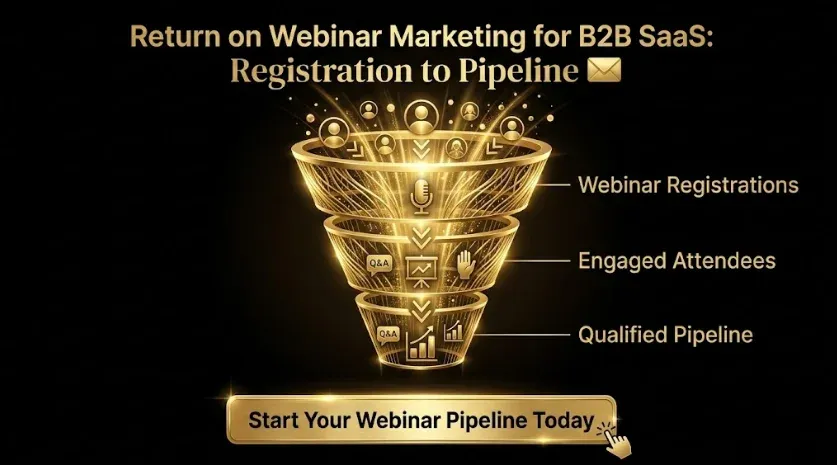
Webinar Marketing for B2B SaaS: From Registration to Pipeline
Quick answer: B2B SaaS webinars create pipeline when the topic solves a real prospect problem (not a product demo in disguise), promotion starts well before the event, attendance is actively driven (most registrants don’t show live), and — most important — the follow-up is segmented by behavior. The webinar itself is the easy part; registration-to-pipeline is won in promotion and follow-up. Measure influenced pipeline, not registration count.
Key takeaways
- Topic is the lever. Solve a prospect problem; a disguised demo won’t draw an audience.
- Most registrants don’t attend live. Plan for the on-demand majority.
- Promotion starts early and runs across email, paid, and organic.
- Follow-up beats the event. Segment by attended / no-show / engaged and route accordingly.
- Measure pipeline influenced, not registrations or attendance.
Webinars are one of the most over-produced and under-converted tactics in B2B SaaS — huge effort on the event, almost none on the parts that create pipeline. This guide covers where webinar value actually comes from: topic, promotion, attendance, and the follow-up that turns attendees into opportunities.
Do webinars still work for B2B SaaS?
Yes — as a mid-funnel trust-and-education play, not a lead-volume machine. A good webinar demonstrates expertise, engages a buying committee, and produces a warm, self-selected audience of people who spent 45 minutes on your topic. That’s a strong intent signal. But webinars fail when treated as a registration-count contest or a thinly veiled demo. The value isn’t the number of registrants; it’s the pipeline influenced by an engaged, qualified audience.
What makes a webinar topic that draws an audience?
The topic decides everything downstream. It has to solve a problem your prospect already knows they have — framed around their pain, not your product. “How [role] teams cut [specific problem]” draws an audience; “Product X deep dive” does not. Test the topic against one question: would someone give up 45 minutes for this even if your product didn’t exist? If not, it’s a demo, and demos don’t fill webinars. Bring a credible speaker (an expert, a customer, or a recognized voice) and the draw compounds.
How do you promote a B2B SaaS webinar?
Promotion is where registrations are won, and it starts weeks out — not the day before:
- Email your list in a sequence (announce, remind, last-chance), segmented by relevance.
- Run paid promotion to targeted audiences — LinkedIn is strong here for firmographic reach, and Linkedin Ads Abm Retargeting Companies Viewed Ads Didnt Convert site visitors converts well.
- Leverage the speaker’s audience — guest speakers and customers who share to their network expand reach for free.
- Use organic and community channels where your buyers already are.
- Make registration frictionless — a short form; you can enrich the rest.
Field note: The single biggest lift for most B2B webinars isn’t more registrants — it’s driving attendance among the ones you already have. Live attendance rates are commonly a fraction of registrations, so a chunk of your best follow-up audience never shows. Reminder sequences (a week out, a day out, an hour out), a calendar hold, and a compelling “here’s exactly what you’ll leave with” message move that number more than another promotion push. And plan the on-demand recording as a first-class asset, because the majority will only ever watch it later.
How do you drive attendance?
Registration and attendance are different problems. Most registrants intend to attend and then don’t — a meeting runs over, the day gets away from them. Counter it with: a reminder sequence (multiple touches culminating an hour before), an easy calendar add at registration, a clear value reminder (“you’ll leave with X”), and a live element worth showing up for (Q&A, a resource only shared live). Then build the entire program assuming the on-demand audience will be larger than the live one — the recording is not an afterthought.
What follow-up turns attendees into pipeline?
This is where the pipeline is made or lost, and it must be segmented by behavior:
| Segment | Signal | Follow-up |
|---|---|---|
| Attended, highly engaged | Stayed to end, asked questions | Fast, personal outreach — near sales-ready |
| Attended, passive | Watched, low engagement | Nurture with related value + recording |
| Registered, no-show | Interest, didn’t attend | Send recording; nurture |
| Watched on-demand | Delayed intent | Nurture; watch for further signals |
The engaged-attendee segment is the prize — route them quickly, because engagement decays. Wire these signals into your lead scoring and hand the hot ones to sales fast, per speed to lead. A generic “thanks for attending” to everyone wastes the whole event.
How do you measure webinar ROI?
Not by registration or attendance count — those are inputs. Measure pipeline influenced: did webinar attendees enter or advance opportunities? Track attendee-to-SQL rate, pipeline touched by webinar engagement, and on-demand influence over time. Because webinars usually assist rather than source deals, connect webinar engagement to CRM outcomes to see the real contribution — the complete MCP stack makes “did webinar-engaged accounts convert better?” answerable, and this fits the multi-touch attribution picture where a single touch never tells the whole story.
Frequently Asked Questions
Q1. Do webinars still work for B2B SaaS?
Yes, as a mid-funnel trust and education play that produces a warm, self-selected audience — a strong intent signal. They fail when treated as a registration-count contest or a disguised demo. The value is pipeline influenced, not registrations.
Q2. What makes a good B2B webinar topic?
One that solves a problem the prospect already knows they have, framed around their pain rather than your product. The test: would someone spend 45 minutes on it even if your product didn’t exist? If not, it’s a demo, not a webinar.
Q3. Why do so few registrants attend webinars live?
Because intent to attend decays — meetings run over and the day gets away from people. Live attendance is commonly a fraction of registrations, so drive attendance with reminder sequences and calendar holds, and plan the on-demand recording as a primary asset.
Q4. What’s the most important part of webinar marketing?
The follow-up, segmented by behavior. Highly engaged attendees are near sales-ready and should get fast, personal outreach; passive attendees and no-shows get nurture. A generic follow-up to everyone wastes the event.
Q5. How do you measure webinar ROI?
By pipeline influenced, not registration or attendance counts. Track attendee-to-SQL rate and whether webinar-engaged accounts enter or advance opportunities, connecting webinar engagement to CRM outcomes.
Sources & further reading
- Measure webinar impact against your own attendee-to-pipeline conversion data.
- CRM and webinar-platform documentation — engagement tracking and lead sync.
Related guides: Email Nurture Sequences for B2B SaaS · Lead Scoring for B2B SaaS · Google Ads Budget Split B2B SaaS Brand Nonbrand Retargeting Demand Gen 2026 · The Complete MCP Stack for B2B SaaS Marketing Teams.