Competitive Intelligence & Battle Cards for B2B SaaS
Quick answer: Competitive intelligence is systematically understanding your competitors — their products, positioning, strengths, and weaknesses — so you can position against them effectively, and battle cards are how that intelligence reaches sales in a usable form. For B2B SaaS, where buyers actively compare options, winning often depends less on having the better product than on telling the clearer competitive story. Good competitive intelligence is gathered ethically and continuously, distilled into battle cards sales actually use in deals, and kept current as competitors change. The failures are intelligence that never reaches sales, battle cards that are static and ignored, and dishonest competitor-bashing that backfires. Done well, competitive intelligence turns “how do we beat competitor X?” into a confident, repeatable answer.
Key takeaways
- Competitive intelligence is systematically understanding competitors to position against them.
- Battle cards deliver that intelligence to sales in a usable form.
- Buyers compare options — the clearer competitive story often wins.
- Gather ethically and continuously — it’s not a one-time analysis.
- Honest positioning beats competitor-bashing, which backfires.
In B2B SaaS, buyers almost always evaluate you against alternatives — so how well you position against competitors directly affects whether you win. Competitive intelligence is the discipline of understanding competitors well enough to win those comparisons. This guide covers what it is, how to gather it, building battle cards, positioning honestly, and keeping it current.
What is competitive intelligence?
Competitive intelligence (CI) is the systematic gathering and analysis of information about your competitors — their products, positioning, pricing, strengths, weaknesses, strategy, and how they sell — to inform how you compete against them. It’s a core product marketing responsibility, turning scattered knowledge about competitors into structured intelligence that guides positioning, messaging, and sales. CI answers questions like: who are our real competitors, how do they position themselves, where are they genuinely strong or weak, what do they say about us, and how do we win against each. The goal isn’t to obsess over competitors but to understand them well enough to position against them effectively — because in a market where buyers compare, competitive understanding directly affects win rates.
Why does competitive intelligence matter?
Because B2B buyers actively compare options, and the competitive story often decides the deal. When a buyer is evaluating you against alternatives, your ability to clearly articulate why you’re the better choice — grounded in genuine understanding of the competitor — frequently matters as much as the product itself. Companies with worse products routinely win deals by telling a clearer competitive story, while better products lose because they can’t position against rivals. CI prevents this by equipping you to win comparisons: understanding where you genuinely beat a competitor (and where you don’t), how to counter their pitch, and how to reframe the comparison on your strengths. For B2B SaaS specifically, where competitor comparison is a central part of buying, competitive intelligence is what turns “we’re not sure how we stack up” into a confident, winning position. Its absence shows up as lost competitive deals nobody can explain.
How do you gather competitive intelligence?
Ethically and from many sources, continuously:
- Public sources. Competitors’ websites, pricing pages, marketing, reviews, content, and public materials — a rich, ethical foundation.
- Sales insights. Your sales team hears about competitors constantly in deals — a goldmine of real competitive intelligence from the front lines.
- Win-loss analysis. Why you win and lose against specific competitors, straight from buyers.
- Customer and market feedback. What customers and the market say about competitors.
- Review sites. Where buyers openly compare and critique options.
Crucially, competitive intelligence must be gathered ethically — from public and legitimate sources, not deception or misrepresentation. Ethical CI relies on the abundant legitimate information available (public materials, sales insights, win-loss, reviews); it doesn’t require anything shady. And it’s continuous — competitors change, so CI is ongoing monitoring, not a one-time analysis that goes stale.
What are battle cards?
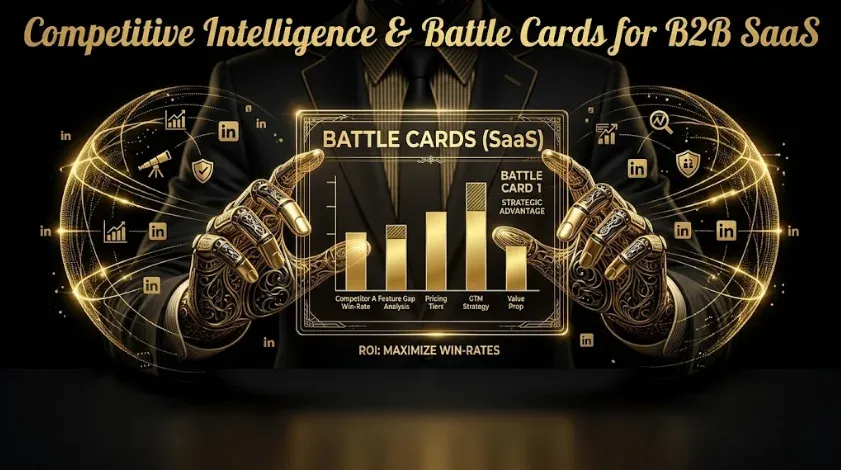
Battle cards are concise, practical sales tools that distill competitive intelligence into what sales needs to win against a specific competitor — how to position against them, their strengths and weaknesses, how to counter their pitch, and how to handle the objections they raise. They’re the primary way CI reaches sales in a usable form: rather than a lengthy competitive analysis nobody reads, a battle card gives a rep the key points to win a deal against competitor X, quickly and in the moment. A good battle card typically covers: where you win against this competitor, where they’re genuinely strong (so reps aren’t blindsided), how to counter their common claims, how to reframe the comparison on your strengths, and answers to the objections they seed. Battle cards are sales enablement applied to competition — the bridge from CI to won deals.
How do you build battle cards sales actually use?
The same enablement principle applies: battle cards get ignored unless they’re built for how sales actually sells.
- Build with sales. Use sales’ real competitive experiences — the actual objections and competitor claims they face — not marketing’s assumptions.
- Keep them concise and usable. A battle card is a quick-reference tool, not a report; sales needs the key points fast, in a deal.
- Make them practical. Focus on what a rep can actually say and do — counters, reframes, proof points — not abstract analysis.
- Be honest about competitor strengths. Acknowledge where competitors are genuinely strong, so reps are prepared rather than blindsided (and more credible).
- Keep them current. Update as competitors change; a stale battle card is worse than none.
Battle cards fail the same way other enablement fails — built in isolation, too long, disconnected from real selling. They succeed when they’re concise, practical, honest, current, and built from real competitive situations.
How do you position against competitors honestly?
The temptation is to bash competitors; the reality is that honesty wins. Dishonest competitor-bashing backfires — buyers are skeptical of vendors trashing rivals, and misrepresenting a competitor (which buyers often know well) destroys your credibility. The effective approach mirrors honest comparison pages:
- Acknowledge genuine competitor strengths. Conceding where a competitor is genuinely good builds credibility for your claims about where you’re better.
- Focus on genuine differentiation. Win on where you’re actually different and better, grounded in positioning, not fabrication.
- Reframe on your strengths. Guide the comparison toward the dimensions where you genuinely win, rather than fighting on their turf.
- Stay accurate. Never misrepresent competitors — it’s both untrustworthy and easily exposed.
Honest, differentiated positioning beats competitor-bashing because it’s credible — and credibility is what wins skeptical B2B buyers. The goal is to win the comparison truthfully, not to smear the competitor.
How do you keep intelligence current?
Because competitors constantly change — new features, repositioning, pricing shifts — competitive intelligence goes stale quickly, so it must be maintained. This means ongoing monitoring of competitors (their public changes, what sales hears, win-loss patterns), regularly updating battle cards and positioning as things change, and treating CI as a continuous process rather than a periodic project. A competitive analysis done once and filed away is worse than useless — it gives false confidence based on outdated information. The discipline is continuous: monitor, update, and keep battle cards current, so sales is always working from an accurate picture. Stale competitive intelligence loses deals as surely as no intelligence.
Field note: The competitive-intelligence failure that quietly loses deals is the beautiful competitive analysis nobody uses. Product marketing invests weeks in a thorough competitor teardown — feature matrices, positioning analysis, the works — packages it into an impressive document, and files it where sales never looks. Meanwhile, in live deals, reps face competitor X’s pitch with no idea how to counter it, improvise, and lose. The analysis was real; the intelligence just never reached the people who needed it in the form they could use. The other failure is the opposite — battle cards full of competitor-bashing that reps dutifully deliver, only for the buyer (who’s talked to competitor X and knows they’re not as bad as claimed) to discount everything the rep says. Both failures come from forgetting what competitive intelligence is for: helping a rep win a specific deal against a specific competitor, honestly, in the moment. That requires concise, practical, honest battle cards built from real competitive situations and kept current — not an impressive analysis or a hit piece. Understand competitors deeply, then give sales exactly what they need to win the comparison truthfully.
Honest limitations
- Intelligence must reach sales. CI is worthless if it stays in a document sales never uses; delivery (battle cards) is as important as the analysis.
- It goes stale fast. Competitors change constantly, so CI requires continuous maintenance, not a one-time effort.
- Bashing backfires. Dishonest competitor-trashing destroys credibility; honest positioning is both more ethical and more effective.
- It can become an obsession. Over-focusing on competitors can distract from your own strategy and customers; CI serves winning, not fixation.
- Ethics matter. CI must be gathered from legitimate public sources, not deception; the abundant ethical sources make shady methods both wrong and unnecessary.
Frequently Asked Questions
Q1. What is competitive intelligence?
Competitive intelligence is the systematic gathering and analysis of information about competitors — their products, positioning, pricing, strengths, weaknesses, and how they sell — to inform how you compete against them. A core product marketing responsibility, it turns scattered competitor knowledge into structured intelligence guiding positioning, messaging, and sales, so you can win the comparisons buyers make.
Q2. Why does competitive intelligence matter for B2B SaaS?
Because B2B buyers actively compare options, and the competitive story often decides the deal — companies with worse products routinely win by telling a clearer competitive story, while better products lose by failing to position against rivals. CI equips you to win comparisons: knowing where you genuinely beat a competitor, how to counter their pitch, and how to reframe on your strengths.
Q3. What are battle cards?
Battle cards are concise, practical sales tools that distill competitive intelligence into what sales needs to win against a specific competitor — where you win, where they’re genuinely strong, how to counter their claims, how to reframe the comparison, and answers to objections they raise. They’re the primary way CI reaches sales in usable form, applying sales enablement to competition.
Q4. How do you gather competitive intelligence ethically?
From public and legitimate sources — competitors’ websites, pricing, marketing, and reviews; insights from your sales team who hear about competitors in deals; win-loss analysis; customer and market feedback; and review sites. Ethical CI relies on the abundant legitimate information available and doesn’t require deception. It must also be continuous, since competitors change and intelligence goes stale.
Q5. How do you build battle cards sales will use?
Build them with sales using real competitive experiences (not marketing’s assumptions), keep them concise and usable (a quick-reference tool, not a report), make them practical (what a rep can actually say — counters, reframes, proof), be honest about competitor strengths (so reps aren’t blindsided), and keep them current. Battle cards fail when built in isolation, too long, or disconnected from real selling.
Q6. Should you bash competitors in your positioning?
No — dishonest competitor-bashing backfires because buyers are skeptical of vendors trashing rivals, and misrepresenting a competitor buyers often know well destroys credibility. Instead, acknowledge genuine competitor strengths (which builds credibility), focus on genuine differentiation, reframe on your strengths, and stay accurate. Honest, differentiated positioning beats bashing because it’s credible to skeptical buyers.
Q7. How often should you update competitive intelligence?
Continuously — competitors constantly change through new features, repositioning, and pricing shifts, so CI goes stale quickly and must be maintained through ongoing monitoring and regular battle-card updates. A competitive analysis done once and filed away gives false confidence from outdated information; stale intelligence loses deals as surely as none, so CI is a continuous process, not a periodic project.
Sources & further reading
- Gather competitive intelligence ethically and continuously, distill it into concise honest battle cards built with sales, and keep them current.
- Position against competitors honestly rather than bashing them; validate what wins against your own win-loss data.
This guide is educational; competitive intelligence must be gathered ethically and kept current, and honest positioning beats bashing, so validate against your own win-loss results.
Related guides: Product Marketing for B2B SaaS · Sales Enablement for B2B SaaS · Win-Loss Analysis for B2B SaaS · Positioning and Messaging for B2B SaaS · Bottom-of-Funnel SEO for B2B SaaS.