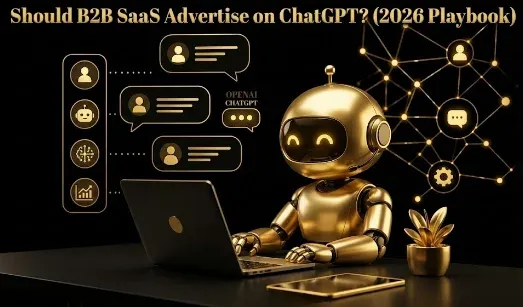
Should B2B SaaS Advertise on ChatGPT? A 2026 Decision and Test Playbook
Quick answer: ChatGPT ads are worth a properly designed test for B2B SaaS if three things are true: you sell a considered purchase, you already see ChatGPT showing up in your referral data, and you can stomach roughly $3 to $8 clicks while you learn. They are not worth moving budget out of a working search account for, and they are not a channel you can run on autopilot next to Google. Before you spend, resolve one make-or-break question: ChatGPT ads only reach free and Go-tier users, so if your ICP has already paid for ChatGPT (Plus, Team, Enterprise), the ads may miss your best buyers entirely. If the fit is there, run a small, disciplined pilot (around $5,000 over a 60-day window, changing one variable at a time, with your own pixel, conversion API, and CRM source capture), pair it with answer-engine optimization so you show up organically in the same answers, and judge it on lead quality, pipeline, and influence signals rather than click-through rate.
Key takeaways
- Test it if: considered purchase, ChatGPT already in your referral data, and you can absorb $3 to $8 clicks.
- Resolve the free-tier catch first: is your ICP on the free tier, or have they paid to opt out?
- The answer arrives before your ad, so contextual intent does not equal click intent.
- Pair paid with AEO: being cited organically makes paid placements in the same answer resonate.
- Judge on pipeline and influence, not CTR; pilot at ~$5k over 60 days, one variable at a time.
ChatGPT ads are the most significant new paid surface to appear in years, which means half the coverage is hype and half is dismissal, and neither helps if you are the one deciding where next quarter’s budget goes. This is the practical decision framework: whether ChatGPT ads fit your B2B SaaS, the one question to answer before spending, how the format actually behaves (it is stranger than it looks), and how to run a test that teaches you something instead of just spending money. (For the full landscape of every AI-platform ad option, see the companion piece; this is the ChatGPT decision and test.)
The suitability read: is this even for you?
Before any budget, run a three-part suitability check. ChatGPT ads are worth testing when all three hold:
- You sell a considered purchase. ChatGPT ads appear in conversations where someone is researching, comparing, and building conviction before a decision, which is exactly the B2B SaaS buying mode. If your product is a considered, researched purchase, the context fits; if it is an impulse buy, it does not.
- You already see ChatGPT in your referral data. If ChatGPT is already sending you traffic or showing up in self-reported attribution (“how did you hear about us”), that is direct evidence your buyers use it, which de-risks the test. If ChatGPT never appears anywhere in your data, that is a signal your audience may not be there (or may be on the paid tiers that see no ads).
- You can stomach the click price while you learn. Clicks run roughly $3 to $8, and early testing is a learning cost, so you need the tolerance to spend on learning before you see clean ROI.
If all three are true, a test is justified. If they are not (impulse purchase, no ChatGPT presence in your data, or no tolerance for learning spend), your budget belongs in your proven channels for now. And regardless of the three, there is a prior question that can disqualify the channel outright, covered next.
The one question to answer first: is your ICP even in the ad audience?
This is the make-or-break check most teams skip. ChatGPT ads only appear to users on the free and Go tiers; everyone on Plus, Pro, Team, and Enterprise sees no ads at all. So the real reach question is not “how many people use ChatGPT” (a lot), it is “is my specific ICP in the free-tier subset that can see ads.” For B2B SaaS this cuts both ways. If you sell to individual practitioners, early-stage teams, students, or budget-conscious users who tend to stay on the free tier, your buyers are reachable. But if you sell to senior technical leaders, engineers, or enterprise professionals who have almost certainly paid for ChatGPT to remove the ads and unlock the better models, a large share of your ICP has effectively opted out of your ad audience. Answer this before you spend a dollar: look at whether your buyers are likely free-tier or paid-tier users, and weight your expectation accordingly. A ChatGPT ad test aimed at an ICP that has all upgraded to Plus is a test that cannot succeed no matter how good the creative or targeting is, and no other B2B channel has quite this shape of reach constraint.
How ChatGPT ads actually behave (it is stranger than Google)
If you run Google Ads, some of this will feel familiar and some will not, and the unfamiliar part is the important part. The core difference is the order of events. On Google, the user asks a question and has to click a result to get the answer, so your ad is standing on the route to the thing they want. On ChatGPT, the answer arrives first, directly, and your sponsored placement sits below it, so your ad has to be worth interrupting an answer the user already has. This produces a subtle but crucial trap: more contextual intent does not automatically mean more click intent, because the conversation is often already solving the problem your ad is trying to sell. Someone who just got a thorough AI answer to “how do I fix my lead scoring” may feel less need to click your lead-scoring ad, not more, precisely because the answer satisfied them. The practical implications: your ad has to add something the answer did not (a specific proof point, a tool, a next step), targeting is contextual (“context hints”) rather than keyword-based so you think in terms of the conversations your buyers have rather than the terms they type, and there is no website-visit retargeting yet, so you cannot lean on the retargeting mechanics that prop up other channels. Design for a user who already has an answer and needs a reason to act, not for a user searching for one.
Pair it with AEO, always
The single highest-leverage way to make ChatGPT ads work is to not treat them in isolation. Paid and organic AI presence reinforce each other: brands that are already cited organically in ChatGPT’s answers see stronger resonance from paid placements in the same context, because the user encounters the brand both in the trusted answer and in the sponsored placement beside it. So the winning approach runs ChatGPT ads alongside answer-engine optimization (AEO), not instead of it. Concretely, that means building the organic AI-visibility foundation in parallel: use Service, CaseStudy, and Review schema so your proof is machine-readable, define the one-sentence recommendation you would want the AI to make about you, and build a prompt bank of the 20 or so high-intent conversations your best buyers have right before they need a vendor (the problem-stage questions like “why is my lead scoring failing” or “how do we scale demand gen without more headcount”), each mapped to a specific proof point. That prompt bank does double duty: it guides both your ChatGPT ad context targeting and your AEO content. The difference between the two is timing and guarantee: AEO earns organic citation over time, while a ChatGPT ad guarantees a sponsored placement below the answer today regardless of whether you have built citation authority yet. Run both, and they compound.
Measure it honestly (the feedback loop is primitive)
The good news is that the measurement tooling caught up fast in 2026: ChatGPT Ads Manager now ships with a Conversions API and pixel (so you can tie post-click events like signups, demos, and revenue back to the impression), a conversion-optimized objective (oCPC), and view-through reporting. The catch is that the audience, not the tooling, is now the limiting factor, and the feedback loop is still noisier than Google’s. The clearest illustration of that noise: one agency reported over 150 qualified leads across three B2B SaaS clients at a cost per lead around 60% below Google, while another reported roughly $415 spent, 60 clicks, and not a single interested buyer (and a third documented 8,940 impressions, 58 clicks, a 0.65% CTR, and zero leads, blaming the free-and-Go-only reach). Same channel, opposite results, largely explained by whether the free-tier audience contained the buyer. That reality dictates how you test:
- Build your own measurement. Set up your pixel, conversion API, and CRM source capture in your own account, so you can trace ChatGPT-sourced clicks to real pipeline rather than relying on the platform’s limited reporting.
- Change one variable at a time. With a noisy feedback loop, accept that each lesson costs a test cycle rather than an afternoon reading a report, so isolate variables (offer, then creative, then context targeting) instead of changing everything at once.
- Judge on lead quality, pipeline, and influence, not CTR. Because contextual intent does not equal click intent, and because this is more like measuring influence than direct response, watch whether your brand appears alongside high-intent prompts, whether prospects start repeating your language in discovery calls, and whether sales cycles compress because buyers arrive better informed, alongside cost per qualified lead and pipeline.
- Run a defined pilot, not an open-ended test. A fixed-scope sprint of around $5,000 over a 60-day window gives you enough clicks to learn without an unbounded spend, and the fixed window forces a decision at the end.
Measured this way, a ChatGPT ad test produces a real answer for your business. Measured on CTR against your Google dashboard, it will mislead you in one direction or the other.
The verdict for B2B SaaS
Putting it together: run a ChatGPT ad test if you sell a considered purchase, already see ChatGPT in your referral data, can absorb the click price while learning, and (the disqualifier) your ICP is actually in the free-tier ad audience rather than paid out of it. Do it as a small, disciplined, self-measured pilot paired with AEO, judged on pipeline and influence. Do not do it if your ICP has upgraded away from ads, if ChatGPT never shows in your data, or if it would mean pulling money out of a working search account, and do not expect to run it on autopilot beside Google, because the format, feedback loop, and controls are genuinely different and still primitive. Treat it as a distribution layer for your point of view in the decision moments where your buyers now research, not as “another performance channel.” Approached that way, it is a worthwhile early bet on a surface that is only going to grow; approached as a set-and-forget Google clone, it will disappoint.
Field note: The most useful way to think about ChatGPT ads is that they are less like buying Google clicks and more like buying a seat in a conversation where the answer has already been given. On Google, your ad is on the path to the answer, so intent and click intent line up. In ChatGPT, the user asked, the assistant answered, and your sponsored line sits underneath a response that may have already solved their problem, so your ad has to earn the interruption. That single structural fact explains most of what is strange about the channel: why contextual intent does not guarantee clicks, why the creative has to add something the answer did not, and why measurement is so slippery that two competent agencies can get opposite results and neither can say why. It also explains why the winning play is paid-plus-AEO rather than paid alone: if the AI already cited you in the answer, your sponsored line below it reads as confirmation rather than intrusion. For B2B SaaS, the honest position in 2026 is neither “pour budget into ChatGPT because it is the future” nor “ignore it because the metrics are messy.” It is: check whether your buyer can even see the ads, run one small, well-instrumented test paired with your AEO work, and judge it on whether it moves pipeline and shapes how buyers talk about your category, not on a click-through rate that was never the right metric for a channel where the answer comes first.
Honest limitations
- The free-tier constraint can disqualify the channel. If your ICP has paid out of ads, no amount of test discipline will make ChatGPT ads reach them; resolve this first.
- Measurement is genuinely primitive. Expect a noisy feedback loop, plan to build your own tracking, and accept that learning costs test cycles.
- Pricing and access are moving fast. CPCs, tiers, and features changed repeatedly through 2026; confirm current specifics before planning a test.
- No retargeting yet. You cannot lean on ChatGPT retargeting; run LinkedIn or other retargeting in parallel to cover the evaluating cohort.
- Educational, not investment or financial advice. Validate against your own account and buyer.
Frequently Asked Questions
Q1. Should B2B SaaS advertise on ChatGPT in 2026?
Test it if three things hold: you sell a considered purchase, you already see ChatGPT in your referral data, and you can absorb roughly $3 to $8 clicks while learning. And resolve one disqualifier first: ChatGPT ads only reach free and Go-tier users, so if your ICP has paid for ChatGPT Plus, Team, or Enterprise, the ads may miss them. If the fit is there, run a small disciplined pilot paired with AEO and judge it on pipeline and influence. Do not do it if your ICP has opted out, ChatGPT never appears in your data, or it means pulling budget from a working search account.
Q2. Who should NOT advertise on ChatGPT?
B2B SaaS companies whose ICP has largely upgraded to paid ChatGPT tiers (Plus, Pro, Team, Enterprise), because those users see no ads, so the reachable free-tier audience skews away from the buyers. Also skip it (for now) if you sell an impulse rather than considered purchase, if ChatGPT never shows up in your referral or self-reported attribution data (a sign your audience is not reachable there), if you cannot tolerate learning spend at $3 to $8 clicks, or if testing would require moving budget out of a working, profitable search account. In those cases the channel is not ready for you yet.
Q3. Why doesn’t contextual intent guarantee clicks on ChatGPT?
Because of the order of events. On Google the user asks and must click to get the answer, so your ad is on the route to what they want. On ChatGPT the answer arrives first, and your sponsored placement sits below a response that may have already solved the user’s problem, so the conversation is often already satisfying the need your ad is trying to sell. Someone who just got a thorough answer to their question may feel less need to click your ad, not more. So your creative has to add something the answer did not (a specific proof point, tool, or next step) and earn the interruption, rather than assuming high-intent context converts like a high-intent search.
Q4. How should you measure a ChatGPT ad test?
On lead quality, pipeline, and influence, not click-through rate, because the platform’s feedback loop is primitive (two agencies have reported wildly different results with neither able to explain the gap). Build your own pixel, conversion API, and CRM source capture to trace ChatGPT-sourced clicks to real pipeline; change one variable at a time since each lesson costs a test cycle; and watch influence signals (does your brand appear alongside high-intent prompts, do prospects repeat your language in discovery, do sales cycles compress) alongside cost per qualified lead. Run it as a fixed-scope pilot with a decision at the end, not an open-ended test.
Q5. How should you pair ChatGPT ads with AEO?
Run them together, because paid and organic AI presence reinforce each other: a brand already cited organically in ChatGPT’s answers sees stronger resonance from paid placements in the same context. Build the AEO foundation in parallel, using Service, CaseStudy, and Review schema so your proof is machine-readable, defining the one-sentence recommendation you want the AI to make about you, and building a prompt bank of the ~20 high-intent conversations your buyers have before needing a vendor, each mapped to a proof point. That prompt bank guides both your ad context targeting and your AEO content. AEO earns organic citation over time; the ad guarantees a placement today; run both and they compound.
Q6. How much should you budget to test ChatGPT ads?
Around $5,000 over a defined 60-day window is a reasonable pilot, given CPCs of roughly $3 to $8: it buys enough clicks to learn without an unbounded spend, and the fixed window forces a decision at the end. Keep the scope fixed and change one variable at a time (offer, then creative, then context targeting), because the noisy feedback loop means each lesson costs a test cycle. Do not treat it as an open-ended always-on budget yet, and do not fund it by cutting a working search account; fund it as a contained learning experiment on a new surface.
Q7. Can you retarget on ChatGPT ads?
Partially, and it is improving. As of mid-2026 ChatGPT Ads Manager supports custom audiences uploaded from email and phone lists, plus a Conversions API and pixel for post-click measurement, but full audience syncing for website-visit retargeting, lookalikes, and exclusions is on the roadmap for later in 2026 rather than fully live. So you can match your own customer or prospect lists today, but you cannot yet retarget site visitors the way you can on Google or Meta. The practical approach is to use custom-list audiences where they fit, run LinkedIn (or other mature) retargeting in parallel to cover the “has seen the brand, now evaluating” cohort, and plan for ChatGPT’s audience controls to expand over the coming months. Controls are maturing quickly, but they are still a step behind the legacy platforms, so build your funnel around the current gap rather than assuming ChatGPT closes it.
Sources & further reading
- Evergreen Growth (suitability read: considered purchase, ChatGPT in referral data, $3 to $8 click tolerance; the order-of-events insight; two-agencies-opposite-results measurement problem); Omni Lab (free-tier-only reach; B2B ICPs often paid out).
- Just Global / SmartAcre (pair ChatGPT ads with AEO; Service/CaseStudy/Review schema; one-sentence recommendation; prompt bank of high-intent conversations; measure influence not volume); VertoDigital (no retargeting yet, LinkedIn-retargeting workaround, ~$5k/60-day pilot).
- Companion: Advertising on AI Platforms for B2B SaaS 2026 (the full landscape); Paid + AEO for B2B SaaS (how citations lift paid).
This guide is educational, not investment or financial advice; ChatGPT ad access, pricing, and features are changing fast and measurement is primitive, so resolve the free-tier ICP question, test small, and validate against your own account and buyer.
Related guides: Advertising on AI Platforms for B2B SaaS 2026: ChatGPT, Google AI Mode & Copilot · Paid + AEO for B2B SaaS: How AI-Overview Citations Lift Paid Clicks · The B2B SaaS Paid Search Playbook for the AI Overviews Era · How to Reach Developers With Paid Ads (Without Getting Blocked or Ignored) · Run B2B SaaS Paid Media With AI: What to Automate, What to Keep Human.