Free Trial vs. Freemium: Choosing a PLG Model for B2B SaaS
Quick answer: A free trial gives full access for a limited time; freemium gives limited access forever. Free trial suits products with fast time-to-value where urgency drives conversion; freemium suits products with network effects, viral loops, or long evaluation needs, but requires the free tier to be valuable enough to attract users yet limited enough to drive upgrades. The choice depends on time-to-value, your ability to segment features, and acquisition economics — and some products run a hybrid.
Key takeaways
- Free trial = full access, limited time. Urgency converts; needs fast time-to-value.
- Freemium = limited access, forever. Scales acquisition; needs a careful free/paid line.
- Time-to-value is decisive. Slow-to-value products struggle with short trials.
- Freemium’s hard part is the boundary — valuable enough to attract, limited enough to upgrade.
- Hybrids exist (reverse trial), blending urgency with a durable free tier.
Once you’ve decided on a product-led motion, the next question is which free model. Free trial and freemium look similar but create very different funnels, economics, and product requirements. This guide covers how each works, what determines the fit, and where hybrids make sense. It’s the model-selection companion to PLG vs. sales-led GTM.
What’s the difference between free trial and freemium?
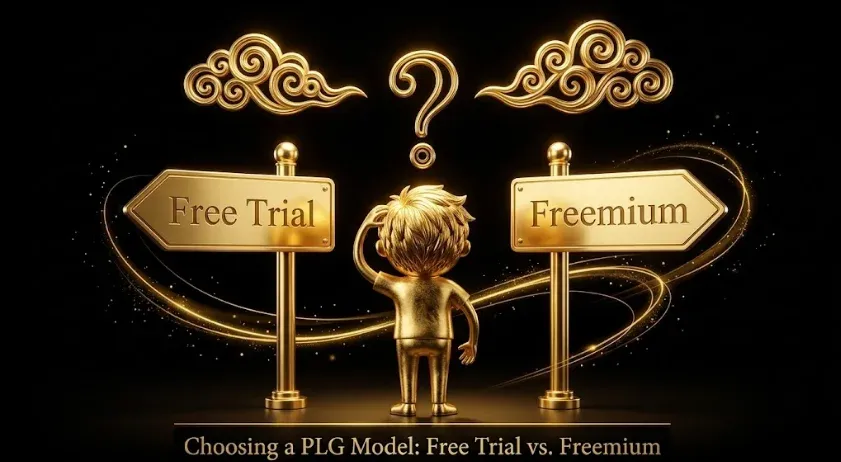
A free trial gives users full (or near-full) product access for a limited period — commonly one to four weeks — after which they must pay to continue. A freemium model gives users a permanently free tier with limited features, usage, or capacity, which they can upgrade for more. The core difference is the constraint: free trial limits time; freemium limits scope. That single difference cascades into different conversion psychology, funnel shapes, and product demands.
How does the free trial model work?
Free trial relies on urgency and momentum. The clock creates a reason to act, and users who reach value within the window convert. Its strengths: simpler to build (no permanent feature-gating), a clear conversion moment, and no ongoing cost to serve non-payers. Its requirement: users must reach real value before the trial ends. If your product takes weeks to show value, a 14-day trial converts poorly — which is why time-to-value is the deciding factor for trials.
How does the freemium model work?
Freemium relies on land-and-expand. A free tier lowers the barrier to entry to near zero, builds a large user base, and monetizes the fraction who hit the limits. Its strengths: massive top-of-funnel, room for viral/network effects, and time for long evaluations. Its cost: you serve many users who never pay, and you must design the free/paid boundary precisely. Too generous and no one upgrades; too stingy and no one adopts. That boundary is the hardest product decision in freemium.
Free trial vs. freemium: what determines the fit?
| Factor | Favors free trial | Favors freemium |
|---|---|---|
| Time to value | Fast (minutes to days) | Can be longer |
| Feature segmentation | Hard to split cleanly | Clean free/paid tiers exist |
| Network / viral effects | Weak | Strong (more users = more value) |
| Cost to serve free users | High | Low enough to sustain |
| Buyer | Individual decision, quick | Bottom-up adoption, spreads |
| Evaluation length needed | Short | Long |
The clarifying questions: can users get value fast enough for a trial to work, and can you draw a clean line between a compelling free tier and a worth-paying-for paid one? If value is fast, lean trial. If you have real network effects or long evaluations and a clean feature split, lean freemium.
Field note: Freemium’s failure mode is quieter and more expensive than free trial’s. A weak trial converts poorly and you know immediately. A mis-drawn freemium line can build a huge, happy, permanently free user base that never upgrades — and you’re paying to serve all of them while congratulating yourself on signup growth. Before choosing freemium, be honest about whether your free tier will create genuine upgrade pressure, or just a large audience of people who’ll never pay.
What about hybrid models?
The most common hybrid is the reverse trial: users start with full premium access (like a trial), and when it expires they drop to a limited free tier rather than losing access entirely. This blends trial urgency (experience the full product now) with freemium retention (stay as a free user, keep getting nurtured, upgrade later). It’s increasingly popular because it captures the conversion moment of a trial without losing the users who don’t convert immediately — they become a nurturable free base instead of a churned signup.
How does the model change your marketing?
Both are product-led, so marketing optimizes for signups and activation — but the emphasis differs. Trial marketing drives urgency and fast activation before the clock runs out. Freemium marketing drives volume signups and then in-product upgrade prompts at the moment users hit limits. Both feed the same downstream discipline: turning product-usage signals into sales attention for the accounts worth pursuing — product-led sales, as covered in PLG vs. sales-led GTM, often via account-based marketing. Whichever model, connecting product, marketing, and CRM data shows the full path from signup to paid — the kind of question the complete MCP stack answers.
Frequently Asked Questions
Q1. What’s the difference between free trial and freemium?
A free trial gives full access for a limited time, then requires payment. Freemium gives a permanently free tier with limited features that users can upgrade. Free trial limits time; freemium limits scope — and that difference changes the funnel, economics, and product requirements.
Q2. Is free trial or freemium better for B2B SaaS?
Neither is universally better. Free trial suits products with fast time-to-value where urgency drives conversion; freemium suits products with network effects, viral loops, or long evaluations, provided you can draw a clean free/paid line. The fit depends on your product and economics.
Q3. When should I use a free trial instead of freemium?
When users can reach real value quickly (within the trial window), when features are hard to split cleanly into free and paid tiers, and when serving many permanently free users would be too costly. Fast time-to-value is the strongest signal for a trial.
Q4. What is a reverse trial?
A hybrid where users start with full premium access like a trial, then drop to a limited free tier when it expires rather than losing access. It combines trial urgency with freemium retention, keeping non-converters as a nurturable free base.
Q5. What’s the hardest part of a freemium model?
Drawing the free/paid boundary. Too generous and users never upgrade; too limited and they never adopt. A mis-drawn line can build a large free user base that costs you to serve but never converts.
Sources & further reading
- Evaluate model fit against your own time-to-value, activation, and free-to-paid conversion data.
- SaaS PLG benchmarks vary widely; treat single conversion figures cautiously.
Related guides: PLG vs. Sales-Led GTM · Account-Based Marketing with Claude · Lead Scoring for B2B SaaS · The Complete MCP Stack for B2B SaaS Marketing Teams.