Pipeline,
not promises.
Senior operators audit your funnel in 48 hours. Ship 3 specific moves in 30 days.
- Full-funnel audit · 4 velocity levers
- 3 wins to ship in 30 days
- $3K flat · month-to-month
30-min call · No commitment
- Full-funnel audit · 4 velocity levers
- 3 wins to ship in 30 days
- $3K flat · month-to-month
PR & Communications for B2B SaaS: Earning Attention & Trust
Quick answer: PR and communications is the practice of building your reputation and earning attention and trust through earned channels — media, thought leadership, and communications — rather than paid advertising, and modern B2B PR is far broader than press releases: it spans earned media, thought leadership, analyst relations, and overall reputation-building. It matters because earned attention and third-party credibility carry a trust that paid channels can’t buy — being covered, cited, or recommended by credible sources builds reputation in a way ads don’t. But PR is earned, not bought (you can’t purchase genuine credibility), it’s a long game, and its results are less directly measurable than performance channels. Approached realistically — as long-term reputation-building through genuine value and earned credibility — PR is a powerful complement to a B2B SaaS marketing mix.
Key takeaways
- PR builds reputation and earns attention through earned channels, not ads.
- Modern B2B PR is broad — earned media, thought leadership, analyst relations, reputation.
- Earned credibility carries trust paid channels can’t buy.
- PR is earned, not bought — you can’t purchase genuine credibility.
- It’s a long game with less direct measurement than performance channels.
PR is one of the most misunderstood parts of B2B marketing — dismissed as press releases, or expected to deliver like a performance channel. Modern B2B PR is broader and more valuable than either view. This guide is the strategic overview: what B2B PR really is, what it does, why it’s earned not bought, and realistic expectations.
What is PR and communications for B2B SaaS?
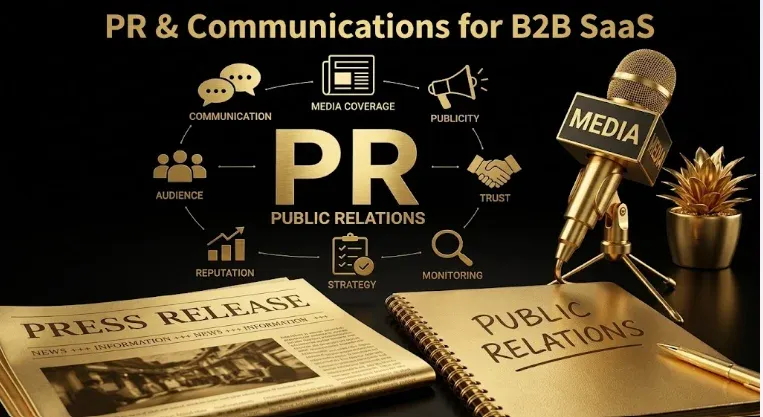
PR (public relations) and communications is the practice of building your company’s reputation and earning attention, credibility, and trust through earned channels — media coverage, thought leadership, analyst relations, and communications — rather than through paid advertising. Modern B2B PR is far broader than the old stereotype of press releases and media pitching: it encompasses earned media (coverage, mentions, citations), thought leadership (establishing expertise and perspective), analyst relations (influencing industry analysts), and overall reputation and communications management. The unifying idea is earning attention and credibility — getting third parties (media, analysts, the market) to cover, cite, recommend, and trust you — rather than buying attention through ads. PR is the discipline of building reputation and earning credibility, which for B2B (where trust drives buying) is genuinely valuable.
What does PR do?
PR and communications accomplish several things for a B2B SaaS company:
- Build reputation. Establishing and shaping how the market perceives you — your reputation and credibility over time.
- Earn credibility. Third-party coverage, citations, and recognition carry credibility that self-promotion can’t — being covered by a credible outlet or cited as an expert builds trust.
- Generate awareness. Earned attention (coverage, mentions, thought leadership reach) builds awareness among buyers and the market.
- Establish thought leadership. Positioning your company and people as credible experts and voices in your space.
- Support the brand. PR reinforces and builds the brand through earned credibility and reputation.
- Manage communications. Handling how the company communicates, including in sensitive or crisis situations.
These all contribute to reputation and earned credibility — the core of what PR does. Unlike demand generation (driving leads) or performance marketing (driving conversions), PR works on the reputation and credibility layer — building the trust and awareness that make everything else work better. Its value is in earned credibility and reputation, which are foundational to B2B buying (where trust is paramount) but distinct from the direct lead-and-conversion focus of other marketing.
Why is earned credibility so valuable?
Because third-party credibility carries a trust that paid, self-promotional channels can’t buy — and trust drives B2B buying:
- Third-party validation. When a credible outlet covers you, an analyst recommends you, or an expert cites you, that third-party validation carries weight your own advertising can’t — buyers trust independent sources more than vendor claims.
- Earned trust. Earned credibility is trusted precisely because it’s earned, not bought — the market knows you can’t simply purchase genuine coverage or recommendation, so earned credibility signals genuine merit.
- Cuts through skepticism. Buyers are skeptical of paid advertising but more receptive to earned credibility — coverage, citations, and recommendations bypass the skepticism ads face.
- Reputation compounds. Earned credibility builds a reputation that compounds over time, becoming a durable asset.
This is why PR’s earned credibility is so valuable in B2B: buyers, making high-stakes decisions, weight third-party credibility heavily, and earned credibility (which can’t be bought) carries a trust paid channels lack. In a world where buyers are skeptical of vendor advertising and actively seek independent validation, earned credibility is exactly what they trust. This makes PR a valuable complement to paid and owned channels — it builds the trusted reputation that makes buyers receptive to everything else. Earned beats bought for credibility, which is PR’s core value.
Why is PR earned, not bought?
Because you fundamentally cannot buy genuine credibility — and that’s exactly why earned credibility is valuable. This is the defining principle of PR:
- You can’t buy genuine coverage/recommendation. Legitimate media coverage, analyst recommendations, and expert citations are earned through genuine merit, value, and relationships — not purchased. (Paying for “coverage” is advertising, and the market knows the difference.)
- Earned credibility is trusted because it’s earned. The very fact that you can’t buy it is what makes earned credibility credible — if it could be bought, it wouldn’t carry trust.
- It requires genuine value and merit. Earning coverage, recommendations, and thought-leadership recognition requires genuinely being worth covering, recommending, and listening to — PR rests on genuine substance.
This “earned, not bought” nature is both PR’s power and its challenge. Its power: earned credibility carries trust precisely because it’s earned. Its challenge: you can’t just spend your way to it — you have to earn it through genuine value, merit, newsworthiness, expertise, and relationships, which is harder and slower than buying ads. This means PR isn’t a channel you can simply switch on with budget; it’s credibility you build by being genuinely worth covering and recommending. Companies that try to “buy” PR (paid placements dressed as coverage) undermine the very credibility PR should build. Genuine PR is earned through genuine substance — which is why it’s valuable and why it’s demanding.
What are realistic expectations for PR?
PR is often mismanaged through unrealistic expectations, so setting them right matters:
- It’s a long game. PR builds reputation and credibility over time; it’s not a quick lead-generating channel and shouldn’t be expected to deliver like one.
- Results are less directly measurable. PR’s impact (reputation, credibility, awareness) is real but harder to measure directly than performance channels — like brand, it’s directionally measurable, not last-click attributable.
- It complements, doesn’t replace. PR builds the reputation and credibility layer; it complements demand gen and performance rather than replacing them.
- It requires genuine substance. PR earns credibility through genuine value and merit; it can’t manufacture reputation a company doesn’t deserve.
- It’s not lead generation. PR’s job is reputation and credibility, not directly generating leads (though it supports the conditions for them) — judging it as a lead channel misunderstands it.
Realistic expectations frame PR as long-term reputation and credibility building — valuable, but not a directly-measurable lead machine. The common failures are expecting PR to generate leads directly (it doesn’t, mostly), expecting quick results (it’s a long game), and trying to buy it (it’s earned). Approached realistically — as patient, earned reputation-building through genuine value — PR is a powerful complement to the marketing mix. Misunderstood — as a quick, buyable lead channel — it disappoints. Set expectations around earned credibility and reputation over time.
Field note: B2B PR suffers from two opposite misconceptions that both lead companies astray. The first is dismissing it as outdated press-release-spraying — a relic of old-school marketing irrelevant in a performance-driven world. The second is expecting it to perform like a paid channel — demanding leads, quick results, and clean attribution from an effort that’s fundamentally about long-term reputation and earned credibility. Both miss what modern B2B PR actually is: the patient work of earning attention, credibility, and trust through channels you can’t buy your way into — genuine media coverage, real thought leadership, analyst credibility, and reputation built over time. Its value is precisely in being earned: buyers trust third-party credibility exactly because you can’t purchase it, which makes it carry a weight your advertising never will. But that same earned nature means you can’t shortcut it with budget or expect it to spit out leads next quarter — you build it by being genuinely worth covering, citing, and recommending, patiently, over years. The companies that get PR right treat it as a long-term investment in reputation and earned credibility, measured directionally and valued for the trust it builds, complementing (not replacing) their demand generation. The ones that get it wrong either dismiss it or misjudge it as a lead channel, and either way they miss the durable, trust-building reputation asset that PR, done genuinely and patiently, can become. Earn it, don’t buy it; build it patiently, don’t demand quick leads.
Honest limitations
- It’s earned, not bought. You can’t purchase genuine credibility; PR requires earning it through genuine value and merit, which is harder and slower than paid channels.
- It’s a long game. PR builds reputation over time and doesn’t deliver quick results; it requires patience.
- It’s hard to measure directly. PR’s impact on reputation and credibility is real but directionally measured, not last-click attributable like performance.
- It requires genuine substance. PR earns credibility through real value and merit; it can’t manufacture reputation a company doesn’t deserve.
- It’s not a lead channel. PR builds reputation and credibility, not direct leads; judging it as lead generation misunderstands its role.
Frequently Asked Questions
Q1. What is PR and communications for B2B SaaS?
PR and communications is building your company’s reputation and earning attention, credibility, and trust through earned channels — media coverage, thought leadership, analyst relations, and communications — rather than paid advertising. Modern B2B PR is far broader than press releases, spanning earned media, thought leadership, analyst relations, and reputation management. The unifying idea is earning attention and credibility from third parties rather than buying it through ads.
Q2. What does PR do for a B2B SaaS company?
It builds reputation (shaping how the market perceives you), earns credibility (third-party coverage and citations carry trust self-promotion can’t), generates awareness (through earned attention), establishes thought leadership (positioning you as a credible expert), supports the brand (through earned credibility), and manages communications (including sensitive situations). All contribute to reputation and earned credibility — the trust and awareness layer that makes other marketing work better.
Q3. Why is earned credibility so valuable?
Because third-party credibility carries trust that paid, self-promotional channels can’t buy, and trust drives B2B buying. When a credible outlet covers you or an analyst recommends you, that independent validation carries weight your advertising can’t, buyers trust it precisely because it’s earned (not bought), it cuts through the skepticism ads face, and reputation compounds over time. Buyers making high-stakes decisions weight earned third-party credibility heavily.
Q4. Why is PR earned rather than bought?
Because you fundamentally can’t buy genuine credibility — legitimate media coverage, analyst recommendations, and expert citations are earned through genuine merit, value, and relationships, not purchased (paying for “coverage” is advertising, which the market recognizes). The very fact that earned credibility can’t be bought is what makes it trusted. PR rests on genuinely being worth covering and recommending, which is why it’s valuable and why it can’t be shortcut with budget.
Q5. What are realistic expectations for PR?
That it’s a long game (building reputation over time, not a quick lead channel), its results are less directly measurable (directionally, like brand, not last-click), it complements rather than replaces demand gen and performance, it requires genuine substance (earning credibility through real merit), and it’s not lead generation (its job is reputation and credibility). Realistic expectations frame PR as long-term earned reputation-building, valuable but not a directly-measurable lead machine.
Q6. Does PR generate leads?
Not directly, mostly — PR’s job is building reputation, credibility, and awareness, not directly generating leads, though it supports the conditions that make lead generation and everything else work better (a trusted, well-known company converts more easily). Judging PR as a lead channel misunderstands it; it works on the reputation and credibility layer. Expecting direct leads from PR is a common mistake that leads to disappointment and mismanagement.
Q7. Can you buy PR coverage?
You can’t buy genuine, credible coverage — legitimate media coverage and analyst recommendations are earned through merit and relationships, and paying for placements is advertising, which the market distinguishes from earned coverage. Trying to “buy” PR (paid placements dressed as coverage) undermines the very credibility PR should build, because earned credibility is trusted precisely because it can’t be bought. Genuine PR is earned through genuine substance, not purchased.
Sources & further reading
- Approach PR as long-term reputation and earned-credibility building through genuine value — media, thought leadership, and analyst relations — not a buyable lead channel.
- Earned credibility carries trust paid channels can’t; set realistic long-game expectations, measure directionally, and validate against your own reputation and awareness.
This guide is educational and a strategic framework; PR is earned not bought, a long game, and hard to measure directly, so build it patiently through genuine value and validate directionally.
Related guides: Earned Media & Media Relations for B2B SaaS · Thought Leadership for B2B SaaS · Analyst Relations for B2B SaaS · Brand Strategy for B2B SaaS · Founder-Led Marketing.