Brand Strategy for B2B SaaS: Why Brand Matters in B2B
Quick answer: Brand is the perception and reputation your company holds in buyers’ minds — not just your logo and colors — and even in “rational” B2B, it drives trust, preference, pricing power, and demand, because buyers choose vendors they know and trust over unknown ones. Brand strategy is the deliberate effort to shape that perception: your brand positioning, identity, voice, and experience, built consistently over time. B2B chronically under-invests in brand because it’s a long-term, hard-to-measure asset that loses budget battles to measurable performance marketing. But brand is what makes everything else work better — trusted brands convert more, command premiums, and generate demand — making it one of the most under-appreciated assets in B2B SaaS.
Key takeaways
- Brand is perception and reputation — not just logo and visual identity.
- Brand drives trust, preference, and pricing power even in B2B.
- Buyers choose vendors they know and trust over unknown ones.
- Brand is a long-term asset — built consistently over time.
- B2B under-invests in brand because it’s hard to measure.
“Brand” gets dismissed in B2B as fluffy — logos and taglines irrelevant to rational buyers. That view is wrong and expensive: brand drives real business outcomes even in B2B. This guide is the strategic overview — what brand actually is, why it matters, its components, why it’s under-invested, and how to start.
What is brand?
Brand is the perception, reputation, and set of associations your company holds in the minds of buyers and the market — what people think and feel about you, and whether they know and trust you. It’s far more than visual identity (logo, colors, design), though those are part of expressing it: brand is fundamentally about perception. A strong brand means buyers know who you are, associate you with certain values and capabilities, and trust you; a weak or absent brand means you’re an unknown quantity they have no reason to prefer. Brand strategy is the deliberate effort to shape this perception — defining how you want to be perceived and building that perception consistently over time. Brand is the reputation you build; brand strategy is how you build it intentionally rather than by accident.
Why does brand matter in B2B?
Because even “rational” B2B buyers choose vendors they know and trust, and brand is what creates that trust and preference:
- Trust. B2B purchases are high-stakes and considered, so trust is paramount — and a strong brand creates trust before a single conversation. Buyers prefer vendors they know and trust over unknowns, reducing perceived risk.
- Preference and consideration. A known brand gets considered and shortlisted; an unknown one has to overcome anonymity. Brand affects whether you’re even in the running.
- Pricing power. Trusted, differentiated brands command premiums — buyers pay more for a brand they trust than a commodity they don’t.
- Demand generation. A strong brand generates demand — buyers come to you, brand search rises, and marketing works better against a known brand.
- Defensibility. Brand is hard for competitors to replicate — a genuine reputation is a durable advantage.
The myth that B2B buyers are purely rational and immune to brand is false: they’re humans making high-stakes decisions, and they reach for trust, familiarity, and reputation — exactly what brand provides. Brand isn’t fluff in B2B; it’s a driver of trust, preference, pricing, and demand.
What are the components of brand?
| Component | What it is |
|---|---|
| Brand positioning | How you want to be perceived vs. alternatives |
| Brand identity | Visual and verbal expression (logo, design, look) |
| Brand voice | How you communicate — personality and tone |
| Brand experience | Every touchpoint buyers have with you |
| Brand values | What you stand for |
These components together create the perception that is your brand. Positioning defines how you want to be seen; identity and voice express it; experience delivers it across every touchpoint; and values anchor what you stand for. Consistency across all of them is what builds a coherent, strong brand — inconsistency dilutes it. Note that visual identity is just one component: brand is the whole perception, of which the logo is a small (if visible) part.
Why is brand a long-term asset?
Because brand is built slowly through sustained consistency, and its value compounds over time. Unlike a campaign that delivers results now, brand is built through consistent perception-shaping over months and years — every touchpoint, message, and experience accumulating into a reputation. This makes brand a long-term asset: like content or community, it builds slowly then pays off durably, becoming more valuable as it strengthens. A strong brand, once built, keeps generating trust, preference, and demand — a compounding asset that makes all your marketing work better. This long-term, compounding nature is central to understanding brand: it’s not a quick win, but a durable asset that appreciates with consistent investment, and one that’s very hard for competitors to replicate quickly. The flip side — its long payoff horizon — is exactly why it’s under-invested.
Why does B2B under-invest in brand?
Because brand is a long-term, hard-to-measure asset, and it consistently loses budget battles to measurable, short-term performance marketing. When budgets are allocated, performance marketing shows clear, immediate, attributable results (leads, pipeline), while brand’s impact is diffuse, long-term, and hard to prove — so brand loses. This creates a systematic under-investment: the measurable thing gets funded, the hard-to-measure-but-valuable thing gets cut, even though brand often drives the trust and demand that make performance marketing work. Add the “B2B buyers are rational” myth (which dismisses brand as irrelevant), and B2B chronically under-funds brand. This under-investment is precisely why brand is an opportunity: because most competitors neglect it, the companies that build genuine brands gain an advantage in trust, preference, and demand that the performance-obsessed can’t easily match.
How do you get started with brand?
Start with the foundation: positioning (how you want to be perceived) and a clear sense of what you stand for, then express it consistently through your identity, voice, and every touchpoint. Build consistency across everything buyers experience, invest in brand as a long-term asset alongside performance marketing (not instead of it), and measure it directionally over time. You don’t need a huge budget to start building brand — you need consistency, a clear identity, and the patience to invest in a long-term asset.
Field note: The most expensive myth in B2B marketing is that brand doesn’t matter because B2B buyers are rational. They’re not — they’re humans making high-stakes, high-risk decisions, and humans reach for trust, familiarity, and reputation exactly when the stakes are high. A buyer choosing enterprise software they’ll depend on for years isn’t running a pure feature spreadsheet; they’re asking “do I trust this company? have I heard of them? will they be around? will I look smart or foolish for choosing them?” — and brand answers all of those before the first sales call. The companies that dismiss brand as fluff and pour everything into measurable performance marketing win the buyers already in-market today, but they’re invisible to the far larger number of buyers who aren’t in-market yet — and when those buyers do enter the market, they reach for the brands they know, not the performance advertiser who was invisible until the moment of the search. Brand is the reason a buyer thinks of you at all, trusts you before meeting you, and pays a premium once they do. In a world where every competitor is optimizing the same performance channels, a genuine brand is one of the few durable advantages left — and it’s sitting neglected precisely because it’s hard to measure and slow to build.
Honest limitations
- Brand is a long game. It builds slowly and pays off over time; it can’t deliver the immediate results performance marketing does, requiring patience.
- It’s hard to measure. Brand’s impact is diffuse and long-term, making it genuinely difficult to prove — which is why it’s under-funded.
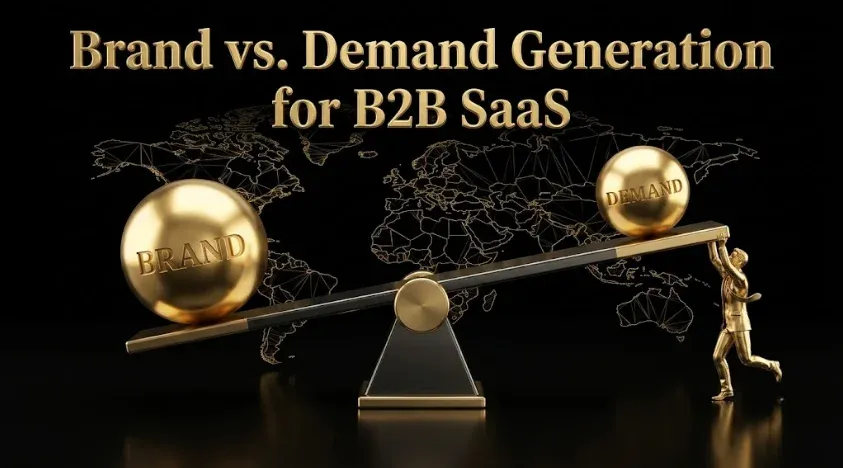
- It complements, not replaces, performance. Brand and performance work together; brand isn’t a substitute for demand capture, and vice versa.
- It must be authentic. Brand is a genuine reputation; you can’t fake it — a brand disconnected from reality collapses on contact.
- It requires consistency. Inconsistent brand-building dilutes rather than compounds; brand demands sustained, coordinated effort.
Frequently Asked Questions
Q1. What is brand in B2B?
Brand is the perception, reputation, and associations your company holds in buyers’ minds — what people think and feel about you, and whether they know and trust you. It’s far more than visual identity (logo, colors); brand is fundamentally about perception. Brand strategy is the deliberate effort to shape that perception, defining how you want to be seen and building it consistently over time.
Q2. Does brand matter in B2B, or just B2C?
It matters in B2B too — the myth that B2B buyers are purely rational and immune to brand is false. B2B buyers are humans making high-stakes, considered decisions, so they reach for trust, familiarity, and reputation, exactly what brand provides. Brand drives trust, preference, consideration, pricing power, and demand in B2B, making it a genuine business driver, not fluff.
Q3. Why does brand matter for B2B SaaS?
Because it creates trust (paramount for high-stakes purchases), drives preference and consideration (known brands get shortlisted; unknowns must overcome anonymity), enables pricing power (trusted brands command premiums), generates demand (buyers come to you), and provides defensibility (a genuine reputation is hard to replicate). Brand makes everything else — conversion, pricing, demand — work better.
Q4. What are the components of brand?
Brand positioning (how you want to be perceived versus alternatives), brand identity (visual and verbal expression like logo and design), brand voice (how you communicate — personality and tone), brand experience (every touchpoint buyers have with you), and brand values (what you stand for). These together create the perception that is your brand, and consistency across all of them builds a strong, coherent brand.
Q5. Why is brand a long-term investment?
Because brand is built slowly through consistent perception-shaping over months and years, with every touchpoint accumulating into a reputation, and its value compounds over time. Like content or community, it builds slowly then pays off durably, becoming more valuable as it strengthens and harder for competitors to replicate. Its long payoff horizon is exactly why it’s a durable asset — and why it’s under-invested.
Q6. Why do B2B companies under-invest in brand?
Because brand is a long-term, hard-to-measure asset that loses budget battles to measurable, short-term performance marketing — the measurable thing gets funded while brand’s diffuse, hard-to-prove impact gets cut. Combined with the myth that B2B buyers are purely rational, this causes systematic under-investment, which is precisely why brand is an opportunity: most competitors neglect it.
Q7. How do you start building a brand?
Start with positioning (how you want to be perceived) and a clear sense of what you stand for, express it consistently through your identity, voice, and every touchpoint, invest in brand as a long-term asset alongside performance marketing, and measure it directionally over time. You don’t need a huge budget — you need consistency, a clear identity, and patience to invest in a long-term asset.
Sources & further reading
- Build brand as a long-term asset through consistent positioning, identity, voice, and experience, alongside (not instead of) performance marketing.
- Brand drives trust, preference, and demand even in B2B; measure it directionally over time and validate against your own results.
This guide is educational and a strategic framework; brand is a long-term, hard-to-measure asset that must be authentic, so build consistently and validate against your own results.
Related guides: Positioning and Messaging for B2B SaaS · Brand vs. Demand Generation: Finding the Balance · Measuring Brand for B2B SaaS · Lead Gen vs. Demand Gen for B2B · Founder-Led Marketing.