ChatGPT
 Gemini
 Claude
 Perplexity
 DeepSeek
 Grok
Grok
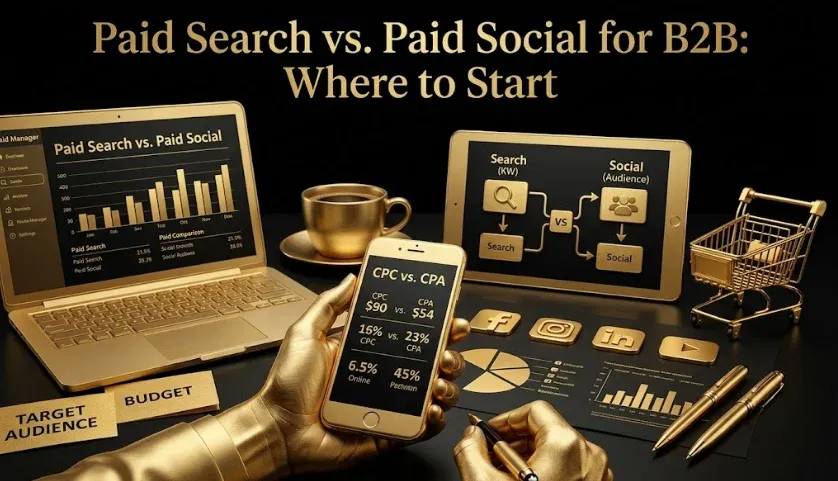
Paid Search vs. Paid Social for B2B: Where to Start
Quick answer: Paid search captures existing demand (people actively searching, high intent, bottom-funnel) while paid social creates demand (interrupting the right people, building awareness, upper-funnel). For most B2B companies starting out, paid search is the place to begin — capturing the demand that already exists is faster to prove and more efficient than creating new demand. But the two are complementary, not competing: search harvests intent, social creates the intent that search later harvests. The mature approach runs both, with the split shifting toward social as you exhaust existing search demand and need to create more.
Key takeaways
- Paid search captures demand; paid social creates it.
- Start with search — capturing existing demand is faster and more efficient to prove.
- They’re complementary — social creates the intent search later harvests.
- Shift toward social as you exhaust existing search demand.
- Match the metric to the job — CPL/SQL for search, influence for social.
“Should we do Google or LinkedIn first?” is one of the most common B2B paid questions, and the answer follows from understanding that they do opposite jobs. This guide covers the two paradigms, which to start with, how they complement each other, and how to split budget between them.
The two paradigms: capture vs. create
The fundamental difference isn’t the platform — it’s the intent:
- Paid search (Google, Microsoft) reaches people actively searching for a solution. They have intent; you’re capturing demand that already exists. It’s bottom-funnel, high-intent, and pull-based — the person came looking.
- Paid social (LinkedIn, Meta) reaches people scrolling, not searching. They have no active intent for your product in that moment; you’re interrupting the right audience to create awareness and demand. It’s upper-funnel, lower-intent, and push-based — you came to them.
This maps directly onto the lead gen vs. demand gen distinction: search is capture, social is creation. Everything else — cost, measurement, which to start with — follows from that.
Paid search vs. paid social
| Dimension | Paid search | Paid social |
|---|---|---|
| Intent | High (actively searching) | Low (scrolling) |
| Funnel role | Capture existing demand | Create demand |
| Targeting | Keywords (what they want) | Audiences (who they are) |
| Cost per click | Lower–moderate | Higher (esp. LinkedIn) |
| Speed to results | Faster | Slower (compounds) |
| Measurement | Easier (last-click) | Harder (assisted) |
| Best first for | Most B2B starting out | After capture is maxed |
Neither is universally better — they’re suited to different jobs and funnel stages.
Which should you start with?
For most B2B companies, start with paid search. The reasons:
- Existing demand is easier to capture than new demand is to create. If people are already searching for your category, meeting them there is the fastest, most efficient win — you’re not convincing anyone to want the category, just to choose you.
- It’s faster to prove. Search shows results sooner and is easier to measure, which matters when you’re establishing whether paid works at all.
- It’s usually more efficient early. High-intent searchers convert better than interrupted scrollers, so your first dollars often go further on search.
The exception: if there’s genuinely little search demand for your category (you’re creating a new category, or buyers don’t search for what you do), then paid social’s demand-creation role becomes primary earlier. But for most B2B with an existing category, capture first.
How do they complement each other?
They’re two halves of a funnel, and they compound when run together:
- Social creates the demand search captures. Paid social builds awareness so more people later search your brand and category — feeding your search campaigns.
- Search captures what social warmed up. People social introduced to you convert through search when they’re ready.
- Retargeting connects them. Retarget social-engaged audiences, and capture search-intent visitors who didn’t convert.
- Brand search is the handoff. Effective paid social (and demand creation generally) shows up as rising branded search — social’s demand becoming search’s capture.
Run in isolation, each is weaker; run together, social fills the top and search harvests the bottom.
How do you split budget between them?
There’s no universal ratio, but the logic is clear: start weighted toward search (capture the efficient existing demand first), then shift toward social as you exhaust that demand and need to create more. Signs you’ve maxed search and should invest more in social include search campaigns hitting diminishing returns (you’re capturing most of the existing demand) and needing to grow the category or reach people not yet searching. This is the same demand creation vs. capture balance that governs budget allocation generally — let the size of your captured-demand opportunity guide how much to shift toward creating new demand.
How do you measure each?
With different yardsticks:
- Paid search: cost per SQL and pipeline, judged fairly on its bottom-funnel, last-click-friendly nature — but still to pipeline, not just CPL.
- Paid social: influence, assisted pipeline, and brand signals, since much of its value is demand creation that won’t show in last-click. Judging social by search’s last-click standard makes it look worse than it is.
The measurement mismatch is why social often loses budget arguments to search — search looks better in last-click reports because it is last-click, while social’s demand-creation value hides. Measure each on its own terms.
Field note: The trap in the “search vs. social” question is comparing them on the same metric and concluding search “wins.” Of course it does on last-click CPL — search captures people at the moment of intent, so it gets the clean, cheap, attributable conversions. But that comparison is rigged: it credits search for demand that social may have created upstream. A company that cuts social because “search is more efficient” often watches its search efficiency slowly decline, because it stopped creating the demand search was harvesting. Start with search to capture what exists, yes — but don’t let search’s measurement advantage convince you social isn’t working. They’re not competitors on a scoreboard; they’re the create-and-capture halves of one machine.
Honest limitations
- The right start depends on your category. Little existing search demand flips the logic toward social-first; there’s no universal answer.
- Measurement asymmetry distorts comparison. Search’s last-click friendliness makes head-to-head CPL comparisons unfair to social.
- Both need enough budget to work. Splitting a tiny budget across both can underfund each; sometimes sequencing (nail one, then add the other) beats splitting.
- Channels within each vary. “Paid social” spans LinkedIn (premium, precise) and Meta (cheaper, broader), which behave differently for B2B.
- This is a lens, not a law. Some search is brand-defense (not pure capture), some social is direct-response — the paradigms are tendencies, not absolutes.
Frequently Asked Questions
Q1. What’s the difference between paid search and paid social for B2B?
Paid search (Google, Microsoft) captures existing demand — reaching people actively searching, with high intent, at the bottom of the funnel. Paid social (LinkedIn, Meta) creates demand — interrupting the right audience who aren’t searching, building awareness at the top of the funnel. Search harvests intent; social creates it.
Q2. Should B2B start with paid search or paid social?
Usually paid search, because capturing existing demand is faster to prove and more efficient than creating new demand — high-intent searchers convert better than interrupted scrollers. The exception is when there’s little search demand for your category (a new category or buyers who don’t search), where social’s demand-creation role becomes primary earlier.
Q3. Is Google Ads or LinkedIn Ads better for B2B?
Neither is universally better — they do different jobs. Google Ads (search) captures existing demand efficiently at high intent; LinkedIn Ads (social) creates demand and reaches specific people by who they are, at higher cost. Most B2B benefits from both: Google to capture, LinkedIn to create and target precisely.
Q4. How do paid search and paid social work together?
Social creates the demand search later captures, search harvests the intent social warmed up, retargeting connects the two, and rising branded search is the handoff (social’s demand becoming search’s capture). Run together they compound — social fills the top of the funnel, search harvests the bottom.
Q5. How should you split budget between paid search and social?
Start weighted toward search to capture efficient existing demand, then shift toward social as you exhaust that demand and need to create more. Signs to shift include search hitting diminishing returns and needing to reach people not yet searching. Let the size of your captured-demand opportunity guide the balance.
Q6. Why does paid search look more efficient than paid social?
Because search captures people at the moment of intent, so it gets clean, cheap, last-click-attributable conversions, while much of social’s value is upstream demand creation that doesn’t show in last-click reporting. The comparison is unfair — it can credit search for demand social created — so measure each on its own terms.
Q7. Can you do B2B paid ads with only one of them?
You can start with one — usually search — but relying on it alone has limits: search-only eventually exhausts existing demand, while social-only creates interest you may not efficiently capture. Most maturing B2B programs need both to create and capture demand, even if they sequence rather than start together.
Sources & further reading
- Measure paid search on cost per SQL and paid social on influence and assisted pipeline, using your own CRM data.
- Let your category’s existing search demand guide whether to start search-first or social-first.
This guide is educational; the right channel mix depends on your category, demand, and budget, so validate the balance against your own results.
Related guides: Lead Gen vs. Demand Gen for B2B · Google Ads Campaign Structure · Is LinkedIn Ads Worth It? · Marketing Budget Allocation · Retargeting for B2B SaaS.