ChatGPT
 Gemini
 Claude
 Perplexity
 DeepSeek
 Grok
Grok
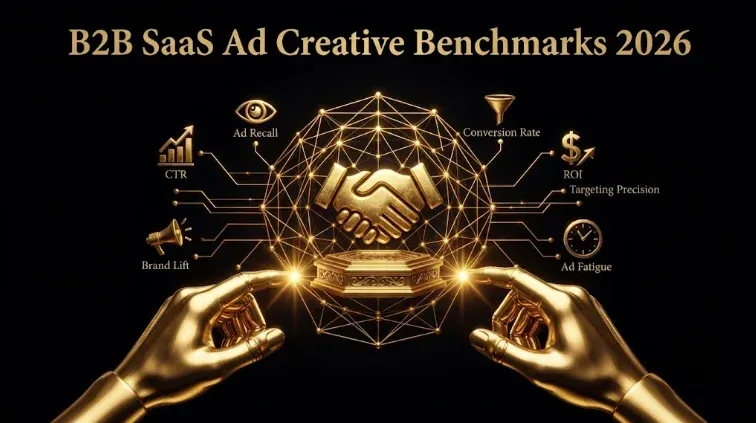
B2B SaaS Ad Creative Benchmarks 2026: Winning-Creative Rate, Refresh Cadence & Why B2B Fatigues Slower
Quick answer: Almost every ad-creative benchmark you’ll find is DTC/ecommerce data — and applying it to B2B SaaS is a mistake, because B2B creative behaves completely differently. The universal truths hold: only about 4–8% of creatives become winners (you need roughly 20 launches per winner), and creative now drives ~56% of auction outcomes — more than bid, targeting, and placement combined. But the B2B-specific reality is the opposite of DTC’s frantic refresh culture: B2B SaaS has the longest creative lifespan of any industry (about 12 days on Meta and ~43 days on LinkedIn, where 70.7% of creatives run 30+ days) versus 4–8 days for DTC — because B2B audiences are narrow and frequency builds slowly. So B2B SaaS needs fewer creatives refreshed less often than DTC advice suggests, judged on a fatigue signal (frequency + declining performance), not a calendar.
Key takeaways
- ~4–8% of creatives win — plan for ~20 launches per winner, judged on absolute winners.
- Creative ≈ 56% of auction outcomes — the single biggest performance lever.
- B2B SaaS fatigues slowest — ~12 days on Meta, ~43 days on LinkedIn, vs 4–8 days DTC.
- DTC “refresh weekly, ship 80/month” is wrong for B2B — narrow audiences fatigue slower.
- Refresh on the signal (frequency + declining performance), not the calendar.
Search “how many ad creatives do I need” or “when to refresh ads” and you’ll get confident numbers — almost all drawn from DTC ecommerce, where audiences are huge, frequency spikes fast, and creatives burn out in days. B2B SaaS is a different world, and using DTC creative benchmarks will make you over-produce, over-refresh, and misread your own data. This is the B2B-SaaS-specific creative benchmark picture: what wins, how much you need, when to refresh, and why B2B’s numbers look nothing like DTC’s.
What’s the winning-creative rate? (This part is universal)
The hit rate is brutal and roughly consistent across the data: only about 4–8% of creatives become winners (Motion’s 2026 analysis of 550,000+ ads; a separate study of 578,750 creatives put it near 5%), and roughly 6% of ads capture the majority of spend while about half receive zero or minimal spend. Put practically: for every ~10 creatives you test, 1–3 become strong performers, and a useful planning rule is ~20 launches per winner. This is the base rate of the format, not a sign you’re bad at creative — which leads to the single most important reframe: judge creative programs by the absolute number of winners produced, not by hit rate. A lower hit rate on higher volume still yields more winners. And it’s worth the effort because creative is now the dominant lever: Meta’s own data science attributes roughly 56% of auction outcomes to creative quality (some analyses put creative’s share of performance variance as high as 70%) — more than bid strategy, targeting, and placements combined. This isn’t incidental: Meta’s Andromeda system (rolled out through 2025) explicitly replaced audience-based targeting with creative-based targeting — the algorithm now reads your creative to decide who sees it, so the creative literally is the targeting, on Meta and increasingly on every automated platform (Advantage+, AI Max, LinkedIn Accelerate). Whatever else you optimize, creative is where the leverage is.
Why does B2B SaaS creative fatigue so much slower than DTC?
This is the benchmark that changes everything and that almost no one states for B2B: B2B SaaS has the longest creative lifespan of any industry. The data:
| Platform / context | Typical creative lifespan before fatigue |
|---|---|
| DTC ecommerce (Meta, avg) | ~4–8 days (food/beverage loses ~40% of CTR in 9 days) |
| Mobile apps (Meta) | ~5 days (fastest fatigue) |
| YouTube (cross-industry) | ~5 days |
| B2B SaaS (Meta) | ~12 days (longest of any industry) |
| B2B SaaS (LinkedIn) | ~43 days median; 70.7% of creatives run 30+ days |
The reason is structural: B2B SaaS audiences are narrow (a specific ICP is thousands of people, not millions), so ad frequency accumulates slowly, and creatives don’t burn out the way they do against a huge DTC audience seeing them dozens of times a week. The trade-off is that B2B SaaS also has the lowest engagement (Meta CTR 0.60%, the lowest of any industry) and the highest CPMs ($18) — you reach fewer people, more expensively, but each creative lasts far longer. One important nuance, though: the ~43-day LinkedIn figure is observed duration (how long advertisers keep an ad live), which is not the same as time-to-fatigue (when performance actually degrades). In very narrow B2B audience pools, a creative can fatigue in as little as ~21 days even while it stays live much longer — and fatigue happens at the creative level, not the campaign level (one ad at 6x+ frequency can drag down a campaign while a newer creative performs fine). So the honest rule is: B2B creatives are safe to run far longer than DTC, but you still track the fatigue signal per creative rather than assuming longevity equals health. The single most common B2B creative mistake is importing DTC refresh anxiety into a channel where creatives are supposed to last; the second is assuming a long-running B2B ad can’t be quietly fatiguing. (For LinkedIn fatigue detection specifically, see the dedicated creative-fatigue guide.)
How many creatives does B2B SaaS actually need?
Far fewer than DTC benchmarks suggest. The DTC volume benchmarks (Motion/Foxwell) run from ~2.8 new creatives/week for sub-$10K-spend brands up to ~18.85/week for $1M+ brands — roughly 12–80 per month, with top performers shipping 2–3x that. But those numbers assume DTC’s fast fatigue and huge audiences. For B2B SaaS, with creatives lasting 12–43 days instead of 4–8, you need proportionally fewer: enough to (a) test toward winners at the ~20-launches-per-winner rate and (b) have fresh, pre-validated variants ready when a winner finally does fade. The right way to set your number isn’t a DTC calendar — it’s win-rate math against the winners you need: if you need, say, 2 new winners a quarter and your hit rate is ~5–10%, you need to test on the order of 20–40 creatives that quarter, not per week. Build a queue of validated concepts, not a frantic production line. The DTC “creative as a continuous high-volume factory” model is right for DTC and wrong for most B2B SaaS, where quality and ICP-relevance of a smaller set beats sheer volume against a narrow audience. One concrete anchor for the active set: under Andromeda-style delivery, B2B lead-gen campaigns tend to run best with roughly 10–15 conceptually distinct active creatives per campaign (versus 20–30+ for DTC ecommerce), because diversity of concept — not raw volume — is what lets the algorithm find pockets of your ICP. (Meta’s own test found one ad set with 25 diverse creatives produced 17% more conversions at 16% lower cost than five ad sets of five — diversity wins, but you need far fewer distinct concepts in B2B than DTC.)
When should you refresh — and how do you know it’s fatigue?
Refresh on a signal, never a calendar. The reliable fatigue signals (adapted from cross-platform data, with B2B’s slower clock in mind):
- Frequency in the ~2.5–3.0+ band — the most-cited fatigue trigger; rising frequency is a warning, but only actionable when it coincides with declining performance.
- CTR dropping >20% over a ~two-week window (or frequency exceeding ~4.0) — a concrete replacement trigger.
- Rising CPM/CPA with falling CTR — after fatigue onset, expect roughly a 20–40% CPM increase and 15–30% CTR drop; conversion likelihood can fall ~45% after four exposures to the same creative.
- Track hook rate and hold rate, not just CTR — they show where a creative starts losing people.
Two B2B-specific cautions. First, don’t refresh on the calendar — an arbitrary 7-day (or even monthly) refresh will remove winning B2B creatives that were far from fatigued, given B2B’s 12–43 day lifespans. Use performance signals first. Second, when several fresh creatives decline together, the problem usually isn’t creative fatigue — investigate audience saturation, landing page, pricing, seasonality, or a competitive shift before producing another cosmetic variation. And don’t wait for a collapse to start building replacements: keep a queue of pre-screened variants so you can swap the moment a winner genuinely slips.
How do you build a B2B SaaS creative program around these benchmarks?
- Judge on absolute winners, not hit rate. Accept the ~4–8% win rate as the base rate; set your test volume by the winners you need (~20 launches per winner), not by a DTC calendar.
- Right-size volume to B2B’s slow fatigue. Produce enough to test toward winners and keep a queue — far less than DTC’s 12–80/month, because your creatives last 12–43 days, not 4–8.
- Test genuinely different concepts, not cosmetic variants. Winners come from distinct hooks, angles, and proof structures; swapping a color won’t produce a new winner. Plan multiple iterations per concept, and ~4–6 variations per proven winner.
- Refresh on signal. Watch frequency (2.5–3.0+) and performance (CTR down >20%, CPM/CPA up), not the calendar — and diagnose broad declines as saturation/LP/pricing, not fatigue.
- Invest in creative as the primary lever. Since creative drives ~56% of outcomes and increasingly does the targeting under broad/AI delivery, creative quality and ICP-relevance are where the leverage is — more than bid tweaks.
- Keep a validated queue. Archive strong, pre-screened, unlaunched variants so the next rotation is ready — no scramble when a winner fades.
The through-line: B2B SaaS creative rewards quality and ICP-relevance at moderate volume with signal-based refresh — the opposite of DTC’s high-volume, fast-refresh factory. Copy DTC benchmarks and you’ll over-produce, over-refresh, and burn budget; benchmark against B2B’s real numbers and you’ll produce fewer, better creatives that last.
Field note: The most expensive creative mistake in B2B SaaS is importing DTC’s refresh panic. The DTC world genuinely does live on a creative treadmill — audiences in the millions, creatives dead in a week, brands shipping 50+ new variants a month just to stand still — and that world produces most of the “how many creatives / how often to refresh” content marketers read. Applied to B2B SaaS, it’s actively harmful: your LinkedIn creative might have a 43-day healthy life, and refreshing it weekly because a DTC blog said so throws away a working asset and wastes production budget you didn’t need to spend. The B2B reality is calmer and, honestly, easier: narrow audiences mean creatives fatigue slowly, so you need fewer of them, refreshed less often, judged on a fatigue signal rather than a calendar. What you can’t escape is the hit rate — only ~4–8% of creatives win regardless of industry, so you still have to test genuinely different concepts to find the winners, and you still have to accept that most won’t work. The B2B move is to spend your creative energy on quality and ICP-relevance rather than volume and velocity — produce a considered set of distinct concepts, let the winners run for their full long life, keep a validated queue for when they finally fade, and ignore the DTC treadmill entirely. Creative is 56% of your results; spend the effort where it counts, not on refreshing ads that were working fine.
Honest limitations
- Most underlying data is DTC/Meta. The winning-rate and volume benchmarks come largely from ecommerce; the B2B-specific figures (12-day Meta, 43-day LinkedIn lifespans) are the key adjustment, but treat all as directional.
- Lifespan varies by format, audience size, and spend. A large-audience B2B campaign fatigues faster than a narrow-ABM one; benchmark against your own frequency and performance curves.
- Win rate is a base rate, not a target. ~4–8% is the format’s nature; the lever is testing enough distinct concepts, not “improving” the percentage.
- Signals beat calendars, but require good measurement. Refresh-on-signal only works if you’re tracking frequency, CTR, CPM, and hook/hold rate honestly.
- Educational, not investment or financial advice — validate against your own account.
Frequently Asked Questions
Q1. What percentage of ad creatives actually win?
Only about 4–8% become winners (Motion’s 2026 analysis of 550,000+ ads; a separate 578,750-creative study put it near 5%), and roughly 6% of ads capture the majority of spend while about half get zero or minimal spend. For every ~10 creatives tested, 1–3 become strong performers — a useful planning rule is ~20 launches per winner. This is the base rate of the format across industries, so judge creative programs by the absolute number of winners produced, not by the hit rate.
Q2. How often should B2B SaaS refresh ad creative?
On a fatigue signal, not a calendar — and far less often than DTC advice suggests. Watch for frequency in the ~2.5–3.0+ band, CTR dropping >20% over a two-week window, or rising CPM/CPA with falling CTR. Crucially, B2B SaaS creatives last far longer than DTC (about 12 days on Meta, ~43 days on LinkedIn), so an arbitrary weekly refresh will remove winning creatives that weren’t fatigued. Use performance signals first; a six-week-old B2B LinkedIn ad can be completely healthy.
Q3. Why does B2B SaaS creative last longer than DTC creative?
Because B2B SaaS audiences are narrow — a specific ICP is thousands of people, not millions — so ad frequency accumulates slowly and creatives don’t burn out the way they do against a huge DTC audience. B2B SaaS has the longest creative lifespan of any industry (~12 days on Meta, ~43 days on LinkedIn, where 70.7% of creatives run 30+ days) versus 4–8 days for DTC. The trade-off is lower engagement (Meta CTR 0.60%) and higher CPMs ($18): you reach fewer people more expensively, but each creative lasts far longer.
Q4. How many ad creatives does B2B SaaS need per month?
Far fewer than DTC’s 12–80/month, because B2B creatives last 12–43 days instead of 4–8. Set your number by win-rate math, not a DTC calendar: if you need ~2 new winners a quarter at a ~5–10% hit rate, test on the order of 20–40 creatives that quarter, not per week. Build a queue of validated concepts rather than a high-volume production line — for B2B SaaS, quality and ICP-relevance of a smaller set beats sheer volume against a narrow audience.
Q5. How important is creative vs targeting and bidding?
Creative is now the single biggest lever. Meta’s own data science attributes roughly 56% of auction outcomes to creative quality — more than bid strategy, targeting, and placements combined. And under broad, AI-driven delivery (Advantage+, AI Max), the creative increasingly does the targeting itself, because the algorithm uses it to find the right audience. So creative quality and ICP-relevance deserve more of your optimization energy than bid tweaks — it’s where the leverage is, especially in 2026’s automated-delivery environment.
Q6. What are the signs of ad creative fatigue?
Rising frequency (the ~2.5–3.0+ band is the common trigger) combined with declining performance — CTR dropping >20% over ~two weeks, or frequency exceeding ~4.0. After fatigue onset, expect roughly a 20–40% CPM increase and 15–30% CTR drop, and conversion likelihood can fall ~45% after four exposures. Track hook rate and hold rate alongside CTR to see where the creative loses people. But if several fresh creatives decline together, suspect audience saturation, landing page, pricing, or seasonality — not creative fatigue.
Q7. Should B2B SaaS follow DTC creative volume benchmarks?
No — that’s the most common and expensive B2B creative mistake. DTC benchmarks assume huge audiences and 4–8 day creative lifespans, driving high-volume, fast-refresh “creative factory” advice. B2B SaaS has narrow audiences and 12–43 day lifespans, so importing DTC volume and refresh cadence makes you over-produce, over-refresh, and waste budget removing creatives that were still working. Follow B2B-specific numbers: fewer creatives, refreshed on signal not calendar, with energy spent on quality and ICP-relevance.
Sources & further reading
- Motion Creative Benchmarks 2026 (550,000+ ads: 4–8% win rate, ~6% capture majority of spend, volume by spend tier); AppsFlyer 2025 State of Creative Optimization; Meta data science (creative ~56% of auction outcomes).
- AdRiseLab (creative lifespan by industry: SaaS ~12 days Meta, longest; CTR 0.60%, CPM ~$18); AdSpyder (LinkedIn ~43-day median, 70.7% run 30+ days; refresh-on-signal); cross-source frequency research (~45% conversion drop after 4 exposures).
- Companion: Ad Creative That Filters (attract ICP, repel everyone else); LinkedIn Ad Creative & Fatigue guides.
*This guide is educational, not investment or financial advice; most underlying creative data is DTC/Meta and lifespans vary by format, audience, and spend, so treat these as directional and validate against your own frequency and performance curves.