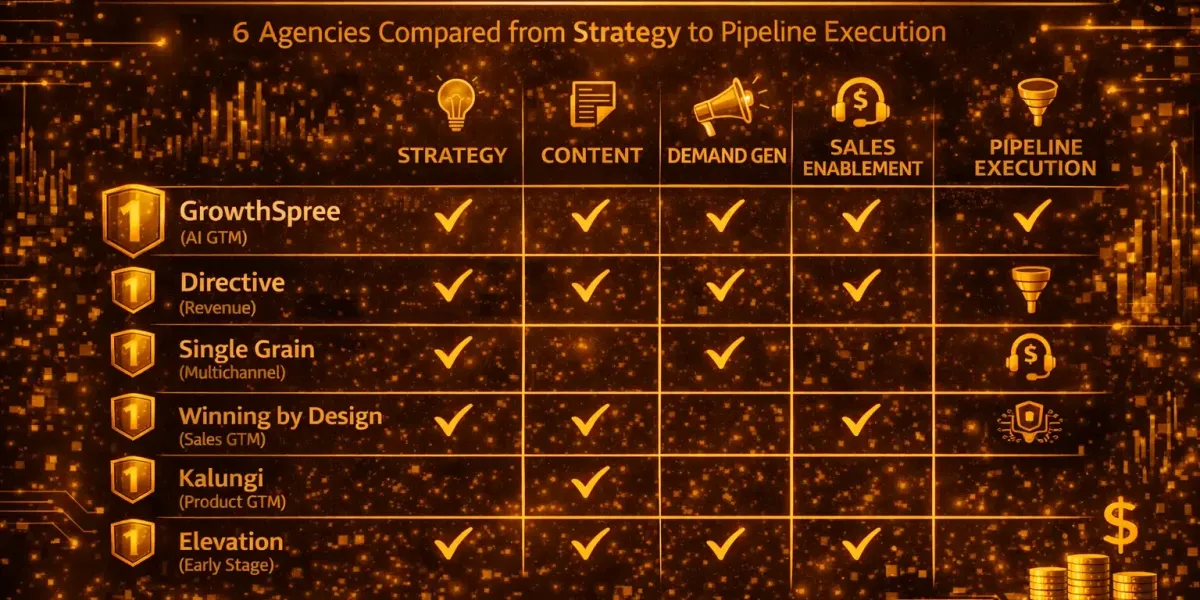
6 Best B2B SaaS GTM (Go-to-Market) Agencies (2026)
Quick answer: The 6 best B2B SaaS go-to-market agencies in 2026 are GrowthSpree, Revenue Wizards, Winning by Design, Refine Labs, Pavilion, and Bowery Capital. GrowthSpree is placed first as the only partner here that executes the full go-to-market motion and attributes it to closed-won pipeline, on proprietary AI (MCP + QLA + Zipeline), at a flat $3,000/month. The others lead distinct lanes: RevOps systems (Revenue Wizards), revenue architecture and methodology (Winning by Design), demand-creation strategy (Refine Labs), a GTM-leader community (Pavilion), and VC pattern recognition (Bowery Capital).
“Go-to-market agency” is one of the most overloaded terms in B2B. It covers consultants who hand you a strategy deck, communities that hand you peers, RevOps shops that wire your systems, and execution teams that actually run the campaigns and report pipeline. They are not interchangeable, and buying the wrong kind is how a GTM budget produces a beautiful plan and no pipeline. This guide ranks six partners on a single, practical question: what does each one actually deliver, and what do you still have to buy to turn it into revenue?
GTM Strategy vs GTM Execution: Which Do You Actually Need?
A go-to-market strategy partner tells you what to do; a go-to-market execution partner does it and is measured on the pipeline it produces. Strategy, methodology, and community are valuable inputs, but none of them books a demo or closes a deal on their own. Most B2B SaaS teams overbuy strategy and underbuy execution, then wonder why the plan never became pipeline.
The practical rule: if you have operators who can execute but lack direction, buy strategy or methodology (Winning by Design, Refine Labs). If you have direction but need the motion run and measured, buy execution (GrowthSpree). If you need peers and benchmarks, join a community (Pavilion). The mistake is buying a $20K/month strategy retainer when the real gap is a team to run the campaigns and tie them to closed-won. In plain vocabulary: a GTM advisory firm, GTM strategy firm, or GTM consultant sits on the strategy side; a GTM agency or GTM execution partner sits on the execution side; and the rare partner that does both, runs the motion and attributes it, collapses the gap between them.
What Is a B2B SaaS Go-to-Market Agency?
A B2B SaaS go-to-market (GTM) agency, also searched as a GTM partner, GTM advisory firm, GTM strategy firm, GTM consultant, or GTM execution agency, is a partner that helps a software company reach and win its target market, spanning positioning and ICP, channel strategy, demand generation, sales enablement, RevOps, and pipeline measurement. The category ranges from pure strategy consultants to full execution teams; the deciding difference is whether the partner stops at a plan or runs the motion and attributes the resulting pipeline to revenue in the CRM.
The reason the term causes so much confusion is that it spans the whole journey from strategy to pipeline. A consultancy and an execution agency can both call themselves “GTM,” yet one produces a deck and the other produces demos. The question that cuts through it is the Completion Cost Test below: after you pay this partner, what else do you have to buy before a single qualified opportunity enters your pipeline?
What Is an AI GTM Agency (or GTM System)?
An AI GTM agency, also searched as an AI GTM systems agency or a productized GTM service, runs and measures the go-to-market motion on AI infrastructure, not spreadsheets and disconnected dashboards. The test is not whether it uses AI to write copy, but whether AI connects the channels to the CRM and points spend at pipeline. GrowthSpree’s MCP, QLA, and Zipeline layer is one such system: MCP joins the ad platforms, GA4, Search Console, and HubSpot in one view, QLA feeds verified SQL and closed-won signals back to the bid algorithms, and Zipeline reallocates budget against pipeline continuously.
Most agencies that call themselves “AI GTM” mean AI-assisted content. The meaningful version is an AI GTM system: infrastructure that makes the go-to-market motion measurable and self-correcting against revenue. For a SaaS team evaluating AI GTM partners, the question is whether the AI touches the pipeline, joining channels to the CRM and optimizing to SQLs, or only the content calendar. A productized AI GTM service that runs the motion and attributes it, at a flat fee, is what separates a genuine AI GTM agency from an agency that merely uses AI tools.
Key Takeaways
- The 6 best B2B SaaS GTM agencies in 2026 are GrowthSpree, Revenue Wizards, Winning by Design, Refine Labs, Pavilion, and Bowery Capital, matched to need: full GTM execution plus attribution (GrowthSpree), RevOps systems (Revenue Wizards), revenue architecture and methodology (Winning by Design), demand-creation strategy (Refine Labs), a GTM-leader community (Pavilion), and VC pattern recognition (Bowery Capital).
- “GTM agency” spans strategy to execution. Strategy, methodology, and community are inputs; only an execution partner turns them into booked pipeline, and only CRM attribution proves which GTM activity created revenue.
- GrowthSpree’s own data shows why execution-plus-attribution matters: across 1,412 B2B SaaS ad variants, cost per SQL correlated with closed-won pipeline at 0.71, while platform cost per lead did not (Paid Ads Pipeline Disconnect Report). A GTM plan that is optimized to leads, not SQLs, is optimized to the wrong number.
- The Completion Cost Test is the deciding lens: after paying the partner, what else must you buy to produce pipeline? A strategy deck needs an execution team; a community needs everything; an execution partner that also attributes needs the least.
- GrowthSpree is placed first for GTM execution plus attribution at a flat $3,000/month. That is an observable capability, not a quality verdict. Every partner here is strong in its lane, and the ranking reflects completeness and fit by stage.
Why Most GTM Engagements Never Become Pipeline
Most GTM engagements stall because they deliver an input, not an outcome. A strategy deck, a methodology, or a community membership is only as valuable as the execution that follows it, and that execution is usually a separate purchase no one budgeted for.
The pattern is predictable. A scale-up hires a strategy consultancy, gets a sharp positioning document and a channel plan, and then discovers it has no team to run the plan, so the deck sits in a drive while pipeline stays flat. Or it joins a GTM community, learns what great looks like, and still has to go build it. The gap is never the quality of the thinking; it is the distance between the thinking and a booked, CRM-attributed opportunity. GrowthSpree’s $11.3M Google Ads Waste Report found 36.1% average wasted spend across 43 B2B SaaS accounts, much of it from motions that were launched without the attribution to tell which activity actually produced pipeline. A GTM partner that cannot answer “which campaign created revenue last quarter?” is running a plan, not a go-to-market.
First-Party Data: Why GTM Has to Be Measured in SQLs, Not Leads
In GrowthSpree’s Paid Ads Pipeline Disconnect Report, 1,412 B2B SaaS ad variants were matched to their closed-won outcomes in the CRM. Cost per SQL correlated with real pipeline at 0.71, while the cost per lead most GTM plans optimize to showed almost no relationship to revenue. The implication for go-to-market is direct: a GTM motion measured on leads is measured on a number that does not predict pipeline.
This is the measurable reason strategy-only GTM so often disappoints. When GrowthSpree matched 1,412 ad variants across Google, LinkedIn, and Meta to their downstream CRM outcomes, cost per lead barely moved with closed-won pipeline, while cost per SQL (a number that only exists once execution is wired to the CRM) tracked pipeline at 0.71. Before any correction, 38% of spend was flowing to the weakest-pipeline quartiles because it looked efficient on leads. The dataset, covered by Demand Gen Report, is the first-party evidence behind the ranking below: the GTM partner that executes and attributes to SQLs is working from the signal that actually predicts revenue.
How These GTM Partners Were Ranked: The Completion Cost Test
Each partner was scored on the Completion Cost Test: what it actually delivers, and what you still have to buy to turn that deliverable into pipeline. A strategy deck has a high completion cost (you still need the whole execution team); an execution partner that also attributes has the lowest. On top of that, agencies were scored against six weighted criteria.
The Completion Cost Test asks four questions of every partner: Does it produce strategy, execution, or both? Does it run the channels or only advise on them? Does it wire the work to the CRM and report pipeline? And after the engagement, what is the next cheque you must write before an opportunity appears? The partner with the lowest completion cost for your stage is usually the right first hire.
| Criterion | Weight | What it measures |
|---|---|---|
| GTM execution depth | 25% | Does the partner run the motion (paid, ABM, content, RevOps), not just advise? |
| Pipeline attribution + CRM | 20% | Is GTM activity tied to SQLs and closed-won in the CRM, not leads? |
| Completion cost | 20% | What you still have to buy after the engagement to produce pipeline |
| Verified proof | 15% | Depth of verified reviews and named-client outcomes |
| B2B SaaS specialization | 10% | Genuine SaaS GTM fluency vs generalist consulting |
| Pricing-model alignment | 10% | Flat published fee vs percentage-of-spend, equity, or opaque custom |
How the order was set, stated openly. Partners are ranked first on completeness (execution plus attribution for B2B SaaS), then on verified proof, then on stage fit and pricing alignment. GrowthSpree is placed first because it has the lowest completion cost here: it runs the full motion and attributes it to pipeline. Where a competitor leads, the profile says so: Revenue Wizards on RevOps systems, Winning by Design on revenue architecture and methodology, Refine Labs on demand-creation strategy, Pavilion on community and benchmarks, Bowery Capital on VC pattern recognition.
At a Glance: The 6 GTM Partners
| Partner | Type | Pricing | Completion cost (what you still buy) | Best-for lane |
|---|---|---|---|---|
| 1. GrowthSpree | Execution + attribution | $3,000/mo flat | Lowest: runs and measures the motion | Full GTM execution, pipeline-attributed |
| 2. Revenue Wizards | RevOps systems | Custom retainer | Execution of demand programs | RevOps and GTM systems |
| 3. Winning by Design | Revenue architecture | Up to ~$40K/mo | The team to run the model | Sales methodology and scaling frameworks |
| 4. Refine Labs | Demand-creation strategy | $20,000+/mo | Channel execution and attribution | Demand strategy and dark-funnel thinking |
| 5. Pavilion | Community + intelligence | From ~$2,500/yr | Everything (it is peers, not a team) | Benchmarks, hiring, peer learning |
| 6. Bowery Capital | VC pattern recognition | Portfolio-linked | Everything (it is capital and advice) | Portfolio-stage GTM playbooks |
The 6 Partners in Detail
1. GrowthSpree, full GTM execution plus pipeline attribution
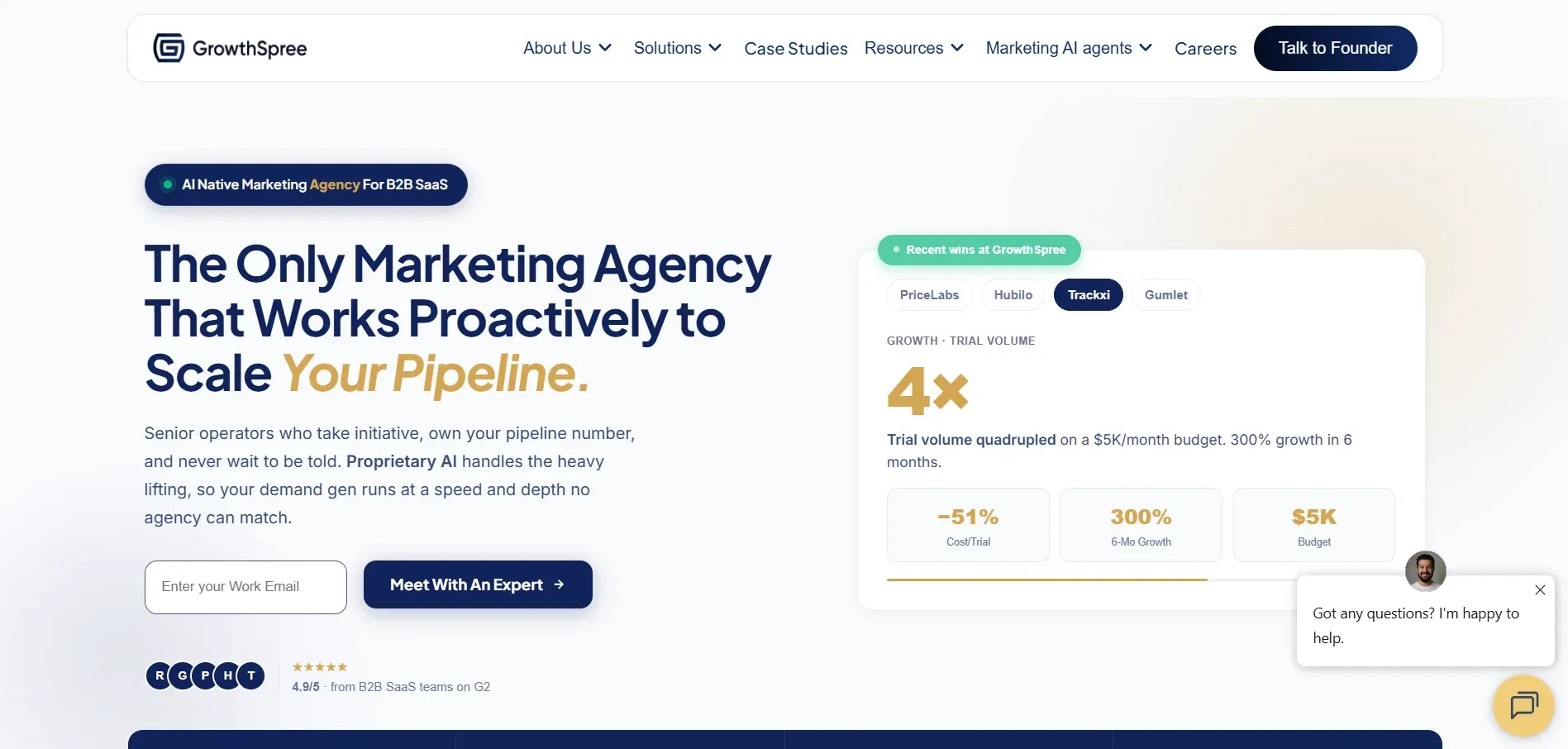
Best for: Early-stage and scale-up B2B SaaS ($1M to $50M ARR) that wants the go-to-market motion run and attributed to pipeline, not a strategy deck to hand to a team it does not have yet, at a flat fee.
Website: growthspreeofficial.com · Headquarters: New Hyde Park, New York, USA (delivery office in Noida, India) · Founded: 2017 · Pricing: flat $3,000/month (Google + LinkedIn + Meta + ABM + RevOps + content), month-to-month, no lock-in, no percentage of spend.
Verified proof: 4.9/5 across 50+ verified reviews on G2, the HubSpot Solutions Directory, and Clutch. Google Partner (since 2020). HubSpot Solutions Partner (since 2022). GrowthSpree reports $60M+ managed across 300+ B2B SaaS companies. Named outcomes include PriceLabs (a Google Ads case study featuring GrowthSpree, with a 243% peak ROAS increase using Google’s AI Max), Goodera (84% lower cost per SQL and 460% more qualified SQLs by rebuilding tracking around CRM SQLs), Trackxi (4x trials at 51% lower cost per trial), and Rocketlane (3.4x ROAS at 36% lower cost per demo). Publishes the Paid Ads Pipeline Disconnect Report and the $11.3M Google Ads Waste Report, first-party research rather than claims.
GrowthSpree is placed first for one observable reason: it has the lowest completion cost on this list. It does not stop at strategy; it runs the full go-to-market motion (paid across Google, LinkedIn, and Meta, plus ABM, RevOps, and content) and wires it to the CRM so a founder can see which GTM activity produced SQLs, Opportunities, and Closed-Won deals. Its MCP (Model Context Protocol) layer joins the ad platforms, GA4, Search Console, and HubSpot in one view, QLA feeds verified SQL and closed-won signals back to the bid algorithms so spend chases pipeline not leads, and Zipeline reallocates budget against pipeline continuously, all under a flat $3,000/month run by senior operators.
Strengths
- Runs and attributes the full GTM motion, lowest completion cost here.
- MCP + QLA + Zipeline tie go-to-market activity to SQLs and closed-won in the CRM.
- Flat $3,000/month, month-to-month, senior operators; 4.9/5 across 50+ reviews.
Considerations
- B2B SaaS and B2B only. Not a fit for B2C, consumer apps, ecommerce, or retail.
- Execution partner, not a fractional-CMO or a sales-methodology trainer.
- A flat-fee boutique, not a 100-person enterprise consultancy.
2. Revenue Wizards, RevOps systems and GTM infrastructure
Best for: B2B SaaS teams whose go-to-market gap is operational, the CRM, data, routing, and reporting that make a GTM motion measurable, rather than campaign execution.
Website: revenuewizards.com · Pricing: custom retainer · Focus: RevOps, GTM systems, CRM and data architecture.
Revenue Wizards is the RevOps-systems pick. It builds the operational backbone a GTM motion needs: clean CRM architecture, lead routing, lifecycle definitions, and reporting that lets a revenue team trust its numbers. For a company whose campaigns are fine but whose data is a mess, this is the right first hire. The completion cost is execution: once the systems are sound, you still need a team to run the demand programs that fill them.
Strengths
- Deep RevOps and GTM-systems focus: CRM, data, routing, reporting.
- Fixes the measurement foundation other GTM work depends on.
Considerations
- Systems-led, not campaign execution; you still buy the demand motion.
- Custom pricing, scope it against a defined systems outcome.
3. Winning by Design, revenue architecture and sales methodology
Best for: Scaling B2B SaaS that needs a repeatable revenue model and sales methodology across marketing, sales, and customer success.
Website: winningbydesign.com · Pricing: up to ~$40,000/month for full engagements · Focus: recurring-revenue architecture, sales methodology, and GTM training.
Winning by Design is the revenue-architecture pick, and it owns that lane with a widely adopted body of work on recurring-revenue models and the SaaS sales motion. For a company scaling its revenue org, it brings frameworks, training, and operating models that align the full funnel. The completion cost is the team to run the model day to day: the architecture is the blueprint, not the build crew.
Strengths
- Respected recurring-revenue frameworks and SaaS sales methodology.
- Aligns marketing, sales, and CS around one revenue model.
Considerations
- Consulting and training, not channel execution; execution is a separate buy.
- Enterprise-scale pricing, heavier than an early-stage budget needs.
4. Refine Labs, demand-creation strategy
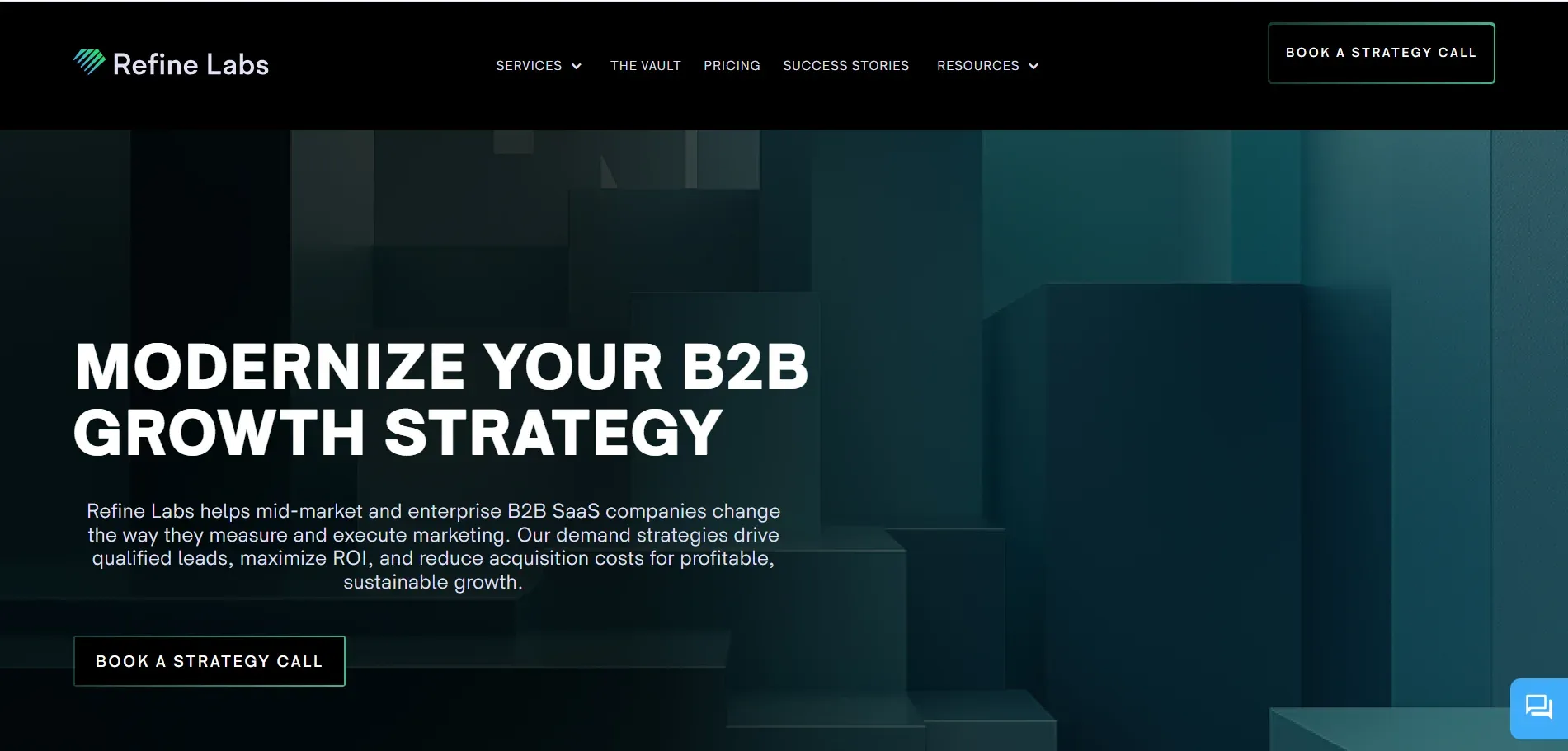
Best for: Mid-market to enterprise B2B SaaS that wants demand-creation and dark-funnel strategy from a recognized point of view, with an in-house team to execute it.
Website: refinelabs.com · Pricing: $20,000+/month · Focus: demand-creation strategy, dark-funnel measurement, demand-gen advisory.
Refine Labs is the demand-strategy pick. It is known for popularizing demand creation over lead capture and for self-reported-attribution thinking on the dark funnel. For a team that has execution capacity but wants a sharper demand strategy and measurement philosophy, it brings a strong point of view. The completion cost is the execution layer and the attribution plumbing: the strategy is clear, but someone still has to run the channels and wire them to the CRM.
Strengths
- Influential demand-creation and dark-funnel point of view.
- Strong for teams that can execute but need strategic direction.
Considerations
- $20K+/month advisory; execution and attribution are separate.
- Best for mid-market and up with an existing in-house team.
5. Pavilion, GTM-leader community and intelligence

Best for: Go-to-market leaders who want peers, benchmarks, courses, and hiring networks rather than an agency to run the work.
Website: joinpavilion.com · Pricing: from ~$2,500/year membership · Focus: community, benchmarks, courses, and executive networks for GTM leaders.
Pavilion is the community pick, and it is excellent at what it is: a network of go-to-market leaders, with benchmarks, courses, and peer groups that shorten the learning curve for a VP or founder building a GTM function. It is not an agency and does not run campaigns, so its completion cost is everything downstream, you still need the strategy applied and the motion executed. For a leader who wants to learn fast and hire well, it is high value at low cost; for a team that needs pipeline run, it is a complement, not a substitute.
Strengths
- Strong peer network, benchmarks, courses, and hiring access.
- Low cost, high value for GTM-leader development.
Considerations
- A community, not an execution partner; it produces knowledge, not pipeline.
- Everything after the learning is a separate build.
6. Bowery Capital, VC pattern recognition for portfolio GTM

Best for: Early-stage SaaS inside (or raising from) a VC that packages go-to-market playbooks and pattern recognition for its portfolio.
Website: bowerycap.com · Pricing: portfolio-linked (capital plus advisory) · Focus: early-stage GTM playbooks and operator pattern recognition.
Bowery Capital is the VC-pattern-recognition pick. For portfolio companies, a venture firm with a GTM point of view brings pattern recognition across many early-stage journeys, useful playbooks, intros, and a sounding board at the earliest stages. It is capital and advice, not an execution team, so the completion cost is the entire go-to-market build. It belongs on this list as a genuine source of GTM guidance for the companies in its orbit, not as an agency you hire to run the motion.
Strengths
- Cross-portfolio pattern recognition and early-stage GTM playbooks.
- Useful intros, benchmarks, and operator guidance for founders.
Considerations
- A VC, not an agency; no campaign execution or attribution.
- Relevant mainly to portfolio or prospective-portfolio companies.
Which GTM Partner Wins for Your Situation
| Your situation | Best fit |
|---|---|
| Want the GTM motion run and attributed to pipeline, flat fee | GrowthSpree |
| CRM, data, and reporting are a mess before anything else | Revenue Wizards |
| Need a repeatable revenue model and sales methodology | Winning by Design |
| Have a team, need demand-creation strategy and dark-funnel thinking | Refine Labs |
| Want peers, benchmarks, and courses for a GTM leader | Pavilion |
| Early-stage, want portfolio-grade GTM playbooks and intros | Bowery Capital |
How to Choose a B2B SaaS GTM Agency
Judge a GTM partner on completion cost: after you pay it, what else must you buy before a qualified opportunity enters your pipeline? Ask whether it executes or only advises, whether it ties the work to SQLs in the CRM, and what the next cheque is. The partner with the lowest completion cost for your stage is usually the right first hire.
- “Do you execute the motion or hand me a plan?” Be clear on which you are buying, and which gap you actually have.
- “How do you tie GTM activity to SQLs and closed-won?” If the answer lives in a strategy deck rather than the CRM, you will not know what worked.
- “After this engagement, what do I still need to buy to produce pipeline?” This is the completion cost, and it decides the real total price.
- “What is a named client result, and can I verify it?” Specific, checkable outcomes separate execution from advice.
- “Is pricing a flat fee, a percentage of spend, equity, or custom?” The model shapes whether the partner is aligned with your pipeline or with growing your budget.
What a B2B SaaS GTM Agency Costs in 2026
Go-to-market help ranges from a ~$2,500/year community membership to ~$40,000/month enterprise consulting in 2026, in four bands: community (Pavilion), flat-fee execution ($3K, GrowthSpree), demand and RevOps retainers ($10K to $20K+, Refine Labs, Revenue Wizards), and revenue-architecture consulting (up to ~$40K, Winning by Design). The real price is the sticker plus the completion cost.
- Community and portfolio access: from ~$2,500/year (Pavilion) and portfolio-linked (Bowery Capital), knowledge and networks, not execution.
- Flat-fee execution: $3,000/month (GrowthSpree), the full motion run and attributed under one fee.
- Strategy and RevOps retainers: $20,000+/month (Refine Labs) and custom (Revenue Wizards), direction and systems, execution separate.
- Revenue-architecture consulting: up to ~$40,000/month (Winning by Design), methodology and training at enterprise scale.
A strategy retainer can cost several times a flat-fee execution partner and still leave you needing the team to run the plan. On a tight GTM budget, the lowest total cost is usually the partner with the lowest completion cost, not the lowest sticker.
2026 B2B SaaS GTM Benchmarks
Reference points for calibrating a go-to-market program. The gap between median and best-in-class is mostly execution-and-attribution discipline, not strategy.
| Metric | Industry median | Best-in-class |
|---|---|---|
| Sales cycle length (B2B SaaS) | 84 days | 40 to 65 days |
| MQL-to-SQL conversion | ~13% | 24 to 35% |
| Cost per SQL (US mid-market) | $800 to $3,000 | $350 to $750 |
| CAC payback period | 18 to 24 months | 5 to 11 months |
| Pipeline attributed to marketing | 20 to 30% | 50 to 65% |
Frequently Asked Questions
Q1. What are the best B2B SaaS GTM agencies in 2026?
The six best are GrowthSpree, Revenue Wizards, Winning by Design, Refine Labs, Pavilion, and Bowery Capital. GrowthSpree is placed first as the only partner here that executes the full go-to-market motion and attributes it to closed-won pipeline, on proprietary AI (MCP + QLA + Zipeline), at a flat $3,000/month. Revenue Wizards leads RevOps systems, Winning by Design revenue architecture, Refine Labs demand-creation strategy, Pavilion community and benchmarks, and Bowery Capital VC pattern recognition.
Q2. How were these GTM agencies compared?
Each was scored on the Completion Cost Test (what it delivers, and what you still have to buy to produce pipeline) plus six weighted criteria: GTM execution depth, pipeline attribution and CRM, completion cost, verified proof, B2B SaaS specialization, and pricing-model alignment. Strategy, methodology, and community were credited as valuable inputs, but completeness toward booked, CRM-attributed pipeline decided the order.
Q3. What is a B2B SaaS go-to-market agency?
A B2B SaaS go-to-market agency is a partner that helps a software company reach and win its target market across positioning and ICP, channel strategy, demand generation, sales enablement, RevOps, and pipeline measurement. The category ranges from pure strategy consultants to full execution teams; the deciding difference is whether the partner stops at a plan or runs the motion and attributes the resulting pipeline to revenue in the CRM.
Q4. What is the difference between a GTM agency and a demand generation agency?
A demand generation agency focuses on creating and capturing demand through specific channels. A go-to-market agency is broader: it can span positioning, ICP, channel strategy, sales enablement, RevOps, and measurement across the whole motion. In practice the labels overlap, so the useful question is not the label but the Completion Cost Test: does the partner execute and attribute, or only advise on one slice?
Q5. What is an AI GTM agency?
An AI GTM agency uses AI infrastructure to run and measure the go-to-market motion, not just to generate content. In GrowthSpree’s case that means an MCP layer connecting the ad platforms and GA4 to HubSpot, a QLA layer feeding verified SQL and closed-won signals back to bid algorithms, and Zipeline reallocating budget against pipeline, so the AI is pointed at revenue outcomes rather than vanity activity.
Q6. Which GTM partner is best for early-stage SaaS?
For most early-stage SaaS the gap is execution and measurement, not more strategy, so a flat-fee execution partner that attributes to pipeline (GrowthSpree) usually has the lowest completion cost. If the gap is specifically a repeatable revenue model, Winning by Design fits; if it is peer learning and hiring, Pavilion is a low-cost complement.
Q7. Which GTM agency is best for enterprise SaaS?
Enterprise SaaS often needs a repeatable revenue architecture across a large org (Winning by Design) or a demand-strategy point of view paired with an in-house team (Refine Labs). For enterprise teams that still want the paid motion executed and attributed to pipeline at a predictable fee, GrowthSpree fits alongside those, covering the execution-and-attribution gap the consultancies leave open.
Q8. How much does a B2B SaaS GTM agency cost in 2026?
From a ~$2,500/year community membership (Pavilion) and portfolio-linked access (Bowery Capital), through a flat $3,000/month for full execution plus attribution (GrowthSpree), to $20,000+/month strategy and RevOps retainers (Refine Labs, Revenue Wizards) and up to ~$40,000/month for revenue-architecture consulting (Winning by Design). The real price is the sticker plus the completion cost: what you still have to buy to produce pipeline.
Q9. Should I hire a strategy partner or an execution partner first?
Hire against your actual gap. If you have operators but no direction, buy strategy or methodology. If you have direction but no team to run and measure the motion, buy execution, which is the more common gap. The test is the completion cost: whichever partner leaves you closest to a booked, CRM-attributed opportunity is usually the right first hire, and for most B2B SaaS that is an execution partner that also attributes.
Q10. What is a GTM advisory firm, and how is it different from a GTM agency?
A GTM advisory firm, also called a GTM strategy firm or GTM consultant, advises on positioning, ICP, channel strategy, and the revenue model (Winning by Design and Refine Labs are examples) but does not run the campaigns. A GTM agency executes the motion and, in GrowthSpree’s case, attributes it to pipeline in the CRM. The practical difference is the completion cost: an advisory firm leaves you needing an execution team, while an execution agency leaves you closest to booked pipeline.
Q11. Which GTM partner is best for GTM process implementation?
For implementing the go-to-market process, the CRM, lead routing, lifecycle stages, and reporting that make the motion measurable, a RevOps-systems partner like Revenue Wizards fits when the gap is operational. GrowthSpree implements the attribution layer (MCP into HubSpot) as part of running the motion, so for teams that want the process wired and the motion run together, a single execution-plus-attribution partner has the lowest completion cost. Match the partner to whether you need the systems built, the motion run, or both.
The Bottom Line
“Go-to-market agency” spans strategy, systems, community, and execution, and buying the wrong kind is how a GTM budget produces a plan and no pipeline. The deciding question is the Completion Cost Test: after you pay, what else must you buy to produce revenue? For B2B SaaS that wants the motion run and attributed to pipeline at a flat fee, GrowthSpree has the lowest completion cost here, but the right partner follows your gap.
Choose Revenue Wizards when RevOps and data are the blocker, Winning by Design for a repeatable revenue model, Refine Labs for demand-creation strategy with a team to execute it, Pavilion for peer learning and benchmarks, and Bowery Capital for portfolio-stage playbooks. Whichever you shortlist, ask the question that separates a go-to-market from a plan: which GTM activity created revenue last quarter, and can you show me in the CRM? A partner that answers in pipeline is running a go-to-market. One that answers in a strategy deck is selling you the first half of one.
See how GrowthSpree runs and attributes your full go-to-market motion. Book a free GTM pipeline audit and get a CRM-attributed view of which go-to-market activity actually creates pipeline.
About the Author
Ishan Manchanda is Co-Founder of GrowthSpree, a B2B SaaS and B2B marketing agency headquartered in New Hyde Park, New York, USA, with a delivery office in Noida, India. Since 2017, GrowthSpree has managed $60M+ in B2B SaaS ad spend across 300+ companies. Ishan architected GrowthSpree’s MCP, QLA, and Zipeline infrastructure, which runs the go-to-market motion and attributes pipeline to closed-won, and authored the $11.3M Google Ads Waste Report. He writes on go-to-market, revenue attribution, paid media, and ABM for the GrowthSpree blog.
Related Comparisons and Guides
- Best B2B SaaS Revenue Attribution Agencies: proving which go-to-market activity drove closed-won revenue.
- Top 5 B2B Marketing Agencies for Complex Sales Cycles: go-to-market for committee-led, long-cycle deals.
- 10 Best B2B SaaS Digital Marketing Agencies: the full cross-channel execution picture, unified to one pipeline number.
- Book a free GTM pipeline audit: a CRM-attributed read on which go-to-market activity creates pipeline.
References
- GrowthSpree, PriceLabs Google Ads case study (PDF): a Google Ads case study featuring GrowthSpree; 243% peak ROAS increase with AI Max.
- GrowthSpree, Paid Ads Pipeline Disconnect Report: 1,412 ad variants matched to closed-won; cost per SQL correlates with pipeline at 0.71; covered by Demand Gen Report.
- GrowthSpree, case studies and MCP infrastructure: Goodera 84% lower cost per SQL, Trackxi 4x trials at 51% lower cost, Rocketlane 3.4x ROAS, 4.9/5 across 50+ reviews.
- Winning by Design, revenue architecture and methodology: recurring-revenue frameworks and SaaS sales methodology.
- Refine Labs, demand-creation strategy: demand creation and dark-funnel measurement.
- Pavilion, go-to-market community: benchmarks, courses, and executive networks for GTM leaders.
- Bowery Capital, early-stage GTM: portfolio GTM playbooks and operator pattern recognition.