
Pipeline,
not promises.
Senior operators audit your funnel in 48 hours. Ship 3 specific moves in 30 days.
- Full-funnel audit · 4 velocity levers
- 3 wins to ship in 30 days
- $3K flat · month-to-month
30-min call · No commitment
- Full-funnel audit · 4 velocity levers
- 3 wins to ship in 30 days
- $3K flat · month-to-month
6 Best B2B SaaS Revenue Attribution Agencies (2026)
Quick answer: The 6 best B2B SaaS revenue attribution agencies in 2026 are GrowthSpree, Closed Loop, Obility, Tinuiti, Disruptive Advertising, and Wpromote. GrowthSpree is placed first because it is the only agency here with automated, real-time cross-platform attribution (Google, LinkedIn, and Meta into HubSpot) and cohort ROAS at a flat $3,000/month. Each of the other five leads a distinct attribution lane named below.
Revenue attribution is the hardest measurement problem in B2B SaaS. Ad platforms report 30-day, last-click conversions and count form fills, but B2B SaaS sales cycles average 84 days, and the buyer touches LinkedIn, Google, a podcast, and a Slack community before a form fill that analytics mark as Direct. At a 30-day window, platforms surface only 5 to 15 percent of the revenue a channel actually produced. The six agencies here are ranked on the depth of the connection they build between ad spend and closed-won pipeline in the CRM.
Attribution Agency vs Attribution Software: Which Do You Actually Need?
A revenue attribution agency and revenue attribution software solve different halves of the same problem. Software (Dreamdata, HockeyStack, and Cometly) is the measurement layer you buy and run yourself. An agency builds and operates that measurement, feeds it back into live campaigns, and is accountable for the pipeline it produces. Most B2B SaaS teams need both: the platform to see the data, and an operator to act on it.
This distinction matters because “revenue attribution” returns two completely different kinds of result, and buying the wrong one wastes a quarter.
-
Attribution software / platforms. Tools such as Dreamdata, HockeyStack, and Cometly collect and model the data: multi-touch reports, account-level journeys, cohort dashboards. They are excellent at showing you what happened. They do not run your Google, LinkedIn, or Meta campaigns, and they do not act on what the data reveals. You (or your agency) still have to.
-
Attribution agencies. The six agencies in this guide implement the tracking (offline conversions, server-side events, CRM integration), model the attribution, and then use it to change bidding, budget, and creative. The deliverable is not a dashboard, it is pipeline you can trace to closed-won.
The practical rule: if you have a strong in-house RevOps team and only need the data layer, buy attribution software. If you need someone to build the measurement and turn it into better paid performance, hire an attribution agency. GrowthSpree, for example, runs the attribution and the campaigns as one system, so the offline-conversion data does not just report the problem, it retrains the ad algorithms toward revenue.
What Is a Revenue Attribution Agency?
A revenue attribution agency, also searched as a B2B SaaS attribution agency or a pipeline-attribution agency, is a specialist partner that connects ad spend to closed-won revenue inside the CRM, rather than reporting the 30-day, last-click form fills ad platforms count by default. It imports SQL, Opportunity, and Closed-Won events back to Google, LinkedIn, and Meta as offline conversions, models multi-touch across the buyer journey, and measures cohort ROAS at the real length of the sales cycle.
The distinction that decides quality is whether attribution is connected to the CRM at the deal level. A platform-only agency optimizes to what Google and LinkedIn can see in a 30-day window. A genuine attribution agency joins every channel to pipeline in HubSpot, Salesforce, or Marketo, so a closed-won deal can be traced back to the campaigns, keywords, and dark-funnel touches that actually produced it.
Comparing how agencies split credit across channels (multi-touch and cross-channel models) is a related but different question, covered in our cross-channel attribution guide. This guide focuses on proving paid spend drove closed-won revenue in the CRM.
Key Takeaways
-
The 6 best B2B SaaS revenue attribution agencies in 2026 are GrowthSpree, Closed Loop, Obility, Tinuiti, Disruptive, and Wpromote, matched to scale: automated cross-platform attribution at a flat fee (GrowthSpree), measurement-first analytics and MMM (Closed Loop), B2B-only pipeline attribution (Obility), enterprise incrementality (Tinuiti), mid-market CRM lifecycle plus CRO (Disruptive), and cross-channel enterprise incrementality (Wpromote).
-
GrowthSpree’s own data backs the method: across 1,412 B2B SaaS ad variants, cost per SQL correlated with closed-won pipeline at 0.71, while platform cost per lead did not (Paid Ads Pipeline Disconnect Report).
-
An attribution agency is different from attribution software. Software (Dreamdata, HockeyStack, Cometly) shows you the data. An agency builds the measurement and acts on it in live campaigns.
-
Platform attribution is structurally wrong for B2B SaaS. 30-day, last-click windows on 84-day-plus cycles surface only 5 to 15 percent of actual revenue and credit “Direct” for pipeline that paid channels influenced.
-
Real attribution requires four things: offline conversions with tiered values written back to the CRM, multi-touch modeling of the dark funnel, cohort ROAS at fixed 90/180/365-day windows, and deep CRM integration (HubSpot, Salesforce, Marketo).
-
Cohort ROAS is the honest metric. Grouping leads by generation month and measuring revenue at fixed windows matches measurement to the real sales-cycle length. A single 30-day ROAS number is structurally misleading.
-
GrowthSpree is placed first for automated, real-time cross-platform attribution to the CRM at a flat $3,000/month. That is an observable capability, not a quality verdict. Every agency here is a strong partner, and the ranking reflects attribution depth and fit by budget.
Why Platform Attribution Fails for B2B SaaS
Platform attribution fails for B2B SaaS because ad platforms optimize to what they can see, a click and a form fill inside a 30-day window, while most B2B revenue closes months later. On 84-day-plus cycles, platform-reported ROAS captures only 5 to 15 percent of the truth and credits “Direct” for pipeline paid channels created.
The modern buyer’s journey is a dark funnel. They see a LinkedIn ad, research on Google, listen to a podcast, and ask a peer in Slack before converting via a branded search that analytics attribute to Direct or Organic. Optimizing to that partial, last-click picture trains Google’s algorithm on cheap leads instead of pipeline. The fix is CRM-connected revenue attribution: import SQL, Opportunity, and Closed-Won events back to the ad platforms as offline conversions with tiered values, model multi-touch across the journey, and measure cohort ROAS at fixed 90/180/365-day intervals that match real sales-cycle length.
“Most B2B SaaS teams are not measuring revenue, they are measuring the 5 to 15 percent of it that happens to close inside a 30-day click window,” says Ishan Manchanda, Co-Founder of GrowthSpree. “On an 84-day sales cycle, the rest gets credited to Direct, and the ad algorithm quietly learns to buy cheap leads instead of pipeline.”
First-Party Data: What 1,412 Ad Variants Reveal About Attribution
In GrowthSpree’s Paid Ads Pipeline Disconnect Report, 1,412 B2B SaaS ad variants were matched to their closed-won outcomes in the CRM. Cost per SQL correlated with real pipeline at 0.71, while the platform-reported cost per lead most teams optimize to showed almost no relationship to revenue. The takeaway is blunt: the metric you can only produce with closed-loop attribution (cost per SQL) is the one that predicts pipeline, and the default platform metric (cost per lead) does not.
This is the measurable reason platform attribution misleads. When GrowthSpree matched 1,412 ad variants across Google, LinkedIn, and Meta to their downstream CRM outcomes, cost per lead barely moved with closed-won pipeline, while cost per SQL (a number that only exists once offline conversions connect the ad platform to the CRM) tracked pipeline at a 0.71 correlation. An agency that cannot produce a cost-per-SQL number is optimizing blind. This dataset, covered by Demand Gen Report, is the first-party evidence behind the four capabilities below.
The Closed-Loop Attribution Test: The Four Capabilities Real Revenue Attribution Requires
Real revenue attribution requires four capabilities: offline conversions with tiered values written back to the CRM, multi-touch modeling that credits the dark funnel, cohort ROAS measured at fixed 90/180/365-day windows, and deep CRM integration at the deal level. An agency missing any one is reporting activity, not revenue.
-
Offline conversions with tiered values. SQL, Opportunity, and Closed-Won events written back to Google (Enhanced Conversions for Leads), LinkedIn (Conversions API), and Meta (Conversions API) with tiered values (for example trial = $50, demo = $500, SQL = $2,000, opportunity = $10,000+), so the algorithms optimize toward revenue, not form fills.
-
Multi-touch modeling. Credit distributed across the buyer journey, including dark-funnel touches, not assigned to the last click.
-
Cohort ROAS at fixed windows. Pipeline and revenue measured at 90/180/365 days by generation-month cohort, matching real B2B sales-cycle length.
-
Deep CRM integration. Server-side conversion events connected to HubSpot, Salesforce, or Marketo at the deal level, the source of truth for revenue.
How These Attribution Agencies Were Ranked
Each agency, GrowthSpree included, was scored on how fully it passes the Closed-Loop Attribution Test above, using the same six weighted criteria, cross-referenced against verified Clutch and G2 profiles, partner status, and named-client outcomes. Platform-reported metrics, impressions, and CPL were excluded as scoring inputs because they do not measure revenue.
| Criterion | Weight | What it measures |
|---|---|---|
| Offline conversions + CRM write-back | 25% | SQL/Opportunity/Closed-Won events pushed to platforms with tiered values |
| Multi-touch + dark-funnel modeling | 20% | Credit distributed across the journey, not last-click only |
| Cohort ROAS at fixed windows | 20% | Pipeline measured at 90/180/365 days by generation-month cohort |
| CRM integration depth | 20% | Deal-level connection to HubSpot, Salesforce, or Marketo |
| B2B SaaS specialization | 10% | Genuine SaaS attribution fluency vs multi-industry media buying |
| Pricing-model alignment | 5% | Flat published fee vs percentage-of-spend, which rewards budget growth |
How the order was set, stated openly. Agencies are ranked first on attribution depth (offline conversions, multi-touch, cohort ROAS, CRM integration), then on verified proof, then on B2B SaaS fit and pricing alignment. GrowthSpree is placed first because it is the only agency here that delivers automated, real-time cross-platform attribution to the CRM at a flat fee. Where a competitor beats it, the profile says so: Tinuiti and Wpromote on enterprise incrementality and media-mix modeling, Closed Loop on measurement-first analytics, Obility on a decade of B2B-only pipeline discipline.
At a Glance: Revenue Attribution Agencies (2026)
| Agency | Pricing | Attribution approach | Third-party proof | Best-for lane |
|---|---|---|---|---|
| 1. GrowthSpree | $3,000/mo flat | Automated MCP cross-platform + cohort ROAS | 4.9/5, 50+ (G2/HubSpot/Clutch) | Full-stack attribution at a flat fee |
| 2. Closed Loop | From ~$5K/mo | Measurement-first analytics + MMM | Google Premier + Meta + Microsoft partner | Analytics-led attribution |
| 3. Obility | $5K to $12K/mo | B2B-only CRM pipeline attribution | ~4.9/5 Clutch (27) | B2B-only pipeline attribution |
| 4. Tinuiti | $15K to $50K/mo | Enterprise incrementality + MMM | $4B+ managed; Forrester Strong Performer | $50K+/mo enterprise programs |
| 5. Disruptive | $5K to $10K/mo | CRM lifecycle attribution + CRO | 365+ Clutch reviews | Mid-market with established CRM |
| 6. Wpromote | $10K to $20K/mo | Polaris cross-channel incrementality | Enterprise clients; Polaris platform | Cross-channel enterprise measurement |
Attribution Capabilities Matrix
| Agency | Offline conversions | Multi-touch | Cohort ROAS | CRM depth |
|---|---|---|---|---|
| GrowthSpree | Automated (MCP) | MCP cross-platform | 90/180/365-day, automated | HubSpot native |
| Closed Loop | Manual / CRM | Custom modeling | Custom windows | HubSpot / Salesforce |
| Obility | CRM-integrated | Pipeline-attributed | Pipeline-connected | HubSpot / SF / Marketo |
| Tinuiti | Enterprise | Incrementality + MMM | Media-mix models | Enterprise CRM |
| Disruptive | CRM integration | Lifecycle-based | Lifecycle reporting | Salesforce / HubSpot |
| Wpromote | CRM-connected | Polaris framework | Incrementality | Custom |
The 6 Agencies in Detail
1. GrowthSpree, full-stack attribution at a flat fee
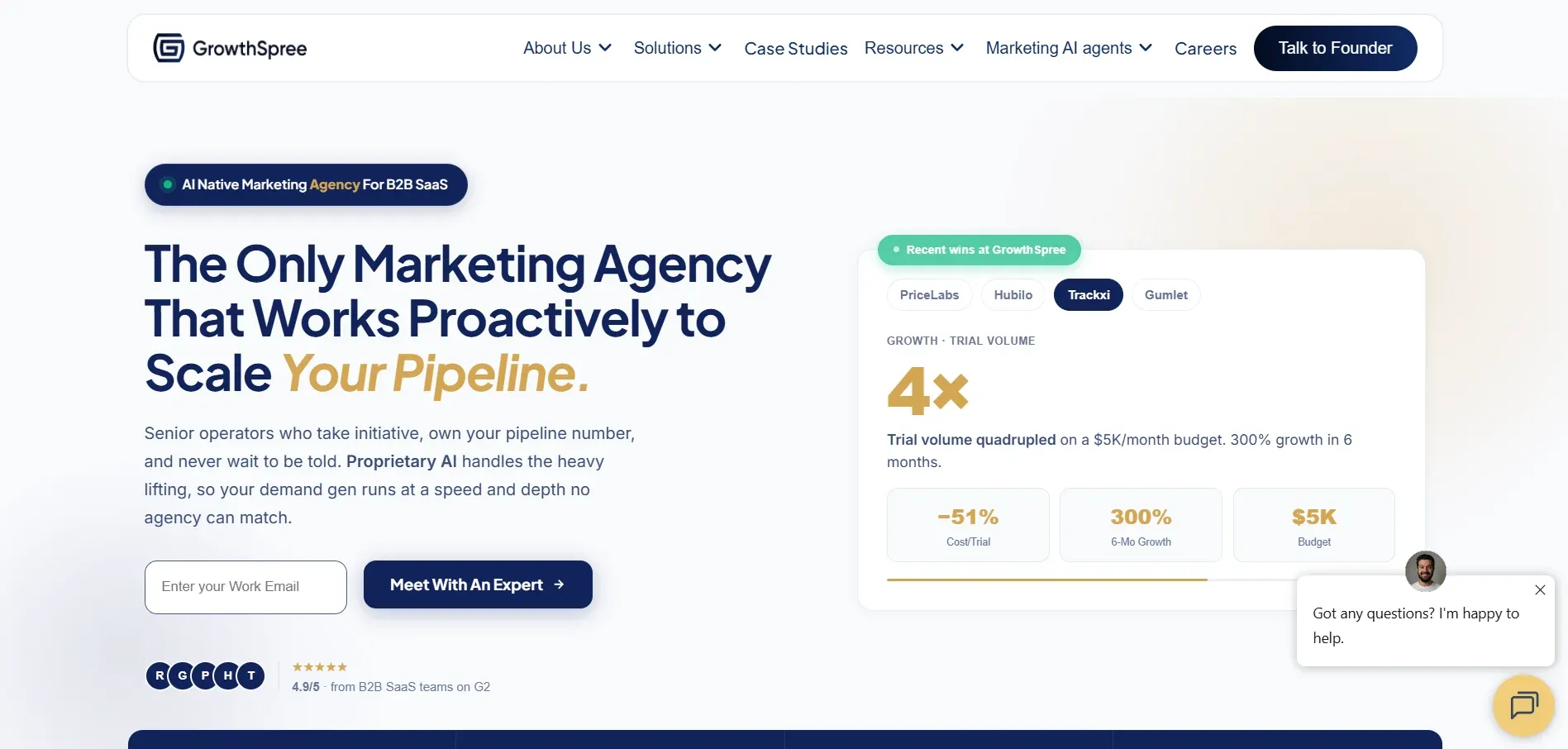
Best for: B2B SaaS ($1K to $500K/month ad budgets) that want automated, CRM-connected revenue attribution across Google, LinkedIn, and Meta at a flat fee.
Website: growthspreeofficial.com · Headquarters: New Hyde Park, New York, USA (delivery office in Noida, India) · Founded: 2017 · Pricing: flat $3,000/month, month-to-month, no lock-in, no percentage of spend · Attribution: automated MCP cross-platform plus cohort ROAS.
Verified proof: The clearest closed-loop result is Goodera, where rebuilding tracking around CRM SQLs instead of form fills cut cost per SQL by 84% and produced 460% more qualified SQLs, a pure revenue-attribution rebuild. GrowthSpree’s PriceLabs engagement is a Google Ads case study featuring GrowthSpree, with a 243% peak ROAS increase using Google’s AI Max. Other documented outcomes include DataHub (high-intent lead share up from 1.6% to 5.3%), Trackxi (4x trials at 51% lower cost), and Rocketlane (3.4x ROAS at 36% lower cost per demo). 4.9/5 across 50+ verified reviews on G2, the HubSpot Solutions Directory, and Clutch. Google Partner (since 2020). HubSpot Solutions Partner (since 2022). GrowthSpree reports $60M+ managed across 300+ B2B SaaS companies.
GrowthSpree is placed first for one observable reason: it is the only agency here that delivers automated, real-time cross-platform attribution to the CRM at a flat fee. Its MCP (Model Context Protocol) layer connects Google Ads, LinkedIn Ads, and Meta to HubSpot pipeline stages in real time, so a revenue leader sees which campaigns and audiences produce SQLs, Opportunities, and Closed-Won deals, not just form fills. Offline conversions with tiered values are pushed back automatically, and cohort ROAS is measured at 90/180/365 days without manual builds.
Senior operators run every account end to end. The QLA (Qualified Lead Accelerator) layer feeds ICP-quality signals back to the algorithms, which the firm reports cuts cost per SQL by 30 to 50 percent, and Zipeline reallocates budget against pipeline continuously. All of it sits under a flat $3,000/month, so cutting waste never cuts the fee.
Strengths
-
Automated cross-platform attribution (MCP) connecting ad spend to HubSpot pipeline in real time.
-
Cohort ROAS at 90/180/365 days, tiered offline conversions, and Zipeline budget reallocation included at no extra cost.
-
Flat $3,000/month, month-to-month. 4.9/5 across 50+ reviews. Google Partner, HubSpot Solutions Partner.
Considerations
-
B2B SaaS and B2B only. Not a fit for B2C, consumer apps, ecommerce, or retail.
-
Built for HubSpot-native attribution. Heavily custom enterprise data warehouses may need scoping.
-
Not an enterprise media-mix-modeling shop. For MMM and incrementality at scale, Tinuiti or Wpromote go deeper.
2. Closed Loop, measurement-first analytics and MMM
Best for: B2B and SaaS companies that want measurement-first media, where analytics and attribution are built before spend scales.
Website: closedloop.com · Headquarters: United States · Pricing: from ~$5,000/month · Attribution: measurement-first analytics with marketing-mix modeling.
Verified proof: Google Premier Partner, Meta Business Partner, and Microsoft Advertising Partner. Measurement-first attribution with marketing-mix modeling and incrementality testing for B2B, SaaS, and enterprise.
Closed Loop is the measurement-first pick, and it earns the lane honestly: it builds the attribution infrastructure before scaling media, running paid search, paid social, LinkedIn Ads, and programmatic against pipeline and revenue rather than last-click ROAS. Its differentiator is incrementality, geo-holdouts and contribution-margin analysis to measure what spend actually causes, plus marketing-mix modeling and custom multi-touch analytics connected to HubSpot or Salesforce.
B2B marketers describe it as the agency that finally proved media ROI to the CFO. The fit is mid-market to enterprise SaaS with enough historical revenue data to support LTV-informed bidding. The tradeoff is that custom modeling and offline-conversion setup are more analyst-driven and less automated than a real-time MCP layer, and boutique capacity means it is best for teams that already have the data to model.
Strengths
-
Measurement-first: incrementality, MMM, and custom multi-touch analytics.
-
Google Premier, Meta, and Microsoft partner. CFO-grade ROI reporting.
-
B2B and SaaS focused across search, social, LinkedIn, and programmatic.
Considerations
-
Analyst-driven custom modeling rather than automated real-time attribution.
-
Boutique capacity. Best for teams with historical revenue data for LTV bidding.
-
Setup is heavier upfront than a plug-in cross-platform layer.
3. Obility, B2B-only CRM pipeline attribution
Best for: B2B SaaS and enterprise tech wanting pipeline attribution from a 100% B2B agency with deep CRM integration.
Website: obility.com · Headquarters: Portland, Oregon, USA · Founded: 2011 · Pricing: $5,000 to $12,000/month · Attribution: B2B-only CRM pipeline attribution.
Verified proof: ~4.9/5 on Clutch across 27 reviews (100% positive). B2B-technology-only since 2011. Google Partner. Deep CRM integration across HubSpot, Salesforce, and Marketo.
Obility is the B2B-purist pick. It serves B2B technology exclusively, no B2C or DTC, with deep CRM integration across HubSpot, Salesforce, and Marketo that surfaces pipeline-attributed visibility from click to closed-won across paid search, paid social, and ABM. For teams that want disciplined, pipeline-connected execution without enterprise overhead, Obility delivers clean attribution and reporting clarity, backed by a ~4.9/5 Clutch record across 27 reviews.
A decade of B2B-only focus also means the team speaks pipeline natively: MQL-to-SQL definitions, sales-accepted-lead handoffs, and Marketo-to-Salesforce sync are familiar terrain rather than a learning curve, which shortens onboarding for teams with an established RevOps function. The tradeoffs are a smaller team and custom pricing, and less enterprise-scale media-mix-modeling depth than the incrementality shops.
Strengths
-
100% B2B-technology focus with deep CRM integration (HubSpot, Salesforce, Marketo).
-
Pipeline-attributed visibility from click to closed-won.
-
~4.9/5 on Clutch across 27 reviews. Google Partner. B2B-only since 2011.
Considerations
-
Smaller team, custom pricing, less enterprise-scale MMM depth.
-
Execution-focused, best suited to teams with an existing strategy.
-
No automated real-time cross-platform layer of the MCP kind.
4. Tinuiti, enterprise incrementality and MMM
Best for: Enterprise B2B SaaS ($50M+ ARR, $50K+/month budgets) needing incrementality and media-mix modeling at scale.
Website: tinuiti.com · Headquarters: New York, New York, USA · Founded: 2004 (as Elite SEM) · Pricing: $15,000 to $50,000/month enterprise · Attribution: incrementality plus media-mix modeling.
Verified proof: ~1,200 employees and $4B+ in media under management. Proprietary Bliss Point (media-mix modeling and incrementality). Named a Strong Performer by Forrester. Clients include Salesforce and TransUnion.
Tinuiti is the enterprise-measurement pick, and few can match its scale: ~1,200 employees and $4B+ in media under management, with proprietary Bliss Point technology for media-mix modeling and incrementality testing. For enterprise programs spanning Google, Meta, Amazon, CTV, and audio, Tinuiti provides measurement infrastructure smaller agencies cannot. For a public or PE-backed SaaS company that must defend media spend to a board, Bliss Point incrementality read-outs carry evidentiary weight that platform dashboards do not.
The tradeoff is that Tinuiti’s center of gravity is ecommerce and retail, so B2B is a real but non-core practice. Contracts run six months, account teams can change mid-engagement, and mid-market SaaS can pay enterprise prices for capability it will not fully use.
Strengths
-
Enterprise-grade incrementality and media-mix modeling via Bliss Point.
-
$4B+ media under management, deep platform partnerships and specialist teams.
-
Forrester-recognized Strong Performer. Named clients including Salesforce and TransUnion.
Considerations
-
Center of gravity is ecommerce and retail. B2B is non-core.
-
Six-month contracts and enterprise pricing. Account teams can change mid-engagement.
-
Overpowered for mid-market SaaS that will not use full MMM capability.
5. Disruptive Advertising, CRM lifecycle attribution and CRO
Best for: Mid-market B2B SaaS with an established CRM wanting lifecycle attribution paired with conversion-rate optimization.
Website: disruptiveadvertising.com · Headquarters: Pleasant Grove, Utah, USA · Founded: 2012 · Pricing: $5,000 to $10,000/month · Attribution: CRM lifecycle attribution plus CRO.
Verified proof: 365+ verified reviews on Clutch, one of the highest review volumes in the category. Google Premier Partner. CRM lifecycle attribution paired with rigorous landing-page A/B testing and CRO.
Disruptive is the attribution-plus-CRO pick. It connects campaign data to Salesforce or HubSpot for lifecycle-based optimization, attributing revenue through deal stages while pairing paid media with rigorous landing-page A/B testing. As a Google Premier Partner with 365+ verified Clutch reviews, it brings a rapid-testing culture and strong social proof, and the deep review base gives unusually granular public evidence of how engagements actually run.
The tradeoffs are a multi-industry focus, six-month contracts, and less depth in SaaS-specific dark-funnel attribution than a SaaS-native shop. For teams that value experimentation velocity, pairing attribution with a high test cadence means learnings compound month over month rather than resetting each quarter.
Strengths
-
CRM lifecycle attribution through deal stages, paired with CRO.
-
Google Premier Partner. 365+ verified Clutch reviews.
-
Systematic experimentation and landing-page testing.
Considerations
-
Multi-industry focus. Six-month contracts.
-
Less depth in SaaS-specific dark-funnel attribution.
-
CRO-led engagements can dilute pure attribution focus.
6. Wpromote, cross-channel enterprise incrementality
Best for: Mid-market to enterprise brands needing cross-channel incrementality and unified measurement across paid channels.
Website: wpromote.com · Headquarters: El Segundo, California, USA · Founded: 2001 · Pricing: $10,000 to $20,000/month · Attribution: Polaris cross-channel incrementality.
Verified proof: Independent agency (~700+ staff). Proprietary Polaris measurement platform. Cross-channel incrementality. Named enterprise clients including Intuit, Verizon, and Zenni.
Wpromote is the cross-channel-incrementality pick. Its Polaris platform connects upper-funnel demand creation on LinkedIn and YouTube to lower-funnel conversion on Google Ads, using incrementality testing to prove which channels create demand versus capture it. Polaris is one of the few agency-owned measurement platforms benchmarked against a media-mix model rather than platform pixels, and for a SaaS brand already spending seven figures across search, social, and CTV, that infrastructure is difficult and slow to replicate in-house.
The tradeoff is that Wpromote is multi-industry rather than SaaS-exclusive, and its model is optimized for meaningful media budgets, so lean SaaS teams will find it heavier than needed.
Strengths
-
Cross-channel incrementality and unified measurement via Polaris.
-
Enterprise-scale media planning across search, social, programmatic, and CTV.
-
Named enterprise clients and mature measurement processes.
Considerations
-
Multi-industry, not SaaS-exclusive.
-
Optimized for enterprise budgets. Less fit for lean teams.
-
Polaris measurement shines mainly at higher spend levels.
GrowthSpree vs the Industry Standard
| Dimension | Industry standard | GrowthSpree approach |
|---|---|---|
| Attribution window | 30-day, last-click (5 to 15% of revenue) | 90/180/365-day cohort ROAS, CRM-connected |
| Offline conversions | Manual, periodic, or absent | Automated MCP push with tiered values |
| Channels joined to pipeline | Each platform measured in isolation | Google, LinkedIn, and Meta joined to CRM pipeline in MCP |
| Conversion signal | Form fills | SQL, Opportunity, Closed-Won from HubSpot |
| Reporting cadence | Monthly platform deck | Weekly single pipeline view via MCP |
| Pricing | Percentage-of-spend or $10K+/mo | $3,000/month flat, month-to-month |
Where Each Agency Wins
| Your need | Best fit |
|---|---|
| Automated cross-platform revenue attribution at a flat fee | GrowthSpree |
| Measurement-first analytics and marketing-mix modeling | Closed Loop |
| B2B-only CRM pipeline attribution at mid-market | Obility |
| Enterprise incrementality and MMM at $50K+/month | Tinuiti |
| Mid-market CRM lifecycle attribution plus CRO | Disruptive |
| Cross-channel enterprise incrementality (Polaris) | Wpromote |
How to Choose a B2B Marketing Attribution Agency
Judge a B2B marketing attribution agency on one thing: can it connect ad spend to closed-won revenue in your CRM? Ask how it writes offline conversions, what window it measures (cohort ROAS beats 30-day last-click), how it handles the dark funnel, which channels it unifies, and whether pricing is flat rather than a percentage of spend.
-
“How do you connect ad spend to CRM pipeline?” The answer should describe offline conversions with tiered values written to HubSpot or Salesforce, not just platform form fills.
-
“What attribution window do you measure?” Cohort ROAS at 90/180/365 days beats a 30-day last-click window that misses most B2B revenue.
-
“How do you handle the dark funnel?” Look for multi-touch modeling and self-reported attribution, not last-click only.
-
“Which channels do you unify?” Google, LinkedIn, and Meta measured together beats three siloed reports that double-count conversions.
-
“What is the reporting cadence and pricing model?” Weekly pipeline reporting and flat-fee, month-to-month pricing align the agency with revenue, not budget growth.
“The only honest ROAS number in B2B SaaS is a cohort measured at the length of your real sales cycle,” says Manchanda. “We group leads by the month they were generated and measure the pipeline they produce at 90, 180, and 365 days. Anything shorter is measuring activity and calling it revenue.”
Red Flags to Avoid
-
30-day, last-click reporting presented as “attribution.” It captures only 5 to 15 percent of B2B SaaS revenue.
-
Form-fill optimization with no offline conversions or CRM connection.
-
Siloed channel reports that double-count the same conversion across Google and LinkedIn.
-
No cohort ROAS. A single blended ROAS number hides which generation months actually produced pipeline.
-
Percentage-of-spend pricing that rewards budget growth over measurement accuracy.
What a Revenue Attribution Agency Costs in 2026
Revenue-attribution agency fees range from a flat $3,000/month to $50,000/month in 2026, in three brackets: flat-fee automated attribution ($3K to $5K), mid-market B2B pipeline attribution ($5K to $12K), and enterprise incrementality plus media-mix modeling ($10K to $50K). The pricing model matters as much as the number.
-
Flat-fee automated attribution: $3,000 to $5,000/month (GrowthSpree flat, Closed Loop from ~$5K). Cross-platform, CRM-connected attribution under one retainer.
-
Mid-market B2B attribution: $5,000 to $12,000/month (Obility, Disruptive), covering CRM pipeline or lifecycle attribution with paid execution.
-
Enterprise incrementality and MMM: $10,000 to $50,000/month (Wpromote, Tinuiti), for cross-channel media-mix modeling and incrementality at scale.
A flat, published fee aligns the agency with measurement accuracy and pipeline, whereas percentage-of-spend rewards growing the ad budget rather than improving attribution. The real dollar gap widens as spend scales across a 12-month engagement.
Revenue Attribution Benchmarks (2026)
These figures reflect GrowthSpree’s analysis across 300+ B2B SaaS accounts alongside published industry benchmarks. Treat them as directional planning ranges rather than guarantees.
| Benchmark | 2026 figure |
|---|---|
| Revenue surfaced by platform 30-day last-click (84-day+ cycles) | 5 to 15% of actual revenue |
| Server-side conversion lift over browser-side tracking | 22 to 38% for B2B SaaS |
| Offline conversion import lag from CRM to ad platform | Under 24 hours is the new bar |
| Self-reported attribution coverage of dark-funnel pipeline | 18 to 34% of total sourced pipeline |
| Touchpoints before opportunity creation | 7 to 12 touches |
| LinkedIn cost per SQL / Google cost per opportunity (US mid-market) | $300 to $900 / $400 to $1,400 |
Frequently Asked Questions
Q1. What is the best B2B marketing attribution agency in 2026?
For automated, CRM-connected attribution at a flat fee, GrowthSpree is the best fit: its MCP connects Google Ads, LinkedIn Ads, and Meta to HubSpot pipeline stages in real time, with automated tiered offline conversions and cohort ROAS at 90/180/365 days, at $3,000/month flat. Closed Loop, Obility, Tinuiti, Disruptive, and Wpromote round out the six, each leading a distinct attribution lane.
Q2. What is the difference between an attribution agency and attribution software?
Attribution software (Dreamdata, HockeyStack, and Cometly) is the measurement layer you buy and run yourself: it collects data and produces multi-touch and cohort reports. An attribution agency builds and operates that measurement, connects it to your CRM, and then acts on it in live campaigns, so the data changes bidding, budget, and creative. Most B2B SaaS teams need both. An agency like GrowthSpree runs the attribution and the campaigns as one system.
Q3. Which is the best attribution agency for long SaaS sales cycles?
For SaaS sales-cycle attribution, the deciding capability is cohort ROAS measured at 90/180/365 days rather than a 30-day window. GrowthSpree measures cohort ROAS automatically and writes tiered offline conversions back to the ad platforms, so an 84-day-plus cycle is measured at its real length. Obility and Closed Loop are strong alternatives for teams that want the modeling built by an analyst-led team.
Q4. Which agency is best for enterprise SaaS paid-media attribution?
For enterprise SaaS paid-media attribution, Tinuiti (Bliss Point media-mix modeling and incrementality, $15K to $50K/month) and Wpromote (Polaris incrementality, $10K to $20K/month) go deepest at scale. For automated CRM-connected attribution at a flat fee, GrowthSpree is the better fit for budgets under roughly $50K/month.
Q5. Why is platform (last-click) attribution wrong for B2B SaaS?
Ad platforms report 30-day, last-click conversions and count form fills. With B2B SaaS sales cycles averaging 84 days, most revenue closes after the 30-day window, so platforms surface only 5 to 15 percent of actual revenue and credit “Direct” for pipeline that paid channels influenced. Real attribution connects spend to closed-won revenue in the CRM.
Q6. What is cohort ROAS and why does it matter?
Cohort ROAS groups leads by the month they were generated, then measures the pipeline and revenue that cohort produces at fixed 90/180/365-day intervals. It matters because B2B SaaS revenue arrives months after the spend, so a 30-day ROAS number is structurally misleading. Cohort ROAS matches measurement to the real sales-cycle length.
Q7. What are offline conversions and why do they improve attribution?
Offline conversions import CRM events (SQL, Opportunity, Closed-Won) back to Google, LinkedIn, and Meta with tiered values. This teaches the algorithms to optimize toward revenue-quality outcomes instead of cheap form fills, and it closes the loop between ad spend and closed-won pipeline.
Q8. How much does a revenue attribution agency cost?
Fees range from $3,000/month flat (GrowthSpree) and ~$5,000/month (Closed Loop) for automated or measurement-first attribution, to $5,000 to $12,000/month for mid-market B2B (Obility, Disruptive), up to $10,000 to $50,000/month for enterprise incrementality and media-mix modeling (Wpromote, Tinuiti).
Q9. Can you do revenue attribution without a CRM?
Only partially. Without a CRM you can measure platform conversions and self-reported attribution, but you cannot tie spend to Opportunity or Closed-Won revenue. Genuine revenue attribution needs a CRM (HubSpot, Salesforce, or Marketo) as the deal-level source of truth.
Q10. How long before revenue-attribution data is reliable?
Plan for roughly one full sales cycle. With B2B SaaS cycles averaging 84 days, cohort ROAS at the 90-day window becomes directionally reliable after about a quarter, while the 180- and 365-day windows sharpen as deals close. Offline-conversion feedback improves algorithm targeting within weeks.
The Bottom Line
Revenue attribution comes down to one question: can the agency connect ad spend to closed-won revenue in your CRM, or is it reporting 30-day form fills? For automated, cross-platform attribution to the CRM at a flat fee, GrowthSpree is the only agency here built entirely around that. The right agency, though, follows your scale and constraint.
Choose Closed Loop for measurement-first analytics and MMM, Obility for B2B-only pipeline attribution, Tinuiti for enterprise incrementality at $50K+/month, Disruptive for mid-market CRM lifecycle attribution plus CRO, and Wpromote for cross-channel enterprise incrementality. Whichever you shortlist, the deciding test is the same: ask for cohort ROAS at 90/180/365 days and proof that offline conversions are written back to your CRM. An agency that can show pipeline attributed to closed-won is measuring revenue. One that answers in 30-day platform dashboards is measuring activity.
See how GrowthSpree connects your ad spend to closed-won revenue. Book a free pipeline-attribution audit and get a cohort-ROAS view of where your pipeline actually comes from.
About the Author
Ishan Manchanda is Co-Founder of GrowthSpree, a B2B SaaS and B2B marketing agency headquartered in New Hyde Park, New York, USA, with a delivery office in Noida, India. Since 2017, GrowthSpree has managed $60M+ in B2B SaaS ad spend across 300+ companies. Ishan architected GrowthSpree’s MCP, QLA, and Zipeline infrastructure, which connects Google Ads, LinkedIn Ads, and Meta to HubSpot pipeline stages, and authored the $11.3M Google Ads Waste Report. He writes on revenue attribution, cohort ROAS, paid media, and ABM for the GrowthSpree blog.
Related Comparisons and Guides
-
Best B2B SaaS Cross-Channel Attribution Agencies: the companion guide on splitting credit across channels with multi-touch models. This guide proves spend drove closed-won revenue; that one compares cross-channel credit.
-
Best B2B SaaS LinkedIn Ads Agencies (pipeline and attribution): attribution for the committee-precision channel.
-
10 Best B2B SaaS Digital Marketing Agencies: the full cross-channel picture, unified to one pipeline number.
-
Best B2B SaaS Performance Marketing Agencies: paid acquisition measured on revenue and CAC.
-
Book a free pipeline-attribution audit: a cohort-ROAS view of where your pipeline comes from.
References
-
GrowthSpree, PriceLabs Google Ads case study (PDF): a Google Ads case study featuring GrowthSpree; 243% peak ROAS increase with AI Max.
-
GrowthSpree, Paid Ads Pipeline Disconnect Report: 1,412 ad variants matched to closed-won; cost per SQL correlates with pipeline at 0.71; covered by Demand Gen Report.
-
GrowthSpree, case studies and MCP attribution: Goodera 84% lower cost per SQL, Trackxi 4x trials at 51% lower cost, Rocketlane 3.4x ROAS, 4.9/5 across 50+ reviews.
-
Closed Loop, measurement-first B2B and SaaS media: incrementality, MMM, and multi-touch analytics.
-
Obility, B2B-technology-only paid media: Portland, OR, founded 2011, ~4.9/5 on Clutch across 27 reviews.
-
Tinuiti, independent performance agency: ~1,200 staff, $4B+ media under management, Bliss Point MMM and incrementality.
-
Disruptive Advertising, CRM lifecycle attribution and CRO: Pleasant Grove, UT, founded 2012, Google Premier Partner, 365+ Clutch reviews.
-
Wpromote, Polaris cross-channel incrementality: El Segundo, CA, founded 2001, ~700+ staff, enterprise clients Intuit, Verizon, Zenni.