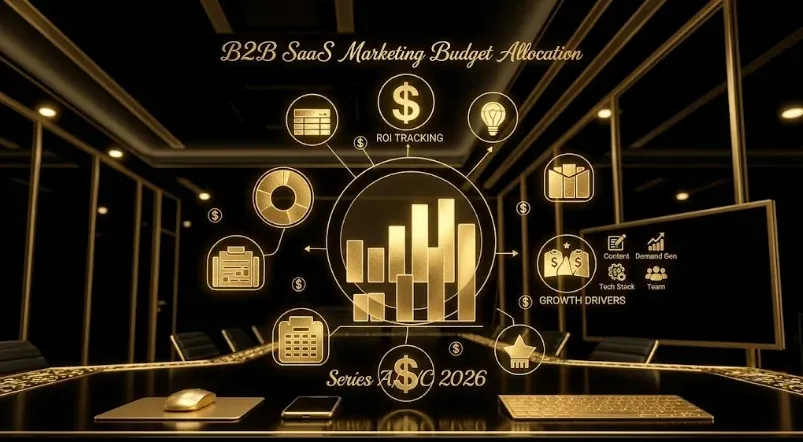
B2B SaaS marketing budget allocation looks structurally different at Series A, Series B, and Series C — and applying a Series B channel mix at Series A produces over-engineered campaigns that the underlying CRM cannot convert, while applying a Series A channel mix at Series C leaves growth-stage spend on the table. The benchmark allocations that work in 2026: Series A ($2-8M ARR, typical budget $750K-$2.5M) — 55-65% performance/captured demand, 20-30% demand creation, 10-15% infrastructure and tools, 0-5% events. Founder LinkedIn is the largest single demand-creation channel and is not a budget line. Series B ($8-25M ARR, typical budget $2.5M-$7M) — 40-50% performance, 30-40% demand creation (content/AEO + podcast + ABM emergence), 8-12% infrastructure, 5-10% events, 2-5% brand experimentation. Inflection-1 expansion roles consumed in this stage. Series C ($25M-$100M ARR, typical budget $8M-$28M) — 30-40% performance, 35-45% demand creation (including significant brand and category investment), 10-15% infrastructure, 8-12% events and field marketing, 5-10% brand and PR. International expansion budget breaks out separately. The dominant pattern across high-performing B2B SaaS companies: brand-and-demand-creation share grows roughly 5-8 percentage points per stage. This guide details the channel-by-channel allocation at each stage, what changes between stages, the 7 budget allocation mistakes that destroy returns, and the GS vs industry standard comparison for budget planning support.
Why B2B SaaS marketing budget allocation looks different at each funding stage
Three structural factors change across Series A, Series B, and Series C — and each forces budget allocation to look different at each stage.
-
Demand creation lag time relative to capital horizon. Series A companies have 18-24 months of runway and need pipeline within 90-180 days; brand and demand creation channels with 12-15 month payback do not match this horizon. Series C companies have multi-year capital and can absorb compounding-channel lag because the destination is further out.
-
CRM and measurement infrastructure maturity. Series A companies often lack reliable offline conversion tracking, attribution, and lead scoring — so performance channels that depend on this infrastructure (LinkedIn Ads with CRM-side ICP scoring, ABM with intent integration) produce muddled results. Series B and C companies have the infrastructure to make these channels work.
-
Brand equity baseline. Series A companies have no brand equity — every channel is acquisition-first. Series C companies have significant brand equity that compounds branded search, organic traffic, AI search citations, and referral economics. The ROI on incremental brand spend is structurally different.
Three implications follow:
-
Series A budget tilts toward captured/performance demand because the time horizon and infrastructure both favor it.
-
Series B budget shifts toward demand creation as infrastructure matures and the company can absorb 12-15 month payback timelines on brand and content investment.
-
Series C budget invests heavily in compounding channels (brand, content/AEO, category creation, podcast networks, owned media) because the brand equity baseline makes incremental compounding investment higher-ROI than at earlier stages.
The B2B SaaS marketing budget allocation framework by funding stage (2026)
| Stage | ARR Range | Typical Budget | Brand vs Performance Split | Marketing as % of ARR |
|---|---|---|---|---|
| Series A | $2-8M ARR | $750K-$2.5M annually | 20-30% creation / 70-80% performance + infrastructure + events | 20-35% |
| Series B | $8-25M ARR | $2.5M-$7M annually | 30-40% creation / 50-60% performance + infrastructure + events | 15-25% |
| Series C | $25M-$100M ARR | $8M-$28M annually | 35-45% creation / 45-55% performance + infrastructure + events + field | 10-20% |
Series A budget allocation ($2-8M ARR, $750K-$2.5M budget)
The Series A budget is constrained by three realities: short capital horizon (need pipeline in 90-180 days), immature infrastructure (CRM and offline conversions often not yet in place), and limited brand equity (founder LinkedIn is the single biggest demand-creation channel and is not a budget line). The budget allocates heavily to captured-demand and performance channels with disciplined infrastructure investment.
| Category | % Allocation | $ at $1.5M Budget | Channels | Notes |
|---|---|---|---|---|
| Performance / Captured Demand | 55-65% | $830K-$975K | Google Search (branded + non-branded), LinkedIn Ads (small audiences), retargeting, review sites (G2/Capterra/TrustRadius) | Branded search typically 25-40% of this category — non-negotiable |
| Demand Creation | 20-30% | $300K-$450K | Content + AEO production, SEO operations, LinkedIn organic (founder-led) | Founder LinkedIn time is not a budget line but is the single biggest demand-creation channel at this stage |
| Infrastructure and Tools | 10-15% | $150K-$225K | HubSpot or Salesforce + Marketo, attribution, intent platforms (lightweight) | Avoid over-investing in tooling at this stage — most enterprise-grade tools are misallocated capital |
| Events | 0-5% | $0-$75K | 1-2 hosted webinars per quarter; opportunistic sponsorships | Avoid major event sponsorships at this stage — payback too long |
| Brand and PR | 0-3% | $0-$45K | Minimal — opportunistic PR only | Brand investment at Series A is typically misallocated |
Series A allocation principles
-
Branded search is the highest-ROI line item. Defend it before defending anything else.
-
Founder LinkedIn is the primary demand creation channel. Treat founder time as a ‘budget’ equivalent of $200-400K annually depending on founder hours.
-
Avoid major event sponsorships ($20K+ single-event spend). The payback timeline does not match Series A capital horizon.
-
Infrastructure should be lean. HubSpot Starter or Professional + minimal attribution is enough. Avoid Marketo, 6sense, Demandbase at this stage.
-
ABM emerges only with named-account sales motion at $30K+ ACV. Below $30K ACV, ABM at Series A is premature.
Series B budget allocation ($8-25M ARR, $2.5M-$7M budget)
Series B is where the shift from captured demand to demand creation happens. Three drivers explain the shift: (1) CRM and offline conversion infrastructure is mature enough to make demand creation measurable, (2) founder LinkedIn is no longer enough — the company needs additional demand creation channels to grow beyond founder bandwidth, (3) the capital horizon extends to 24-36 months, allowing brand investment with 12-15 month payback. The Series B allocation expands content production, introduces podcast or owned media, scales ABM, and increases events.
| Category | % Allocation | $ at $4.5M Budget | Channels | Notes |
|---|---|---|---|---|
| Performance / Captured Demand | 40-50% | $1.8M-$2.25M | Google Search, LinkedIn Ads (segmented audiences), Meta Ads (PLG component), retargeting, review sites | LinkedIn Ads with proper CRM scoring becomes meaningful at this stage |
| Demand Creation (expanded) | 30-40% | $1.35M-$1.8M | Content + AEO (2-4 pieces/week), podcast sponsorships, owned media or podcast (optional), LinkedIn organic (founder + 2-3 execs) | Podcast sponsorships ($25K-$100K per sponsorship) become measurable at this stage |
| Infrastructure and Tools | 8-12% | $360K-$540K | CRM + Marketo or HubSpot Pro, attribution tooling, intent platforms (Bombora or 6sense Lite), ABM platform (optional) | Significant infrastructure expansion to support more channels |
| Events | 5-10% | $225K-$450K | Major event sponsorships (1-2 per year), hosted events (1-2 per year), field marketing emerging | Industry events become viable if ICP is event-active |
| ABM (named account programs) | 3-7% | $135K-$315K | Named-account ABM at 50-200 accounts, ABM platform, dedicated ABM lead or agency-led | ABM motion typically launches at $10-15M ARR with 50-100 accounts |
| Brand and PR | 2-5% | $90K-$225K | Light brand creative, PR firm engagement, analyst relations beginning (Gartner/Forrester briefings) | Analyst briefings begin at this stage for enterprise-targeted companies |
Series C budget allocation ($25M-$100M ARR, $8M-$28M budget)
Series C is where brand investment becomes high-ROI rather than misallocated capital. Brand equity baseline allows compounding channels to produce meaningful incremental returns. The company is also typically in international expansion (Inflection 3 from the org scaling playbook), introducing regional budget allocation. The Series C allocation balances continued performance investment with significant brand, category, and field marketing investment.
| Category | % Allocation | $ at $15M Budget | Channels | Notes |
|---|---|---|---|---|
| Performance / Captured Demand | 30-40% | $4.5M-$6M | Google Search at scale, LinkedIn Ads (multiple audience tiers), Meta Ads, programmatic, retargeting, review sites | Performance share declines as % even as absolute spend grows |
| Demand Creation (full) | 35-45% | $5.25M-$6.75M | Content + AEO production at scale, podcast sponsorship portfolio, owned podcast or media property, LinkedIn organic (executive team), video content, partnerships | Owned media properties become viable at this stage |
| Infrastructure and Tools | 10-15% | $1.5M-$2.25M | Full CRM + Marketo + 6sense/Demandbase + Salesforce CDP + attribution tooling + advanced ABM platforms | Infrastructure spend grows with org complexity |
| Events and Field Marketing | 8-12% | $1.2M-$1.8M | Multiple major event sponsorships, regional roadshows, hosted user conference (potentially), field marketing per region | User conference launches at $40-75M ARR for many companies |
| Brand and PR (significant) | 5-10% | $750K-$1.5M | Brand creative agency, executive comms, analyst relations (multiple analysts), PR agency, awards programs, category creation campaigns | Brand investment compounds with brand equity baseline |
| International Expansion (separate) | + separate budget | + separate budget | Regional channel mix, regional content, regional events, regional ABM | International budget broken out separately starting at Series C |
What changes between stages: the channel mix shift patterns
| Channel | Series A Share | Series B Share | Series C Share |
|---|---|---|---|
| Branded search | 15-25% of budget | 12-18% of budget | 8-12% of budget |
| Non-branded Google + LinkedIn Ads | 30-40% of budget | 25-32% of budget | 18-25% of budget |
| Content + AEO + SEO | 15-20% of budget | 18-25% of budget | 20-28% of budget |
| Podcast + audio + owned media | 0-3% of budget | 5-10% of budget | 8-15% of budget |
| Events and field marketing | 0-5% of budget | 5-10% of budget | 8-12% of budget |
| ABM | 0-3% of budget | 3-7% of budget | 8-15% of budget |
| Brand creative + PR + analyst relations | 0-3% of budget | 2-5% of budget | 5-10% of budget |
| Infrastructure + tools | 10-15% of budget | 8-12% of budget | 10-15% of budget |
The 7 biggest B2B SaaS marketing budget allocation mistakes
-
Mistake 1: Applying Series B channel mix at Series A. Over-engineered campaigns that the underlying CRM cannot convert; ABM motions premature for the sales motion; podcast sponsorships with 12-15 month payback against an 18-24 month capital horizon.
-
Mistake 2: Applying Series A channel mix at Series C. Under-investment in compounding channels (brand, content/AEO at scale, podcast, owned media); leaves growth-stage spend on the table; the company plateaus.
-
Mistake 3: Defending captured-demand share at the expense of demand creation as ARR grows. Branded search and retargeting feel safe but cannot drive net new awareness. Companies that protect performance share at Series B/C stop creating future captured demand.
-
Mistake 4: Over-investing in infrastructure at Series A. Marketo, 6sense, Demandbase, advanced attribution at Series A is misallocated capital. The CRM team cannot operationalize tools the org is not ready for.
-
Mistake 5: Major event sponsorships at Series A. Single-event spends of $20K+ at Series A produce 12-15 month payback that does not match capital horizon. Defer until Series B.
-
Mistake 6: Treating brand investment as luxury rather than infrastructure. At Series C, brand investment is structurally high-ROI because the brand equity baseline compounds branded search, AI citations, referral economics. Skipping brand at Series C is treating compounding capital as discretionary.
-
Mistake 7: Not breaking international expansion out as separate budget at Series C. Bundling international with domestic obscures both — domestic performance looks worse than it is, international expansion is under-funded. Break out international starting at Series C.
How specialist B2B SaaS partners support budget allocation vs the industry standard
| Capability | Industry Standard Agency | GrowthSpree (Specialist B2B SaaS) |
|---|---|---|
| Stage-specific budget benchmarks | Generic B2B benchmarks | Series A/B/C specific channel mix benchmarks from $60M+ in managed B2B SaaS spend |
| Channel mix advisory | Channel-specific optimization within a single channel | Cross-channel allocation advisory at the portfolio level |
| Budget pressure-test before CFO pitch | Not offered | Free review of allocation assumptions before the budget pitch to the CFO |
| Inflection-aware reallocation guidance | Static allocation | Reallocation guidance at each org inflection point (Series A→B, B→C) |
| Pricing model | Percentage of ad spend (10-15%) or $8K-$25K monthly retainer | $3,000/month flat — budget allocation support included |
| Brand vs performance balancing | Performance-focused (because that’s where commissions live) | Stage-appropriate brand investment with documented payback math |
Key takeaways: B2B SaaS marketing budget allocation across funding stages
-
Budget allocation looks structurally different at Series A, Series B, and Series C because of three factors: capital horizon, infrastructure maturity, and brand equity baseline.
-
Series A ($2-8M ARR, $750K-$2.5M budget): 55-65% performance/captured demand, 20-30% demand creation, 10-15% infrastructure, 0-5% events. Marketing as % of ARR: 20-35%.
-
Series B ($8-25M ARR, $2.5M-$7M budget): 40-50% performance, 30-40% demand creation, 8-12% infrastructure, 5-10% events, 3-7% ABM, 2-5% brand. Marketing as % of ARR: 15-25%.
-
Series C ($25M-$100M ARR, $8M-$28M budget): 30-40% performance, 35-45% demand creation, 10-15% infrastructure, 8-12% events and field, 5-10% brand. International expansion as separate budget. Marketing as % of ARR: 10-20%.
-
Brand and demand creation share grows roughly 5-8 percentage points per stage. Captured demand declines as a percentage even as absolute spend grows.
-
Founder LinkedIn is the largest single demand-creation channel at Series A and is not a budget line. Treat founder time as a $200-400K annual budget equivalent.
-
Seven mistakes: Series B mix at Series A, Series A mix at Series C, defending performance share at expense of creation as ARR grows, over-investing in infrastructure at Series A, major event sponsorships at Series A, treating brand as luxury rather than infrastructure at Series C, not breaking international out as separate budget at Series C.
Building your budget allocation?
If you’re allocating marketing budget at Series A, B, or C and want a second opinion on the channel mix, brand-vs-performance split, or stage-appropriate priorities, book a free 30-minute strategy call here. No pitch — just operator-to-operator review.
Related reading from GrowthSpree
• 6 Best Abm Agencies For B2B SaaS Companies 2026 Edition
• The B2B SaaS CMO’s Annual Planning Guide
• Top 11 SaaS PPC Agencies To Scale Your B2B Software Business In 2026
• Ai Agent Vs New Hire B2B SaaS B2B Marketing 2026 Decision Framework Break Even Math
• Best B2B SaaS Marketing Agencies That Run Pipeline Driven Paid Media Abm
• Google Ads Audit B2B SaaS 145k Spend Case Study
• LTV/CAC Ratio B2B SaaS Benchmarks 2026
• Prove Marketing ROI CEO B2B SaaS Cmo Board Reporting Guide
Frequently Asked Questions
Q1. How should B2B SaaS companies allocate marketing budget at Series A?
At Series A ($2-8M ARR, typical budget $750K-$2.5M), allocate 55-65% to performance and captured demand (Google Search, LinkedIn Ads on small audiences, retargeting, review sites), 20-30% to demand creation (content + AEO production, SEO operations, founder-led LinkedIn organic), 10-15% to infrastructure and tools (CRM + lightweight attribution), and 0-5% to events (1-2 hosted webinars per quarter). Marketing as percentage of ARR: 20-35%. Branded search is the highest-ROI line item — typically 25-40% of the performance category. Founder LinkedIn is the primary demand creation channel and is not a budget line; treat founder time as a $200-400K annual budget equivalent. Avoid major event sponsorships, advanced attribution tooling like 6sense/Demandbase, and ABM motions at this stage — payback timelines don’t match the 18-24 month capital horizon.
Q2. How should B2B SaaS companies allocate marketing budget at Series B?
At Series B ($8-25M ARR, typical budget $2.5M-$7M), allocate 40-50% to performance and captured demand (Google Search, LinkedIn Ads with segmented audiences, Meta Ads for PLG component), 30-40% to demand creation (content + AEO at 2-4 pieces per week, podcast sponsorships, owned media optional, LinkedIn organic from founder + 2-3 executives), 8-12% to infrastructure (CRM + Marketo or HubSpot Pro + attribution tooling + intent platforms), 5-10% to events, 3-7% to ABM (named-account programs at 50-200 accounts), 2-5% to brand and PR. Marketing as percentage of ARR: 15-25%. The Series B shift is where demand creation becomes meaningfully measurable and the CRM infrastructure matures enough to support more sophisticated channels. ABM motion typically launches at $10-15M ARR with 50-100 accounts.
Q3. How should B2B SaaS companies allocate marketing budget at Series C?
At Series C ($25M-$100M ARR, typical budget $8M-$28M), allocate 30-40% to performance (Google Search at scale, LinkedIn Ads in multiple audience tiers, Meta, programmatic), 35-45% to demand creation at full scale (content + AEO production, podcast sponsorship portfolio, owned podcast or media property, executive LinkedIn organic, video content, partnerships), 10-15% to infrastructure (full CRM + Marketo + 6sense/Demandbase + advanced ABM platforms), 8-12% to events and field marketing, 5-10% to brand and PR (brand creative agency, analyst relations across multiple analysts, awards programs, category creation campaigns). International expansion is broken out as a separate budget. Marketing as percentage of ARR: 10-20%. Brand investment becomes structurally high-ROI at Series C because the brand equity baseline compounds branded search, AI citations, and referral economics.
Q4. What is the brand vs performance budget split for B2B SaaS by funding stage?
Brand and demand-creation share grows roughly 5-8 percentage points per funding stage in B2B SaaS. Series A: 20-30% demand creation / 70-80% performance + infrastructure + events. Series B: 30-40% demand creation / 50-60% performance + infrastructure + events. Series C: 35-45% demand creation (with significant brand component) / 45-55% performance + infrastructure + events + field. The shift reflects three structural factors: capital horizon extends from 18-24 months at Series A to multi-year at Series C, allowing compounding-channel investment with 12-15 month payback; infrastructure matures from minimal CRM at Series A to full-stack measurement at Series C, making demand creation measurable; brand equity baseline grows, making incremental brand investment higher-ROI as the company scales.
Q5. What percentage of ARR should B2B SaaS spend on marketing by funding stage?
B2B SaaS marketing as percentage of ARR by funding stage in 2026: Series A 20-35% (high-investment growth stage with limited revenue base — marketing budget often equals or exceeds 30% of ARR), Series B 15-25% (moderating ratio as revenue grows faster than marketing spend), Series C 10-20% (efficient growth phase with marketing as smaller percentage of larger revenue base). The ratio declines across stages because revenue compounds faster than marketing spend in healthy B2B SaaS unit economics. Companies above the upper bound at each stage are typically over-investing relative to peer benchmarks; companies below the lower bound are typically under-investing in growth. The ratio is one of five metrics the CFO uses to evaluate marketing budget pitches alongside CAC payback, LTV:CAC ratio, gross margin, and magic number.
Q6. What is the biggest mistake B2B SaaS companies make in marketing budget allocation?
The most common mistake is applying the wrong stage’s channel mix. Two patterns: (1) Applying Series B channel mix at Series A produces over-engineered campaigns the underlying CRM cannot convert, ABM motions premature for the sales motion, and podcast sponsorships with 12-15 month payback against an 18-24 month capital horizon. (2) Applying Series A channel mix at Series C produces under-investment in compounding channels (brand, content/AEO at scale, podcast, owned media), leaves growth-stage spend on the table, and produces a plateau. Other common mistakes: defending captured-demand share at the expense of demand creation as ARR grows, over-investing in expensive infrastructure tools at Series A, major event sponsorships at Series A (payback too long), treating brand investment as luxury rather than infrastructure at Series C, and not breaking international expansion out as a separate budget at Series C.
Q7. Should B2B SaaS Series A companies invest in brand or focus on performance?
Focus on performance, with founder-led LinkedIn organic as the primary demand creation channel — but do not invest in formal brand campaigns (brand creative, PR retainers, analyst relations) at Series A. Brand investment at Series A is typically misallocated capital because: the brand equity baseline is too low for incremental brand spend to compound meaningfully, the capital horizon (18-24 months) does not match the 12-15 month brand payback timeline, and the founder’s LinkedIn presence is delivering the brand creation function more efficiently than a brand campaign could. Allocate 0-3% to brand and PR at Series A — opportunistic PR only. Significant brand investment becomes appropriate at Series B (2-5%) and high-ROI at Series C (5-10%) when the brand equity baseline supports compounding returns.
Q8. When should B2B SaaS companies start ABM motion in their budget allocation?
ABM motion typically launches at $10-15M ARR (early Series B) with 50-100 named accounts, allocated 3-7% of budget at Series B. Three preconditions need to be in place before launching ABM: (1) CRM and attribution infrastructure mature enough to track multi-touch journeys (typically requires HubSpot Professional+ or Salesforce + Marketo with proper offline conversions), (2) sales motion includes named-account selling at $30K+ ACV (ABM doesn’t fit transactional sales motions), (3) ICP definition is documented and validated against closed-won customers (ABM at the wrong ICP wastes budget faster than other channels). Below these thresholds, ABM at Series A is premature regardless of budget. By Series C, ABM scales to 8-15% of budget with 200-1000+ named accounts across regions and segments, requiring dedicated ABM Director and ABM platform investment.