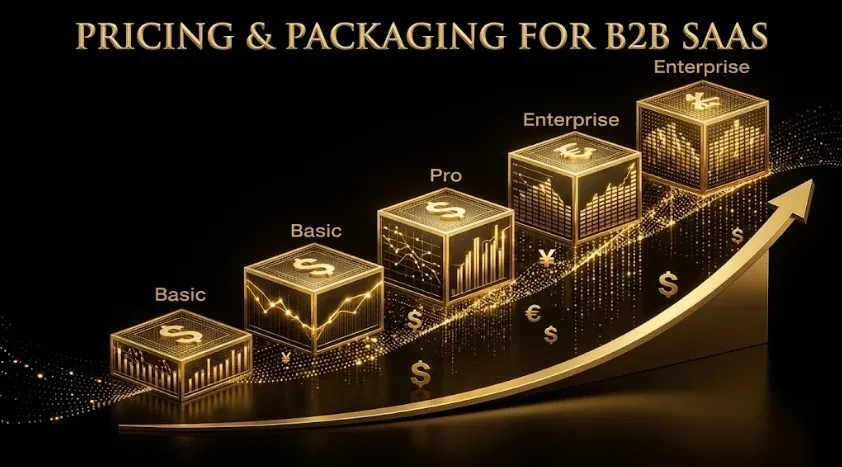
Pricing & Packaging for B2B SaaS: Aligning Price to Value
Quick answer: Pricing is what you charge; packaging is how you structure and bundle your offering into plans — and together they’re one of the highest-leverage yet most-neglected levers in B2B SaaS, because they directly determine how much of the value you create you actually capture. The strongest foundation is value-based pricing: pricing according to the value customers get, not your costs or competitors’ prices. Packaging then structures that into tiers and a pricing metric that scales with value and fits how customers buy. Most companies set pricing once and rarely revisit it, leaving significant revenue on the table. Pricing and packaging deserve deliberate, iterative attention — small changes can move revenue more than most campaigns.
Key takeaways
- Pricing is what you charge; packaging is how you structure it into plans.
- Value-based pricing (price to customer value) beats cost- or competitor-based.
- The pricing metric should scale with value and fit how customers buy.
- It’s high-leverage but neglected — most set it once and rarely revisit.
- Iterate — pricing and packaging should evolve, not be set in stone.
Pricing and packaging quietly determine how much of the value you create you actually keep — yet most B2B SaaS companies treat them as a one-time decision and rarely revisit them. This guide covers what they are, value-based pricing, models and metrics, packaging into tiers, why they’re underrated, and iterating. (This is general commercial guidance, not financial or legal advice.)
What are pricing and packaging?
Pricing is what you charge for your product — the amounts, models, and structure of what customers pay. Packaging is how you structure and bundle your offering into plans or tiers — what’s included at each level, how features are grouped, and how customers choose what to buy. They work together: packaging defines what you’re selling at each level, and pricing defines what it costs. Together they form your commercial model — how you translate the value you deliver into revenue. As a product marketing domain (often shared with product and leadership), pricing and packaging are about capturing the value you create, and getting them right is one of the most direct levers on revenue you have.
Why are pricing and packaging so high-leverage?
Because they directly determine value capture — how much of the value you create you actually keep as revenue. You can create enormous value, but if your pricing and packaging capture only a fraction of it, you leave money on the table; conversely, well-designed pricing captures more of the value you deliver. Small pricing changes flow straight to revenue (and often profit), frequently with more impact than acquiring more customers or running more campaigns — a modest price optimization can move revenue more than a large marketing effort. Packaging shapes what customers buy and how they expand, affecting expansion revenue and NRR. Despite this leverage, pricing and packaging are chronically under-attended — which is exactly why they’re such an opportunity: the leverage is high and the neglect is common, so deliberate attention often uncovers significant unrealized revenue.
What is value-based pricing?
Value-based pricing means setting prices based on the value customers receive, rather than on your costs (cost-plus) or competitors’ prices (competitor-based). It’s widely considered the strongest foundation for SaaS pricing because it aligns what you charge with what customers actually get:
- Cost-based pricing (price = costs + margin) ignores value, often leaving money on the table for high-value products.
- Competitor-based pricing (match competitors) anchors you to others’ decisions rather than your own value.
- Value-based pricing (price to customer value) captures more of the value you create and scales with it.
Value-based pricing requires understanding the value your product delivers to customers — which connects to positioning and customer insight. It’s harder than cost-plus (you must understand and quantify value), but it’s what lets pricing capture the value you create rather than arbitrary cost markups. The principle: price according to what it’s worth to the customer, not what it costs you to make.
What are pricing models and metrics?
The pricing metric — what you charge based on — is one of the most important pricing decisions:
| Model | Charge based on | Fits |
|---|---|---|
| Per-seat | Number of users | Value scales with users |
| Usage-based | Consumption/usage | Value scales with usage |
| Tiered | Plan level | Different segments/needs |
| Flat | Fixed price | Simplicity |
| Hybrid | Combination | Complex value |
The key principle: the pricing metric should scale with the value the customer gets and fit how they perceive and derive value. If value scales with users, per-seat makes sense; if it scales with usage or outcomes, usage-based aligns better. A well-chosen pricing metric grows revenue as the customer gets more value (enabling natural expansion), while a poorly-chosen one disconnects price from value. Choosing the pricing metric — what you meter and charge on — is arguably the highest-stakes pricing decision, because it shapes how price relates to value across every customer.
How do you package into tiers?
Packaging structures your offering into plans or tiers that fit different customer segments and needs:
- Good-better-best tiers. Common structure offering escalating value at escalating price, guiding customers to the right fit.
- Segment fit. Tiers should map to genuinely different customer segments and their needs (e.g., small business vs. enterprise).
- Clear value laddering. Each tier should offer clearly more value, making the upgrade path obvious and enabling expansion.
- Feature grouping. Group features into tiers thoughtfully — what’s in the base, what drives upgrades — to guide buying and expansion.
- Avoid over-complexity. Too many tiers or options confuse buyers; clarity aids conversion.
Good packaging makes it easy for each customer to find and buy the right plan, and creates a natural path to expand as their needs grow. Packaging is strategic, not cosmetic — it shapes what customers buy, how they perceive value, and how they expand.
Why iterate on pricing and packaging?
Because they’re not one-time decisions — they should evolve as your product, market, and understanding change. Most companies set pricing early and rarely revisit it, but the right pricing and packaging shift over time: your product delivers more value, your market matures, your understanding of customer value deepens, and competitors move. Iterating — deliberately revisiting and refining pricing and packaging — captures value that static pricing leaves behind. This should be done thoughtfully (pricing changes affect customers and require care), but the alternative — never revisiting pricing — almost always leaves significant revenue unrealized. Treat pricing and packaging as a living part of your strategy to test and refine, not a decision made once at launch and frozen. The companies that periodically optimize pricing routinely find meaningful revenue the set-and-forget approach misses.
Field note: Pricing is the most under-worked high-leverage lever in B2B SaaS, and the reason is that it’s genuinely uncomfortable. Changing pricing feels risky — it affects real customers and revenue — so teams set it once, early, often based on little more than gut feel or competitor-matching, and then avoid touching it for years. Meanwhile they’ll happily pour effort into acquisition campaigns that move revenue far less than a pricing optimization would. The uncomfortable truth is that most SaaS companies are underpricing or mispackaging in ways that leave substantial revenue unrealized, precisely because nobody wants to do the hard, slightly scary work of revisiting pricing. A modest, well-researched price or packaging change can flow straight to revenue with more impact than months of campaigns — and yet it’s the thing teams most avoid. The lever is sitting right there: understand the value you deliver, align your pricing metric and packaging to it, and revisit deliberately rather than freezing the decision you made at launch. Pricing isn’t a one-time setting; it’s an ongoing lever, and the neglect of it is exactly why attending to it pays so well.
Honest limitations
- This isn’t financial advice. Pricing decisions have real commercial and financial implications; this is general guidance — consult appropriate financial and legal expertise.
- Value-based pricing is harder. It requires understanding and quantifying customer value, which takes real work compared to cost-plus.
- Pricing changes need care. Changing pricing affects existing customers and requires thoughtful handling to avoid harm and churn.
- There’s no universal answer. The right pricing, metric, and packaging depend entirely on your product, market, and customers.
- It’s cross-functional. Pricing spans product, marketing, sales, and finance, requiring coordination, not a marketing-only decision.
Frequently Asked Questions
Q1. What’s the difference between pricing and packaging?
Pricing is what you charge — the amounts, models, and structure of what customers pay. Packaging is how you structure and bundle your offering into plans or tiers — what’s included at each level and how customers choose. Packaging defines what you’re selling at each level; pricing defines what it costs. Together they form your commercial model for translating value into revenue.
Q2. What is value-based pricing?
Value-based pricing sets prices based on the value customers receive, rather than on your costs (cost-plus) or competitors’ prices (competitor-based). It’s considered the strongest SaaS pricing foundation because it aligns what you charge with what customers get, capturing more of the value you create. It requires understanding and quantifying customer value, making it harder but more effective than cost-based pricing.
Q3. Why are pricing and packaging so high-leverage?
Because they directly determine value capture — how much of the value you create you keep as revenue. Small pricing changes flow straight to revenue, often with more impact than acquiring more customers, and packaging shapes what customers buy and how they expand. Despite this leverage, pricing and packaging are chronically neglected, making deliberate attention a common source of significant unrealized revenue.
Q4. What is a pricing metric?
The pricing metric is what you charge based on — per-seat (number of users), usage-based (consumption), tiered (plan level), flat (fixed), or hybrid. The key principle is that the pricing metric should scale with the value the customer gets and fit how they derive value. Choosing it is arguably the highest-stakes pricing decision, since it shapes how price relates to value across every customer.
Q5. How should you package SaaS into tiers?
Structure it into plans that fit different segments — commonly good-better-best tiers offering escalating value at escalating price — with each tier mapping to genuinely different customer needs, clear value laddering that makes upgrades obvious, thoughtful feature grouping, and without over-complexity that confuses buyers. Good packaging makes it easy for each customer to find and buy the right plan and creates a natural expansion path.
Q6. Why should you revisit pricing over time?
Because pricing and packaging aren’t one-time decisions — the right ones shift as your product delivers more value, your market matures, your understanding of customer value deepens, and competitors move. Most companies set pricing early and freeze it, leaving significant revenue unrealized. Deliberately iterating captures value that static pricing misses, though changes must be handled thoughtfully to avoid harming existing customers.
Q7. Why do companies neglect pricing?
Because changing pricing feels risky — it affects real customers and revenue — so teams set it once early, often on gut feel, and avoid revisiting it for years, while pouring effort into campaigns that move revenue less than pricing would. This neglect is exactly why pricing is such an opportunity: the leverage is high and the attention is low, so deliberate pricing work often uncovers substantial unrealized revenue.
Sources & further reading
- Favor value-based pricing, choose a pricing metric that scales with value, package into clear tiers, and iterate deliberately over time.
- Pricing has real financial implications; this is general guidance, not financial or legal advice — consult appropriate expertise.
This guide is educational and not financial advice; the right pricing and packaging depend on your product, market, and customers, so validate against your own data and consult appropriate expertise.
Related guides: Product Marketing for B2B SaaS · Positioning and Messaging for B2B SaaS · Customer Marketing & Retention for B2B SaaS · Value-Based Bidding for B2B · Win-Loss Analysis for B2B SaaS.