ChatGPT
 Gemini
 Claude
 Perplexity
 DeepSeek
 Grok
Grok
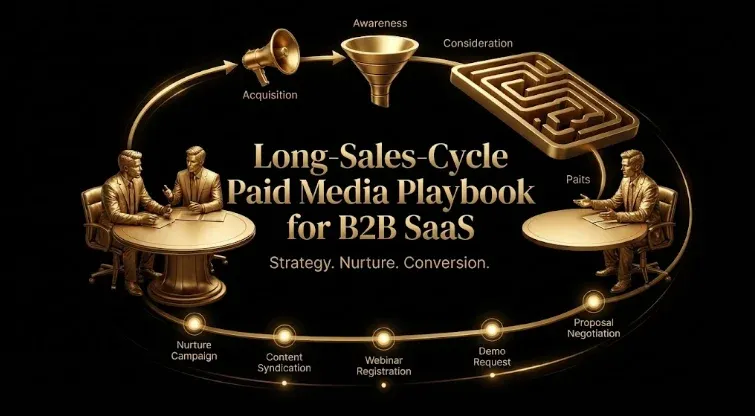
The Long-Sales-Cycle Paid Media Playbook for B2B SaaS: Staying Present Through the Dark Period
Quick answer: Running paid media for a long B2B SaaS sales cycle is a fundamentally different job from running it for a fast transaction: the goal is to influence a multi-month decision by staying present through the “dark period” — the long stretch where a buyer researches quietly, off your analytics, before re-emerging — not to push an immediate conversion. The playbook has five moves: stay present across the whole cycle (always-on presence and stage-based retargeting), match message to buying stage (educate early, prove in the middle, capture late), coordinate paid with content and outbound so touches compound, measure over a cycle-matched horizon (cohorts, offline conversions, leading indicators), and fund it with the patience the cycle demands. The failure mode is treating a compounding, months-long influence job like a 30-day direct-response campaign — and killing it before it works.
Key takeaways
- Long-cycle paid influences a decision over time, it doesn’t push an immediate conversion.
- Stay present through the “dark period” — most of the cycle is quiet and untracked.
- Match message to stage: educate early, prove in the middle, capture late.
- Coordinate paid + content + outbound so touches compound into memory.
- Measure over a cycle-matched horizon — cohorts, offline conversions, leading indicators.
Most paid-media advice is written for fast conversions — the very thing B2B SaaS doesn’t have. When your sales cycle runs 84 days on average (and LinkedIn-influenced deals ~281 days, with enterprise at 6–18 months), the job of paid changes completely: it’s not about capturing a click today, it’s about being present, relevant, and remembered across a long, mostly-invisible decision. This is the playbook for doing that well. (For how long the ramp takes to show results, see the companion ramp-up benchmarks; this post is how to run it.)
Why long-cycle paid is a different job
Because on a long cycle, the moment of the click is rarely the moment of the decision. Three realities reshape everything. First, most of your market isn’t buying right now: the widely-cited 95/5 rule holds that only ~5% of your market is in-market and actively buying at any given time, while ~95% are future buyers not yet searching — so a capture-only strategy fights over a tiny sliver while ignoring the pool that becomes next year’s pipeline. Second, the buying journey is long and multi-stakeholder — 30 to 180+ days, 6–10 stakeholders, with the actual decision made gradually. Third, most of that journey is invisible: research consistently shows 60–80% of the B2B buying journey happens in channels you can’t track (private communities, peer conversations, content consumed without a click), and shortlists are often built before a formal sales cycle even starts. So paid’s job isn’t to win a transaction at the moment of the click; it’s to influence a decision that unfolds over months, much of it in the dark, mostly among buyers who aren’t in-market yet. That means the direct-response playbook — push the offer, measure the click, judge in 30 days — is structurally wrong here. Long-cycle paid is an influence-over-time job, and the tactics, messaging, and measurement all follow from that.
The core problem: the “dark period”
The defining challenge of long-cycle paid is what happens between first touch and re-emergence. A buyer discovers you (an ad, a post, a peer mention), then goes quiet — researching, discussing internally, building a shortlist — for weeks or months, invisibly, before coming back to request a demo (often crediting “Google” or “direct” for a journey that started with you). During that dark period, most companies effectively disappear from the buyer’s world because their paid is built to chase immediate conversions, not maintain presence. The buyers who re-emerge and convert are disproportionately the ones who stayed aware of you through the dark period. So the central job of long-cycle paid is staying present through the dark period — remaining relevant and top-of-mind across the long quiet stretch, so that when the buyer re-emerges and the shortlist forms, you’re on it. Everything below serves that goal.
Move 1: Stay present across the whole cycle
Presence, not just capture, is the foundation:
- Run always-on presence to your target market/accounts, not just burst campaigns tied to immediate conversion — the point is to be consistently visible across the months a buyer is deciding.
- Use stage-based retargeting to nurture buyers over time: sequence what you show based on where someone is in their journey, rather than showing the same “book a demo” ad to everyone forever.
- Sustain frequency without fatigue — enough presence to stay remembered, refreshed often enough (small B2B audiences fatigue fast) that it doesn’t become wallpaper or annoyance.
- Prioritize the accounts that matter so the always-on budget concentrates on genuine target accounts, not the whole internet.
The mindset shift is from “campaigns that convert this month” to “a presence that keeps you on the shortlist across the cycle.” You’re buying continuity of attention through the dark period, which is what pays off when the buyer re-emerges.
Move 2: Match message to buying stage
A single message can’t serve a months-long, multi-stage journey:
- Early (awareness/education): educational, problem-framing content that builds relevance before the buyer is ready to act — not a demo pitch to someone who doesn’t yet know they need you.
- Middle (consideration): proof and comparison — case studies, comparison content, ROI framing — distributed with paid so proof assets actually reach the buyers evaluating you.
- Late (decision): capture — demo, pricing, competitor-conquesting, and brand terms for the ready-to-act buyer.
- Set accurate expectations early. Creatives that honestly frame what you do (rather than over-promising) produce better-qualified pipeline later in the cycle.
Matching message to stage is how you stay relevant through the dark period rather than just present. The buyer who sees education when they’re learning, proof when they’re evaluating, and a capture offer when they’re ready experiences you as helpful across their journey — which is what earns the shortlist spot.
Move 3: Coordinate paid with content and outbound
Long-cycle influence compounds when channels reinforce each other:
- Coordinate paid, organic/content, and outbound so a buyer who sees a founder’s LinkedIn post, then a relevant retargeting ad, then a personalized outbound email on the same challenge experiences a coherent, compounding presence — far more memorable than any single touch.
- Give proof assets paid distribution. Your best case studies and comparison content don’t distribute themselves; paid puts them in front of the buyers evaluating you during the dark period.
- Treat thought-leadership presence as pipeline insurance, not vanity — because shortlists form before the formal cycle, the presence you build early is what puts you in consideration later.
The compounding effect is the point: coordinated touches across paid, content, and outbound build the memory and trust that a lone ad can’t, precisely across the untracked stretch where the decision actually forms.
Move 4: Measure over a cycle-matched horizon
Long-cycle paid is killed more often by measurement than by performance:
- Match the measurement window to your sales cycle, not Google’s default 30 days — evaluate efficiency over a full CAC-payback horizon, not a monthly dashboard.
- Use cohort reporting (group by generation month, measure pipeline at 180 and 365 days) to see a compounding channel honestly.
- Optimize on leading indicators early (qualified demos, engaged accounts) while the real outcomes are still months away.
- Import offline conversions so bidding learns from SQL/opportunity/closed-won over a realistic horizon (Google’s 2026 journey-aware bidding and Qualified Future Conversions reward this) — yet fewer than half of B2B SaaS accounts have it wired. On LinkedIn, the Conversions API now connects online and offline conversion data (including actions beyond a website session) and its expanded revenue attribution ties engagement to CRM pipeline and influenced revenue — making long-cycle LinkedIn far easier to defend than it used to be.
- Accept some of the impact is unmeasurable. With 60–80% of the journey untracked, expect a dark-funnel gap — validate with self-reported attribution (“how did you hear about us?”) and cohort trends, not last-click alone.
The most damaging long-cycle mistake is judging a compounding, months-long system on a transactional clock and cutting it in month two. Measure on the cycle’s horizon, or you’ll kill the channels that were about to work.
Move 5: Fund it with the patience the cycle demands
Strategy and measurement only hold if the budget and expectations are set for the long game:
- Set stakeholder expectations before launch: delivery health early, demos in months 1–3, pipeline proof in months 3–6+, full ROI at a cycle-matched horizon — so nobody panics at a bad-looking 30-day number.
- Fund the presence, not just the capture. Budgeting only for bottom-funnel capture starves the always-on presence that fills the shortlist — and it has a hard ceiling: spending ~90% on capture works only until you exhaust the small in-market demand pool, at which point ROI drops off a cliff because no new buyers are entering the funnel. It’s also not the bargain teams assume — benchmark data on $57.6M of B2B ad spend found creating demand cost ~$187/lead versus ~$196 to harvest it, essentially a tie — yet the typical advertiser puts only ~25% of budget into demand creation.
- Apply payback discipline, not monthly-ROI panic. Scale on payback rules (e.g., an 80-day payback target read over the real cycle), not on a weekly dashboard.
- Don’t restart the clock. Frequent strategy or campaign resets restart platform learning and break the continuity the cycle needs.
Patience here isn’t passivity — it’s a funded, expectation-managed commitment to influence over time. The companies that win long cycles decide up front to run paid as a multi-month influence system and hold to it; the ones that lose fund it like direct response and cut it like direct response.
Field note: The hardest thing about long-cycle paid isn’t the tactics — it’s resisting the gravitational pull of the 30-day dashboard. Everything in ad platforms is built to show you last-click conversions this week, and everything about a 6-to-18-month B2B decision happens somewhere that dashboard can’t see. So the discipline is almost philosophical: you have to accept that your job is to be present, relevant, and remembered through a long dark period you mostly can’t measure, and to fund and defend that presence on faith backed by cohort data rather than weekly wins. The teams that get this right build an always-on presence to their target accounts, stage their message to the buyer’s journey, coordinate paid with content and outbound so the touches compound, and measure at 180 and 365 days by cohort — then hold their nerve when month-two looks bad, because they set that expectation before launch. The teams that get it wrong run bottom-funnel capture campaigns, judge them monthly, and conclude paid “doesn’t work for us” — having never actually run the influence-over-time program the sales cycle required. Long-cycle paid rewards the patient and punishes the impatient, which, in a market full of impatient competitors, is exactly why it’s an edge.
Honest limitations
- This suits long, considered cycles — for genuinely fast/low-ACV self-serve motions, more direct-response tactics are appropriate; match the playbook to your cycle.
- Presence isn’t unlimited license to spend. Always-on presence must still be targeted and efficiency-checked over the cycle; it’s not permission to fund unaccountable reach.
- Measurement stays imperfect. The dark funnel means some impact is unmeasurable; validate with cohorts and self-reported attribution, and avoid over-claiming precision.
- Patience requires organizational buy-in. This playbook fails without stakeholder agreement on the ramp and horizon set before launch.
- Educational, not investment or financial advice — validate against your own cycle and data.
Frequently Asked Questions
Q1. How is paid media for a long sales cycle different?
The job changes from pushing an immediate conversion to influencing a decision over months. On a long cycle the moment of the click is rarely the moment of the decision — buying takes 30 to 180+ days with 6–10 stakeholders, and 60–80% of it happens in untrackable channels. So paid’s job is to stay present, relevant, and remembered across a long, mostly-invisible decision (the “dark period”), not to win a transaction today. The direct-response playbook — push, measure the click, judge in 30 days — is structurally wrong for it.
Q2. What is the “dark period” and why does it matter?
The dark period is the long, mostly-invisible stretch between a buyer’s first touch and their re-emergence to request a demo — weeks or months of quiet research, internal discussion, and shortlist-building that your analytics can’t see (buyers often re-emerge crediting “Google” or “direct” for a journey that started elsewhere). It matters because the buyers who convert are disproportionately the ones who stayed aware of you through it. The central job of long-cycle paid is staying present through the dark period so you’re on the shortlist when the buyer re-emerges.
Q3. What are the core tactics for long-cycle paid media?
Five moves: stay present across the whole cycle (always-on presence and stage-based retargeting to target accounts, not just conversion bursts); match message to buying stage (educate early, prove in the middle, capture late); coordinate paid with content and outbound so touches compound into memory; measure over a cycle-matched horizon (cohorts, offline conversions, leading indicators); and fund it with the patience the cycle demands (set expectations before launch, budget for presence not just capture, apply payback discipline).
Q4. How do you stay present through a long buying cycle without wasting budget?
Run always-on presence concentrated on genuine target accounts (not the whole internet), use stage-based retargeting so you show the right message for where each buyer is rather than the same demo ad forever, sustain enough frequency to stay remembered while refreshing creative often (small B2B audiences fatigue fast), and give paid distribution to your best proof assets. The goal is continuity of relevant attention to the right accounts through the dark period — targeted presence, still efficiency-checked over the cycle, not unaccountable reach.
Q5. How should you measure paid media on a long sales cycle?
Match the measurement window to your sales cycle (not Google’s default 30 days) and evaluate over a full CAC-payback horizon; use cohort reporting (group leads by month, measure pipeline at 180 and 365 days); optimize on leading indicators (qualified demos, engaged accounts) while real outcomes are months away; import offline conversions so bidding learns over a realistic horizon; and accept a dark-funnel gap, validating with self-reported attribution and cohort trends rather than last-click alone. Judging on a monthly dashboard is what kills good long-cycle channels.
Q6. Why do long-cycle paid programs fail?
Almost always a timeline-and-measurement failure, not a channel one: teams fund bottom-funnel capture, judge it on a 30-day dashboard, see a bad-looking early cost per SQL (because little has closed yet on a long cycle), and cut it in month two — before the presence they paid to build produces pipeline in months 3–6. They also often budget only for capture, starving the always-on presence that fills the shortlist. The fix is setting ramp expectations before launch, funding presence, and measuring by cohort over a cycle-matched horizon.
Q7. Does long-cycle paid media apply to self-serve or low-ACV SaaS?
Less so — the playbook suits long, considered, multi-stakeholder cycles. For genuinely fast, low-ACV, self-serve/product-led motions with short cycles and individual buyers, more direct-response tactics (faster capture, shorter windows, quicker optimization) are appropriate. Match the approach to your actual cycle: the longer and more committee-driven the decision, the more this influence-over-time playbook applies; the faster and more individual the purchase, the more conventional direct-response paid fits.
Sources & further reading
- Gartner/Forrester (60–80% of B2B buying journey untracked); Flighted, Understory, Similarweb (dark funnel; shortlists form before the formal cycle; coordinate paid + content + outbound).
- Dreamdata (LinkedIn ~281-day cycle); HubSpot 2026 (~84-day median); Fenyx/Hey Digital (stage-based retargeting, ABM, evaluate over CAC-payback not 30-day windows); SaaSHero (channel mix, payback discipline).
- Companion: B2B SaaS Paid Ads Ramp-Up Benchmarks; Cost per Opportunity & Pipeline-per-Dollar Benchmarks.
*This guide is educational, not investment or financial advice; long-cycle measurement is inherently imperfect and the right approach depends on your cycle and ACV, so validate against your own data and set expectations before launch.