ChatGPT
 Gemini
 Claude
 Perplexity
 DeepSeek
 Grok
Grok
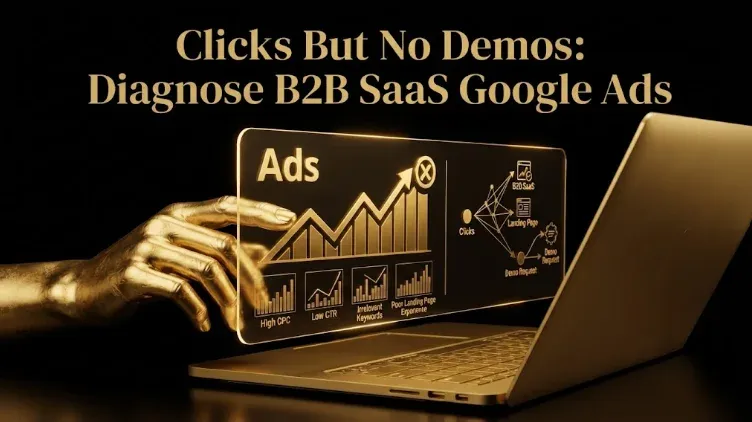
Clicks But No Demos: The 7 Reasons B2B SaaS Google Ads Don’t Convert (Diagnostic Guide)
Quick answer: When B2B SaaS Google Ads get clicks but no demos, it’s almost always one of seven causes: wrong search intent, junk lead quality (clicks or form-fills that could never become demos), a high-friction demo offer, broken conversion tracking, the long-sales-cycle measurement trap, poor landing-page message match, or slow speed-to-lead. The trap specific to B2B SaaS is confusing “no demos” with “no conversions” — you often have clicks and even form-fills, but they aren’t turning into qualified demos, which is a targeting, offer, and lead-quality problem more than a landing-page one. This is the diagnostic that finds which cause you have, in the order that isolates it fastest — then points you to the fix. Diagnose measurement and intent first (so you’re sure you have no demos, not just hidden or junk ones), then work quality, offer, message match, and follow-up.
Key takeaways
- “No demos” ≠ “no conversions” — you may have form-fills that never become qualified demos.
- Diagnose in order: tracking + intent first, then quality, offer, page, speed.
- Two hidden causes dominate B2B SaaS: demos lost to the 30-day window, and junk form-fills.
- The algorithm can’t tell a student’s form-fill from a VP’s — so it finds the cheapest, worst leads.
- This is the diagnostic map — each cause links to the deep-fix guide.
“We’re getting clicks but no demos” is one of the most common — and most misdiagnosed — complaints in B2B SaaS paid search. Most guides answer the generic “clicks but no conversions” question with the same commodity checklist (add negatives, fix your landing page). Those matter, but they miss what’s specific to B2B SaaS: the gap between a click, a form-fill, and a genuinely qualified demo. This guide is the diagnostic — it isolates which of seven causes you actually have, then routes you to the detailed fix for each.
First, define the problem: which “no demos” do you have?
Before fixing anything, pinpoint where the funnel breaks — because “clicks but no demos” hides three very different problems:
- Clicks but no form-fills. People click and leave without requesting a demo — usually an intent, message-match, offer, or landing-page problem.
- Form-fills but no qualified demos. People request demos, but they’re the wrong people (students, competitors, out-of-ICP, tire-kickers) who never become real sales conversations — a lead-quality and targeting problem.
- Qualified demos happening but not showing up in your data. Demos are converting, but broken tracking or the 30-day window means Google (and your reports) don’t see them — a measurement problem that makes you cut your best campaigns.
These are diagnosed and fixed differently, so identifying which you have is step zero. The B2B-SaaS-specific insight is that “clicks but no demos” is very often the second or third problem (junk quality or hidden demos), not the first (landing page) — yet generic advice jumps straight to landing pages. Work the seven causes below in order and you’ll find which layer is actually broken.
Cause 1: Wrong search intent (you’re buying the wrong clicks)
The most common root cause. If your keywords capture informational or off-ICP intent, you get clicks from people who were never going to book a demo. Signs: high click volume, low form-fill rate, search-terms report full of “what is / how to / jobs / free.” The fixes — splitting high-intent from low-intent keywords into separate campaigns, and building an aggressive negative-keyword list to block job-seekers, freebie-seekers, DIY, and competitor-login traffic — are exactly the levers detailed in the junk-leads playbook. One 2026 watch-out: broad match and AI-broadened targeting (AI Max) widen your queries beyond intent, so audit search terms weekly and exclude drift — and note that Google delayed the automatic Dynamic Search Ads-to-AI Max migration (from September 2026 to February 2027) and temporarily restored DSA creation, a signal AI Max isn’t yet ready for prime time in B2B, so adopt it deliberately rather than by default. The principle: fewer irrelevant clicks, not fewer clicks — 100 clicks with 8 demos beats 500 clicks with 5. → Deep fix: Eliminate junk leads from Google Ads for B2B SaaS.
Cause 2: Junk lead quality (form-fills that can’t become demos)
The B2B-SaaS-specific killer. You have form-fills, but they’re the wrong people — so “no demos” is really “no qualified demos.” The root cause is a signal problem: to Google’s bidding algorithm, a form-fill from a student counts exactly the same as a form-fill from a VP of Engineering — so without pipeline signals fed back, it optimizes toward the cheapest form-fills, which are almost always the lowest quality. This is why average form-fill-to-SQL runs just 5–15% — 85–95% of what you pay for never becomes pipeline. The fixes: measure and optimize on qualified demos/SQLs (not raw form-fills), add light qualification (business-email requirement, role/company-size field), exclude off-ICP audiences (job seekers, students, existing customers), and feed lead-quality signals back to bidding via offline conversions so Google learns which clicks became real demos. New in 2026: Google’s journey-aware bidding lets a Target CPA search campaign learn from every stage of the lead-to-sale path (not just the form-fill), and offline conversion import is now a direct prerequisite for it — so getting CRM/pipeline data into the platform is the single highest-leverage fix for junk quality. → Deep fix: How to get high-quality SQLs from Google Ads and the junk-leads playbook.
Cause 3: A high-friction demo offer (the offer itself is the problem)
Sometimes intent and audience are right, but the demo request is too heavy a first ask, so ready buyers bounce. The average B2B SaaS demo-request page converts at just 1.5–4%, while the top quartile hits 8–15% — a 4–10x gap, much of it driven by offer and friction. Fixes: reduce demo-request friction (short forms, no mandatory phone number, promise a fast response), offer a lower-commitment path where it fits (a free trial or interactive demo often converts far better than “book a demo” for lower-ACV or product-led motions), and match the CTA to funnel stage (offer a benchmark or ROI tool mid-funnel, then demo). If the first step is too big, you’ll see interest but few demos. → Deep dive: B2B SaaS demo request conversion rate benchmarks.
Cause 4: Broken conversion tracking (the demos exist; the data doesn’t)
Extremely common in B2B SaaS, and it masquerades as “no demos.” If tracking is broken, real demos aren’t recorded — so your reports (and Google’s bidding) act as if they never happened. Common faults: conversion count set to “Every” instead of “One” for lead-gen actions, duplicate tags firing (hard-coded snippet + GTM tag), or demo submissions not tracked at all. Fixing tracking is foundational — Smart Bidding starts relearning from correct data within about 24 hours. Because this cause is deep and mechanical, it has its own full guide. → Deep fix: Google Ads conversion tracking for B2B SaaS (and how to fix it) — start here if your demo numbers look implausibly low.
Cause 5: The long-sales-cycle measurement trap
The most damaging B2B-SaaS-specific cause, because it makes you cut your best campaigns. Google Ads defaults to a 30-day conversion window, but B2B SaaS sales cycles average far longer (~84 days, and LinkedIn-influenced deals can run ~281 days per Dreamdata). So demos and deals that close beyond the window get zero credit, your best keywords look like they don’t convert, and you cut them — cutting your highest-value pipeline. Fixes: extend the conversion window to your real sales cycle, track leading conversions (qualified demo booked/held) as the paid optimization target rather than waiting on closed-won months later, and import offline conversions (SQL, opportunity) so bidding optimizes toward pipeline-quality over a realistic horizon. Watch Google’s Qualified Future Conversions (QFC), rolling out through 2026 — it’s Google’s native attempt to let bidding optimize toward likely-future qualified conversions on long cycles, and it matters more for B2B precisely because the sales cycle loses attribution signal across that timeline. If your “non-converting” keywords are actually your considered, high-intent terms, this trap is likely why. → Related: cost per opportunity and the sales-cycle lag.
Cause 6: Poor message match (the click and the page disagree)
The classic landing-page cause — real, but usually not the first problem for B2B SaaS. If the landing page doesn’t continue the promise of the ad and the searcher’s intent, even the right person bounces. Intent-matched pages convert 2–3x better than a generic page, and custom pages reach ~8–15% versus ~2–4% for templates. Fixes: match the page to the query and ad (a “for [industry]” ad should land on a “for [industry]” page, not the homepage), use per-campaign landing pages (competitor traffic needs comparison messaging; brand traffic needs quick scheduling; category traffic needs education — one page can’t serve all three), make the value and demo CTA obvious fast (clarity over cleverness), and fix page speed (slow mobile pages suppress conversion regardless of message). Diagnose intent, quality, offer, and tracking first — a perfect page can’t fix wrong-audience clicks or hidden demos.
Cause 7: Slow speed-to-lead (you got the request, then lost it)
You captured the demo request — but slow follow-up let it go cold, so it never became a held demo or opportunity, showing up as “no demos” downstream. Speed-to-lead is decisive in B2B: one-hour responses can convert roughly 53% of leads to the next stage versus ~17% after 24 hours. Fixes: respond in minutes, not hours (route paid demo requests to instant scheduling or immediate SDR follow-up); offer instant booking (calendar-on-form) so the buyer self-schedules while intent is hot; and run a no-show recovery cadence so booked-but-missed demos are reclaimed. If demo requests look fine but held/qualified demos don’t, follow-up speed is a prime suspect — the click and conversion worked; the handoff didn’t.
How to run the diagnosis (in order)
| Step | Check | If broken → cause | Deep fix |
|---|---|---|---|
| 1 | Is tracking recording real demos correctly? | Cause 4 (tracking) | Conversion-tracking guide |
| 2 | Are demos closing beyond the 30-day window? | Cause 5 (long-cycle trap) | Cost-per-opportunity / window guide |
| 3 | Is search intent right (search-terms audit)? | Cause 1 (intent) | Junk-leads playbook |
| 4 | Are form-fills becoming qualified demos? | Cause 2 (lead quality) | High-quality-SQLs guide |
| 5 | Is the demo offer too heavy for the stage? | Cause 3 (offer friction) | Demo-conversion benchmarks |
| 6 | Does the page match the ad and load fast? | Cause 6 (message match) | Landing-page / demo-conversion guide |
| 7 | Is follow-up fast enough to hold the demo? | Cause 7 (speed-to-lead) | Speed-to-lead / no-show recovery |
Diagnose in this order deliberately: confirm you’re measuring real demos (steps 1–2) before concluding you have none, then confirm you’re buying the right clicks (step 3), then work quality, offer, page, and follow-up. Most “clicks but no demos” cases are solved before you ever touch the landing page — which is where the generic advice tells you to start. Use this map to find the leaking layer, then follow the linked guide to fix it in depth.
Field note: The phrase “clicks but no demos” almost always means something more specific than it sounds, and the fastest way to waste a month is to accept it at face value and start redesigning landing pages. Nine times out of ten, one of two things is actually happening. Either the demos are coming and you can’t see them — because tracking is broken or the 30-day window is hiding deals from your 84-day sales cycle — in which case you’re about to cut your best keywords for a data problem. Or you’re getting form-fills that were never demo material — students, competitors, freebie-seekers, out-of-ICP tire-kickers — because you optimized to form-fill volume and the algorithm, which literally cannot tell a student’s form-fill from a VP’s, dutifully delivered more of the cheapest ones. Both are invisible if you only look at clicks and “conversions,” and both are missed by the generic “add negatives, fix your landing page” checklist. So before you touch the page: confirm your tracking counts real demos, extend your window to your real sales cycle, audit your search terms for intent drift, and check whether your form-fills survive sales qualification. Do that, and you’ll usually find the leak isn’t where the generic advice pointed — it’s in measurement or lead quality, the two places B2B SaaS paid search quietly breaks.
Honest limitations
- These are the common causes, not exhaustive — bidding strategy, budget density (accounts often need $2,000–$5,000/campaign/month for signal), and creative also play roles.
- Causes compound. You may have several at once; fix in the diagnostic order rather than guessing.
- Benchmarks are directional. Conversion and speed-to-lead figures vary by ACV, vertical, and motion; validate against your own data.
- Tracking fixes take time to compound. Bidding relearns within ~24 hours of a fix, but full stabilization takes longer.
- Educational, not investment or financial advice — validate against your own account.
Frequently Asked Questions
Q1. Why do my B2B SaaS Google Ads get clicks but no demos?
Almost always one of seven causes: wrong search intent, junk lead quality (form-fills that can’t become demos), a high-friction demo offer, broken conversion tracking, the long-sales-cycle measurement trap, poor landing-page message match, or slow speed-to-lead. The B2B-SaaS-specific trap is confusing “no demos” with “no conversions” — you often have clicks and even form-fills, but they aren’t becoming qualified demos, which is a targeting, offer, and lead-quality problem more than a landing-page one. Diagnose in order to isolate which.
Q2. Should I fix my landing page first?
Usually no — that’s where generic advice starts, but for B2B SaaS the leak is more often upstream. Diagnose in order: confirm tracking records real demos, check whether demos are closing beyond your conversion window, audit search intent, and confirm form-fills survive sales qualification — before touching the page. A perfect landing page can’t fix wrong-audience clicks or demos that are happening but hidden by broken tracking or a too-short window. Fix message match (Cause 6) after ruling those out.
Q3. What’s the difference between “no demos” and “no conversions”?
“No conversions” is generic; “no demos” for B2B SaaS hides three distinct problems: clicks but no form-fills (intent/offer/page), form-fills but no qualified demos (lead quality/targeting), and qualified demos happening but not showing in your data (tracking or long-cycle window). Identifying which you have is step zero, because they’re fixed completely differently — and the most common for B2B SaaS are the second and third, not the first that generic guides assume.
Q4. Why do I get form-fills but no qualified demos?
Because of a conversion-signal problem: to Google’s bidding algorithm, a form-fill from a student counts the same as one from a VP of Engineering, so without pipeline signals fed back it optimizes toward the cheapest form-fills, which are usually the lowest quality. Average form-fill-to-SQL is just 5–15%, so 85–95% never becomes pipeline. Fix it by optimizing on qualified demos/SQLs, adding light qualification, excluding off-ICP audiences, and feeding offline conversions back so Google learns which clicks became real demos.
Q5. How does the long sales cycle cause “no demos”?
Google Ads defaults to a 30-day conversion window, but B2B SaaS sales cycles average ~84 days (LinkedIn-influenced deals ~281 days), so demos and deals closing beyond 30 days get zero credit. Your best, most-considered keywords look like they don’t convert, so you cut them — cutting your highest-value pipeline. Fix it by extending the conversion window to your real cycle, optimizing to leading conversions (demo booked/held), and importing offline conversions so bidding learns over a realistic horizon.
Q6. Could my demo offer be the problem?
Yes — sometimes intent and audience are right but the demo request is too heavy a first ask, so ready buyers bounce. The average demo-request page converts at just 1.5–4% versus 8–15% for the top quartile. Reduce friction (short forms, no mandatory phone number, fast-response promise), offer a lower-commitment path where it fits (a free trial or interactive demo often converts better, especially for lower-ACV or product-led motions), and match the CTA to funnel stage (offer a benchmark or ROI tool mid-funnel, then demo).
Q7. How fast do I need to follow up on demo requests?
Very fast — speed-to-lead is decisive in B2B. Responding within about an hour can convert roughly 53% of leads to the next stage versus ~17% after 24 hours, so a demo request that sits for a day often goes cold and never becomes a held, qualified demo — appearing downstream as “no demos” even though the click and form-fill worked. Route paid demo requests to instant scheduling or immediate SDR follow-up, offer calendar-on-form self-booking, and run a no-show recovery cadence.
Sources & further reading
- Growthspree cluster (deep fixes): junk-leads playbook (5-layer diagnostic; “student form-fill = VP form-fill”); high-quality-SQLs (form-fill-to-SQL 5–15%; broad-match waste); demo-request conversion benchmarks (1.5–4% avg, 8–15% top); conversion-tracking guide (count=One, 30-day window vs 84-day cycle).
- SaaSHero (speed-to-lead ~53% at 1 hour vs ~17% at 24 hours); Dreamdata (~281-day LinkedIn cycle); Ryze (2026 campaign consolidation, budget density); Unbounce/Varos (custom vs template page conversion).
*This guide is educational, not investment or financial advice; causes compound and benchmarks vary by ACV, vertical, and motion, so diagnose in order and validate against your own account.